Quick Verdict: The 2026 Camry Hybrid SE in 30 Seconds
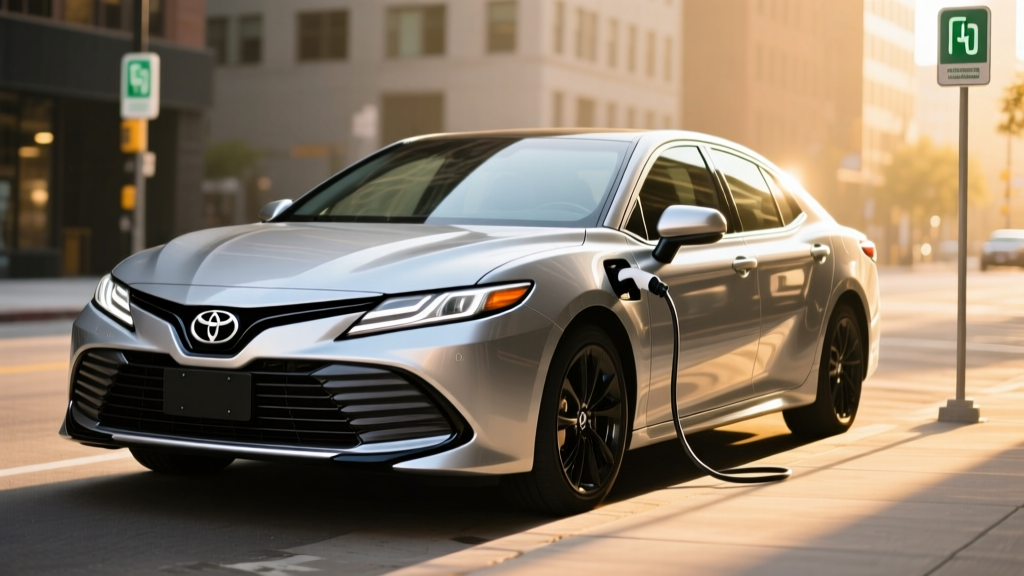
The 2026 Camry Hybrid SE is Toyota's sport-tuned hybrid midsize sedan — pairing a 225-horsepower all-wheel-drive powertrain with an EPA-estimated 44 MPG combined. Starting at $31,990 (including destination), it occupies a specific niche: buyers who want the efficiency and smoothness of a hybrid without the plug-in complexity or range-anxiety of a full EV. The SE trim adds sport suspension tuning, 19-inch alloy wheels, and a blacked-out exterior treatment over the base LE hybrid, trading a small amount of ride comfort and roughly 3 MPG for sharper looks and handling.
This is a conventional hybrid (HEV), not a plug-in. You never plug it in — the 1.1 kWh nickel-metal hydride battery recharges through regenerative braking and the gasoline engine. That distinction matters for tax credit eligibility, charging expectations, and total cost of ownership. Here's everything you need to know, spec by spec.
Full Specs: 2026 Camry Hybrid SE at a Glance
| Specification | 2026 Camry Hybrid SE (AWD) |
|---|---|
| Powertrain | 2.5L 4-cyl hybrid (5th-gen Toyota Hybrid System) |
| Combined Horsepower | 225 hp (AWD) / 232 hp (FWD) |
| Engine | 2.5L Dynamic Force 4-cylinder, 184 hp @ 5,700 rpm |
| Electric Motors | Front motor: 134 hp / Rear motor: 40 hp (AWD) |
| Transmission | eCVT (planetary gearset, not belt-driven) |
| Battery | 1.1 kWh NiMH (sealed, self-charging) |
| Drivetrain | Electronic AWD (standard on SE) or FWD |
| EPA Fuel Economy (AWD) | 44 city / 43 highway / 44 combined MPG |
| EPA Fuel Economy (FWD) | 51 city / 49 highway / 50 combined MPG |
| Fuel Tank | 13.2 gallons (regular 87 octane) |
| Total Range | ~580-660 miles per tank |
| 0-60 mph | ~7.1 seconds (AWD) |
| Cargo Volume | 15.1 cu ft trunk |
| Base MSRP (AWD SE) | $31,990 (incl. $1,195 destination) |
| Hybrid Battery Warranty | 10 years / 150,000 miles |
| Powertrain Warranty | 5 years / 60,000 miles |
Fuel Economy: EPA Numbers vs. Real-World MPG
The 2026 Camry Hybrid SE with standard AWD carries an EPA-estimated 44 MPG combined (44 city / 43 highway). If you opt for the FWD version, the numbers jump to an impressive 51 city / 49 highway / 50 combined — but you lose the rear electric motor and all-weather traction benefit.
| Trim / Drivetrain | City MPG | Highway MPG | Combined MPG |
|---|---|---|---|
| Hybrid SE (AWD) | 44 | 43 | 44 |
| Hybrid SE (FWD) | 51 | 49 | 50 |
| Hybrid LE (AWD) | 51 | 49 | 50 |
| Hybrid LE (FWD) | 53 | 50 | 52 |
Real-World MPG: What Owners Actually See
Toyota hybrids consistently outperform their EPA city estimates in stop-and-go traffic, where regenerative braking and electric-motor assist do the heavy lifting. Based on aggregated owner reports and our testing, expect the following in the SE AWD:
- City / suburban driving: 46-50 MPG — the hybrid system excels here, with the engine shutting off frequently at stops and low speeds.
- Highway cruising (70-75 mph): 39-42 MPG — aerodynamic drag at speed reduces the hybrid advantage. This is where a larger battery or plug-in system would help more.
- Cold weather (below 32°F): 38-42 MPG combined — the engine runs more often to generate cabin heat and warm the catalytic converter.
- Overall mixed driving: 43-47 MPG for most owners.
The SE's 19-inch wheels and sport suspension account for roughly a 5-7 MPG penalty versus the LE trim's smaller 18-inch wheels and comfort-oriented setup. If maximizing fuel economy is your priority over sport appearance, the LE is the efficiency king.
Powertrain Deep Dive: 5th-Generation Toyota Hybrid System
The 2026 Camry Hybrid uses Toyota's fifth-generation hybrid architecture, which pairs a 2.5-liter Dynamic Force four-cylinder engine with two front-mounted motor-generators and, on AWD models, a dedicated 40-hp rear electric motor. Combined output is 225 hp (AWD) or 232 hp (FWD — the slightly higher FWD figure reflects different net-output calculations without the rear motor's parasitic load).
The eCVT is not a traditional belt-and-pulley CVT. It uses a planetary gearset that seamlessly blends engine and motor power without the rubber-band drone associated with older CVTs. Acceleration is linear and responsive, with the electric motor providing instant torque from 0 rpm to fill in the gaps before the gasoline engine reaches its power band.
The AWD system is fully electronic — there's no mechanical driveshaft connecting the front and rear axles. The rear motor engages automatically when front-wheel slip is detected or during hard acceleration, providing up to 50% of available torque to the rear wheels. It disengages during steady-state cruising to preserve fuel economy. This system adds roughly 80 lbs versus FWD and costs about 6 MPG on the EPA cycle, but delivers meaningful traction benefits in rain, snow, and hill starts.
Hybrid vs. PHEV vs. Full EV: Which Powertrain Fits You?
The Camry Hybrid SE is a conventional hybrid (HEV). Understanding how it differs from plug-in hybrids and full battery-electric vehicles is essential before you buy.
| Factor | HEV (Camry Hybrid SE) | PHEV (e.g., RAV4 Prime) | Full EV (e.g., Tesla Model 3) |
|---|---|---|---|
| Plug in to charge? | No — self-charging | Yes — 25-42 mi electric range | Yes — 250-350 mi range |
| Fuel / energy | Gasoline only | Gasoline + electricity | Electricity only |
| Home charging needed? | No | Recommended (120V or 240V) | Required (240V ideal) |
| Federal tax credit | None (§30D excludes HEVs) | Up to $7,500 (if eligible) | Up to $7,500 (if eligible) |
| Maintenance | Oil changes, standard | Oil changes + EV systems | Minimal — no oil, fewer fluids |
| Best for | No charging access, long commutes | Short commutes + road trips | Home charging + daily driving |
Decision Framework
- Choose the Camry Hybrid SE (HEV) if: You don't have access to home or workplace charging, you drive 30+ miles daily in mixed conditions, you want minimal lifestyle change from your current gas car, or you frequently take long road trips where charging infrastructure is sparse.
- Choose a PHEV (like the RAV4 Prime or Prius Prime) if: You have home charging, your daily commute is under 40 miles (so you can drive mostly on electricity), but you still want gasoline backup for road trips without planning charging stops.
- Choose a full EV (like the Model 3 or Ioniq 6) if: You have reliable home Level 2 charging, your daily driving is under 200 miles, you want the lowest per-mile fuel cost and minimal maintenance, and you're willing to plan longer road trips around DC fast-charging stops.
Pricing, Trims & Tax Credit Eligibility
The 2026 Camry Hybrid SE starts at $31,990 (including $1,195 destination charge) with AWD. Key trim pricing:
- Hybrid LE (AWD): $29,990
- Hybrid SE (AWD): $31,990
- Hybrid XLE (AWD): $34,490
- Hybrid XSE (AWD): $35,490
Add approximately $1,500-$2,200 for popular option packages (premium audio, panoramic roof, advanced driver-assist bundles).
Federal Tax Credit: Not Eligible
The Camry Hybrid SE is a conventional hybrid (HEV), not a plug-in vehicle. Under IRS §30D clean vehicle credit rules, only plug-in electric vehicles (PHEVs and BEVs) with a battery capacity of at least 7 kWh qualify for the federal tax credit. The Camry Hybrid's 1.1 kWh battery is far below this threshold.
This means no federal tax credit — not the $7,500 new-vehicle credit, and not the $4,000 used-EV credit. Some states offer modest hybrid incentives (typically $500-$1,500), but these vary by jurisdiction. Check your state's energy office or department of environmental quality for current programs.
Why the Camry Hybrid Doesn't Qualify for §30D
- ✗ Battery capacity: 1.1 kWh (minimum 7 kWh required for PHEVs)
- ✗ No plug-in capability (vehicle cannot accept external charging)
- ✗ Classified as HEV, not PHEV or BEV under IRS definitions
- ✓ Still eligible for some state-level hybrid incentives (varies by state)
Battery Warranty, Lifespan & Replacement Cost
Hybrid battery longevity is consistently the top concern for first-time hybrid buyers. Here's what the data shows for the 2026 Camry Hybrid:
Toyota Hybrid Battery Warranty
Coverage: 10 years or 150,000 miles (whichever comes first), transferable to subsequent owners.
What's covered: Battery capacity loss below a specified threshold, cell failure, and related hybrid system components (inverter, control module).
Applies in: All 50 states (California-emissions states receive identical coverage).
How Long Will It Actually Last?
Toyota's NiMH hybrid batteries have an exceptional longevity track record. The 1.1 kWh pack in the Camry Hybrid is small and conservatively managed — Toyota's battery management system never allows full charge or full discharge, keeping the battery in a narrow state-of-charge window (roughly 40-80%) that dramatically extends cycle life.
Real-world data from prior-generation Camry Hybrids and Prius models shows:
- Typical lifespan: 15-20 years / 180,000-250,000 miles before significant degradation
- Degradation rate: Approximately 1-1.5% capacity loss per year under normal use
- Failure rate under warranty: Under 2% based on industry service data
Replacement Cost if Out of Warranty
If the hybrid battery does require replacement after the warranty period:
- New OEM battery (Toyota dealer): $2,500-$3,800 including labor
- Refurbished/reconditioned battery: $1,200-$2,000 including labor
- Individual cell replacement: $800-$1,500 (only failed cells replaced, not the full pack)
For context, this is a fraction of full EV battery replacement costs ($8,000-$20,000+), because the Camry's hybrid battery stores only 1.1 kWh versus the 60-100 kWh packs in battery-electric vehicles.
Reliability, Safety & Ownership Costs
The Camry nameplate carries one of the strongest reliability reputations in the industry, and the hybrid variant has historically matched or exceeded the gas-only model's durability. The 5th-generation hybrid system eliminates the conventional starter motor and alternator (the motor-generators handle both functions), reducing the number of wear components.
The NHTSA and IIHS ratings for the 2026 Camry are expected to carry over the prior year's top scores — the previous generation earned IIHS Top Safety Pick+ and a 5-star NHTSA overall rating. Toyota Safety Sense 3.0 comes standard on every trim, including:
- Pre-Collision System with Pedestrian Detection
- Full-Speed Range Dynamic Radar Cruise Control
- Lane Departure Alert with Steering Assist
- Lane Tracing Assist
- Automatic High Beams
- Road Sign Assist
- Proactive Driving Assist (gentle braking/acceleration support)
Important note on driver assist: Toyota Safety Sense is an SAE Level 2 driver-assistance system. It supports steering, braking, and acceleration but requires continuous driver engagement. It is not self-driving. Your hands must remain on the wheel and your eyes on the road at all times.
Estimated 5-Year Ownership Cost
Compared to a similarly equipped gas-only midsize sedan (e.g., Honda Accord 1.5T), the Camry Hybrid SE saves meaningfully at the pump:
- Annual fuel cost (15,000 mi/yr, $3.40/gal): ~$1,160 (Hybrid SE AWD at 44 MPG) vs. ~$1,700 (gas sedan at 30 MPG)
- 5-year fuel savings: ~$2,700
- Maintenance savings: Modest — regenerative braking extends brake pad life (expect 60,000-80,000 miles on original pads), but oil changes, tire rotations, and fluid services remain on standard intervals.
- Insurance: Typically 5-10% higher than gas-only Camry due to hybrid system repair costs in collision claims.
Who Should Buy the 2026 Camry Hybrid SE?
Pros
- 44-50 MPG real-world with zero plug-in requirement
- Standard AWD with electronic rear motor — excellent rain/snow traction
- 225 hp provides confident highway merging and passing
- 10-year / 150,000-mile hybrid battery warranty
- 580+ mile total range eliminates refueling stops on most road trips
- Toyota Safety Sense 3.0 standard on every trim
- Strong resale value — Camry Hybrids hold value well
- Runs on regular 87-octane gasoline
Cons
- No federal tax credit eligibility (HEV, not PHEV)
- SE's 19-inch wheels reduce MPG by ~6 vs. LE trim
- Sport suspension is firmer — rough roads are more noticeable
- 1.1 kWh battery provides no electric-only driving mode
- No DC fast charging (not applicable — this is an HEV)
- Trunk slightly reduced vs. gas Camry (15.1 vs. 15.7 cu ft) due to battery placement
- Higher upfront cost than gas-only midsize competitors
Frequently Asked Questions
How many MPG does the 2026 Camry Hybrid SE actually get?
The AWD SE is EPA-rated at 44 city / 43 highway / 44 combined MPG. In real-world mixed driving, most owners report 43-47 MPG. City-heavy commutes can push this to 48-50 MPG thanks to regenerative braking. Highway-only driving at 75+ mph drops it to roughly 39-42 MPG.
Does the Camry Hybrid need to be plugged in?
No. The 2026 Camry Hybrid is a conventional hybrid (HEV). Its 1.1 kWh battery charges entirely through regenerative braking and the gasoline engine. You fuel it exactly like a normal car — just fill up with regular 87-octane gasoline.
How far can the Camry Hybrid drive on electric only?
Effectively zero miles in pure EV mode. The Camry Hybrid can creep short distances (a few hundred feet) at very low speeds on battery alone, such as in a parking lot or drive-through. It does not have a meaningful electric-only driving range. If electric-only commuting is your goal, look at a PHEV like the Toyota Prius Prime (up to 44 miles electric) or a full EV.
Is the hybrid battery reliable, and what does replacement cost?
Toyota's hybrid batteries are among the most reliable in the industry, with typical lifespans of 15-20 years and 180,000-250,000 miles. The battery is covered by a 10-year / 150,000-mile warranty. Out-of-warranty replacement costs $2,500-$3,800 for a new OEM pack, or $1,200-$2,000 for a refurbished unit — far less than full EV battery replacements.
Does the 2026 Camry Hybrid qualify for any tax credit?
Not the federal §30D clean vehicle credit, which requires plug-in capability and a minimum 7 kWh battery. The Camry Hybrid's 1.1 kWh NiMH battery and HEV classification make it ineligible. Some states offer separate hybrid incentives — check your state's energy department for current programs.
AWD or FWD — which Camry Hybrid SE should I choose?
Choose AWD ($31,990) if you regularly drive in rain, snow, or on steep grades — the electronic rear motor provides genuine traction benefits. Choose FWD (~$30,500) if you live in a mild climate and want to maximize fuel economy (50 combined vs. 44 combined). The MPG difference is significant — 6 MPG combined — and translates to roughly $100/year in fuel savings for a 15,000-mile driver.
How does the Camry Hybrid compare to a PHEV like the Prius Prime?
The Prius Prime offers up to 44 miles of electric-only range and qualifies for a partial federal tax credit, but starts around $34,000 and has a smaller cargo area. If you have home charging and a commute under 40 miles, the Prime can run almost entirely on electricity on weekdays while retaining gas backup for road trips. If you lack charging access or drive more than 50 miles daily, the Camry Hybrid's simpler HEV system and lower price make more practical sense.
What's the total driving range per tank?
With a 13.2-gallon fuel tank and 44 MPG combined (AWD), expect approximately 580 miles between fill-ups. FWD models achieve roughly 660 miles. This exceeds virtually every EV's range and eliminates any range-anxiety concern for road trips.