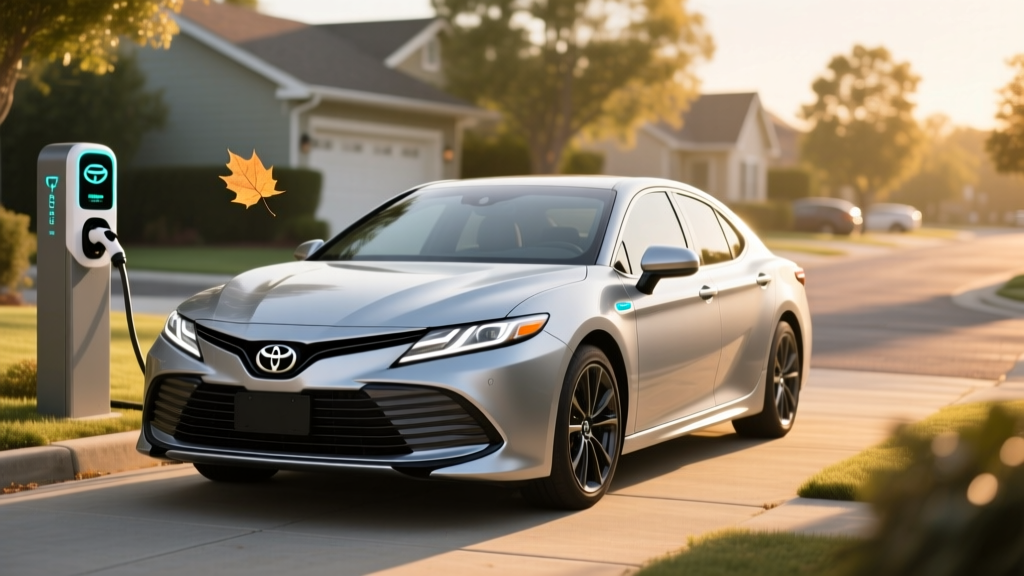
The Toyota Camry has been America's best-selling sedan for years, and for 2026, every Camry is a hybrid. Toyota dropped the four-cylinder gas-only model entirely, betting that its fifth-generation hybrid system offers the best blend of efficiency, reliability, and everyday usability. If you're researching the 2026 Camry Hybrid MPG numbers, you've likely noticed the EPA estimates vary by trim and drivetrain — and real-world results often tell a different story than the sticker.
We've driven the 2026 Camry Hybrid across city loops, highway stretches, and mixed commuting routes to give you the full picture: exact EPA figures, what to expect in real-world conditions, and whether this HEV (conventional hybrid) or a plug-in alternative makes more sense for your garage.
2026 Camry Hybrid MPG: EPA Estimates by Trim
Not every 2026 Camry Hybrid returns the same fuel economy. Front-wheel-drive (FWD) models in the LE and SE trims achieve the highest ratings, while all-wheel-drive (AWD) variants and sportier trims sacrifice a few MPG for added traction and performance tuning. Here's the complete EPA breakdown from fueleconomy.gov:
| Trim | Drivetrain | City MPG | Highway MPG | Combined MPG |
|---|---|---|---|---|
| LE | FWD | 53 | 50 | 51 |
| SE | FWD | 48 | 47 | 47 |
| XLE | FWD | 48 | 47 | 47 |
| XSE | FWD | 48 | 47 | 47 |
| LE | AWD | 51 | 49 | 50 |
| SE | AWD | 46 | 46 | 46 |
| XLE | AWD | 46 | 46 | 46 |
| XSE | AWD | 44 | 43 | 44 |
The headline number — 51 MPG combined on the LE FWD — is legitimate and makes the Camry Hybrid one of the most efficient midsize sedans on the market. The spread between the LE and XSE AWD (44 combined) is 7 MPG, which translates to roughly $75–$90 more per year in fuel costs for a driver covering 15,000 miles annually at $3.40/gallon.
Real-World MPG: What We Actually Observed
The 2026 Camry Hybrid LE FWD is rated at 51 MPG combined by the EPA. In mixed real-world driving — suburban errands, stop-and-go commuting, and highway cruising at 70–75 mph — we observed between 46 and 54 MPG depending on conditions. City-heavy routes consistently exceeded the EPA city estimate of 53 MPG, while sustained highway driving at 75+ mph dropped efficiency to the low-to-mid 40s.
This is typical Toyota hybrid behavior. The hybrid system recovers significant energy during braking and low-speed driving, so urban commuters often see numbers above the EPA city rating. Highway driving, where the gasoline engine runs continuously and aerodynamic drag dominates, is where real-world MPG dips below the sticker.
Cold-weather impact: In temperatures below 40°F, expect a 5–10% reduction in fuel economy. The engine runs more frequently to heat the cabin and keep the catalytic converter warm, reducing electric-only operation. A 51 MPG combined rating may drop to 44–47 MPG in winter for northern-climate drivers.
Powertrain Specs: 5th-Gen Hybrid System Under the Hood
| Specification | Detail |
|---|---|
| Engine | 2.5L 4-cylinder Dynamic Force (A25A-FXS) |
| Engine Output | 184 hp / 163 lb-ft torque |
| Front Electric Motor | 134 hp / 155 lb-ft |
| Rear Electric Motor (AWD only) | 40 hp / 89 lb-ft |
| Combined System Horsepower | 225 hp (FWD) / 232 hp (AWD) |
| Transmission | eCVT (planetary gearset, no belt) |
| Hybrid Battery | ~1.0 kWh lithium-ion (sealed NiMH on base trims) |
| 0–60 mph | ~7.2 seconds (FWD) |
| Fuel Tank | 13.2 gallons |
| Total Driving Range | ~670 miles (LE FWD at 51 MPG combined) |
The 2026 Camry uses Toyota's fifth-generation hybrid system, which pairs a highly efficient 2.5-liter Atkinson-cycle engine with one or two electric motors. Unlike a plug-in hybrid, the Camry HEV has a small battery — roughly 1.0 kWh — that recharges through regenerative braking and the engine. You never plug it in. The eCVT is not a traditional belt-and-cone CVT; it uses a planetary gearset that's proven extraordinarily durable over millions of Toyota hybrids on the road.
Acceleration is adequate rather than exciting. The 225 hp combined output (232 with AWD) gets the Camry to 60 mph in roughly 7.2 seconds — respectable for a midsize sedan focused on efficiency. The electric motor's instant torque gives it punchy off-the-line response in city driving, which is where this powertrain feels most at home.
Camry Hybrid (HEV) vs. Plug-In Hybrid vs. Full EV
The 2026 Camry is offered exclusively as a conventional hybrid (HEV). Toyota does not currently sell a Camry Plug-In Hybrid in the US market. If you're weighing your electrified options, here's how the three paths compare:
| Factor | Camry Hybrid (HEV) | Typical PHEV Sedan | Full EV (e.g., Tesla Model 3) |
|---|---|---|---|
| Plug-in Charging Required | No — gas only | Yes — for electric range | Yes — always |
| Electric-Only Range | ~1 mile at low speed | 25–45 miles typical | 250–360+ miles |
| Combined Efficiency | 44–51 MPG | 38–42 MPG + 100+ MPGe | 120–140 MPGe |
| Home Charging Needed | No | Recommended (Level 2) | Essential (Level 2) |
| Upfront Price (base) | ~$29,500 | ~$36,000–$45,000 | ~$39,000–$48,000 |
| Federal Tax Credit (§30D) | Not eligible | Up to $7,500 (if eligible) | Up to $7,500 (if eligible) |
| Best For | No home charging access; road-trip heavy | Short commutes + home charging + long trips | Home charging + mostly under 300 mi trips |
The Camry Hybrid is ideal if you lack access to home or workplace charging, drive long or unpredictable routes, or simply want maximum simplicity. You fuel up at any gas station, never think about charging, and still get midsize-sedan-leading efficiency. If you do have home charging and a short commute, a PHEV like the Toyota Prius Prime (44 miles electric-only, then 48 MPG as a hybrid) may save more on fuel — and it qualifies for the federal tax credit.
Pricing, Trims & Tax Credit Eligibility
The 2026 Camry Hybrid starts at approximately $29,495 MSRP for the LE FWD trim, including destination. Here's the approximate trim breakdown:
- LE FWD: $29,495
- LE AWD: $30,895
- SE FWD: $31,095
- SE AWD: $32,495
- XLE FWD: $33,795
- XLE AWD: $35,195
- XSE FWD: $34,595
- XSE AWD: $35,995
- ❌ The 2026 Camry Hybrid is a conventional HEV — it does not qualify for the §30D New Clean Vehicle Credit.
- ❌ It also does not qualify for the §25E Used Clean Vehicle Credit.
- ✅ Some states offer separate hybrid rebates — check your state energy office or DSIRE database.
- ✅ The Camry Hybrid's lower MSRP may save you more over 5 years than a tax-credit-eligible PHEV/EV with a higher purchase price.
While the lack of a federal tax credit stings on paper, the Camry Hybrid's sub-$30K starting price undercuts most PHEVs and EVs by $7,000–$15,000. For many buyers, the lower purchase price plus 50 MPG offsets the absence of a credit. Check IRS.gov §30D guidelines for current credit rules if you're considering a PHEV or EV alternative.
Hybrid Battery Warranty, Lifespan & Replacement Cost
- Coverage: 10 years / 150,000 miles (whichever comes first)
- What's covered: Hybrid battery pack, hybrid control module, inverter
- Capacity threshold: Toyota warrants against defects and abnormal degradation; no specific % retention guarantee (unlike EVs)
- Transferable: Yes — warranty transfers to subsequent owners
Hybrid battery longevity is the number-one concern for first-time hybrid buyers, and it's largely overblown based on two decades of real-world data. Toyota's hybrid batteries are small (~1.0 kWh), never fully charged or fully depleted (the system maintains a buffer between roughly 40% and 80% state of charge), and experience shallow charge cycles. This is far less stressful than the deep cycles an EV battery endures.
Expected lifespan: Based on data from millions of Prius and Camry Hybrids on the road, the traction battery typically lasts 150,000–200,000+ miles before significant degradation. Many original batteries in 2007–2011 Camry Hybrids are still in service at 200K+ miles.
Replacement cost if out of warranty: A new OEM hybrid battery from Toyota runs approximately $2,500–$4,000 installed. Refurbished/remanufactured units are available for $1,000–$2,000. Individual module replacement (only the degraded cells) can cost $500–$1,200 at a hybrid specialist. This is dramatically cheaper than EV battery replacement ($8,000–$20,000+).
Who Should Choose the 2026 Camry Hybrid?
- You don't have access to home or workplace EV charging
- You regularly take road trips exceeding 300 miles
- You want a midsize sedan with sub-$30K starting price and 50+ MPG
- You prefer not to think about charging infrastructure or range planning
- You live in an apartment or street-park where plugging in isn't an option
- You want proven reliability with 20+ years of Toyota hybrid track record
- You have Level 2 home charging and a commute under 40 miles (PHEV like Prius Prime)
- You want to eliminate gasoline use entirely (EV like Hyundai Ioniq 6 or Tesla Model 3)
- You qualify for the full $7,500 federal tax credit and want to maximize incentives
- You live in a state with high gas prices ($4.50+/gallon) where EV charging savings compound
Pros & Cons at a Glance
- Class-leading 51 MPG combined (LE FWD)
- No plug-in charging required — gas and go
- Sub-$30K starting price for a midsize sedan
- 10-year/150,000-mile hybrid battery warranty
- ~670-mile total range on a single tank
- AWD available across all trims
- Proven eCVT durability with no belt to fail
- Toyota Safety Sense 3.0 standard
- No federal tax credit eligibility
- No plug-in hybrid variant available
- AWD and higher trims drop MPG to 44 combined
- Modest 225 hp — not a performance sedan
- Small trunk due to hybrid battery placement (~15.1 cu ft)
- Infotainment learning curve on base 8-inch screen
- No DC fast charging capability (HEV — not applicable)
Frequently Asked Questions
How many MPG does the 2026 Camry Hybrid get?
The 2026 Camry Hybrid LE FWD achieves an EPA-estimated 53 city / 50 highway / 51 combined MPG. AWD trims range from 44–50 combined depending on configuration. Real-world city driving often exceeds the EPA city number, while sustained highway driving above 75 mph typically returns 42–46 MPG.
Does the 2026 Camry Hybrid need to be plugged in?
No. The 2026 Camry Hybrid is a conventional hybrid (HEV), not a plug-in hybrid. It charges its small battery through regenerative braking and the gasoline engine. You simply fill it with gas like any conventional car.
Is there a Camry Plug-In Hybrid (PHEV)?
Not in the US market for 2026. Toyota offers the Camry exclusively as a conventional hybrid. If you want a Toyota PHEV, the Prius Prime (44 miles electric-only, 48 MPG hybrid mode) and RAV4 Prime (42 miles electric-only) are the closest alternatives.
Is the Camry Hybrid reliable and what does battery replacement cost?
Toyota's hybrid system is among the most reliable powertrains ever produced, backed by a 10-year/150,000-mile hybrid battery warranty. Out-of-warranty replacement costs $2,500–$4,000 for a new OEM battery, though most units last 150,000–200,000+ miles based on decades of fleet data.
Does the 2026 Camry Hybrid qualify for any tax credit?
No. The federal §30D New Clean Vehicle Credit applies only to plug-in vehicles (PHEVs and EVs) with sufficient battery capacity. The Camry Hybrid, as a conventional HEV, does not qualify. Some state-level programs offer modest hybrid incentives — check your state's energy office for details.
How does the Camry Hybrid compare to the Prius?
The 2026 Prius achieves up to 57 MPG combined (LE trim) in a smaller, lighter package starting around $28,500. The Camry Hybrid offers more interior space, a smoother ride, and a more premium cabin at the cost of 6 MPG. If maximum efficiency is the goal, the Prius wins. If midsize comfort matters more, the Camry Hybrid is the pick.
What is the total driving range on a full tank?
The LE FWD trim, with its 13.2-gallon tank and 51 MPG combined rating, delivers approximately 670 miles of total range. Highway-heavy driving will reduce this to roughly 600–620 miles; city-heavy driving can push it past 700 miles.