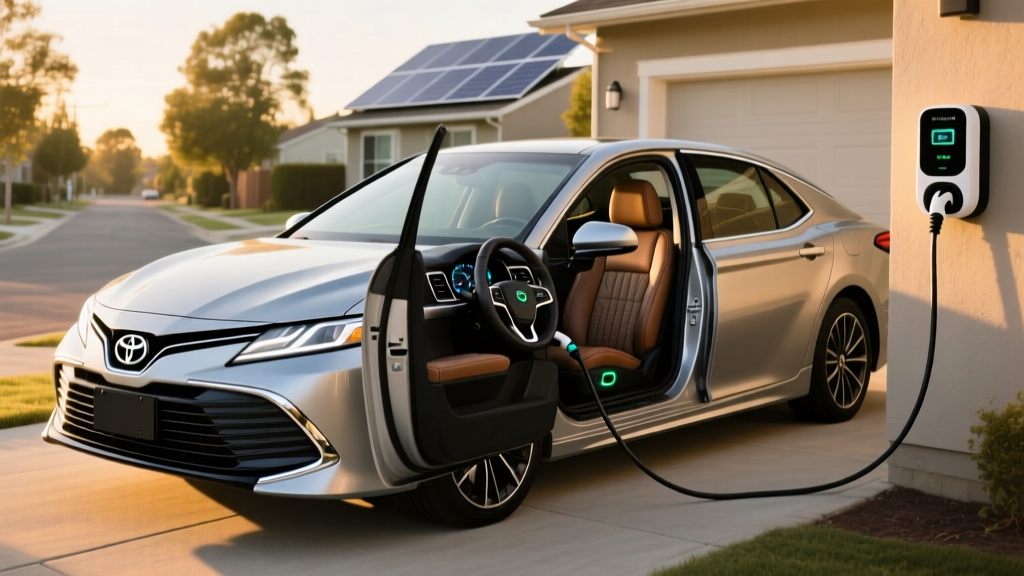
The 2026 Toyota Camry Hybrid LE occupies a rare sweet spot in the midsize sedan market: it delivers over 50 MPG without requiring you to plug in, change your driving habits, or pay a premium for electrification. As Toyota continues its hybrid-only strategy for the Camry lineup, the LE trim remains the efficiency-focused entry point — and arguably the best value in the entire range.
We've spent time with the 2026 Camry Hybrid LE to break down its real-world fuel economy, powertrain behavior, ownership costs, and battery longevity. If you're weighing this against a plug-in hybrid or a full battery-electric vehicle, we'll help you decide which path actually fits your routine.
2026 Camry Hybrid LE: Core Specs at a Glance
| Specification | 2026 Camry Hybrid LE |
|---|---|
| Powertrain | 2.5L 4-cyl + 2 electric motors (FWD) |
| Combined Horsepower | 225 hp |
| EPA MPG (City / Highway / Combined) | 53 / 50 / 51 |
| Fuel Tank Capacity | 13.2 gallons |
| Total Range | ~673 miles |
| 0–60 mph | ~7.2 seconds |
| Hybrid Battery | ~1.6 kWh (NiMH, sealed) |
| Drivetrain | Front-wheel drive (AWD available on higher trims) |
| Base MSRP | ~$30,495 (incl. destination) |
| Battery Warranty | 10 years / 150,000 miles |
| Federal Tax Credit | Not eligible (§30D requires plug-in) |
Fuel Economy: EPA Numbers vs. Real-World MPG
The EPA rates the 2026 Camry Hybrid LE at 53 city / 50 highway / 51 combined MPG. Those are impressive figures for a midsize sedan, but Toyota's hybrid system has a well-documented tendency to actually exceed its EPA city rating in real-world driving — something you rarely see with conventional gas cars or even many EVs.
| Driving Scenario | EPA Rating | Real-World Expectation |
|---|---|---|
| City / Stop-and-Go | 53 MPG | 52–58 MPG (regen thrives here) |
| Highway (70–80 mph) | 50 MPG | 44–48 MPG (aero drag, less regen) |
| Mixed / Combined | 51 MPG | 48–54 MPG (depends on route profile) |
| Cold Weather (below 32°F) | — | 42–47 MPG (engine runs more for heat) |
Why city MPG often beats the sticker: Toyota's Hybrid Synergy System uses regenerative braking to recapture energy at every stop light. The gas engine shuts off frequently in low-speed traffic, and the electric motors handle launches. Highway driving, by contrast, keeps the engine running continuously and offers fewer regen opportunities — which is why the Camry Hybrid's highway number dips slightly, unlike an EV which suffers similar highway range loss but from aerodynamic drag alone.
Cold-weather note: Expect a 10–15% fuel economy drop in freezing temperatures. The gasoline engine must run longer to generate cabin heat (there's no resistive heater on the LE), and the battery's charge/discharge efficiency drops in the cold. This is still far less range penalty than a battery-electric vehicle experiences in winter.
HEV vs. PHEV vs. EV: Which Powertrain Fits You?
The Camry Hybrid LE is a conventional hybrid (HEV) — it does not plug in, has no electric-only range, and requires nothing beyond regular gasoline. That distinction matters because buyers often confuse HEVs with plug-in hybrids. Here's the breakdown:
| Factor | HEV (Camry Hybrid) | PHEV (e.g., RAV4 Prime) | BEV (e.g., Tesla Model 3) |
|---|---|---|---|
| Plugs in? | No | Yes (Level 1/2) | Yes (Level 1/2/DC) |
| Electric-only range | None | 25–42 miles typical | 250–360 miles typical |
| Fuel/energy source | Gasoline only | Gasoline + grid electricity | Grid electricity only |
| Federal tax credit (§30D) | Not eligible | Up to $7,500 (if eligible) | Up to $7,500 (if eligible) |
| Home charging needed? | No | Recommended for benefit | Essential |
| Best for | No charging access, long trips | Short commutes + road trips | Home charging + daily driving |
| Upfront cost premium | Low (~$1,500 over gas) | High ($5,000–$10,000+) | Moderate to high |
Choose the Camry Hybrid LE if: You don't have access to home or workplace charging, you drive a mix of city and highway miles, and you want maximum fuel savings without behavioral changes. It's also the right call if you take frequent long road trips where charging infrastructure is sparse.
Consider a PHEV instead if: You have a garage or outlet for overnight charging, your daily commute is under 35 miles round-trip, and you still want gas-engine flexibility for road trips. A PHEV can run most daily miles on cheap electricity while retaining a gas tank for longer drives.
Consider a full BEV if: You have reliable Level 2 home charging, your daily driving is under 250 miles, and you want to eliminate gasoline entirely. The per-mile energy cost is lowest with a BEV, but you need charging infrastructure to make it practical.
Powertrain Deep Dive: 225 hp Without a Plug
The 2026 Camry Hybrid LE pairs a 2.5-liter Dynamic Force four-cylinder engine (184 hp on its own) with two front-mounted electric motor-generators. Combined system output is 225 horsepower, routed through Toyota's eCVT — a planetary gearset that seamlessly blends engine and motor power without the rubber-band feel of traditional belt-driven CVTs.
The hybrid battery pack is a compact ~1.6 kWh nickel-metal hydride (NiMH) unit mounted under the rear seat. Unlike the large lithium-ion packs in PHEVs and BEVs, this battery isn't designed for sustained electric-only driving. Instead, it acts as an energy buffer — capturing regenerative braking energy and deploying it for electric assist during acceleration and low-speed maneuvers. The engine can shut off entirely at stops and during gentle coasting, which is where much of the fuel savings come from.
Toyota's fifth-generation hybrid system is notably more responsive than earlier iterations. The electric motors deliver instant torque at low speeds, making the Camry Hybrid LE feel quicker off the line than its 7.2-second 0–60 time might suggest. Passing power on the highway is adequate, though the engine note does become audible under hard acceleration — a trade-off for the efficiency gains.
Pricing, Trims, and Tax Credit Eligibility
The 2026 Camry Hybrid LE starts at approximately $30,495 including destination charges. That positions it competitively against the Honda Accord Hybrid (starting around $33,000) and well below any PHEV sedan on the market.
Federal tax credit status: The Camry Hybrid LE does not qualify for the IRS §30D clean vehicle credit. That credit — up to $7,500 — is reserved for plug-in electric vehicles (PHEVs and BEVs) that meet battery sourcing, critical mineral, MSRP cap, and buyer income requirements. Conventional hybrids like the Camry Hybrid are excluded by statute.
Some states offer their own rebates or reduced registration fees for hybrids, but these vary widely. Check your state's energy or DMV website for current programs.
Value proposition: At roughly $1,500 more than a comparable gas-only midsize sedan (if one were still available in the Camry line), the hybrid's fuel savings pay back the premium in approximately 2–3 years for a driver covering 15,000 miles annually at $3.50/gallon. After that, the savings are pure upside.
Battery Longevity, Warranty, and Replacement Costs
Hybrid battery anxiety is one of the most common concerns we hear from first-time hybrid buyers. Here's what the data shows:
Toyota Hybrid Battery Warranty: 10 years or 150,000 miles (whichever comes first), covering defects and capacity loss below a defined threshold. This applies to all 50 states.
Real-world lifespan data: Toyota's NiMH hybrid batteries have demonstrated remarkable durability. Taxi fleet data and owner surveys consistently show Camry and Prius hybrid batteries lasting 150,000–200,000+ miles before significant degradation. The small 1.6 kWh pack experiences shallow charge cycles (it never fully charges or fully depletes), which dramatically extends cell life compared to the deep cycles in BEVs and PHEVs.
Replacement cost if out of warranty: A new OEM hybrid battery for the Camry Hybrid typically runs $2,000–$4,000 installed at a dealership. Third-party refurbished packs are available for $1,000–$2,000. Given that most owners will never need a replacement within the vehicle's typical ownership period, this is a low-probability expense.
For context, a BEV battery replacement can cost $10,000–$20,000+ out of warranty. The Camry Hybrid's small, conservatively managed NiMH pack is one of the least risky battery ownership propositions in the electrified vehicle space.
Reliability and Long-Term Ownership Outlook
Toyota's hybrid powertrains have earned a reputation for exceptional reliability, backed by decades of real-world data since the original Prius in 1997. The eCVT planetary gearset has no belts, clutches, or torque converters to wear out — it's one of the simplest and most durable transmission designs in the industry.
The Camry as a nameplate consistently earns top marks from IIHS and strong reliability ratings from owner surveys. The hybrid variant adds minimal complexity over the gas model — the electric motor-generators are sealed, maintenance-free units, and the hybrid system requires no regular service beyond what the gasoline engine already demands (oil changes, air filters, coolant).
Maintenance advantages specific to the hybrid: Regenerative braking significantly reduces wear on the friction brake pads and rotors. Many Camry Hybrid owners report original brake pads lasting 80,000–100,000 miles — roughly double the lifespan of brakes on a conventional gas car. The engine also runs fewer total hours (it shuts off at stops and during coasting), which reduces long-term wear on internal components.
Who Should Buy the 2026 Camry Hybrid LE?
Pros
- 51 MPG combined — among the highest of any midsize sedan
- No plug-in required — zero behavior change from a gas car
- Strong city MPG that often exceeds EPA rating in real driving
- 225 hp provides confident acceleration
- 10-year/150,000-mile hybrid battery warranty
- ~$30,500 starting price is competitive for the segment
- Reduced brake wear from regenerative braking
- Proven Toyota hybrid reliability track record
Cons
- No federal tax credit eligibility (HEV, not plug-in)
- Highway MPG dips to mid-40s in real-world driving
- AWD not available on LE trim (SE/XLE only)
- Cold weather reduces MPG by 10–15%
- Engine noise noticeable under hard acceleration
- No electric-only driving mode
- NiMH battery (older chemistry vs. lithium-ion)
Buy the 2026 Camry Hybrid LE if:
- You lack access to home or workplace charging
- Your commute is mixed city/highway with heavy stop-and-go segments
- You want 50+ MPG without range anxiety or charging logistics
- You plan to own the car 8+ years (warranty coverage and reliability support this)
- Your budget is around $30,000–$33,000 for a well-equipped midsize sedan
Look elsewhere if:
- You want electric-only commuting (consider a PHEV like the Prius Prime or RAV4 Prime)
- You have home charging and want the lowest per-mile energy cost (consider a BEV)
- You need AWD on the base trim (step up to the Camry Hybrid SE or XLE)
Frequently Asked Questions
How many MPG does the 2026 Camry Hybrid LE actually get?
The EPA rates it at 53 city / 50 highway / 51 combined. In real-world driving, expect 52–58 MPG in city traffic, 44–48 MPG at sustained highway speeds, and 48–54 MPG in mixed driving. Cold weather can drop combined MPG into the low-to-mid 40s.
Does the Camry Hybrid LE plug in?
No. The Camry Hybrid LE is a conventional hybrid (HEV). It charges its small battery entirely through regenerative braking and the gasoline engine. You never plug it in — just fill up with gas as you would with any conventional car.
Does the 2026 Camry Hybrid qualify for any tax credit?
The federal §30D clean vehicle credit ($0–$7,500) is not available for conventional hybrids. It applies only to plug-in vehicles (PHEVs and BEVs) that meet specific battery sourcing, MSRP, and income requirements. Some states may offer their own hybrid incentives — check your local energy authority.
How long will the Camry Hybrid battery last?
Toyota warranties the hybrid battery for 10 years or 150,000 miles. Real-world data from taxi fleets and high-mileage owners shows these NiMH packs routinely lasting 150,000–200,000+ miles. The shallow charge/discharge cycles and conservative battery management are key to this longevity.
What does it cost to replace the hybrid battery?
If replacement is needed out of warranty, expect $2,000–$4,000 for a new OEM battery installed at a dealer. Refurbished aftermarket packs run $1,000–$2,000. Most owners will never need this service during their ownership period.
Is the Camry Hybrid LE better than a full EV for saving money?
It depends on your situation. The Camry Hybrid costs roughly $0.07–$0.08 per mile in fuel (at $3.50/gal and 51 MPG). A comparable BEV charging at home at $0.14/kWh and averaging 3.5 miles/kWh costs about $0.04 per mile. However, the BEV has a higher purchase price, potential charging installation costs ($500–$2,000+), and may carry higher insurance premiums. For drivers without home charging, the Camry Hybrid's convenience and low running costs are hard to beat.
Can I get AWD on the Camry Hybrid LE?
No. Electronic AWD is available on the Camry Hybrid SE and XLE trims, which add a rear-mounted electric motor for all-wheel drive (reducing combined MPG to approximately 44–46). The LE trim is front-wheel drive only.