Quick Verdict: The X5 xDrive50e Bridges Two Worlds
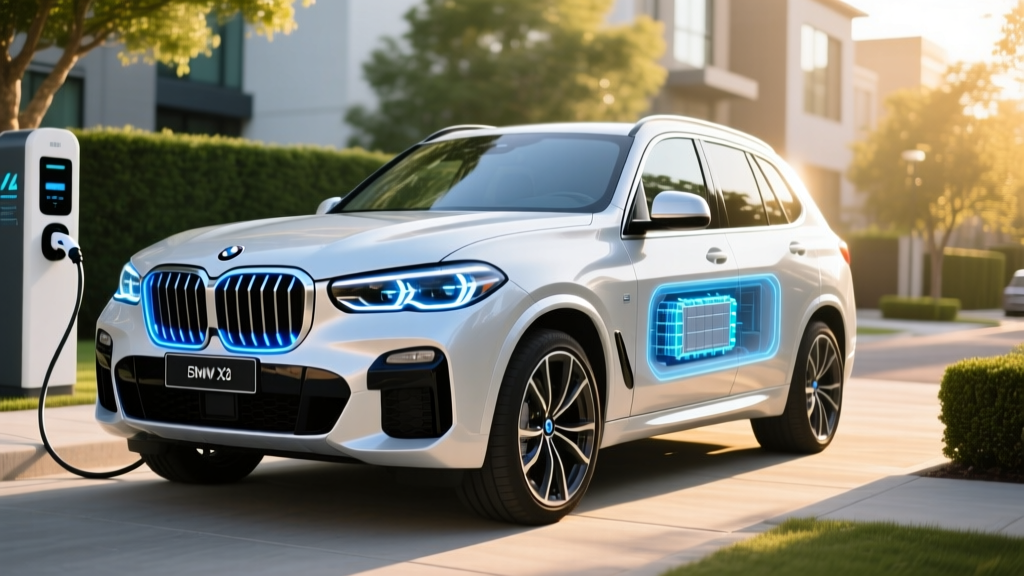
The 2026 BMW X5 xDrive50e is the plug-in hybrid (PHEV) variant of BMW's mid-size luxury SUV, pairing a turbocharged inline-six with an electric motor and a 25.7 kWh battery pack. For buyers who want electric-only commuting without committing to a full battery-electric vehicle (BEV), it's one of the most capable options in the segment — offering 38 miles of zero-emission driving, 483 combined horsepower, and the cargo space and refinement expected from a $70,000+ luxury SUV.
But PHEVs live or die by their daily usability. Can 38 miles of electric range cover a real commute? How fast does it charge at home? And does it still qualify for any federal tax incentive under current IRS §30D rules? This guide breaks down every number that matters.
HEV vs. PHEV: Why the X5 xDrive50e Is a Plug-In
Conventional Hybrid (HEV): A small battery (typically 1–2 kWh) recharges through regenerative braking and the engine. You never plug it in. Examples: Toyota RAV4 Hybrid, Honda CR-V Hybrid. Electric-only driving is limited to very low speeds for short distances.
Plug-In Hybrid (PHEV): A much larger battery (25.7 kWh usable in the X5) that you charge by plugging into a wall outlet or Level 2 charger. It delivers meaningful electric-only range — 38 miles EPA in the X5 — before the gasoline engine engages. Think of it as a short-range EV with a built-in gas engine backup.
The X5 lineup does not offer a conventional HEV variant in the U.S. market. If you're looking at the X5 and want any form of electrification, the xDrive50e PHEV is the option. The alternative is going fully electric with the BMW iX, which sacrifices the gas-engine safety net entirely.
Range, MPGe, and Fuel Economy: The Numbers
| Metric | EPA Rating |
|---|---|
| Combined MPGe (electric + gas) | 56 MPGe |
| Gas-only combined MPG | 22 MPG |
| City MPG (gas-only) | 20 MPG |
| Highway MPG (gas-only) | 24 MPG |
| Electric-only range | 38 miles |
| Total combined range (EV + gas) | ~440 miles |
| Energy consumption (EV mode) | ~58 kWh/100 mi |
Real-World Range Expectations: The EPA rates the X5 xDrive50e at 38 miles of electric-only range. In mixed driving at moderate temperatures (60–75°F), expect 33–37 miles. Highway driving at 70+ mph drops this to roughly 28–32 miles. In cold weather (below 30°F), plan for 24–28 miles as the battery's usable capacity shrinks and cabin heating draws additional power. Once the battery is depleted, the inline-six takes over and you'll see 20–23 MPG in real-world mixed driving — consistent with the EPA gas-only rating.
For context, the average U.S. one-way commute is roughly 16 miles, according to Census Bureau data. That means most X5 PHEV owners with home charging can complete daily round-trip commutes entirely on electricity, only burning gasoline on longer weekend trips or road trips.
Powertrain: Inline-Six Meets Electric Motor
| Specification | Detail |
|---|---|
| Engine | 3.0L turbocharged inline-six (312 hp) |
| Electric motor | Integrated in transmission (184 hp) |
| Combined system output | 483 hp / 516 lb-ft torque |
| 0–60 mph | 4.6 seconds |
| Top speed (electronically limited) | 130 mph (155 mph w/ M Sport) |
| Transmission | 8-speed automatic (ZF) |
| Drivetrain | xDrive all-wheel drive |
| Battery capacity (gross / usable) | 25.7 kWh / ~22.0 kWh usable |
| Battery chemistry | NMC (nickel manganese cobalt) |
| Towing capacity | 5,000 lbs (braked) |
BMW's decision to pair the PHEV system with the inline-six rather than a four-cylinder sets the X5 apart from competitors like the Volvo XC90 Recharge and Porsche Cayenne E-Hybrid. The result is effortless highway passing power and a 4.6-second 0–60 time that feels genuinely quick for a 5,400-pound SUV. The electric motor fills in torque below 2,000 RPM, eliminating the turbo lag that traditionally affected six-cylinder engines.
The transmission-integrated motor also means regenerative braking feels natural — not grabby — and the transition between electric and gas power is nearly imperceptible during normal driving.
Charging: Level 1, Level 2, and No DC Fast Charging
This is where PHEV buyers need to set expectations correctly. The X5 xDrive50e supports AC charging only — there is no DC fast charging capability. This is standard for most PHEVs; the battery is simply too small to justify the cost and weight of DC fast-charge hardware.
| Charging Level | Power | 0–100% Time | Use Case |
|---|---|---|---|
| Level 1 (120V household outlet) | ~1.4 kW | ~17 hours | Overnight top-up; not practical for daily full recharge |
| Level 2 (240V, 40A circuit) | 7.4 kW (max onboard charger) | ~3.5 hours | Daily home charging; full overnight recharge |
| DC Fast Charging | Not supported | N/A | N/A |
At 7.4 kW on a Level 2 home charger, the X5 PHEV battery goes from empty to full in roughly 3.5 hours. Most owners will arrive home with 10–15 miles of range remaining and need only 2–2.5 hours to fully recharge — easily done overnight or even during an evening at home.
The X5 xDrive50e uses a standard J1772 connector for AC charging. If you already have a Level 2 home charger installed for a previous EV or PHEV, it will work with the X5. No adapter needed for home charging. For public Level 2 stations, the same J1772 plug is universal across all non-Tesla EVs and PHEVs in North America.
Home charging installation: A dedicated 240V/40A circuit with a quality Level 2 charger (such as a ChargePoint Home Flex or Emporia Vue) typically costs $800–$1,800 installed, depending on your electrical panel's proximity to the garage and whether a panel upgrade is needed. For a PHEV with a 25.7 kWh battery, a basic 32A charger is sufficient — you don't need a 48A or 80A unit.
Pricing, Trims, and Tax Credit Eligibility
The 2026 BMW X5 xDrive50e starts at approximately $72,500 MSRP (including destination). BMW typically offers the PHEV in a single well-equipped trim, though option packages — M Sport, Premium, Executive, and standalone features like air suspension and advanced driver-assistance — can push the price above $85,000.
Federal Tax Credit (§30D) for PHEVs — Current Rules:
- Credit amount: Up to $7,500, but PHEVs often qualify for a partial credit ($3,750) depending on battery capacity and critical-mineral sourcing requirements.
- MSRP cap: SUVs must have an MSRP at or below $80,000 to qualify. A base X5 xDrive50e qualifies; a heavily optioned one may not.
- Buyer income cap: Modified AGI must not exceed $150,000 (single), $225,000 (head of household), or $300,000 (joint filers).
- Battery sourcing: Critical minerals and battery components must meet phased-in domestic/free-trade sourcing thresholds. BMW's supply chain compliance varies by model year — confirm with your dealer and check the IRS qualified vehicle list before purchasing.
- Point-of-sale transfer: The credit can now be transferred to the dealer at purchase, reducing your out-of-pocket cost immediately rather than waiting for tax filing.
The X5 PHEV's eligibility is not guaranteed. BMW's battery sourcing has shifted across model years, and the IRS updates its qualified vehicle database regularly. Always verify the specific model year and build date on fueleconomy.gov before relying on the credit in your purchase decision.
Battery Warranty, Reliability, and Long-Term Ownership
BMW PHEV Battery Warranty: The high-voltage battery in the X5 xDrive50e is covered for 8 years or 80,000 miles (whichever comes first) against defects and excessive capacity loss. BMW defines excessive loss as dropping below 70% of original capacity. This is consistent with federal emissions-related warranty requirements for PHEV components.
BMW's PHEV powertrain has evolved significantly since the earlier X5 xDrive45e (2021–2023). The current-generation system has shown strong reliability in early ownership data, with no widespread reports of battery degradation or motor failures. The inline-six engine is a proven design (B58 family) with a strong track record in BMW's non-hybrid models.
Battery replacement cost: If the high-voltage battery needs replacement outside of warranty, expect a cost in the range of $8,000–$12,000 including parts and labor. However, PHEV batteries are smaller and less expensive to replace than full BEV batteries (which can exceed $15,000–$25,000). NMC chemistry in PHEVs tends to degrade slowly under normal use — most owners report less than 5–8% capacity loss over the first 5 years of daily charge/discharge cycling.
The conventional 12V auxiliary battery is a separate maintenance item and typically needs replacement every 4–6 years at a cost of $300–$500, as with any modern vehicle.
Driving Modes and the PHEV Ownership Experience
The X5 xDrive50e offers several driving modes that manage the interplay between electric and gas power:
- Electric (default start): The vehicle launches in pure electric mode and stays electric until the battery is depleted or the driver demands full acceleration. Top electric-only speed is approximately 84 mph.
- Hybrid: The system intelligently blends electric and gas power based on route, speed, and battery state. Use this for longer trips to optimize overall fuel consumption.
- Hybrid Eco Pro: Maximizes efficiency by softening throttle response, optimizing climate control, and favoring electric operation where possible.
- Battery Hold / Battery Control: Preserves current battery charge (or charges it via the engine) for later use — useful when you want to save electric range for city driving at the end of a highway trip.
Preconditioning the cabin while the X5 is still plugged in is a key efficiency strategy. Using BMW's Connected app to warm or cool the cabin before departure draws power from the grid rather than the battery, preserving your full 38-mile electric range for actual driving.
BMW X5 PHEV vs. Full EV vs. Gas X5: Which Fits You?
Choose the X5 xDrive50e PHEV if:
- Your daily commute is under 35 miles round-trip and you have home charging
- You take road trips several times a year and don't want to plan around charging stations
- You want near-EV operating costs for daily driving but need gas-engine range flexibility
- You value the inline-six's smoothness and 5,000-lb towing capability
Choose a full EV (like the BMW iX) if:
- You have reliable home charging and your daily driving rarely exceeds 200 miles
- You want zero maintenance on the powertrain side (no oil changes, no spark plugs)
- You qualify for the full $7,500 federal credit (which the iX may qualify for more consistently)
- You're ready to commit to public DC fast charging for road trips
Choose the gas X5 xDrive40i if:
- You don't have access to home or workplace charging
- You regularly drive more than 300+ miles per week and want simplicity
- The $7,000–$10,000 price premium for the PHEV doesn't pencil out for your mileage
Pros
- 38 miles electric-only covers most commutes entirely on electricity
- 483 hp and 4.6-second 0–60 — genuinely quick for a luxury PHEV SUV
- Smooth inline-six with seamless electric/gas transitions
- No range anxiety — 440+ mile total range with gas tank
- 5,000-lb towing capacity (rare for PHEVs)
- Qualifies for partial or full federal tax credit (verify sourcing)
Cons
- No DC fast charging — home Level 2 is essentially required
- $72,500+ starting price; options push past $80,000 MSRP cap for tax credit
- Electric-only range drops significantly in cold weather (24–28 mi)
- Heavier than gas X5 — slightly more tire and brake wear
- Cargo space slightly reduced vs. gas X5 due to battery placement
- Tax credit eligibility depends on evolving battery sourcing rules
Frequently Asked Questions
How many MPG does the BMW X5 plug-in hybrid get?
The EPA rates the 2026 X5 xDrive50e at 56 MPGe when combining electric and gasoline operation. Once the battery is depleted, it returns 22 MPG combined (20 city / 24 highway) on gasoline alone. In real-world city driving with a charged battery, many owners report effectively using zero gasoline for daily commutes under 35 miles.
How far can the X5 PHEV go on electric only?
The EPA rates it at 38 miles of electric-only range. Real-world results vary: expect 33–37 miles in moderate conditions, 28–32 miles at sustained highway speeds, and 24–28 miles in freezing temperatures. The battery's usable capacity is approximately 22 kWh of its 25.7 kWh gross capacity — BMW maintains a buffer to protect long-term battery health.
Does the X5 plug-in hybrid qualify for a tax credit?
It may qualify for a partial or full federal tax credit under IRS §30D, but eligibility depends on the buyer's income, the vehicle's MSRP (must be ≤$80,000 for SUVs), and BMW's battery critical-mineral sourcing compliance for the specific model year. Always check the IRS qualified clean vehicle list and consult a tax professional before relying on the credit.
Is the BMW X5 PHEV reliable, and what does battery replacement cost?
BMW's current-generation PHEV system has shown strong early reliability. The B58 inline-six is one of BMW's most dependable engines. The high-voltage battery is warranted for 8 years/80,000 miles. Out-of-warranty battery replacement costs approximately $8,000–$12,000, but significant degradation within the first 8–10 years is uncommon based on data from the predecessor xDrive45e model.
Can I charge the X5 PHEV at a Tesla Supercharger?
No. The X5 xDrive50e uses a J1772 connector for AC charging and does not support DC fast charging at all. Tesla Superchargers provide DC power and use NACS or CCS connectors — neither is compatible with the X5 PHEV. For public charging, look for Level 2 J1772 stations on networks like ChargePoint, EVgo (Level 2 locations), or Blink.
How does the X5 PHEV compare to the Volvo XC90 Recharge?
The XC90 Recharge offers similar PHEV architecture with roughly 35 miles of electric range and 455 combined hp from a turbocharged/supercharged four-cylinder. The X5's inline-six is smoother and more refined, and the X5 offers more cargo volume. The XC90 provides standard third-row seating (the X5 offers it as an option). Pricing is comparable, starting around $72,000–$74,000 for both.