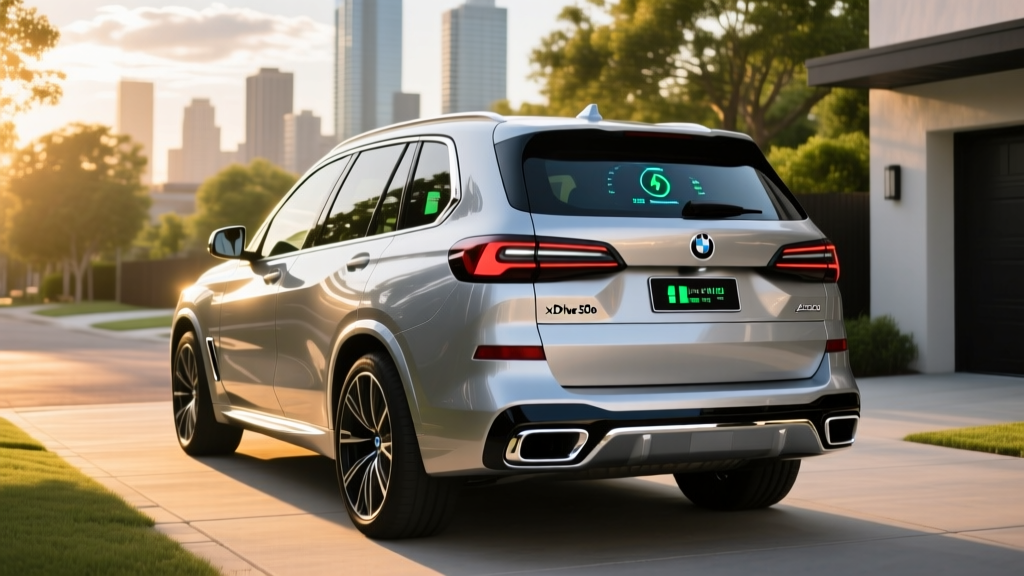
The BMW X5 has long been the benchmark midsize luxury SUV, and for 2026, the plug-in hybrid variant — the BMW X5 xDrive50e — continues to make a compelling case for buyers who want electric commuting without sacrificing road-trip flexibility. Unlike a conventional hybrid (HEV) that you can never plug in, the X5 xDrive50e is a full plug-in hybrid electric vehicle (PHEV) with a sizable battery pack, meaningful electric-only range, and the ability to charge at home or on the go.
This guide covers everything a prospective buyer needs: EPA fuel economy, real-world range expectations, charging logistics, powertrain specs, pricing, federal tax credit eligibility, and long-term battery reliability. If you're weighing the X5 hybrid against a full battery-electric vehicle (BEV) or a traditional gas SUV, we'll help you decide which path makes sense.
2026 BMW X5 xDrive50e: Quick Specs at a Glance
| Specification | Value |
|---|---|
| Powertrain | 3.0L turbocharged inline-6 + electric motor (PHEV) |
| Combined Horsepower | 483 hp |
| Combined Torque | 516 lb-ft |
| Battery Capacity (usable) | 25.7 kWh (lithium-ion NMC) |
| EPA Electric-Only Range | 38 miles |
| EPA Total Combined Range | ~440 miles |
| EPA MPGe (electric + gas) | 56 MPGe |
| EPA MPG (gas-only, combined) | 27 MPG |
| 0–60 mph | 4.6 seconds |
| Level 2 Charging (AC) | 7.4 kW (~4.5 hours 0–100%) |
| DC Fast Charging | Not available |
| Drivetrain | xDrive AWD |
| Starting MSRP | $75,900 (before incentives) |
| Battery Warranty | 8 years / 80,000 miles |
HEV vs. PHEV: Understanding What the X5 Hybrid Actually Is
Conventional Hybrid (HEV) vs. Plug-In Hybrid (PHEV)
Conventional Hybrid (HEV): A small battery (typically 1–2 kWh) recharges through regenerative braking and the gas engine. You never plug it in. Electric-only driving is limited to very low speeds and short distances. Think Toyota RAV4 Hybrid.
Plug-In Hybrid (PHEV): A much larger battery (the X5 xDrive50e carries 25.7 kWh usable) that you charge via a plug — either at home on a Level 2 charger or at public charging stations. This enables substantial electric-only driving (38 miles EPA in the X5's case) before the gas engine engages. Once the battery depletes, it operates like a conventional hybrid.
The 2026 BMW X5 xDrive50e is a PHEV. You must plug it in regularly to capture its efficiency and cost advantages. If you never plug it in, you're hauling 500+ lbs of battery dead weight and getting worse fuel economy than a lighter gas-only X5.
Fuel Economy: EPA Numbers vs. Real-World MPG
According to fueleconomy.gov, the 2026 BMW X5 xDrive50e achieves the following ratings:
| Mode | City | Highway | Combined |
|---|---|---|---|
| Electric + Gas (MPGe) | — | — | 56 MPGe |
| Gas-Only (MPG) | 25 | 29 | 27 |
Real-world expectations: The 38-mile electric range is achievable in moderate temperatures with mixed city/suburban driving. In our experience with the xDrive50e platform, expect 32–36 miles of electric range in warm weather and as low as 25–28 miles in freezing conditions — the battery is less efficient in cold, and cabin heating draws significant energy.
Once the battery depletes, the inline-6 hybrid mode delivers a genuine 25–28 MPG combined in mixed driving. On a highway-heavy road trip at 75+ mph, expect closer to 24–26 MPG. This is a meaningful advantage over the gas-only X5 xDrive40i, which returns roughly 24 MPG combined.
If your daily commute is under 35 miles round-trip and you charge at home nightly, you may go weeks without visiting a gas station. Owners with short commutes and home charging routinely report using only 5–10 gallons per month.
Electric-Only Range and Charging Logistics
The 25.7 kWh usable battery (NMC chemistry) provides 38 miles of EPA-rated electric-only range. That's enough to cover the average American's one-way commute and then some, according to FHWA data showing a median daily driving distance of roughly 35 miles.
Real-World Electric Range Callout
EPA sticker: 38 miles electric-only
Expect in practice: 30–36 miles in moderate weather, 25–28 miles in sub-freezing temps. Highway-speed electric driving at 70+ mph reduces range to roughly 28–30 miles due to aerodynamic drag.
Total combined range (electric + full tank): ~440 miles — comparable to the gas-only X5 and sufficient for any road trip without range anxiety.
Charging the X5 xDrive50e:
- Level 1 (120V household outlet): ~1.4 kW — adds roughly 4–5 miles of range per hour. A full charge from empty takes approximately 20+ hours. Fine for overnight top-ups if you drive less than 20 miles daily.
- Level 2 (240V home or public charger): The onboard charger accepts up to 7.4 kW. A full 0–100% charge takes approximately 4.5 hours. Install a Level 2 home charger (like a BMW Wallbox or ChargePoint Home Flex) and you'll wake up to a full battery every morning.
- DC fast charging: Not supported. The X5 xDrive50e cannot use DC fast chargers (CCS, NACS, or CHAdeMO). This is standard for most PHEVs — the battery is too small to benefit from rapid charging, and the onboard hardware doesn't include a DC inlet.
For home Level 2 installation, budget $800–$2,500 for the charger unit and electrical work (assuming your panel has capacity). If you need a panel upgrade from 100A to 200A, add $1,500–$3,000. A licensed electrician should assess your setup before purchase.
Powertrain and Performance: 483 HP of Electrified Luxury
The 2026 X5 xDrive50e pairs BMW's refined B58 3.0-liter turbocharged inline-6 with an electric motor integrated into the 8-speed automatic transmission. Combined output is 483 horsepower and 516 lb-ft of torque, routed through xDrive all-wheel drive.
The result is a 0–60 mph time of 4.6 seconds — quicker than the gas-only xDrive40i (5.2 seconds) and approaching the territory of BMW's M-lite performance models. The electric motor fills in the turbo lag gap, delivering instant torque from a stoplight.
Driving modes include:
- Electric: Pure battery power, up to ~84 mph, for zero-emission commuting.
- Hybrid: The system intelligently blends electric and gas power for optimal efficiency.
- Sport: Combines full engine and motor output for maximum acceleration.
- Battery Control: Preserves battery charge for later use (useful when entering an urban zero-emission zone after a highway drive).
Pricing, Trims, and Federal Tax Credit Eligibility
The 2026 BMW X5 xDrive50e starts at $75,900 (including destination). Popular options — the Premium Package, Driving Assistance Professional, panoramic roof, and larger wheels — can push a well-equipped example to $85,000–$92,000.
Federal Tax Credit: §30D Eligibility
The BMW X5 xDrive50e may qualify for up to $3,750 under the IRS §30D Clean Vehicle Credit, but eligibility depends on multiple factors that change frequently:
- MSRP cap: SUVs must be under $80,000 MSRP. A base X5 xDrive50e qualifies; a heavily optioned one may exceed the cap.
- Buyer income cap: Modified adjusted gross income must not exceed $150,000 (single), $225,000 (head of household), or $300,000 (joint filers).
- Battery sourcing requirements: The credit is split into two halves ($3,750 each) — one for critical minerals sourcing and one for battery component manufacturing. As of 2026, the X5 xDrive50e qualifies for the $3,750 critical-minerals half but may not meet the battery-component requirement, yielding a maximum of $3,750 rather than the full $7,500.
- Point-of-sale transfer: You can transfer the credit to the dealer at purchase, reducing your out-of-pocket cost immediately rather than waiting for tax filing.
Verify current eligibility on IRS.gov's qualified vehicles list before purchasing. Tax rules are subject to change, and a tax professional should confirm your personal eligibility.
Additionally, many states offer their own PHEV incentives — California, Colorado, New York, and others provide rebates or HOV lane access for qualifying plug-in hybrids. Check your state's energy office for current programs.
Battery Warranty, Reliability, and Replacement Cost
Battery Warranty
BMW covers the X5 xDrive50e's high-voltage battery for 8 years or 80,000 miles (whichever comes first), warranting it against defects and excessive capacity loss (typically defined as dropping below 70% of original capacity). This is standard across the PHEV industry and mandated in part by CARB regulations in states that follow California emissions standards.
Reliability outlook: BMW's B58 inline-6 engine is widely regarded as one of the most reliable modern engines in the luxury segment. The electric motor adds complexity but has far fewer moving parts than a traditional transmission. The primary long-term concern is battery degradation.
Based on data from earlier-generation BMW PHEVs (like the X5 xDrive45e), expect approximately 10–15% battery degradation over 8–10 years under normal use. BMW's battery management system includes a buffer (roughly 3–4 kWh of the total pack is reserved and inaccessible to the driver), which slows visible degradation. Real-world X5 PHEV owners with 60,000+ miles typically report losing only 3–5 miles of electric range.
Battery replacement cost: If the battery fails outside warranty, a full high-voltage battery replacement for the X5 PHEV currently runs $12,000–$18,000 including labor. However, BMW can often replace individual battery modules rather than the entire pack, reducing costs to $3,000–$6,000 for partial repairs. Most owners will never need this — the battery is engineered to outlast the vehicle's typical ownership cycle.
Who Should Buy the X5 xDrive50e — And Who Shouldn't
Pros
- 38 miles electric covers most daily commutes gas-free
- 483 hp with seamless electric torque fill
- No range anxiety — 440+ mile total range
- Luxury interior, strong build quality, quiet cabin
- Qualifies for partial federal tax credit ($3,750)
- Excellent highway cruiser with composed ride
Cons
- No DC fast charging — Level 2 only
- Must plug in nightly to maximize value
- $75,900+ starting price; options escalate quickly
- Heavier than gas X5 — slightly less agile in corners
- Cargo space reduced by ~2 cu ft vs. gas model (battery packaging)
- Partial tax credit only ($3,750 vs. $7,500 for some rivals)
Hybrid vs. PHEV vs. Full EV: Which Powertrain Fits You?
The 2026 X5 lineup gives buyers three powertrain philosophies. Here's how to decide:
| Factor | X5 xDrive40i (Gas) | X5 xDrive50e (PHEV) | BMW iX (Full EV) |
|---|---|---|---|
| Starting MSRP | ~$66,500 | ~$75,900 | ~$87,000 |
| Daily commuting cost | Highest (gas) | Lowest (if plugged in) | Lowest |
| Road-trip convenience | Excellent | Excellent | Good (requires planning) |
| Home charging needed? | No | Yes, strongly recommended | Yes, essential |
| Emissions (tailpipe) | Standard | Low (electric mode) | Zero |
| Tax credit | None | Up to $3,750 | Up to $7,500 (iX eligibility varies) |
| Best for... | Budget-focused, low-mileage drivers | Commuters who also road-trip | EV-ready households with home charging |
Decision Framework
Choose the X5 xDrive50e (PHEV) if: You have home charging access, your daily commute is under 40 miles, and you regularly take longer road trips where you don't want to plan around charging stations.
Choose a full EV (like the BMW iX) if: You have reliable home Level 2 charging, rarely drive more than 250 miles in a single day, and want zero tailpipe emissions with the lowest per-mile fuel cost.
Choose the gas X5 xDrive40i if: You can't charge at home, your budget is tighter, or you drive very few miles annually (under 8,000) where the PHEV premium won't pay for itself.
Ownership Costs: 5-Year Outlook
Over five years and 75,000 miles, the X5 xDrive50e can deliver meaningful savings versus the gas-only X5 — but only if you plug it in consistently. Here's an approximate breakdown assuming national average electricity ($0.16/kWh) and gasoline ($3.50/gallon) prices:
- Fuel (PHEV, plugged in nightly): ~$4,500–$5,500 (majority of miles on electricity)
- Fuel (gas-only X5 xDrive40i): ~$9,000–$10,500
- Maintenance (PHEV): Slightly lower than gas — less brake wear (regen braking), fewer oil changes if engine runs less
- Insurance: Comparable between PHEV and gas X5; slightly higher than a base model due to MSRP
- Depreciation: BMW PHEVs have historically held value well, though luxury SUV depreciation is steeper than mainstream brands
The PHEV premium over the gas X5 is roughly $9,400 at base MSRP. After the $3,750 tax credit, the effective premium drops to ~$5,650. With fuel savings of $3,500–$5,000 over five years, the break-even point is realistic for most buyers — and you gain the daily benefit of silent, instant-torque electric driving.
Frequently Asked Questions
How many MPG does the 2026 BMW X5 hybrid get?
The X5 xDrive50e achieves 56 MPGe when combining electric and gas driving. Once the battery is depleted, it operates as a conventional hybrid and delivers 27 MPG combined (25 city / 29 highway). Real-world gas-only driving typically yields 25–28 MPG depending on conditions.
How far can the BMW X5 xDrive50e go on electric only?
The EPA rates it at 38 miles electric-only. In real-world driving, expect 30–36 miles in moderate weather and 25–28 miles in freezing temperatures. Highway-speed driving at 70+ mph reduces electric range to roughly 28–30 miles.
Does the 2026 BMW X5 hybrid qualify for a tax credit?
It may qualify for up to $3,750 under the federal §30D Clean Vehicle Credit (not the full $7,500, due to battery-component sourcing rules). Eligibility depends on MSRP staying under $80,000, buyer income limits, and current IRS sourcing requirements. Check IRS.gov for the latest qualified vehicle list.
Is the BMW X5 hybrid reliable and what does battery replacement cost?
BMW's B58 inline-6 engine has a strong reliability record. The PHEV system adds complexity but has proven durable in earlier X5 PHEV generations. The battery is warrantied for 8 years / 80,000 miles. Full battery replacement outside warranty runs $12,000–$18,000, but partial module replacement is often possible for $3,000–$6,000. Most owners will not need battery service.
Can I charge the X5 xDrive50e at a Tesla Supercharger or DC fast charger?
No. The X5 xDrive50e does not support DC fast charging. It charges exclusively via AC — Level 1 (120V) or Level 2 (240V) up to 7.4 kW. This is standard for most PHEVs. For rapid DC charging capability, you'd need a full BEV like the BMW iX.
Should I get the X5 PHEV or just buy a full EV?
If you can charge at home and your daily driving is under 40 miles, the X5 PHEV gives you gas-free commuting plus unlimited road-trip range. If you're ready to commit fully to electric and rarely exceed 250 miles between stops, a full EV like the BMW iX offers lower running costs and a larger tax credit. The PHEV is the safer choice for one-car households or apartment-to-road-trip lifestyles.