Quick Verdict: The 2026 BMW X3 Hybrid Lineup
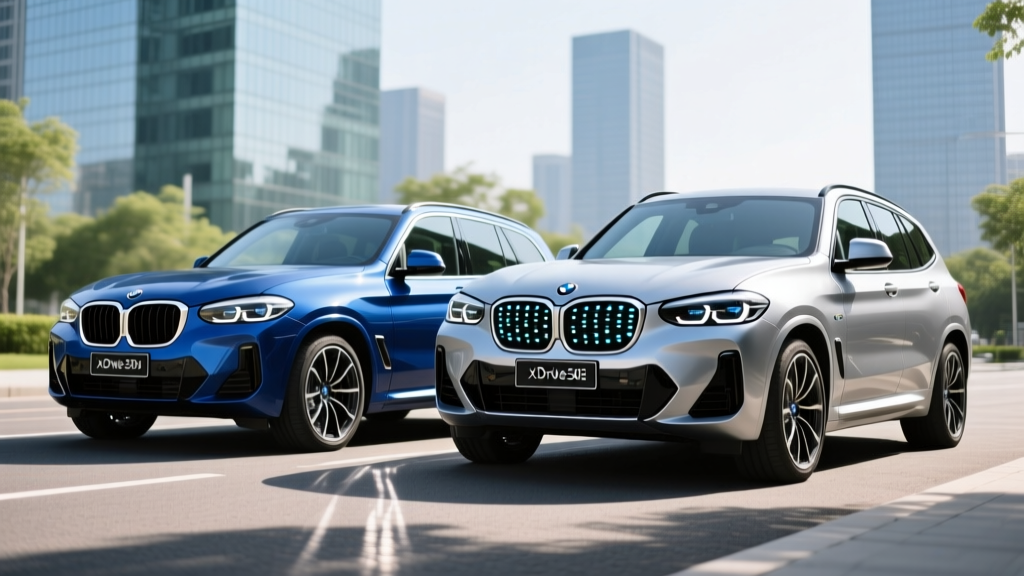
The 2026 BMW X3 hybrid range consists exclusively of plug-in hybrids (PHEVs), not conventional hybrids. BMW offers two variants for this generation: the xDrive30e (a turbocharged four-cylinder paired with an electric motor) and the more powerful xDrive50e (a turbocharged inline-six with a larger motor and battery). Both can drive meaningful distances on electricity alone before the gasoline engine kicks in — making them genuine gas-replacement commuters for drivers with short trips and home charging access.
If you're searching for a conventional self-charging hybrid (HEV) that never needs to be plugged in, the 2026 X3 doesn't offer one. Every X3 hybrid is a PHEV. That's an important distinction that affects your daily routine, your fuel bill, and whether you qualify for a federal tax credit.
HEV vs PHEV — What's the Difference?
Conventional Hybrid (HEV): Uses a small battery recharged by regenerative braking and the engine. You never plug it in. Electric-only driving is limited to very low speeds and short distances (typically under 1 mile). Example: Toyota RAV4 Hybrid.
Plug-in Hybrid (PHEV): Carries a much larger battery (typically 15–30 kWh) that you charge by plugging in. Offers 20–40+ miles of full electric driving before the gas engine takes over. Example: 2026 BMW X3 xDrive50e.
The 2026 BMW X3 hybrid lineup is PHEV only.
2026 BMW X3 PHEV Specs at a Glance
| Spec | xDrive30e | xDrive50e |
|---|---|---|
| Powertrain | 2.0L turbo I4 + electric motor | 3.0L turbo I6 + electric motor |
| Combined Horsepower | 295 hp | 457 hp |
| Combined Torque | 332 lb-ft | 516 lb-ft |
| Battery (usable) | ~19.7 kWh (NMC) | ~25.7 kWh (NMC) |
| EPA Electric-Only Range | ~32 miles | ~38 miles |
| EPA Combined MPG (gas) | ~28 MPG | ~30 MPG |
| MPGe (electric + gas) | ~56 MPGe | ~60 MPGe |
| 0–60 mph | 5.9 sec | 4.6 sec |
| AC Charging (Level 2) | 7.4 kW (~3 hrs 0–100%) | 7.4 kW (~3.75 hrs 0–100%) |
| DC Fast Charging | Not available | Not available |
| Base MSRP | ~$53,400 | ~$64,200 |
Source: BMW USA Press and fueleconomy.gov. Specs reflect 2026 model year estimates; confirm with dealer for final EPA certification.
Fuel Economy: EPA MPG and Real-World Expectations
PHEV fuel economy is measured two ways: MPGe (miles-per-gallon-equivalent when using both the battery and engine) and standard MPG (when the battery is depleted and you're driving on gasoline alone).
| Metric | xDrive30e | xDrive50e |
|---|---|---|
| MPGe (combined, battery + gas) | ~56 MPGe | ~60 MPGe |
| MPG city (gas only) | ~26 MPG | ~28 MPG |
| MPG highway (gas only) | ~30 MPG | ~32 MPG |
| MPG combined (gas only) | ~28 MPG | ~30 MPG |
| Total combined range | ~420 miles | ~440 miles |
Electric-Only Range: How Far Can the X3 PHEV Go Without Gas?
The xDrive30e provides an EPA-estimated ~32 miles of electric-only range, while the xDrive50e extends that to ~38 miles. For many commuters, that covers a full round-trip daily drive without burning a drop of gasoline — provided you charge at home overnight.
Real-world electric range considerations:
- Cold weather (below 32°F): Expect a 20–30% reduction in electric range. A 38-mile EPA rating may drop to 26–30 miles in freezing temperatures due to battery chemistry limitations and cabin heating demands.
- Highway speeds (70+ mph): Electric range drops to roughly 25–30 miles for the xDrive50e. PHEV batteries are optimized for city-speed efficiency, not sustained highway velocity.
- Climate control: Running the heater or A/C draws from the battery. The xDrive50e's heat pump (if equipped) helps reduce this penalty in cold weather compared to resistive heating.
Charging the 2026 BMW X3 Hybrid: What You Need to Know
Both X3 PHEV models charge exclusively via AC — there is no DC fast-charging capability. Here's the practical breakdown:
| Charging Level | Power (kW) | xDrive30e Time (0–100%) | xDrive50e Time (0–100%) |
|---|---|---|---|
| Level 1 (120V household) | ~1.4 kW | ~14 hours | ~18 hours |
| Level 2 (240V home/public) | 7.4 kW max | ~3 hours | ~3.75 hours |
| DC Fast Charge | N/A | Not supported | Not supported |
What this means practically: A Level 2 home charger (240V, 32-amp circuit minimum) is strongly recommended. Level 1 charging from a standard wall outlet will technically work overnight for the xDrive30e if you arrive home with a partially depleted battery, but the xDrive50e's larger battery won't fully replenish on Level 1 in a typical overnight window. Public Level 2 chargers at workplaces or shopping centers are a viable supplement.
The connector is a standard J1772 (the universal AC plug for non-Tesla EVs in North America). No NACS or CCS port is needed since DC fast charging isn't supported.
Pricing, Trims, and Tax Credit Eligibility
The 2026 BMW X3 PHEV lineup starts at approximately $53,400 for the xDrive30e and $64,200 for the xDrive50e, before destination and options. Well-equipped xDrive50e models with M Sport packages and premium options can reach the mid-$70,000s.
Federal Tax Credit: §30D Eligibility
Under current IRS §30D rules, qualifying PHEVs may be eligible for up to $7,500 in federal tax credits — but eligibility is complex and not guaranteed. Key requirements include:
- MSRP cap: SUVs must have a base MSRP at or below $80,000. Both X3 PHEV trims clear this threshold at base, but heavily optioned models may approach it.
- Buyer income cap: Modified AGI must not exceed $150,000 (single), $225,000 (head of household), or $300,000 (joint).
- Battery sourcing: Critical minerals and battery components must meet phased-in domestic/free-trade sourcing thresholds that tighten annually. BMW's supply chain compliance varies — confirm with your dealer at point of sale.
- Point-of-sale transfer: You can transfer the credit to the dealer for an immediate price reduction, or claim it on your tax return.
- Minimum battery capacity: PHEVs must have at least 7 kWh of battery capacity. Both X3 variants exceed this.
Consult a tax professional before relying on credit eligibility. Sourcing rules change, and final determination happens at point of sale.
Battery Warranty, Reliability, and Replacement Cost
BMW PHEV Battery Warranty
BMW covers the high-voltage battery for 8 years or 80,000 miles (whichever comes first), with a capacity retention threshold of 70%. If the battery degrades below 70% of its original capacity within that window, BMW will repair or replace it at no cost.
This warranty is federally mandated for emissions-related components on PHEVs in many states, and BMW extends it nationwide. California and states adopting CARB rules may offer additional protections.
Reliability outlook: BMW's current-generation PHEV powertrains (introduced with the G45 X3) are newer and lack the multi-year track record of, say, Toyota's hybrid systems. The inline-six in the xDrive50e is a proven engine architecture, but the integration with the electric motor and battery management system is more complex than a conventional hybrid. Early reliability data from owner surveys and JD Power will be the best indicator once the 2026 model accumulates real-world miles.
Battery replacement cost: Outside of warranty, a full high-voltage battery replacement for a BMW PHEV of this size typically runs $8,000–$14,000 including parts and labor. However, total battery failure is rare — gradual degradation to 70–80% capacity over 10–15 years is the more likely scenario, and the vehicle remains fully drivable on gasoline with reduced electric range.
Who Should Buy the 2026 BMW X3 Hybrid?
Choose the X3 xDrive30e PHEV if:
- Your daily commute is under 30 miles round-trip and you can charge at home
- You want a premium compact SUV with electric commuting but need gas-engine flexibility for road trips
- You're upgrading from a gas X3 and want to reduce fuel consumption without range anxiety
- Budget is a primary concern within the PHEV lineup
Choose the X3 xDrive50e PHEV if:
- You want 457 hp and a 4.6-second 0–60 time alongside electric commuting
- Your daily driving is 35–38 miles and you want to stay electric-only most days
- You value the smoothness of the inline-six and plan to keep the vehicle long-term
Choose a full BEV instead if:
- You have reliable home charging and your trips rarely exceed 250 miles
- You want to eliminate gasoline entirely (no oil changes, no gas station visits)
- You're considering the BMW iX or i4 for a fully electric BMW experience
Choose a conventional hybrid (HEV) instead if:
- You cannot install a home charger and have no workplace charging access
- You want a simpler ownership experience with no plug-in routine
- A Toyota RAV4 Hybrid or Honda CR-V Hybrid meets your needs at a lower price
Pros
- 32–38 miles of electric-only range covers most commutes
- xDrive50e delivers sports-car acceleration (4.6s 0–60) with SUV practicality
- No range anxiety — gas engine provides 400+ mile total range
- Level 2 charging in ~3–3.75 hours is fast for a PHEV
- Premium interior, iDrive 9 infotainment, strong build quality
- Potential §30D tax credit up to $7,500 (eligibility varies)
Cons
- No DC fast charging — road-trip recharging is limited to slow AC
- Electric range drops significantly in cold weather (20–30% loss)
- No conventional hybrid option for buyers without plug-in access
- Premium pricing vs. mainstream PHEVs (RAV4 Prime, Tucson PHEV)
- Tax credit eligibility uncertain due to battery sourcing rules
- Real-world gas-only MPG (~27–30) is only modestly better than the gas X3
Frequently Asked Questions
How many MPG does the 2026 BMW X3 hybrid get?
When the battery is depleted and you're running on gasoline alone, the xDrive30e delivers an EPA-estimated ~28 MPG combined (26 city / 30 highway), and the xDrive50e achieves ~30 MPG combined (28 city / 32 highway). If you charge daily and most of your driving falls within the electric-only range, your effective fuel consumption can be dramatically lower — reflected in the 56–60 MPGe combined rating.
How far can the 2026 BMW X3 PHEV go on electric only?
The xDrive30e offers approximately 32 miles of EPA-estimated electric-only range, while the xDrive50e provides about 38 miles. Real-world range depends on temperature, speed, and climate control use — expect 25–30 miles in cold weather or at highway speeds for the xDrive50e.
Is the 2026 BMW X3 hybrid a conventional hybrid or a plug-in?
It's exclusively a plug-in hybrid (PHEV). There is no conventional self-charging hybrid (HEV) variant of the 2026 X3. You'll need access to a charging outlet — ideally a Level 2 (240V) home charger — to take full advantage of the electric range.
Does the 2026 BMW X3 PHEV qualify for a federal tax credit?
It may qualify for up to $7,500 under IRS §30D, depending on battery component and critical mineral sourcing, your income, and the vehicle's MSRP. Eligibility rules are complex and change over time. Confirm with your dealer at the point of sale and consult a tax professional before making a purchase decision based on the credit.
Is the BMW X3 PHEV reliable? What does battery replacement cost?
Long-term reliability data for the current-generation X3 PHEV is still accumulating. BMW's high-voltage battery is warranted for 8 years / 80,000 miles at 70% capacity retention. Out-of-warranty battery replacement typically costs $8,000–$14,000, though total battery failure is uncommon — gradual capacity loss is the norm.
Can the 2026 BMW X3 hybrid DC fast charge?
No. Both X3 PHEV variants support AC charging only, up to 7.4 kW on Level 2. There is no DC fast-charging port. A full charge takes approximately 3–3.75 hours on a Level 2 home charger.
Hybrid vs PHEV vs EV — which is right for me?
If you have home charging and a commute under 40 miles, the X3 PHEV lets you drive electric daily with gas-engine backup for longer trips. A full EV (like the BMW iX) eliminates gas entirely but requires charging planning for road trips. A conventional hybrid (like the RAV4 Hybrid) is best if you can't plug in at all but still want better fuel economy than a gas-only vehicle.
Sources: fueleconomy.gov, BMW USA Press, IRS §30D Clean Vehicle Credits.