Quick Verdict: The 2026 Audi A5 TFSI e PHEV
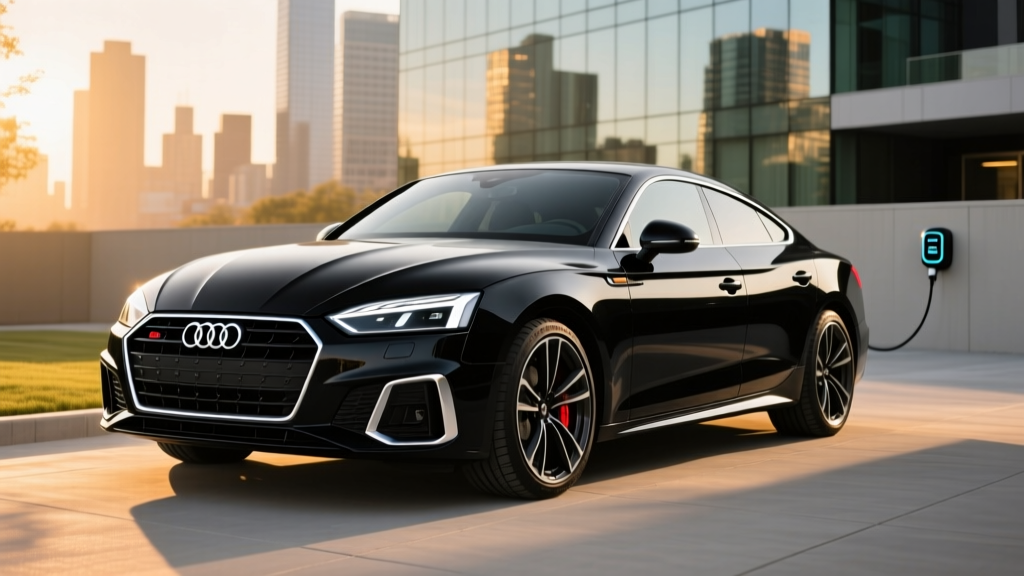
The 2026 Audi A5 is offered exclusively as a plug-in hybrid (PHEV) in the U.S. market — the A5 Sportback 55 TFSI e quattro. There is no conventional self-charging hybrid (HEV) version of the A5 available domestically. This PHEV pairs a turbocharged 2.0-liter four-cylinder engine with an electric motor integrated into the seven-speed S tronic transmission, yielding a combined 362 horsepower and an EPA-estimated 25 miles of electric-only range from a 25.9 kWh battery pack. Starting at $57,995 (including destination), the A5 PHEV targets luxury-sedan buyers who want daily electric commuting with the security of a gas engine for longer trips. It does not qualify for the federal §30D new-vehicle tax credit under current 2026 IRS rules.
HEV vs. PHEV: Why the Audi A5 Is Strictly a Plug-In
A common search question is whether the A5 comes as a conventional hybrid (HEV) or a plug-in hybrid (PHEV). Understanding the difference is essential before evaluating the car:
| Attribute | Conventional Hybrid (HEV) | Plug-In Hybrid (PHEV) — Audi A5 55 TFSI e |
|---|---|---|
| Battery size | ~1–2 kWh | 25.9 kWh (usable) |
| Electric-only range | 0–2 miles at low speed | EPA est. 25 miles |
| Plugs in? | No — regenerates via braking & engine | Yes — Level 2 AC or regen |
| Gas engine role | Primary, supplemented by motor | Secondary on short trips, primary on long trips |
| DC fast charge | N/A | No (AC only) |
| Federal tax credit | Not eligible | Subject to §30D sourcing rules (see below) |
The Audi A5 sold in the U.S. is a PHEV. If you're looking for a self-charging luxury hybrid with no plug, you'd need to look at the Lexus ES 300h or similar HEV — the A5 doesn't serve that segment.
Fuel Economy and Electric-Only Range
EPA MPG and MPGe Breakdown
When the battery is depleted, the A5 55 TFSI e operates as a hybrid. Here's how the EPA rates it:
| Driving Mode | City | Highway | Combined |
|---|---|---|---|
| Charge-depleting (hybrid mode) | 27 MPG | 34 MPG | 30 MPG |
| Charge-sustaining (battery empty) | 25 MPG | 32 MPG | 28 MPG |
| EV mode (MPGe equivalent) | 56 MPGe combined | ||
Total Combined Range
With a 13.2-gallon fuel tank and 25 miles of electric range, the A5 PHEV delivers an approximate total range of 385–400 miles when starting with a full battery and full tank. This eliminates range anxiety entirely — you can drive coast-to-coast using any gas station.
Battery, Charging, and Powertrain Specs
| Specification | 2026 Audi A5 55 TFSI e quattro |
|---|---|
| Powertrain | 2.0L turbo I4 + electric motor, 7-speed S tronic, quattro AWD |
| Combined output | 362 hp / 369 lb-ft torque |
| 0–60 mph | 4.7 seconds |
| Battery chemistry | Lithium-ion (NMC) |
| Battery capacity (gross / usable) | 25.9 kWh / ~22.0 kWh usable |
| EV-only range (EPA) | 25 miles |
| Onboard AC charger | 7.4 kW (Level 2) |
| DC fast charging | Not available |
| Level 2 charge time (0–100%) | ~3.5 hours at 7.4 kW |
| Level 1 charge time (120V, 1.4 kW) | ~16 hours |
| Charge connector | J1772 (AC only) |
| Fuel tank | 13.2 gallons |
| EPA combined MPG (hybrid mode) | 30 MPG |
| Base MSRP | $57,995 (incl. destination) |
Charging Reality: No DC Fast Charging
A critical limitation of the A5 PHEV — and most PHEVs in this class — is the absence of DC fast charging. You cannot plug into a 50–350 kW public fast charger to top up the battery. The 7.4 kW onboard AC charger means a full charge from empty takes about 3.5 hours on a 240V Level 2 home charger. This is fine for overnight charging but impractical for road-trip top-ups. On long highway drives, the car simply runs in hybrid mode, which is the intended use case.
Charging Levels at a Glance
| Level | Power (kW) | Time to Full (from 0%) | Best Use |
|---|---|---|---|
| Level 1 (120V household) | ~1.4 kW | ~16 hours | Overnight top-up if no L2 available |
| Level 2 (240V home/public) | 7.4 kW | ~3.5 hours | Daily overnight charge |
| DC Fast Charge | N/A | N/A | Not supported |
Pricing, Tax Credits, and Ownership Costs
The 2026 Audi A5 55 TFSI e quattro starts at $57,995 including the $1,195 destination charge. A Prestige trim pushes the MSRP to approximately $64,595. Options like the S line package, panoramic sunroof, and driver-assistance packages can bring a loaded example above $70,000.
Federal §30D Tax Credit Eligibility
Under current 2026 IRS §30D rules, the A5 PHEV does not qualify for the federal new clean vehicle credit. The primary disqualifying factor is battery-component and critical-mineral sourcing requirements that Audi has not met for this model. Additionally, buyers must meet income caps ($150,000 single / $300,000 joint for modified AGI) and the vehicle MSRP must not exceed $55,000 for sedans — the A5 at $57,995 exceeds this cap.
- MSRP cap (sedans): $55,000 — A5 exceeds this ❌
- Battery sourcing: Does not meet critical-mineral requirements ❌
- Buyer income cap: $150K single / $300K joint — varies by buyer
- Point-of-sale transfer: N/A since vehicle is ineligible
Source: IRS §30D New Clean Vehicle Credit. Always verify current eligibility with a tax professional before purchasing.
State and Local Incentives
Some states offer their own PHEV rebates or HOV-lane access. California's CVRP program, for example, has historically offered rebates for qualifying PHEVs, though eligibility varies by battery size and income. Check your state energy office or AFDC incentive database for current local programs.
Reliability, Battery Warranty, and Long-Term Costs
Audi covers the A5 PHEV high-voltage battery for 8 years or 100,000 miles (whichever comes first), with a capacity-retention threshold of 70%. The conventional powertrain warranty is 4 years / 50,000 miles. Federal law mandates that hybrid/PHEV battery components be covered for at least 8 years / 100,000 miles, and Audi meets this standard.
Battery Degradation and Replacement Cost
The 25.9 kWh NMC battery in the A5 PHEV is liquid-cooled, which helps mitigate thermal degradation. Based on industry data from similar Volkswagen Group PHEV platforms, expect 8–12% capacity loss over 8 years under normal use — meaning the 25-mile EV range might drop to 22–23 miles by year eight. This is within the 70% warranty threshold.
If replacement is needed out of warranty, a PHEV battery of this size typically costs $6,000–$9,000 including labor. However, individual module replacement (rather than the full pack) may reduce costs. The 2.0L turbocharged engine is well-established across the VW/Audi lineup, and hybrid-system reliability has been solid in the A5's predecessor (the A5 Sportback 55 TFSI e from 2021–2024).
Long-Term Reliability Considerations
The A5 PHEV adds complexity over a pure gas car: a high-voltage battery, electric motor, power electronics, and a more complex transmission. However, the VW Group's PHEV architecture has matured significantly since its 2016 debut. Key reliability factors:
- Transmission: The S tronic dual-clutch is proven but can be costly to service ($3,000–$5,000 if major work is needed out of warranty).
- Brakes: Regenerative braking reduces pad wear — expect 80,000+ miles on original pads in mixed driving.
- Coolant system: The liquid-cooled battery requires periodic coolant service. Neglect can accelerate degradation.
- Insurance: PHEV insurance premiums run 5–15% higher than equivalent gas models due to repair complexity. Get quotes before purchasing.
Who Should Buy the A5 Hybrid vs. a Full EV or Gas Car?
- Choose the A5 PHEV if: You commute 15–25 miles round-trip and can charge at home nightly. You want luxury-sedan refinement with quattro AWD, occasional road trips beyond EV range, and no dependency on public charging infrastructure.
- Choose a full EV (e.g., BMW i4, Tesla Model 3) if: You have reliable home charging, drive under 250 miles daily, want zero tailpipe emissions, lower per-mile energy costs (~$0.04/mi vs. $0.12/mi for the A5 in hybrid mode), and qualify for the §30D credit on an eligible model.
- Choose a conventional HEV (e.g., Lexus ES 300h) if: You cannot charge at home (apartment, street parking), want maximum simplicity, and prioritize fuel economy without plugging in.
- Stick with gas (e.g., Audi A5 45 TFSI, if available) if: You drive very low annual miles, want the lowest purchase price, and don't care about electric-only commuting.
The Daily-Commute Math
If your commute is 22 miles round-trip and you charge nightly at home, you'll burn zero gasoline on weekdays. At an average residential electricity rate of $0.16/kWh, charging the A5's ~22 kWh usable battery costs about $3.52 per full charge — roughly $0.14 per electric mile. Compare that to hybrid mode at 28 MPG with $3.50/gallon gas: $0.125 per mile. The per-mile cost difference is narrow, but the electric mode delivers silent, instant-torque acceleration and zero tailpipe emissions on your daily drive.
Over a year of 12,000 miles (assuming 70% electric-mode driving), you'd use approximately 100 gallons of gas and ~1,800 kWh of electricity. Total annual fuel cost: roughly $640, compared to ~$1,500 for a gas-only A5 averaging 26 MPG.
Pros and Cons
- 362 hp with instant electric torque — genuinely quick (4.7s 0–60)
- 25 miles EV range covers most daily commutes
- quattro AWD standard — excellent all-weather capability
- Premium interior with 11.9" digital cluster + 14.5" infotainment
- No range anxiety — 400-mile total range
- 8-year / 100,000-mile battery warranty
- Luxury build quality and cabin isolation
- No DC fast charging — AC only at 7.4 kW
- Exceeds $55K MSRP cap for §30D federal tax credit
- EV range drops to ~16–18 miles in freezing weather
- Higher purchase price than gas A5 or rivals like Lexus ES 300h
- Trunk space reduced by battery pack (~21 cu ft vs ~25 in gas model)
- No conventional HEV option for buyers without home charging
- Insurance premiums 5–15% higher than gas equivalent
How the A5 PHEV Compares to Rivals
| Spec | 2026 Audi A5 55 TFSI e | 2026 BMW 330e xDrive | 2026 Lexus ES 300h (HEV) |
|---|---|---|---|
| Type | PHEV | PHEV | HEV (no plug) |
| Combined HP | 362 hp | 288 hp | 215 hp |
| EV range | 25 mi | 23 mi | N/A |
| Combined MPG (hybrid) | 30 MPG | 28 MPG | 44 MPG |
| Battery | 25.9 kWh | 19.5 kWh | ~1.6 kWh |
| 0–60 mph | 4.7s | 5.6s | 8.1s |
| Starting MSRP | $57,995 | $49,995 | $46,500 |
| Federal credit eligible | No | Partial ($3,750) | No |
| AWD | Standard | Standard | FWD only |
The BMW 330e offers a lower entry price and partial tax credit, but gives up 74 horsepower and feels noticeably less potent. The Lexus ES 300h delivers far superior hybrid-mode MPG (44 combined) and a lower price, but lacks plug-in capability, AWD, and performance. The A5 PHEV's advantage is the combination of luxury, power, and AWD — but it demands a premium for it.
Frequently Asked Questions
How many MPG does the Audi A5 hybrid get?
The 2026 Audi A5 55 TFSI e gets an EPA-estimated 30 MPG combined (27 city / 34 highway) when operating in hybrid mode with battery charge. In real-world mixed driving, owners report 26–29 MPG combined. When running on electricity alone, it achieves 56 MPGe equivalent.
How far can the Audi A5 PHEV go on electric only?
The EPA rates the A5 PHEV at 25 miles of electric-only range. In real-world conditions, expect 20–23 miles on the highway, up to 28 miles in city driving with regen, and as low as 16–18 miles in freezing temperatures with cabin heating active.
Does the Audi A5 hybrid qualify for any tax credit?
Under 2026 IRS §30D rules, the A5 PHEV does not qualify for the federal new clean vehicle credit. It exceeds the $55,000 MSRP cap for sedans and does not meet battery-sourcing requirements. Some state incentives may apply — check your local programs. The IRS §30D page has the latest rules.
Is the Audi A5 hybrid reliable, and what does battery replacement cost?
The VW Group PHEV platform has matured significantly, and the A5's powertrain is well-proven. The high-voltage battery is warranted for 8 years / 100,000 miles with a 70% capacity-retention threshold. Out-of-warranty battery replacement is estimated at $6,000–$9,000, though module-level repair may cost less. The 2.0L engine and S tronic transmission have extensive service histories.
Can I charge the Audi A5 PHEV at a DC fast charger?
No. The A5 PHEV supports AC charging only — Level 1 (120V, ~1.4 kW) and Level 2 (240V, up to 7.4 kW). It uses a standard J1772 connector. A full Level 2 charge from empty takes approximately 3.5 hours. DC fast charging is not available on this or most PHEVs.
Hybrid vs. PHEV vs. EV — which should I choose?
It depends on your charging access and driving patterns. If you can charge at home and commute under 25 miles, the A5 PHEV gives you electric daily driving with gas-engine flexibility. If you charge at home and rarely exceed 250 miles, a full EV like the BMW i4 or Tesla Model 3 offers lower running costs and tax-credit eligibility. If you cannot charge at home, a conventional HEV like the Lexus ES 300h is the better choice — no plug required, and 44 MPG combined.
Does the Audi A5 hybrid need to be plugged in?
Yes — to get the benefit of its 25-mile EV range, you should plug in nightly. However, you can drive it without ever plugging in; it will simply operate as a 28 MPG hybrid. The car regenerates some charge during braking, but this won't fully recharge the 25.9 kWh battery.
Sources: EPA Fuel Economy, Audi USA, IRS §30D. All figures based on 2026 model-year data available at time of publication. Verify specs and credit eligibility before purchasing.