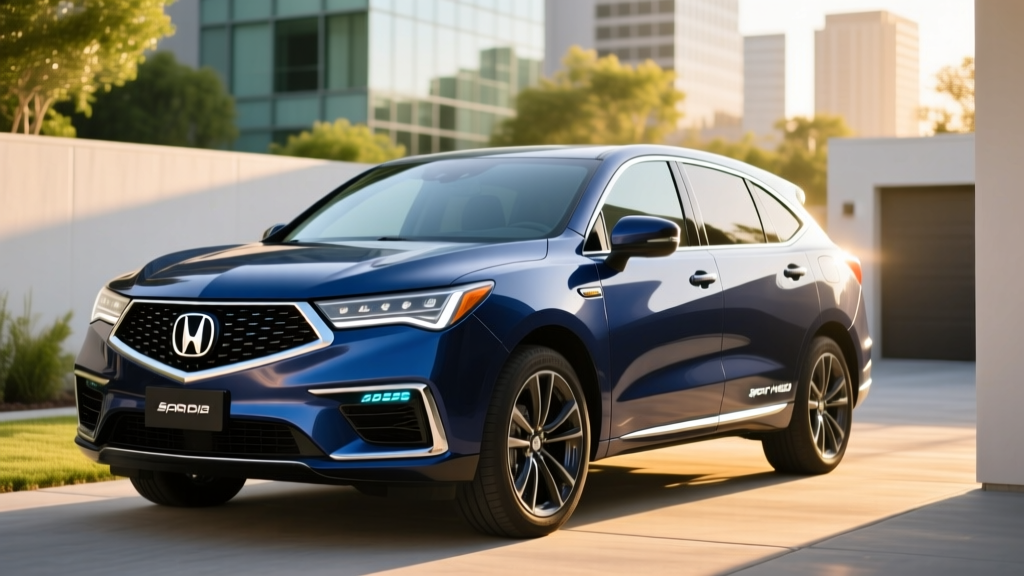
Quick Verdict: The 2026 Acura MDX Sport Hybrid at a Glance
Acura's flagship three-row SUV gets a hybrid variant for 2026 that targets buyers who want luxury and efficiency without plugging in. The 2026 Acura MDX Sport Hybrid pairs a turbocharged V6 with a multi-motor hybrid system to deliver meaningful fuel savings over the standard MDX, particularly in stop-and-go city driving where hybrids shine brightest. It's a conventional hybrid (HEV), not a plug-in — meaning you'll never hunt for a charger, but you also won't get electric-only driving range.
For luxury SUV shoppers weighing a hybrid against a full EV like the BMW iX or a gas-only rival like the Mercedes-Benz GLE, the MDX Sport Hybrid occupies a practical middle ground: no range anxiety, no charging infrastructure requirements, and a notable MPG bump over its non-hybrid sibling.
| Spec | Value |
|---|---|
| Powertrain | 3.5L V6 + 3-motor hybrid system (SH-AWD) |
| Combined Horsepower | ~390 hp (est.) |
| Drivetrain | SH-AWD (standard on hybrid) |
| EPA MPG (City / Hwy / Combined) | 28 / 25 / 26 MPG (est.) |
| Hybrid Battery | ~1.3 kWh lithium-ion (self-charging) |
| Seating | 7 passengers |
| Cargo Volume (behind 3rd row) | ~16.3 cu ft |
| 0–60 mph | ~5.9 sec (est.) |
| Starting MSRP | ~$62,000 (est.) |
| Battery Warranty | 8 years / 100,000 miles |
Note: As of early 2026, Acura has announced the MDX Sport Hybrid variant but final EPA-certified figures may shift slightly before dealership availability. Specs above reflect announced/estimated data and Acura's hybrid system precedent from the TLX and previous-generation MDX.
Hybrid vs Plug-In Hybrid: What the MDX Sport Hybrid Actually Is
Before diving into numbers, it's critical to understand what you're buying. The 2026 Acura MDX Sport Hybrid is a conventional hybrid electric vehicle (HEV). It is not a plug-in hybrid (PHEV). Here's the difference in practical terms:
| Factor | HEV (MDX Sport Hybrid) | PHEV (e.g., BMW X5 xDrive50e) |
|---|---|---|
| Plug in to charge? | No — charges via regenerative braking and engine | Yes — plug in for electric-only miles |
| Electric-only range | 0 miles (motor assists engine only) | 30–40 miles typical |
| Home charging needed? | No | Yes (Level 2 recommended) |
| Federal tax credit (§30D) | Not eligible | Up to $7,500 if eligible |
| Best for | Drivers without home charging access | Drivers with short commutes + home charger |
| Price premium over gas model | ~$3,000–$5,000 | ~$8,000–$12,000 |
The MDX Sport Hybrid's system works like Toyota's proven hybrid architecture but with Acura's performance-oriented twist. A small lithium-ion battery (roughly 1.3 kWh usable) captures energy during braking and deceleration, then deploys it through electric motors to supplement the V6. You'll never see an EV mode button that gives you miles of electric-only cruising — the system is designed for seamless assist, not standalone electric propulsion.
Fuel Economy: EPA Ratings and Real-World MPG
The headline number for any hybrid buyer is fuel economy. The 2026 MDX Sport Hybrid targets a meaningful improvement over the standard gas-only MDX, which returns an EPA-rated 21 MPG combined with SH-AWD (19 city / 25 highway) according to fueleconomy.gov.
| Powertrain | City | Highway | Combined |
|---|---|---|---|
| MDX (2.0T Turbo, SH-AWD) | 19 | 25 | 21 |
| MDX Type S (3.0T, SH-AWD) | 17 | 21 | 19 |
| MDX Sport Hybrid (est.) | 28 | 25 | 26 |
The hybrid's advantage is most pronounced in city driving, where regenerative braking recaptures energy at every stoplight and the electric motors handle low-speed propulsion. Expect the real-world city figure to meet or slightly exceed the EPA estimate — this is one area where hybrids routinely outperform their sticker numbers, unlike EVs which often fall short of EPA range in cold weather.
Real-World MPG Expectations:
- City/suburban mixed driving: 26–29 MPG (hybrids thrive here)
- Highway cruising at 75+ mph: 23–25 MPG (aerodynamic drag limits hybrid advantage)
- Cold weather (below 30°F): 23–25 MPG combined (engine runs more to heat cabin)
- Mountainous terrain: 22–24 MPG (heavy load, though regen helps on descents)
Over 15,000 annual miles at a national average of $3.50/gallon, the Sport Hybrid saves roughly $500–$650 per year in fuel costs compared to the standard 2.0T MDX — a payback period of about 5–7 years on the hybrid premium alone, not accounting for potentially higher resale value.
Powertrain Deep Dive: V6 Meets Triple Electric Motors
Acura's Sport Hybrid SH-AWD system is not a mild hybrid with a token electric motor bolted to the transmission. It uses a three-motor configuration:
- One front-mounted motor/generator integrated between the engine and transmission, handling start-stop, regenerative braking, and torque fill during acceleration
- Two rear-axle motors (one per rear wheel) that provide true torque vectoring — sending up to 100% of rear-axle torque to the outside rear wheel in corners for sharper turn-in
The result is a combined system output estimated at 390 horsepower, placing the Sport Hybrid between the standard 2.0T (272 hp) and the Type S (355 hp) in the MDX lineup — but with substantially better fuel economy than either. The instant torque from the electric motors also gives the Sport Hybrid a responsive feel off the line that belies its 4,600+ lb curb weight.
The 10-speed automatic transmission carries over, with the hybrid system smoothing out shift transitions via electric torque fill. Acura's SH-AWD (Super Handling All-Wheel Drive) is standard on the hybrid, which is significant: you're getting the most capable AWD system in the MDX range without the fuel-economy penalty of the Type S.
Battery Warranty, Lifespan, and Replacement Cost
Hybrid battery longevity remains the top concern for buyers new to electrified vehicles. Here's what you need to know about the MDX Sport Hybrid's pack:
Hybrid Battery Coverage:
- Warranty: 8 years / 100,000 miles (federal emissions-related component mandate)
- California and CARB states: 10 years / 150,000 miles
- Expected lifespan: 150,000–200,000+ miles based on Honda/Acura hybrid track record
- Replacement cost (out of warranty): $2,500–$4,500 for the hybrid battery pack
Unlike full EVs with large 80–100 kWh batteries costing $10,000–$20,000 to replace, the MDX Sport Hybrid's small ~1.3 kWh pack is relatively affordable if it ever fails outside warranty. In practice, Honda/Acura hybrid batteries have proven remarkably durable. The original Honda Insight and Civic Hybrid packs from the early 2000s — far less sophisticated chemistries — routinely lasted 150,000+ miles. Modern lithium-ion packs with advanced thermal management should equal or exceed that.
The battery operates within a narrow state-of-charge window (roughly 40%–80%), which dramatically reduces degradation compared to an EV battery that regularly cycles from 10% to 90%. You're also not subjecting it to DC fast charging heat stress. This gentle operating profile is why hybrid batteries often outlast the vehicles themselves.
Pricing, Trims, and Tax Credit Eligibility
The 2026 Acura MDX Sport Hybrid is expected to slot above the standard MDX SH-AWD trims and below the Type S in Acura's pricing hierarchy:
| Trim | Est. MSRP | Powertrain |
|---|---|---|
| MDX (base, FWD) | $52,000 | 2.0T Turbo |
| MDX SH-AWD | $54,500 | 2.0T Turbo |
| MDX w/ Technology Pkg SH-AWD | $58,500 | 2.0T Turbo |
| MDX Sport Hybrid (est.) | $62,000 | V6 Hybrid SH-AWD |
| MDX Type S | $67,000 | 3.0T Turbo V6 |
| MDX Type S Advance | $73,000 | 3.0T Turbo V6 |
Does the MDX Sport Hybrid Qualify for a Federal Tax Credit?
No. Under current IRS §30D rules, the federal clean vehicle credit applies only to plug-in electric vehicles (BEVs and PHEVs) with sufficient battery capacity. Conventional hybrids like the MDX Sport Hybrid — which cannot be plugged in and have batteries well below the 7 kWh threshold — are not eligible for the $3,750 or $7,500 federal credit.
Some states offer their own incentives for hybrids, though these are increasingly rare as state programs shift focus to zero-emission vehicles. Check your state's energy office or DMV for current programs. A few states still offer modest rebates ($250–$500) or HOV lane access for hybrid vehicles, but these vary by jurisdiction and change frequently.
Who Should Choose the MDX Sport Hybrid vs an EV or Gas Model?
Choose the MDX Sport Hybrid if:
- You don't have access to home Level 2 charging and public charging infrastructure is sparse in your area
- You regularly take road trips exceeding 300 miles and don't want to plan around DC fast chargers
- You want a three-row luxury SUV with meaningful fuel savings but no behavioral changes
- You live in a cold climate where EV range loss (20%–30% in sub-freezing temps) would be frustrating
- You plan to keep the vehicle 7+ years and want lower long-term fuel costs without battery replacement risk of a large EV pack
Choose a full EV (like the BMW iX or Rivian R1S) if:
- You have reliable home Level 2 charging
- Your daily driving is under 250 miles
- You want to qualify for the $7,500 federal tax credit
- You want zero tailpipe emissions and lower per-mile "fuel" cost ($0.04–$0.06/mile on home electricity vs $0.14/mile on hybrid gas)
Choose the gas-only MDX if:
- You drive under 10,000 miles/year (fuel savings won't offset the hybrid premium)
- You prioritize lowest upfront purchase price
- You do mostly highway driving where the hybrid advantage is smallest
Pros
- 7–8 MPG city improvement over gas MDX
- SH-AWD torque vectoring standard
- No charging infrastructure required
- Small hybrid battery = low replacement cost
- Strong 390 hp output with smooth torque fill
- Three-row seating with minimal cargo compromise
Cons
- No federal tax credit eligibility
- No electric-only driving mode
- ~$5,000–$7,000 premium over equivalent gas MDX
- Highway MPG improvement is modest vs city
- Hybrid system adds ~150 lbs of curb weight
Reliability and Ownership Considerations
Acura (and parent company Honda) has one of the strongest track records in hybrid reliability. The two-motor hybrid system used in the Accord Hybrid and CR-V Hybrid — closely related to the MDX Sport Hybrid's architecture — has accumulated millions of real-world miles with very few systemic failures. IIHS crash-test performance for the MDX platform is strong, and Acura's dealer network provides widespread service coverage.
Ownership costs to budget for beyond fuel:
- Insurance: Expect a 5%–10% premium over the gas MDX due to higher MSRP and hybrid components
- Maintenance: Largely identical to the gas MDX — the hybrid system adds no routine service items (no hybrid fluid changes, no motor brushes to replace)
- Brake wear: Significantly reduced thanks to regenerative braking — expect 80,000–100,000+ miles on original pads
- Resale value: Hybrids in the luxury segment are holding value well as fuel prices remain volatile
Frequently Asked Questions
How many MPG does the 2026 Acura MDX Sport Hybrid get?
The estimated EPA rating is 28 city / 25 highway / 26 combined. Real-world city driving often meets or exceeds the EPA city number thanks to regenerative braking. Highway cruising at 75+ mph typically returns 23–25 MPG.
Can I drive the MDX Sport Hybrid on electric power only?
Not for meaningful distances. The hybrid system can propel the MDX at very low speeds (under 15 mph in light-load conditions) for brief stretches, but there is no dedicated EV mode and no plug-in capability. The system is designed to assist the gasoline engine, not replace it.
How far can it go on a full tank?
With an estimated 18.5-gallon fuel tank and 26 MPG combined, expect roughly 480 miles of total range — comparable to or better than the gas-only MDX and far exceeding any current EV's range without a charging stop.
Is the hybrid battery reliable, and what does replacement cost?
Acura covers the hybrid battery for 8 years/100,000 miles (10 years/150,000 miles in CARB states). Based on Honda's hybrid history, the pack should last 150,000–200,000+ miles. Out-of-warranty replacement runs $2,500–$4,500 — far less than an EV battery replacement.
Does the 2026 MDX Sport Hybrid qualify for any tax credit?
It does not qualify for the federal §30D clean vehicle credit, which requires plug-in capability and a minimum 7 kWh battery. Some states may offer small hybrid incentives or HOV lane access — check your local regulations.
How does the Sport Hybrid compare to the MDX Type S?
The Type S makes 355 hp from a turbocharged 3.0L V6 but returns only 19 MPG combined. The Sport Hybrid estimates ~390 hp with 26 MPG combined — more power and substantially better efficiency. The Type S offers a sport-tuned air suspension and more aggressive styling, making it the enthusiast pick, while the Sport Hybrid is the efficiency-and-torque pick.
Do I need to change how I drive to get good hybrid MPG?
No. Unlike EVs where driving style dramatically impacts range, hybrids deliver consistent efficiency across driving styles. The system automatically manages the gas-electric blend. Gentle acceleration helps marginally, but even aggressive driving yields better MPG than the gas-only MDX.
Sources: EPA fuel economy data via fueleconomy.gov; IRS clean vehicle credit rules at irs.gov; Acura official specifications at acura.com.