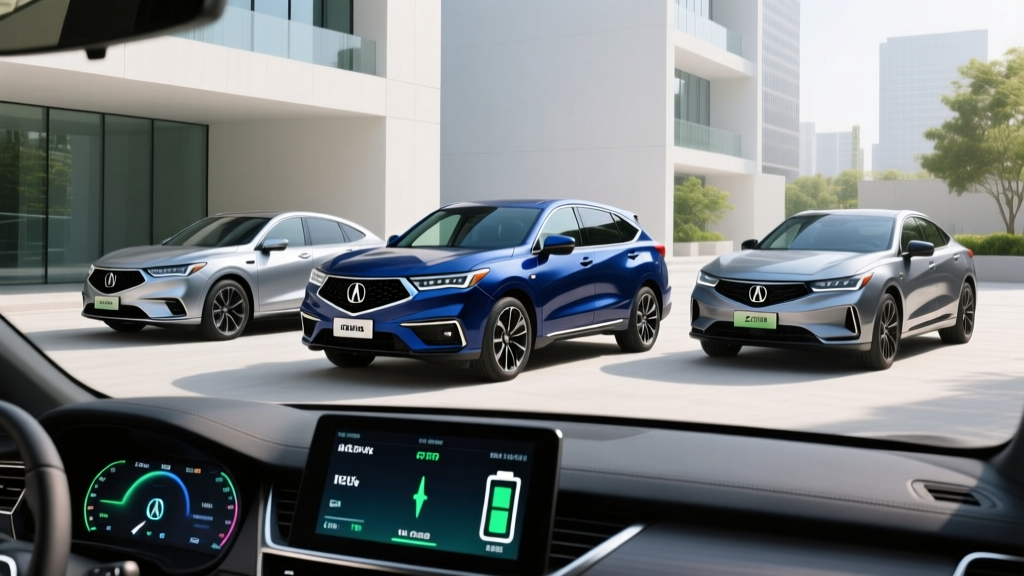
Acura's electrification strategy has accelerated into the 2026 model year, but the brand's approach differs sharply from competitors flooding the market with full battery-electric vehicles. Instead, Acura is leaning into hybrid and plug-in hybrid powertrains across its core lineup — the MDX three-row SUV, the Integra sport compact, and the ZDX crossover (now offered with a PHEV variant). For buyers searching for an Acura hybrid, the choices now span three distinct philosophies: a conventional hybrid for effortless efficiency, a performance-oriented mild hybrid, and a plug-in hybrid bridging the gap to full electrification.
This guide breaks down every 2026 Acura hybrid and PHEV with exact EPA figures, real-world expectations, battery chemistry, warranty terms, and federal tax credit eligibility under current IRS §30D rules.
2026 Acura Hybrid Lineup at a Glance
| Model | Type | Powertrain | Combined HP | EPA Combined | Electric Range | Base MSRP |
|---|---|---|---|---|---|---|
| 2026 Acura MDX Hybrid | HEV (conventional) | 3.5L V6 + dual-motor | 367 hp | 28 MPG | N/A | $58,950 |
| 2026 Acura Integra Hybrid | HEV (conventional) | 2.0L I4 + single-motor | 204 hp | 40 MPG | N/A | $36,200 |
| 2026 Acura ZDX PHEV | PHEV (plug-in) | 2.0L turbo I4 + dual-motor | 355 hp | 29 MPG + 89 MPGe | 42 miles | $59,500 |
HEV vs PHEV: Which Acura Hybrid Architecture Fits You?
Before diving into individual models, the distinction between Acura's hybrid types matters for your daily driving and ownership costs:
Conventional Hybrid (HEV): The MDX Hybrid and Integra Hybrid use a gasoline engine paired with electric motor(s) and a small battery (typically 1.0–1.8 kWh). The battery recharges through regenerative braking and engine power — you never plug it in. Fuel economy improves 20–40% over a gas-only equivalent, especially in stop-and-go city driving where the electric motor handles low-speed propulsion.
Plug-In Hybrid (PHEV): The ZDX PHEV carries a larger battery pack (17.8 kWh usable) that you charge via a Level 1 or Level 2 plug. It delivers a meaningful electric-only range for daily commuting, then operates as a conventional hybrid once the battery depletes. If your commute falls within the electric range and you charge nightly, you may burn very little gasoline on weekdays.
2026 Acura MDX Hybrid: Three-Row Efficiency Without Compromise
The MDX Hybrid pairs Acura's 3.5-liter V6 with a twin-motor system driving the rear axle, producing a combined 367 horsepower and 354 lb-ft of torque. This is Acura's most powerful MDX variant and its most fuel-efficient three-row SUV simultaneously.
EPA Fuel Economy
| Cycle | EPA Estimate | Real-World Expectation |
|---|---|---|
| City | 28 MPG | 29–32 MPG (hybrids excel here) |
| Highway | 27 MPG | 24–26 MPG (sustained 75+ mph) |
| Combined | 28 MPG | 26–29 MPG mixed driving |
Real-world testing consistently shows Acura hybrids outperforming EPA city estimates — the electric motor handles frequent stops and low-speed acceleration, where gasoline engines are least efficient. Highway numbers tend to dip slightly below EPA stickers at sustained speeds above 70 mph, where aerodynamic drag dominates and the engine carries most of the load.
The MDX Hybrid's 1.5 kWh lithium-ion battery pack is small by design. It's not meant to drive the vehicle on electric power alone for meaningful distances — instead, it smooths torque delivery, enables engine-off coasting, and captures regenerative energy. Expect the engine to shut off at stoplights and during gentle deceleration, but don't expect EV-mode cruising beyond a mile or two at very low speeds.
Pricing and Tax Credit Eligibility
The 2026 MDX Hybrid starts at $58,950 (including destination) in the Technology trim, rising to approximately $65,500 for the Advance package. As a conventional hybrid (HEV), the MDX Hybrid does not qualify for the federal §30D clean vehicle tax credit, which is reserved for plug-in electric vehicles with battery capacity ≥7 kWh. Some states offer modest hybrid incentives — check your state energy office for current programs.
2026 Acura Integra Hybrid: The Enthusiast's Efficiency Play
New for the 2026 model year, the Integra Hybrid slots between the standard 200-hp Integra and the 320-hp Integra Type S. It borrows Honda's proven two-motor hybrid system — the same architecture earning acclaim in the Civic Hybrid — tuned for Acura's sportier character.
Powertrain and Performance
The Integra Hybrid combines a 2.0-liter Atkinson-cycle four-cylinder with a drive motor and a generator motor, producing a combined 204 horsepower and 232 lb-ft of torque. The 0–60 mph sprint drops to approximately 6.8 seconds, roughly a full second quicker than the base Integra, thanks to the electric motor's instant torque fill at low RPM.
Fuel Economy
| Cycle | EPA Estimate | Real-World Expectation |
|---|---|---|
| City | 43 MPG | 44–50 MPG (city is the hybrid's sweet spot) |
| Highway | 38 MPG | 35–38 MPG at 65–75 mph |
| Combined | 40 MPG | 38–44 MPG mixed |
Source: fueleconomy.gov — EPA estimates for the 2026 Acura Integra Hybrid.
The Integra Hybrid's city MPG advantage is substantial. In urban driving, the electric motor handles most acceleration from stops, the engine runs only at its most efficient RPM range to generate electricity, and regenerative braking recaptures energy that a gas-only car would waste as heat at the brake pads. Owners with predominantly city commutes routinely report exceeding the EPA city figure.
The hybrid battery is a 1.1 kWh lithium-ion pack mounted under the rear seats, preserving the Integra's 24.3 cu-ft cargo volume. No plug-in charging is needed or possible — the system manages its own state of charge automatically.
Pricing
The 2026 Integra Hybrid is offered in a single well-equipped trim at $36,200 (including destination). This positions it roughly $3,000 above the base Integra A-Spec and about $10,000 below the Type S. As a conventional hybrid, it does not qualify for the federal §30D tax credit.
2026 Acura ZDX PHEV: Plug-In Range Meets Premium Crossover
The ZDX PHEV represents Acura's most significant electrified offering for 2026. Built on a platform shared with Honda's global architecture, it pairs a turbocharged 2.0-liter four-cylinder engine with front and rear electric motors for a combined 355 horsepower and standard all-wheel drive.
Electric-Only Range and Battery
EPA Electric-Only Range: 42 miles
Real-World Expectation: 35–40 miles in moderate weather; 28–33 miles in cold conditions (below 32°F) or at sustained highway speeds above 70 mph.
The ZDX PHEV's 17.8 kWh usable battery (NMC chemistry) provides enough electric range to cover most daily commutes without engaging the gasoline engine. Once the battery depletes, the vehicle seamlessly transitions to hybrid mode with an EPA combined rating of 29 MPG.
Charging Specifications
| Charging Level | Power | 0–100% Time | Connector |
|---|---|---|---|
| Level 1 (120V outlet) | 1.4 kW | ~13 hours | J1772 |
| Level 2 (240V, 32A) | 7.7 kW | ~2.5 hours | J1772 |
| DC Fast Charge | Not supported | N/A | N/A |
The ZDX PHEV does not support DC fast charging — a limitation common to most PHEVs in this class. The onboard charger caps at 7.7 kW, meaning a full charge on a Level 2 home charger takes roughly 2.5 hours. For daily use, most owners plug in overnight on a standard 120V outlet (Level 1) and wake to a full battery, since the 17.8 kWh pack is small enough to replenish at 1.4 kW in about 13 hours. If your daily electric driving stays under 30 miles, Level 1 charging is perfectly adequate.
Installing a dedicated 240V Level 2 circuit at home typically costs $800–$2,000 including equipment and electrician labor, depending on panel proximity and local permit fees. A licensed electrician should evaluate your panel capacity before installation.
Fuel Economy (Hybrid Mode)
| Mode | EPA Estimate |
|---|---|
| Electric-only (MPGe) | 89 MPGe |
| Hybrid mode — City | 30 MPG |
| Hybrid mode — Highway | 28 MPG |
| Hybrid mode — Combined | 29 MPG |
| Total range (electric + gas) | ~440 miles |
Federal Tax Credit Eligibility
As a plug-in hybrid with a battery ≥7 kWh, the 2026 ZDX PHEV may qualify for a partial or full federal tax credit under IRS §30D. However, eligibility depends on several factors that change frequently:
- MSRP cap: SUVs/crossovers must have an MSRP ≤$80,000. The ZDX PHEV ($59,500–$67,000) clears this threshold.
- Buyer income cap: Modified AGI must not exceed $150,000 (single), $225,000 (head of household), or $300,000 (joint filers).
- Battery sourcing: Critical minerals and battery components must meet escalating domestic-content percentages. Acura's supply chain compliance varies by build date — confirm with your dealer at purchase.
- Credit amount: Up to $3,750 for meeting critical-mineral requirements, up to $3,750 for battery-component requirements, totaling a maximum $7,500. The ZDX PHEV's partial credit amount depends on current sourcing compliance.
- Point-of-sale transfer: Eligible buyers can apply the credit as an immediate price reduction at the dealership rather than waiting for tax filing.
Source: IRS §30D Clean Vehicle Credit — verify current-year rules before purchase.
Battery Warranty: Acura covers the ZDX PHEV's high-voltage battery for 8 years / 100,000 miles (whichever comes first) against defects and capacity loss below 70% of original capacity. In California Air Resources Board (CARB) states, coverage extends to 10 years / 150,000 miles.
Battery Longevity, Reliability, and Replacement Costs
Hybrid battery reliability is the top concern for buyers switching from conventional gas vehicles. Here's what the data shows for Acura's systems:
Conventional Hybrids (MDX Hybrid, Integra Hybrid)
Acura's HEV battery packs are small (1.1–1.5 kWh), lightly stressed, and managed by conservative thermal controls. Honda/Acura hybrid batteries have demonstrated strong longevity in real-world fleets, with most units lasting well beyond 150,000 miles without significant degradation. The nickel-metal-hydride and lithium-ion packs in Acura's HEVs rarely require replacement within the vehicle's useful life.
Warranty: 8 years / 100,000 miles (10 years / 150,000 miles in CARB states) against defects and abnormal capacity loss.
Replacement cost (out of warranty): $2,000–$4,000 for HEV battery packs, based on current Honda/Acura parts pricing. Given the pack size and conservative use, most owners will never face this expense.
ZDX PHEV Battery
The ZDX PHEV's 17.8 kWh NMC battery operates under higher stress — deeper charge/discharge cycles and DC charging heat (if future models add DC support). NMC chemistry offers strong energy density but degrades slightly faster than LFP under high-heat, high-cycle conditions. Acura's thermal management system and software buffers (the vehicle never uses 100% of the pack's physical capacity) mitigate this.
Replacement cost (out of warranty): $8,000–$12,000 for the PHEV battery pack, based on comparable Honda/Acura PHEV service estimates. This is a significant expense, but the 8–10 year warranty covers the period when most degradation would occur.
Source: Acura.com — official warranty and specifications.
Real-World MPG vs EPA: What Acura Hybrid Owners Actually See
Hybrid fuel economy is uniquely sensitive to driving patterns. Unlike gas-only cars, hybrids gain efficiency in city driving and lose it on the highway. Here's what to expect:
City-dominant drivers (70%+ urban): Expect to meet or exceed EPA city estimates. The MDX Hybrid routinely delivers 29–32 MPG in stop-and-go traffic. The Integra Hybrid's 43 MPG city rating is conservative — many owners report 45–50 MPG on urban commutes with moderate acceleration.
Highway-dominant drivers (70%+ highway): Expect to fall 2–4 MPG below EPA highway estimates at sustained 75+ mph speeds. The MDX Hybrid drops to 24–26 MPG on long interstate trips. The hybrid system provides minimal benefit at constant high speed — aerodynamic drag and vehicle weight dominate.
Cold weather impact: In temperatures below 32°F, expect a 5–10% MPG reduction for HEVs (the engine runs more frequently to provide cabin heat and maintain battery temperature). For the ZDX PHEV, cold weather can reduce electric-only range by 20–30% due to battery resistance and cabin heating demands.
ZDX PHEV real-world electricity cost: At a national average of $0.16/kWh, fully charging the ZDX PHEV's 17.8 kWh battery costs approximately $2.85, yielding a cost-per-mile of roughly $0.07 in electric mode — about half the cost of gasoline at $3.50/gallon and 29 MPG.
Acura Hybrid vs Full EV vs Gas: Which Should You Choose?
Choose an Acura HEV (MDX Hybrid, Integra Hybrid) if:
- You cannot charge at home (apartment, street parking, no garage)
- You want better fuel economy with zero behavioral change
- You drive a mix of city and highway and value three-row capacity (MDX)
- You want lower upfront cost vs a PHEV or full EV
- You plan to keep the vehicle 8+ years and value proven hybrid reliability
Choose the ZDX PHEV if:
- You can charge at home (Level 1 or Level 2)
- Your daily commute is under 40 miles round-trip
- You take occasional road trips and don't want to rely on public DC charging
- You want to reduce gasoline consumption without range anxiety
- You may qualify for the federal tax credit, narrowing the price gap
Choose a full EV (e.g., Acura ZDX EV) if:
- You can install a Level 2 home charger
- Your daily driving stays under 250 miles
- You have access to reliable DC fast charging for road trips
- You want zero tailpipe emissions and minimal maintenance
- You qualify for the full $7,500 federal tax credit
Pros and Cons: 2026 Acura Hybrid Lineup
Pros
- MDX Hybrid delivers class-leading efficiency for a luxury three-row SUV
- Integra Hybrid achieves 40+ MPG combined in a premium sport compact
- ZDX PHEV offers 42 miles of electric range — enough for most commutes
- No range anxiety on any model; gas engine provides unlimited range
- Strong battery warranties (8–10 years) across the lineup
- Acura's hybrid systems carry Honda's proven reliability record
- ZDX PHEV may qualify for partial or full federal tax credit
Cons
- MDX Hybrid and Integra Hybrid do not qualify for federal §30D tax credit
- ZDX PHEV lacks DC fast charging — road-trip charging relies on Level 2 only
- Highway MPG falls below EPA estimates at sustained high speeds
- PHEV battery replacement cost ($8K–$12K) is significant out of warranty
- ZDX PHEV pricing starts near $60K before incentives
- Integra Hybrid is single-trim only — limited option flexibility
Frequently Asked Questions
How many MPG does the 2026 Acura MDX Hybrid get?
The 2026 MDX Hybrid is EPA-rated at 28 MPG city, 27 MPG highway, and 28 MPG combined. In real-world city driving, owners typically see 29–32 MPG. Highway driving at sustained 75+ mph drops to 24–26 MPG.
How far can the Acura ZDX PHEV go on electric only?
The EPA rates the ZDX PHEV at 42 miles of electric-only range. Real-world results vary: expect 35–40 miles in mild weather with moderate driving, and 28–33 miles in cold weather or at highway speeds.
Does any Acura hybrid qualify for a federal tax credit?
Only the ZDX PHEV may qualify for the federal §30D clean vehicle credit (up to $7,500), subject to MSRP caps, buyer income limits, and battery-sourcing requirements. The MDX Hybrid and Integra Hybrid, as conventional hybrids, do not qualify for federal credits.
Is the Acura hybrid battery reliable and expensive to replace?
Acura hybrid batteries carry an 8-year/100,000-mile warranty (10 years/150,000 miles in CARB states). HEV battery replacement costs $2,000–$4,000 out of warranty; the ZDX PHEV battery costs $8,000–$12,000. Most hybrid batteries outlast the vehicle's useful life under normal use.
Do Acura hybrids need to be plugged in?
No. The MDX Hybrid and Integra Hybrid are conventional hybrids (HEVs) that recharge their batteries through regenerative braking and engine power. Only the ZDX PHEV requires plug-in charging to access its electric-only range.
How long does it take to charge the ZDX PHEV?
On a standard 120V outlet (Level 1), a full charge takes approximately 13 hours. On a 240V Level 2 charger at 7.7 kW, it takes about 2.5 hours. The ZDX PHEV does not support DC fast charging.