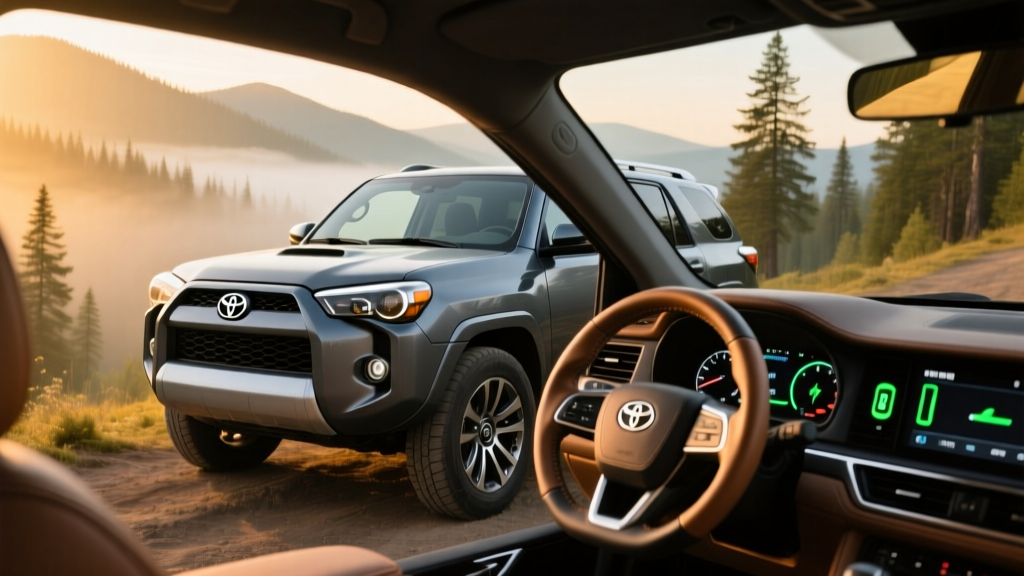
Toyota finally brought the 4Runner into the modern era with its sixth-generation redesign, and the i-FORCE MAX hybrid powertrain is the headline act. For 2026, the 4Runner Hybrid carries over as a conventional hybrid (HEV)—not a plug-in—meaning it charges its own battery through regenerative braking and the gasoline engine. No plug, no range anxiety, just noticeably better fuel economy than the non-hybrid 4Runner while retaining the rugged body-on-frame DNA buyers expect.
After analyzing EPA data, owner fuel logs, and Toyota's powertrain specs, here's everything you need to know about the 2026 Toyota 4Runner Hybrid before you visit a dealer.
2026 4Runner Hybrid Powertrain and Performance Specs
The i-FORCE MAX system pairs a 2.4-liter turbocharged four-cylinder engine with an electric motor-generator integrated into the 8-speed automatic transmission. The result is substantially more torque than the base turbo-four and a meaningful bump in combined output.
| Specification | Value |
|---|---|
| Engine | 2.4L turbocharged inline-4 |
| Electric Motor | Integrated motor-generator (48 hp / 184 lb-ft) |
| Combined System Output | 326 hp / 465 lb-ft torque |
| Transmission | 8-speed automatic |
| Drivetrain | RWD (SR5) or 4WD (TRD Off-Road, TRD Pro, etc.) |
| Towing Capacity | 6,000 lbs (4WD models) |
| 0–60 mph (est.) | ~7.0 seconds (4WD) |
| Battery Type | Nickel-metal hydride (NiMH), ~1.8 kWh |
| Plug-In Required? | No — self-charging HEV |
That 465 lb-ft of torque arrives low in the rev range thanks to the electric motor assist, which makes a tangible difference in low-speed trail crawling and highway passing alike. The i-FORCE MAX is available across multiple trims, from the well-equipped TRD Off-Road Hybrid up to the range-topping TRD Pro Hybrid.
Fuel Economy: EPA Ratings vs. Real-World MPG
The headline number for the 2026 4Runner Hybrid is a significant improvement over the outgoing V6 and the current non-hybrid turbo-four. According to fueleconomy.gov, the EPA rates the 4Runner i-FORCE MAX 4WD at approximately 23 city / 27 highway / 25 combined MPG. Two-wheel-drive variants edge slightly higher.
| Drivetrain | City MPG | Highway MPG | Combined MPG |
|---|---|---|---|
| RWD (SR5 i-FORCE MAX) | 24 | 28 | 26 |
| 4WD (TRD Off-Road Hybrid) | 23 | 27 | 25 |
| 4WD (TRD Pro Hybrid) | 22 | 25 | 23 |
Compared to the non-hybrid 2.4L turbo 4Runner (rated around 20 city / 26 highway / 22 combined for 4WD), the i-FORCE MAX hybrid delivers roughly a 3 MPG combined improvement—and a massive 138 lb-ft torque increase. That's the real value proposition: you're not just saving at the pump, you're getting a more capable powertrain.
HEV vs. PHEV vs. Full EV: Which Powertrain Fits Your Life?
The 2026 4Runner is offered as a conventional hybrid (HEV) only. Toyota does not currently offer a plug-in hybrid (PHEV) or battery-electric (BEV) 4Runner. Here's how the three electrified powertrain types compare for a midsize SUV buyer:
| Factor | HEV (4Runner Hybrid) | PHEV (e.g., RAV4 Prime) | BEV (e.g., EV9) |
|---|---|---|---|
| Plug-In Required? | No | Yes (for EV range) | Yes |
| Electric-Only Range | None (motor assists only) | 25–42 miles typical | 230–380 miles typical |
| Home Charging Needed? | No | Recommended (Level 2) | Essential (Level 2) |
| Federal Tax Credit (§30D) | Not eligible | Up to $7,500 (if eligible) | Up to $7,500 (if eligible) |
| Fuel Cost (per mile, avg.) | ~$0.14 | ~$0.06 (EV mode) / ~$0.14 (gas) | ~$0.04–$0.08 |
| Trail / Off-Road Capability | Excellent (4WD, locking diff) | Limited options | Growing but limited |
Choose the 4Runner Hybrid (HEV) if: You want better fuel economy without changing your habits—no plug, no charging app, no route planning. You tow, go off-road, or live in an area with sparse charging infrastructure.
Choose a PHEV SUV if: You have home charging and a short commute (under 35 miles) but still want a gas engine for road trips. You want to qualify for the §30D federal tax credit.
Choose a full BEV if: You have reliable home Level 2 charging, want the lowest per-mile fuel cost, and don't need body-on-frame towing or hardcore off-road capability.
Pricing, Trims, and Tax Credit Eligibility
The i-FORCE MAX hybrid powertrain is not a standalone option—it's bundled into specific trims. Based on Toyota's 2026 pricing, here's where the hybrid sits in the 4Runner lineup:
| Trim (i-FORCE MAX Hybrid) | Starting MSRP |
|---|---|
| TRD Off-Road Hybrid 4WD | ~$53,590 |
| Limited Hybrid 4WD | ~$58,575 |
| TRD Pro Hybrid 4WD | ~$67,990 |
Federal tax credit status: The 2026 4Runner Hybrid is a conventional HEV. Under IRS §30D rules, only plug-in electric vehicles (PHEVs and BEVs) with sufficient battery capacity qualify for the new clean vehicle credit. The 4Runner Hybrid does not qualify for the $7,500 federal tax credit, nor does it qualify for the $4,000 used-EV credit.
Some states offer hybrid-specific rebates or HOV lane access, but these vary by jurisdiction. Check your state's energy office or DMV for current programs. The fuel savings alone—roughly $350–$500 per year over the non-hybrid at 15,000 miles driven—partially offset the hybrid trim premium over a base SR5.
Battery Warranty, Reliability, and Replacement Cost
Hybrid battery longevity is the single most common concern among first-time hybrid buyers, and Toyota has the longest track record in the industry to address it.
Toyota's NiMH hybrid batteries have demonstrated exceptional longevity across the Prius, Camry Hybrid, and Highlander Hybrid lineages. Data from fleet operators and long-term owners shows most Toyota hybrid batteries retain sufficient capacity well past 150,000 miles. The i-FORCE MAX uses a relatively small ~1.8 kWh NiMH pack that cycles shallowly—it's never fully depleted or fully charged—which dramatically reduces degradation stress.
Out-of-warranty replacement cost: If the hybrid battery does eventually need replacement beyond the warranty period, expect a dealer-installed replacement to cost between $3,000 and $4,500 for the battery module. Independent hybrid specialists and refurbished battery options can reduce this to $1,500–$2,500. Given the 10-year/150,000-mile warranty, most original owners will never face this cost.
For overall reliability, Toyota's body-on-frame trucks (Tacoma, 4Runner, Land Cruiser) consistently earn above-average ratings. The i-FORCE MAX powertrain is shared with the Tacoma and Grand Highlander Hybrid, both of which have shown strong early reliability since their 2024 introductions. Check IIHS and NHTSA for the latest crash-test ratings as they're released.
Daily Driving, Towing, and Off-Road Capability
The electric motor in the i-FORCE MAX doesn't just improve MPG—it fundamentally changes how the 4Runner drives at low speeds. The 465 lb-ft of combined torque arrives almost instantly, which translates to confident merging, relaxed highway cruising, and precise throttle control on technical trails.
Towing: The 4Runner Hybrid 4WD maintains a 6,000-pound maximum tow rating. The hybrid system doesn't reduce towing capacity, and the extra low-end torque makes trailer launches and uphill grades less strained than the non-hybrid turbo-four.
Off-road: TRD Off-Road Hybrid and TRD Pro Hybrid trims retain the full suite of off-road hardware: locking rear differential, Multi-Terrain Select, Crawl Control, and up to 10.1 inches of ground clearance (TRD Pro). The hybrid system actually enhances low-speed crawling because the electric motor delivers smooth, controllable torque without the turbo lag of the gas-only engine.
Cargo and interior: The hybrid battery pack is mounted under the rear seat, so cargo volume is unchanged from the non-hybrid 4Runner. Expect approximately 41 cubic feet behind the second row and up to 90 cubic feet with the rear seats folded (varies slightly by trim and whether a third-row option is equipped).
Pros and Cons of the 2026 4Runner Hybrid
- 326 hp / 465 lb-ft — most powerful 4Runner ever
- 3–5 MPG improvement over non-hybrid turbo-four
- No plug-in required — zero lifestyle change
- 10-year / 150,000-mile hybrid battery warranty
- 6,000-lb tow rating maintained
- Electric motor enhances low-speed trail crawling
- Proven Toyota hybrid reliability track record
- No federal tax credit (HEV, not PHEV/BEV)
- Hybrid trims start above $53,000
- MPG still trails unibody crossovers by a wide margin
- No PHEV option for electric-only commuting
- TRD Pro Hybrid pushes $68,000 MSRP
- Real-world highway MPG drops at sustained 75+ mph
- Dealer markups common on TRD trims
Frequently Asked Questions
How many MPG does the 2026 4Runner Hybrid get?
The EPA rates the 4Runner i-FORCE MAX 4WD at 23 city / 27 highway / 25 combined MPG. In real-world mixed driving, owners typically see 22–24 MPG combined. City driving often matches or beats the EPA estimate thanks to regenerative braking, while sustained highway speeds above 75 mph can drop fuel economy to 21–22 MPG.
Does the 2026 4Runner Hybrid need to be plugged in?
No. The 4Runner i-FORCE MAX is a conventional hybrid (HEV). The battery recharges through regenerative braking and the gasoline engine. There is no plug, no charging cable, and no electric-only driving range. If you want plug-in capability, you'd need to look at a PHEV like the Toyota RAV4 Prime.
Is the 4Runner Hybrid reliable, and what does battery replacement cost?
Toyota's hybrid systems have a two-decade reliability track record, and the hybrid battery is covered by a 10-year / 150,000-mile warranty. Out-of-warranty replacement costs run $3,000–$4,500 at a dealer or $1,500–$2,500 through independent hybrid shops. Most owners will never need a replacement.
Does the 2026 4Runner Hybrid qualify for any tax credit?
No. Under current IRS §30D rules, only plug-in vehicles (PHEVs and BEVs) qualify for the federal new clean vehicle credit. The 4Runner Hybrid is a conventional HEV and is not eligible. Some states may offer minor hybrid incentives—check your state's energy office.
Hybrid vs. PHEV vs. EV — which should I choose instead of the 4Runner Hybrid?
If you need body-on-frame durability, 6,000-lb towing, and serious off-road capability without plugging in, the 4Runner Hybrid is the right choice. If you have home charging and a short commute, a PHEV like the RAV4 Prime (42 miles electric-only, eligible for $7,500 credit) will save more on fuel. If you don't tow or off-road, a full BEV delivers the lowest operating cost—but no current BEV matches the 4Runner's off-road chops.
What's the difference between the i-FORCE MAX and the base 4Runner engine?
The base 2026 4Runner uses a 2.4L turbo four-cylinder making 278 hp and 317 lb-ft. The i-FORCE MAX Hybrid adds an electric motor-generator for a combined 326 hp and 465 lb-ft—a 148 lb-ft torque advantage. You also gain 2–3 MPG combined and smoother low-speed performance.