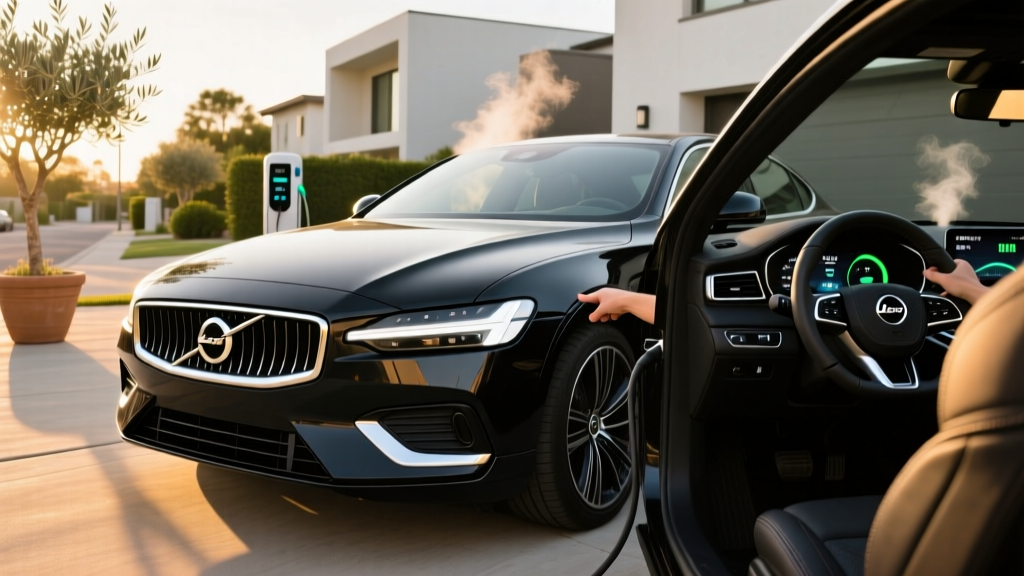
The station wagon refuses to die — at least in Volvo's showroom. The 2025 Volvo V60 Recharge plug-in hybrid pairs Scandinavian utility with a 455-horsepower twin-charged powertrain and a usable electric-only range that makes most daily commutes zero-emission affairs. For buyers who want wagon practicality without committing to a full battery-electric vehicle, the V60 Recharge occupies a compelling middle ground. But at a starting MSRP near $72,000, the math has to work. Here's the data you need to decide.
2025 Volvo V60 Recharge: Core Specifications at a Glance
| Specification | 2025 Volvo V60 Recharge (PHEV) |
|---|---|
| Powertrain | 2.0L turbocharged + supercharged I-4 + rear electric motor (eAWD) |
| Combined Horsepower | 455 hp |
| Combined Torque | 523 lb-ft |
| Battery (Usable) | 14.9 kWh (18.8 kWh gross), lithium-ion NMC |
| EPA Electric-Only Range | 35 miles |
| EPA Combined MPGe | 74 MPGe (electric + gas) |
| EPA MPG (Gas Only) | 30 combined (31 city / 30 highway) |
| Total Combined Range | ~410 miles (est. based on 12.6-gal tank) |
| 0–60 mph | 4.3 seconds |
| Charging (Level 2, 240V) | ~5 hours (3.7 kW onboard charger) |
| DC Fast Charging | Not available |
| Battery Warranty | 8 years / 100,000 miles |
| Base MSRP (Plus) | $71,650 |
| Federal Tax Credit (§30D) | Not eligible (MSRP cap & sourcing) |
Understanding the Powertrain: HEV vs PHEV and Where the V60 Fits
Before evaluating the V60 Recharge, it's worth distinguishing the two hybrid architectures on the market. A conventional hybrid (HEV), like the Toyota Prius, uses a small battery that charges exclusively through regenerative braking and the engine. You never plug it in. A plug-in hybrid (PHEV), like the V60 Recharge, carries a substantially larger battery that you charge from a wall outlet or Level 2 station, enabling a meaningful electric-only driving range before the gasoline engine engages.
| Feature | Conventional Hybrid (HEV) | Plug-In Hybrid (PHEV) — V60 Recharge |
|---|---|---|
| Plug-in charging required? | No | Yes (for EV range benefit) |
| Battery size | 0.5–1.5 kWh | 14.9 kWh usable |
| Electric-only range | 0–1 mile at low speed | 35 miles (EPA) |
| Typical combined MPG | 45–57 MPG | 30 MPG (after battery depleted) |
| Best for | No home charging access | Home charging + short commutes |
The V60 Recharge is firmly a PHEV. Its 14.9 kWh usable battery powers a 107-kW (143-hp) rear electric motor for purely electric driving up to highway speeds. Once the battery is depleted, the 2.0-liter twin-charged four-cylinder takes over, driving all four wheels through an eight-speed automatic. The key advantage: if your commute is under 35 miles round-trip and you charge at home, you may go months without visiting a gas station.
Electric-Only Range: 35 EPA Miles in the Real World
EPA Electric-Only Range: 35 miles
Real-world expectation: Expect 28–33 miles in mixed driving with climate control active. In cold weather (below 40°F), plan for 22–27 miles — the cabin heater and battery thermal management draw from the same pack. Highway-only driving at 70+ mph will also reduce EV range to roughly 25–28 miles due to aerodynamic drag.
Volvo's 35-mile EPA estimate is competitive among luxury PHEV wagons, though it trails the Jeep Wrangler 4xe (22 mi) in raw utility while beating most sedan-based PHEVs. The practical implication: if your daily round-trip commute falls within 25–30 miles, the V60 Recharge operates as a de facto EV on weekdays, with the gas engine reserved for weekend road trips.
Charging the 14.9 kWh usable pack is straightforward but slow by modern standards. The V60 Recharge uses a 3.7 kW onboard charger — meaning a standard 240V Level 2 home station replenishes the battery in approximately five hours. There is no DC fast-charging capability. This is typical for PHEVs, whose smaller batteries make overnight Level 2 charging sufficient for most owners. A standard 120V household outlet (Level 1) will take roughly 10–12 hours, which still works for overnight top-ups.
Fuel Economy: EPA Numbers and Real-World MPG
| Driving Mode | City | Highway | Combined |
|---|---|---|---|
| Charge-depleting (gas only) | 31 MPG | 30 MPG | 30 MPG |
| Charge-sustaining (hybrid mode) | ~33 MPG | ~28 MPG | ~30 MPG |
| Combined MPGe (EV + gas) | 74 MPGe | ||
Per fueleconomy.gov, the 2025 V60 Recharge returns 30 MPG combined once the battery is depleted. This is the figure that matters on long road trips when you're running purely on gasoline. For context, a comparable non-hybrid luxury wagon — say, the Audi A4 allroad — returns roughly 27 MPG combined, so the V60 Recharge still delivers a modest efficiency advantage even without plugging in.
Real-world MPG vs. EPA: PHEVs reward city driving and frequent charging. Owners who plug in nightly and drive under 35 miles daily report effective fuel consumption of 80–100+ MPGe over months of commuting, with the engine running only occasionally for highway trips. Conversely, if you never plug in and drive 500-mile weeks, you'll see 28–31 MPG — the V60 Recharge is a heavy wagon (4,700+ lbs), and physics limits what the hybrid system can do without electric assist.
Performance: 455 Horsepower in a Wagon
The V60 Recharge's T8 eAWD powertrain is one of the most potent four-cylinder setups in production. The gasoline engine alone produces 312 hp and 295 lb-ft of torque (thanks to both a turbocharger and a supercharger), while the rear electric motor adds 143 hp and 228 lb-ft. Combined output: 455 hp and 523 lb-ft, routed through an eight-speed automatic to all four wheels.
The result is a 4.3-second 0–60 mph sprint — quicker than a Porsche Macan base model and remarkably brisk for a five-seat wagon. The electric motor's instant torque delivery makes the V60 Recharge feel even quicker in around-town driving, where the supercharger and turbo haven't yet spooled. Volvo's eAWD system operates the rear axle exclusively via the electric motor in EV mode, providing all-wheel-drive traction without a mechanical driveshaft.
Pricing, Trims, and Tax Credit Eligibility
The 2025 Volvo V60 Recharge is offered in two trims:
- Plus ($71,650 MSRP): Includes 19-inch wheels, leather upholstery, 12.3-inch digital cluster, 11.2-inch infotainment touchscreen with Google built-in, 360-degree camera, and Volvo's full Pilot Assist suite.
- Ultimate ($76,350 MSRP): Adds 20-inch wheels, Nappa leather, head-up display, Harman Kardon premium audio, and Pilot Assist with enhanced highway steering support.
Destination charges add approximately $1,195. Options are limited — Volvo structures the V60 Recharge as heavily equipped from the factory, with metallic paint ($695) and a few accessories as the primary add-ons.
Federal Tax Credit: §30D Eligibility
The 2025 Volvo V60 Recharge does NOT qualify for the $7,500 federal §30D new clean vehicle credit.
Two factors disqualify it: (1) The MSRP exceeds the $55,000 cap for sedans/wagons under current IRS rules, and (2) battery component and critical-mineral sourcing requirements under IRS §30D are not met for Volvo's supply chain. Always verify eligibility at the point of sale and consult a tax professional — rules are subject to legislative change.
Some states offer their own PHEV incentives that are not subject to the federal MSRP cap. California's CVRP program, Colorado's state credit, and various utility rebates may partially offset the purchase price. Check your state's energy office or dealer for current local incentives.
Battery Longevity, Warranty, and Replacement Cost
V60 Recharge Battery Warranty: 8 years or 100,000 miles (whichever comes first), covering defects and capacity loss below 70% of original capacity.
Estimated out-of-warranty replacement cost: $8,000–$14,000 for the high-voltage battery pack, based on current Volvo PHEV parts pricing and independent shop labor rates.
Volvo's hybrid battery warranty matches the industry standard for PHEVs. The 70% capacity-retention threshold means Volvo will replace or repair the pack if usable capacity drops below approximately 10.4 kWh within the warranty period. In practice, Volvo's NMC lithium-ion packs in the 60-series Recharge lineup have shown modest degradation — most owners report 90–95% capacity retention after three to four years of regular Level 2 charging, based on owner-community telemetry.
To maximize battery lifespan:
- Avoid routinely charging to 100% and leaving the car parked for days — set a charge limit to 80–90% for daily use if your schedule allows.
- Use the preconditioning feature (via the Volvo Cars app) to warm or cool the cabin while plugged in, reducing the battery's thermal load.
- Minimize repeated full-throttle launches in Pure EV mode, which generate significant heat in the pack.
The V60 Recharge's smaller 14.9 kWh pack is far less expensive to replace than a full BEV battery. For context, a Tesla Model Y battery replacement runs $12,000–$16,000, and the V60's pack is roughly one-fifth the capacity. Out-of-warranty failure risk is the primary long-term cost variable — but with an 8-year warranty and NMC chemistry that has proven durable in Volvo's SPA-platform vehicles, the risk profile is moderate.
Reliability and Safety
Volvo's reputation for safety is well-earned: the V60 carries top marks from the IIHS, including a Top Safety Pick+ rating when equipped with specific headlights. Standard safety features include automatic emergency braking with pedestrian/cyclist/large-animal detection, run-off-road protection, lane-keeping assist, and blind-spot monitoring with steering support.
Reliability is the more nuanced story. Volvo's SPA-platform vehicles (which include the V60) have received mixed reliability scores from Consumer Reports and J.D. Power, with common complaints centering on infotainment software glitches (the Google-based system has improved with OTA updates but still draws criticism for occasional lag), climate-control quirks, and minor electrical gremlins. The powertrain itself — the T8 hybrid system — has proven mechanically robust since its 2016 introduction, with no widespread reports of battery or motor failures.
Volvo's standard warranty covers 4 years / 50,000 miles bumper-to-bumper, with the hybrid battery and electric motor covered for 8 years / 100,000 miles. Complimentary scheduled maintenance covers 3 years / 36,000 miles.
Who Should Choose the V60 Recharge — and Who Shouldn't
Pros
- 35-mile EV range covers most commutes emission-free
- 455 hp makes it one of the quickest wagons available
- Wagon cargo versatility (25.5 cu ft behind rear seats, 50.9 cu ft folded)
- Standard eAWD for all-weather traction
- Top safety ratings and comprehensive ADAS suite
- 30 MPG on gas alone is respectable for a 4,700-lb luxury wagon
Cons
- $71,650 starting price with no federal tax credit
- No DC fast charging — Level 2 only
- 3.7 kW onboard charger is slow (5-hour Level 2 fill)
- Infotainment software can lag; no physical volume knob
- Real-world EV range drops significantly in cold weather
- Insurance premiums run 15–25% above non-hybrid V60
Choose the V60 Recharge if: You have home Level 2 charging, your commute is under 35 miles, you want wagon cargo space with all-wheel drive, and you're not ready to commit to a full EV due to road-trip habits or charging-infrastructure gaps in your area.
Choose a full BEV (like the Volvo EX90 or BMW i5) if: You want zero gasoline dependency, have reliable home and workplace charging, and your road trips fall within DC fast-charging corridor coverage.
Choose a conventional HEV (like the Toyota Prius or Camry Hybrid) if: You cannot charge at home, want maximum MPG without plug-in behavior changes, and are budget-conscious (HEVs start $25,000–$35,000 lower).
Frequently Asked Questions
How many MPG does the 2025 Volvo V60 plug-in hybrid get?
The V60 Recharge returns 30 MPG combined (31 city / 30 highway) when operating on gasoline after the battery is depleted. When factoring in electric-only driving, its combined rating is 74 MPGe. Your actual fuel consumption depends heavily on how often you plug in — owners who charge nightly and commute under 35 miles may use only a few gallons per month.
How far can the V60 Recharge go on electric only?
The EPA rates the V60 Recharge at 35 miles of electric-only range. Real-world results typically fall between 28 and 33 miles in moderate weather with climate control on, and as low as 22–27 miles in sub-40°F temperatures. The electric motor can propel the wagon to highway speeds — this isn't limited to low-speed city crawling.
Does the 2025 V60 Recharge qualify for a federal tax credit?
No. The 2025 V60 Recharge does not qualify for the $7,500 federal §30D new clean vehicle credit. Its MSRP exceeds the $55,000 sedan/wagon cap, and its battery sourcing does not meet current critical-mineral and component requirements. State-level incentives may still apply — check your state's energy office or a tax professional for specifics.
Is the V60 plug-in hybrid reliable?
The T8 hybrid powertrain has proven mechanically sound since 2016, with no widespread battery or motor failures reported. However, Volvo's SPA-platform vehicles receive average to below-average reliability scores overall, primarily due to infotainment and minor electrical issues. The 8-year/100,000-mile hybrid battery warranty provides meaningful protection against the largest potential repair cost.
How much does it cost to replace the V60 Recharge battery?
Out-of-warranty high-voltage battery replacement is estimated at $8,000–$14,000 including parts and labor. This is substantially less than a full BEV battery replacement due to the V60's smaller 14.9 kWh pack. Most owners will never face this cost within the vehicle's typical ownership period, given the 8-year warranty and NMC chemistry's proven cycle life.
Can the V60 Recharge DC fast charge?
No. The V60 Recharge supports Level 1 (120V) and Level 2 (240V) charging only, with a maximum onboard charge rate of 3.7 kW. A full Level 2 charge takes approximately five hours. DC fast charging is not offered — this is standard for PHEVs, whose smaller batteries don't justify the cost and weight of DC hardware.
Hybrid vs PHEV vs EV — which is right for me?
If you have home charging and a sub-35-mile commute, the V60 Recharge PHEV gives you EV-like daily driving with gas-engine freedom for road trips. If you lack home charging or want simplicity, a conventional HEV (no plug) like a Camry Hybrid delivers strong MPG without behavior changes. If you have reliable charging access and want zero tailpipe emissions, a full BEV eliminates gasoline entirely but requires planning for longer trips around DC fast-charging infrastructure.