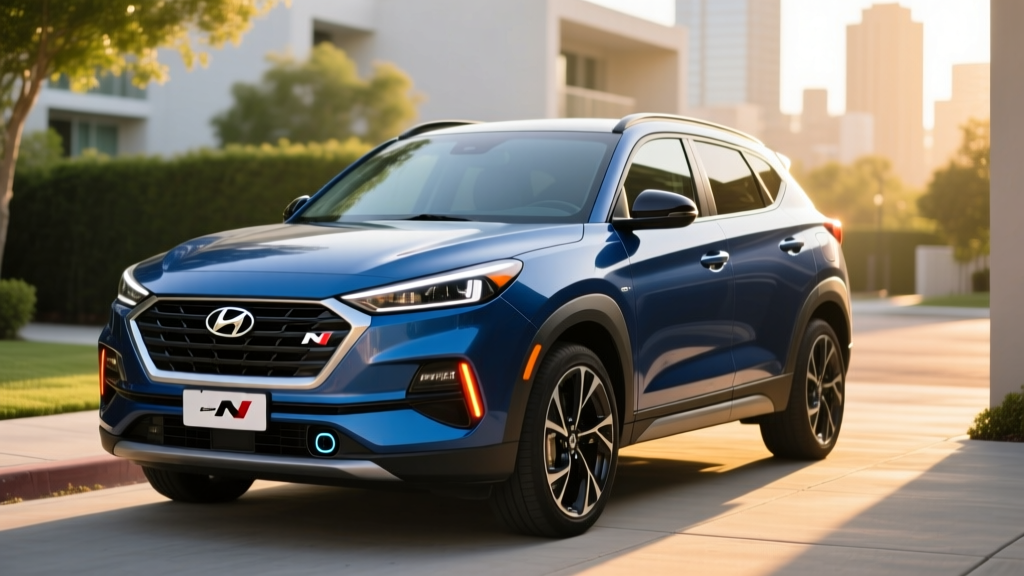
The 2025 Hyundai Tucson Hybrid N Line sits at a compelling crossroads: sport-tuned suspension and aggressive styling wrapped around one of the most efficient compact-crossover powertrains on the market. But does the N Line badge compromise the Tucson Hybrid's core promise of exceptional fuel economy? And for buyers weighing electrification options, how does this conventional hybrid (HEV) stack up against the Tucson Plug-In Hybrid (PHEV) or a full battery-electric vehicle?
We've analyzed the EPA data, real-world driving patterns, and ownership economics to give you the precise numbers you need to decide.
2025 Hyundai Tucson Hybrid N Line: Key Specs at a Glance
| Specification | 2025 Tucson Hybrid N Line |
|---|---|
| Powertrain Type | Conventional Hybrid (HEV) — no plug-in required |
| Combined Horsepower | 261 HP |
| Engine | 1.6L turbocharged 4-cylinder + electric motor |
| Transmission | 6-speed automatic |
| Drivetrain | HTRAC AWD (standard) |
| EPA Fuel Economy | 37 city / 38 highway / 38 combined MPG |
| Battery Warranty | 10 years / 100,000 miles |
| Starting MSRP | $39,095 (includes $1,395 destination) |
| Federal EV Tax Credit | Not eligible (HEV does not qualify under §30D) |
| 0-60 MPH | ~7.1 seconds (est.) |
HEV vs. PHEV: Understanding What You're Buying
Before diving into fuel economy, it's critical to understand the distinction between the Tucson Hybrid (HEV) and the Tucson Plug-In Hybrid (PHEV). They share a nameplate but operate very differently.
Conventional Hybrid (HEV) — Tucson Hybrid N Line: You never plug it in. A small battery (approximately 1.49 kWh) is charged through regenerative braking and the gasoline engine. The electric motor assists the engine during acceleration and enables low-speed electric-only driving for brief stretches. The result is significantly better fuel economy than a gas-only Tucson without any change to your fueling routine.
Plug-In Hybrid (PHEV) — Tucson Plug-In Hybrid: Features a much larger battery (13.8 kWh) that you charge via a wall outlet or Level 2 charger. It delivers an EPA-rated 33 miles of electric-only driving before the gasoline engine engages. If your daily commute is under 33 miles and you charge at home, you could go weeks without visiting a gas station. However, once the battery depletes, it operates as a conventional hybrid with an EPA rating of 35 combined MPG — slightly less than the standard HEV due to the heavier battery.
If you cannot charge at home or at work, the HEV (like the N Line reviewed here) is almost always the better choice. The PHEV's advantage evaporates if you're driving it exclusively on gasoline.
Fuel Economy: EPA Ratings vs. Real-World MPG
| Driving Condition | EPA Rating | Real-World Expectation |
|---|---|---|
| City | 37 MPG | 38–42 MPG (hybrids excel in stop-and-go) |
| Highway | 38 MPG | 35–37 MPG (sustained high speed reduces regen benefit) |
| Combined | 38 MPG | 36–39 MPG depending on driving mix |
The Tucson Hybrid's EPA ratings are strong for a turbocharged, all-wheel-drive compact crossover. According to fueleconomy.gov, the 38 MPG combined figure puts it ahead of the Toyota RAV4 Hybrid (39 combined, FWD-only advantage) and significantly ahead of the gas-only Tucson (28 combined).
Real-world note: Hyundai's hybrid system, like Toyota's, tends to deliver city MPG that meets or exceeds the EPA sticker. Regenerative braking and electric-motor assist shine in urban traffic. Highway driving at 75+ MPH is where you'll see the most deviation — expect 35-36 MPG on long interstate runs, especially with the N Line's sport-tuned suspension and slightly wider 235/55R19 tires creating marginally more rolling resistance than the standard Hybrid trims.
In cold weather (below freezing), expect a 5–10% reduction in fuel economy. The engine runs more frequently to heat the cabin, and the battery is less efficient at low temperatures. This is far less dramatic than the 20–30% range loss a full EV experiences in winter, but it's worth noting for buyers in northern climates.
Powertrain and Performance: 261 HP with Turbo Punch
The Tucson Hybrid N Line pairs a 1.6-liter turbocharged four-cylinder engine (producing 178 HP on its own) with a 47.7 kW electric motor integrated into the transmission housing. Combined system output is 261 HP and 271 lb-ft of torque — a meaningful bump over many competitors in this segment.
The 6-speed automatic transmission is a deliberate choice by Hyundai over the continuously variable transmissions (CVTs) used by Toyota and Honda in their hybrids. The result is a more natural, engaging driving feel — especially in the N Line, which adds sport-tuned suspension, unique steering calibration, and paddle shifters. There's no rubber-band effect under hard acceleration.
HTRAC all-wheel drive is standard across all Tucson Hybrid trims. The system uses an electric motor on the rear axle that engages when slip is detected or when additional traction is needed. Unlike some AWD hybrids that decouple the rear motor entirely during cruising to save fuel, Hyundai's system is calibrated for responsive engagement, which is part of why the N Line feels planted in corners despite its crossover ride height.
For comparison, the Tucson Plug-In Hybrid produces the same 261 HP but carries approximately 350 lbs of additional battery weight, making it slightly less agile. The N Line HEV is the sportiest-feeling electrified Tucson you can buy.
What the N Line Badge Adds (and Doesn't Add)
The N Line trim is Hyundai's sport-appearance package, and on the Tucson Hybrid it includes:
- Unique N Line front and rear bumpers with larger air intakes
- Sport-tuned suspension with firmer damping
- 19-inch alloy wheels with 235/55R19 tires
- N Line sport seats with suede bolsters and N badging
- Leather-wrapped sport steering wheel with paddle shifters
- Dual-zone automatic climate control
- 10.25-inch digital instrument cluster and 10.25-inch infotainment touchscreen
- Bose premium audio system (8 speakers)
What it does not include: the N Line does not add horsepower beyond the standard Hybrid's 261 HP. It is not a performance variant in the way a Tucson N would be (Hyundai does not currently offer a full N version of the Tucson Hybrid). Think of the N Line as an appearance and handling package, not a power upgrade.
Pricing, Tax Credits, and Ownership Economics
The 2025 Hyundai Tucson Hybrid N Line starts at an MSRP of $39,095 (including $1,395 destination). That positions it approximately $5,000 above the Tucson Hybrid SEL Convenience trim and roughly $7,000 above the base Tucson Hybrid Blue.
Federal tax credit: The Tucson Hybrid (HEV) does not qualify for the IRS §30D Clean Vehicle Credit. That credit is reserved for plug-in electric vehicles — battery-electric vehicles (BEVs) and plug-in hybrids (PHEVs) with a minimum battery capacity of 7 kWh. Since the Tucson Hybrid's battery is approximately 1.49 kWh, it does not meet the threshold. The Tucson Plug-In Hybrid, with its 13.8 kWh battery, may qualify for up to $3,750 under current §30D rules, depending on battery-component and critical-minerals sourcing requirements, your income level, and the vehicle's MSRP falling under the $80,000 SUV cap. Always verify current eligibility at irs.gov before purchasing.
Battery Warranty and Longevity
Hyundai provides one of the best hybrid battery warranties in the industry: 10 years or 100,000 miles (whichever comes first) for the hybrid battery system. This covers the lithium-ion battery pack, the electric motor, and related power electronics.
For context, Toyota offers the same 10-year/100,000-mile coverage on its hybrid batteries. Honda offers 8 years/100,000 miles.
Battery replacement cost: If you need a hybrid battery replacement outside of warranty, expect to pay between $2,000 and $4,000 for a refurbished or new unit, plus labor. However, real-world data from Hyundai's hybrid fleet (now spanning over a decade with the Sonata Hybrid) shows that hybrid battery failure before 150,000 miles is uncommon. The smaller battery in a conventional hybrid undergoes less stress than a PHEV or BEV battery because it operates within a narrow state-of-charge window — typically between 40% and 80% — which dramatically extends cell life.
Tucson Hybrid vs. Tucson PHEV vs. Full EV: Which Fits You?
Choose the Tucson Hybrid (HEV) N Line if:
- You cannot charge at home or at work (no garage, street parking, apartment living)
- You want sporty styling and handling without sacrificing fuel economy
- You take frequent long road trips and don't want to plan around charging
- You want AWD and strong power (261 HP) in a sub-$40K package
- You prefer lower purchase price and don't need electric-only driving
Choose the Tucson Plug-In Hybrid (PHEV) if:
- You can charge at home (Level 1 or Level 2) and your daily commute is under 33 miles
- You want to drive mostly on electricity during the week and use gas only for longer trips
- You may qualify for a partial federal tax credit (up to $3,750 depending on sourcing rules)
- You want to reduce your gasoline consumption significantly without full EV commitment
For buyers considering a full EV like the Hyundai Ioniq 5 (303 miles EPA range, starting ~$42,000 before incentives), the calculus changes entirely. A BEV eliminates gasoline costs, offers potential access to the full $7,500 federal tax credit (subject to sourcing and income rules), and delivers lower per-mile fueling costs — but requires reliable home or workplace charging access and acceptance of charging-station planning on road trips.
The Tucson Hybrid N Line is the pragmatic middle ground: no charging infrastructure needed, no range anxiety, and fuel costs roughly 30% lower than the gas-only Tucson.
Reliability, Safety, and What Owners Report
Hyundai's hybrid powertrain has demonstrated strong reliability since its introduction in the Sonata Hybrid over a decade ago. The turbocharged 1.6L engine used in the Tucson Hybrid is shared across multiple Hyundai/Kia models and has been in production since 2020, giving it a substantial track record.
The 2025 Tucson earned a TOP SAFETY PICK designation from the IIHS when equipped with specific headlights. Standard safety features include forward collision-avoidance assist with pedestrian detection, lane-keeping assist, blind-spot collision warning, rear cross-traffic collision-avoidance assist, and Hyundai's Highway Driving Assist (a Level 2 driver-assistance system that combines adaptive cruise control with lane-centering on highways).
Important clarification: Highway Driving Assist is an SAE Level 2 system. The driver must remain attentive and keep hands on the steering wheel. It is not autonomous or self-driving.
Common owner praise centers on the smooth transition between electric and gasoline power, the quiet cabin at cruising speeds, and the responsive infotainment system. The most frequent criticism is that the N Line's sport-tuned suspension transmits more road imperfections than the standard Hybrid trims — a deliberate trade-off for the firmer handling.
Frequently Asked Questions
How many MPG does the 2025 Tucson Hybrid N Line get?
The EPA rates it at 37 city / 38 highway / 38 combined MPG. In real-world city driving, many owners report 38–42 MPG thanks to regenerative braking. Highway driving at sustained high speeds typically yields 35–37 MPG.
Does the Tucson Hybrid need to be plugged in?
No. The Tucson Hybrid (HEV) is a conventional hybrid. Its small battery charges through regenerative braking and the gasoline engine. You fuel it like any other car — at a gas station. Only the Tucson Plug-In Hybrid (PHEV) requires plugging in to access its 33-mile electric-only range.
Does the 2025 Tucson Hybrid qualify for a federal tax credit?
No. The IRS §30D Clean Vehicle Credit applies only to plug-in vehicles (BEVs and PHEVs) with at least 7 kWh of battery capacity. The Tucson Hybrid's ~1.49 kWh battery does not qualify. The Tucson Plug-In Hybrid may qualify for a partial credit — check irs.gov for current sourcing and eligibility rules.
How long will the hybrid battery last, and what does replacement cost?
Hyundai covers the hybrid battery with a 10-year/100,000-mile warranty. Based on long-term data from Hyundai's hybrid lineup, battery failure before 150,000 miles is uncommon. Out-of-warranty replacement costs between $2,000 and $4,000 for the battery pack plus labor.
Is the Tucson Hybrid N Line reliable?
Hyundai's 1.6L turbo hybrid powertrain has been in use across multiple models since 2020 with generally strong reliability results. The Tucson carries Hyundai's standard 5-year/60,000-mile bumper-to-bumper warranty and 10-year/100,000-mile powertrain warranty, which is among the most comprehensive in the segment.
Hybrid vs. PHEV vs. EV — which Tucson should I buy?
If you can't charge at home: Tucson Hybrid (HEV). If you can charge at home and commute under 33 miles daily: Tucson Plug-In Hybrid. If you can charge at home, want the lowest running costs, and are comfortable planning road-trip charging: consider the Hyundai Ioniq 5 or another full EV. The Hybrid N Line is the best choice for buyers who want sporty handling, AWD, strong fuel economy, and zero changes to their fueling routine.