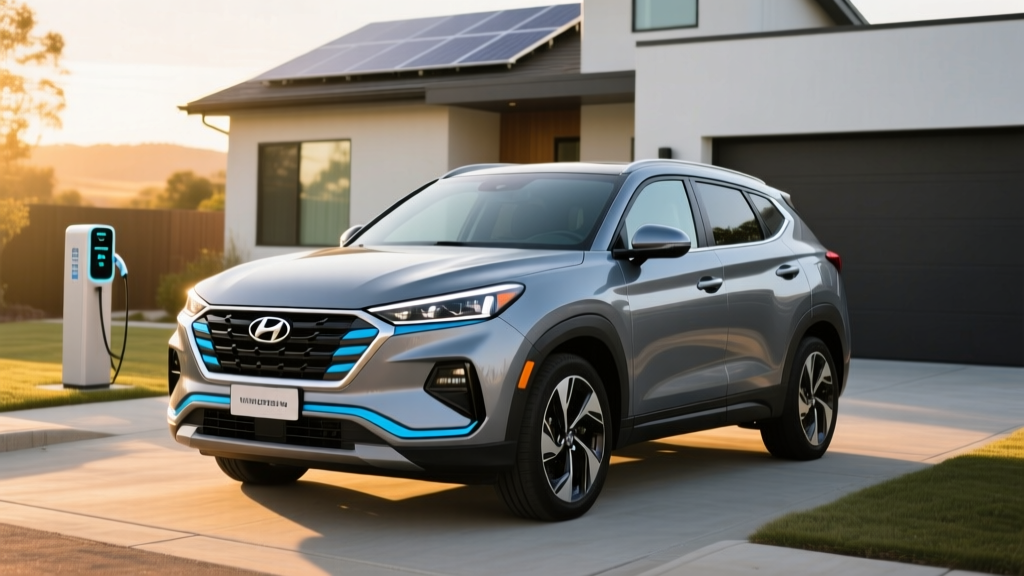
The Hyundai Tucson Hybrid has carved out a strong niche among compact crossover buyers who want electrified efficiency without plugging in. For 2025, the range-topping Limited trim bundles premium features with Hyundai's proven turbocharged hybrid powertrain. But the question every fuel-conscious buyer asks is straightforward: what MPG does the Tucson Hybrid Limited actually deliver, and how does the official EPA sticker translate to real-world driving?
We've pulled the official EPA fuel economy data, cross-referenced Hyundai's powertrain specifications, and synthesized real-world ownership reports to give you a complete picture. Whether you're cross-shopping the Tucson Hybrid against the Toyota RAV4 Hybrid, the Honda CR-V Hybrid, or a full battery-electric vehicle, this guide covers the numbers that matter.
Official EPA MPG: 2025 Hyundai Tucson Hybrid Limited
According to fueleconomy.gov, the 2025 Hyundai Tucson Hybrid (all trims, including the Limited) carries the following EPA fuel economy ratings:
| Metric | Value |
|---|---|
| City MPG | 38 MPG |
| Highway MPG | 38 MPG |
| Combined MPG | 38 MPG |
| Fuel Type | Regular Unleaded (87 octane) |
| Fuel Tank Capacity | 13.7 gallons |
| EPA Estimated Total Range | ~520 miles |
The flat 38/38/38 split is notable. Most conventional gas vehicles lose significant efficiency in city driving due to idling and stop-and-go conditions. The Tucson Hybrid's electric motor fills that gap, providing low-speed propulsion and regenerative braking that recaptures energy the gas engine would otherwise waste. The result is city MPG that matches highway MPG — a hallmark of well-tuned hybrid systems.
Hybrid vs. Plug-In Hybrid: Which Tucson Is Which?
Hyundai sells two electrified Tucson variants, and confusing them is a common buyer mistake. Here's the essential breakdown:
| Attribute | Tucson Hybrid (HEV) | Tucson Plug-In Hybrid (PHEV) |
|---|---|---|
| Powertrain | 1.6L Turbo + Electric Motor | 1.6L Turbo + Larger Electric Motor |
| Combined Horsepower | 232 HP | 268 HP |
| Battery Capacity | 1.49 kWh (small buffer) | 13.8 kWh (usable) |
| Plug-In Required? | No — self-charging via regen & engine | Yes — plug in for electric-only range |
| Electric-Only Range | None (EV assist only, ~1 mi at low speed) | 33 miles (EPA) |
| EPA Combined MPG/MPGe | 38 MPG | 80 MPGe (elec+gas) / 35 MPG (gas only) |
| DC Fast Charging | N/A | No — Level 2 AC only (~2 hrs to full) |
| Federal Tax Credit (§30D) | Not eligible | Up to $7,500 (eligibility varies) |
| Starting MSRP (Limited) | ~$39,650 | ~$44,050 |
The bottom line: The Tucson Hybrid (HEV) is a conventional, self-charging hybrid. You never plug it in. The gasoline engine and regenerative braking keep the small 1.49 kWh battery charged. The Tucson Plug-In Hybrid (PHEV) has a much larger 13.8 kWh battery, can drive roughly 33 miles on electricity alone, and requires plugging in to realize its efficiency advantage. If you don't have reliable access to a home or workplace charger, the HEV is the simpler, more cost-effective choice.
Powertrain Deep Dive: 232 HP Turbo Hybrid
The 2025 Tucson Hybrid Limited uses Hyundai's Smartstream 1.6-liter turbocharged GDI four-cylinder engine paired with a 47.7 kW (64 HP) electric motor integrated into a 6-speed automatic transmission. Combined system output is 232 horsepower and 258 lb-ft of torque.
This is a full parallel hybrid system, meaning the vehicle can operate on the gas engine alone, the electric motor alone (at low speeds for short distances), or both simultaneously for maximum acceleration. The 6-speed automatic is a conventional torque-converter unit — not a CVT — which gives the Tucson Hybrid a more natural, linear acceleration feel compared to the rubber-band sensation some CVT-equipped hybrids exhibit.
| Component | Specification |
|---|---|
| Engine | 1.6L Turbocharged GDI 4-Cylinder |
| Engine Output | 180 HP / 195 lb-ft |
| Electric Motor | 47.7 kW (64 HP) |
| Combined System Output | 232 HP / 258 lb-ft |
| Transmission | 6-Speed Automatic |
| Drivetrain | HTRAC AWD (standard on all trims) |
| 0-60 MPH (est.) | ~7.1 seconds |
| Towing Capacity | 2,000 lbs |
Standard HTRAC all-wheel drive is a key differentiator. The rear axle is driven mechanically via the engine and a driveshaft — not by a separate rear electric motor as in some competitors. This means AWD engagement is seamless but slightly less efficient than electric rear-axle systems in pure-EV mode at low speeds. For snow and rain traction, HTRAC performs competently, and Hyundai includes multiple drive modes (Eco, Smart, Sport) that adjust throttle response, shift points, and AWD torque distribution.
Pricing and Tax Credit Eligibility
The 2025 Hyundai Tucson Hybrid Limited carries an MSRP of approximately $39,650 (including destination). This positions it as a premium offering in the compact hybrid crossover segment, but it includes a substantial feature list: leather seating surfaces, a panoramic sunroof, a 10.25-inch digital instrument cluster, a 10.25-inch navigation touchscreen, Bose premium audio, a surround-view monitor, Hyundai's Highway Driving Assist (Level 2 ADAS), and heated/ventilated front seats.
Some states offer their own hybrid or efficient-vehicle rebates, though these have become less common as incentive programs shift toward full EVs. Check your state's energy or environmental agency for current programs. Hyundai also periodically offers manufacturer loyalty or conquest cash incentives that can reduce out-of-pocket cost — check HyundaiUSA.com for current offers in your ZIP code.
Battery Warranty, Reliability, and Replacement Cost
Hyundai's hybrid system has demonstrated solid reliability across multiple model years and platforms (Ioniq, Sonata Hybrid, Tucson Hybrid). The 1.49 kWh lithium-ion battery in the HEV is small and operates within a narrow state-of-charge window — it never fully charges or fully depletes — which significantly reduces degradation stress. Hybrid batteries in modern vehicles from Hyundai, Toyota, and Honda routinely last 150,000+ miles without significant capacity loss.
Battery replacement cost: If the hybrid battery does fail outside warranty, replacement costs for the Tucson Hybrid's 1.49 kWh pack typically range from $2,000 to $3,500 including labor. This is substantially less than a full EV battery replacement ($8,000-$20,000+) because the pack is small. Third-party remanufactured batteries may be available at lower cost as the vehicle ages. The 10-year/100,000-mile warranty means most owners will never face this expense.
Who Should Choose the Tucson Hybrid (vs. PHEV or Full EV)?
The Tucson Hybrid occupies a specific sweet spot. Here's a decision framework to help you determine if it's the right electrified vehicle for your situation:
- You don't have access to home or workplace charging (apartment, street parking, no garage outlet)
- You want better fuel economy than a gas Tucson (28 MPG combined) without any behavior change
- Your budget is under $40,000 and you want premium features (Limited trim)
- You regularly drive in cold climates where EV range loss is a concern
- You take frequent long road trips and don't want to plan around charging stops
- You can install a Level 2 charger at home or have reliable workplace charging
- Your daily commute is under 30 miles round-trip (you'll rarely use gas on weekdays)
- You want to qualify for the federal §30D tax credit (up to $7,500, income and sourcing rules apply)
- You want more power (268 HP combined) alongside electric-only capability
- You have reliable home Level 2 charging
- You want zero tailpipe emissions and the lowest per-mile "fuel" cost
- Your daily driving is within the EV's range and you're comfortable with road-trip charging planning
- You want maximum federal and state incentives
Pros and Cons: 2025 Tucson Hybrid Limited
- 38 MPG combined matches or beats most compact hybrid SUV competitors
- Standard AWD on all trims — no FWD base model compromise
- 10-year/100,000-mile hybrid battery warranty (class-leading)
- 232 HP provides confident highway merging and passing
- Limited trim loaded with premium features at sub-$40K pricing
- No plug-in required — zero lifestyle change vs. a gas car
- No federal tax credit eligibility (HEV)
- Highway MPG doesn't exceed city MPG — less efficient than some rivals at sustained highway speeds
- 2,000-lb towing capacity limits utility for boat/trailer hauling
- Limited trim pricing approaches PHEV territory when options are added
- Rear electric motor AWD (like RAV4 Hybrid) would improve low-speed efficiency
Frequently Asked Questions
How many MPG does the 2025 Hyundai Tucson Hybrid Limited get?
The official EPA rating is 38 MPG city, 38 MPG highway, and 38 MPG combined. Real-world results typically range from 35 MPG (cold weather, highway-heavy driving) to 40+ MPG (moderate-temperature city driving with frequent regenerative braking opportunities).
Does the Tucson Hybrid need to be plugged in?
No. The Tucson Hybrid (HEV) is a conventional, self-charging hybrid. The small 1.49 kWh battery is charged by the gasoline engine and by regenerative braking during deceleration. You simply fill up at a gas station as you would with any conventional vehicle.
How far can the Tucson Plug-In Hybrid go on electric only?
The Tucson PHEV (a separate model) delivers an EPA-rated 33 miles of electric-only range on its 13.8 kWh battery. Once the battery depletes, it operates as a conventional hybrid with an EPA rating of 35 MPG combined. The conventional Tucson Hybrid (HEV) has no meaningful electric-only range — the motor provides assist only at low speeds for very short distances.
Is the Tucson Hybrid reliable, and what does a battery replacement cost?
Hyundai's hybrid powertrain has a solid reliability track record across multiple models. The 10-year/100,000-mile hybrid component warranty is among the best in the industry. Out-of-warranty battery replacement for the HEV's small 1.49 kWh pack typically costs $2,000-$3,500 — far less than a full EV battery. Most hybrid batteries last well beyond 150,000 miles.
Does the 2025 Tucson Hybrid qualify for any tax credit?
The conventional Tucson Hybrid (HEV) does not qualify for the federal §30D Clean Vehicle Credit, which is reserved for plug-in vehicles (BEVs and PHEVs). The Tucson Plug-In Hybrid may qualify for up to $7,500 depending on your income, the vehicle's MSRP, and battery component sourcing — check IRS.gov for current-year eligibility details. Some states may offer separate hybrid incentives; check your state energy office.
How does the Tucson Hybrid compare to the RAV4 Hybrid and CR-V Hybrid?
The Toyota RAV4 Hybrid is rated at 41 MPG combined (slightly higher, thanks to its rear-electric-motor AWD system), while the Honda CR-V Hybrid achieves 40 MPG combined (FWD) or 37 MPG (AWD). The Tucson Hybrid's 38 MPG combined with standard AWD is competitive, and it distinguishes itself with a more premium interior on the Limited trim, a conventional automatic transmission (no CVT), and Hyundai's industry-leading 10-year powertrain warranty.