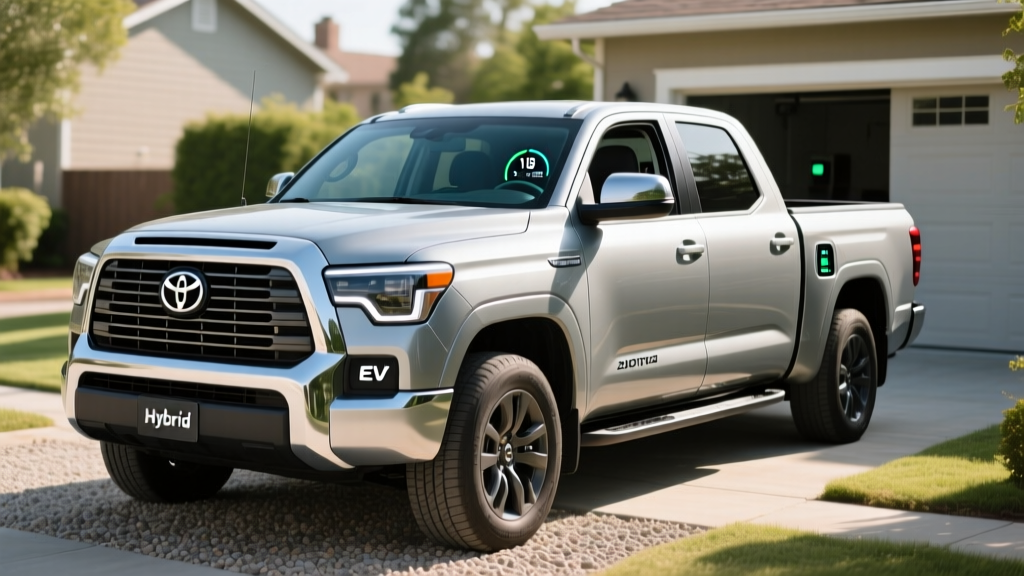
Full-size pickup trucks have historically been fuel-economy laggards, but Toyota's i-FORCE MAX hybrid powertrain in the 2025 Tundra challenges that assumption without sacrificing the payload and towing capability truck buyers demand. The 2025 Toyota Tundra Hybrid pairs a twin-turbo V6 with a 49-hp electric motor sandwiched between the engine and transmission, delivering 437 horsepower and 583 lb-ft of torque while squeezing out meaningfully better mileage than the non-hybrid version. For buyers weighing a half-ton truck against a full EV or a conventional gas rig, the Tundra Hybrid occupies a pragmatic middle ground: no plug required, no range anxiety on job sites, and fuel savings that add up over years of ownership.
HEV vs PHEV: What Kind of Hybrid Is the Tundra?
Before examining the numbers, it's essential to understand what the Tundra Hybrid is — and isn't. Toyota offers two distinct hybrid architectures across its lineup, and confusing them leads to wrong purchase decisions:
| Feature | Conventional Hybrid (HEV) | Plug-In Hybrid (PHEV) |
|---|---|---|
| Plug-in charging? | No — refuels with gas only | Yes — plugs into Level 1/2 charger |
| Electric-only range | Minimal (low-speed assist only) | Typically 25–50 miles |
| Battery size | Small (1–2 kWh) | Larger (10–25 kWh) |
| Federal §30D tax credit | Not eligible | May qualify (up to $7,500) |
| Example | Toyota Tundra i-FORCE MAX | Toyota RAV4 Prime, Ford F-150 Lightning (BEV) |
The 2025 Toyota Tundra Hybrid is a conventional hybrid (HEV). It uses a small 1.87 kWh nickel-metal hydride (NiMH) battery pack to store energy recaptured from regenerative braking and engine excess. You never plug it in. You simply fill the tank with gasoline, and the hybrid system works behind the scenes to optimize fuel delivery, electric motor assist during acceleration, and regenerative braking during deceleration. There is no electric-only driving mode capable of highway speeds — the electric motor assists the gas engine but cannot propel the truck independently for meaningful distances.
Toyota does not currently offer a plug-in hybrid (PHEV) version of the Tundra. If you need electric-only commuting capability in a Toyota truck, you'd need to look at the smaller Tacoma (which also currently offers only a conventional i-FORCE MAX hybrid) or step up to a full battery-electric truck like the Ford F-150 Lightning or Rivian R1T.
Powertrain Specs: i-FORCE MAX Under the Hood
| Spec | Value |
|---|---|
| Engine | 3.5L (3.4L actual) twin-turbo V6 |
| Electric motor | 49 hp / 184 lb-ft (motor-generator, between engine and transmission) |
| Combined output | 437 hp / 583 lb-ft |
| Transmission | 10-speed automatic |
| Hybrid battery | 1.87 kWh NiMH (sealed, under rear seat) |
| Drivetrain | RWD or 4WD (part-time, available) |
| 0–60 mph (est.) | ~5.7 seconds (4WD CrewMax) |
| Max towing capacity | Up to 12,000 lbs (trim/bed/config dependent) |
| Max payload | Up to 1,810 lbs |
The i-FORCE MAX places the electric motor-generator between the twin-turbo V6 and the 10-speed automatic transmission. This "sandwich" layout means the motor can fill torque gaps during gear shifts, provide launch assist off the line, and recover kinetic energy during braking. The result is a truck that feels substantially more responsive than the non-hybrid i-FORCE (which produces 389 hp and 479 lb-ft in its top tune) while consuming less fuel in stop-and-go driving where the electric assist does the most work.
The 1.87 kWh battery pack is modest by EV standards — a Tesla Model Y carries roughly 75 kWh — but it's appropriate for a conventional hybrid. It charges exclusively through regenerative braking and engine-driven generation. There is no plug, no charging port, and no DC fast-charge capability. The battery lives under the rear seat, preserving bed and cabin space.
Fuel Economy: EPA MPG and Real-World Expectations
The headline number for the 2025 Tundra Hybrid is EPA-estimated fuel economy that beats the gas-only Tundra by a meaningful margin, particularly in city driving where hybrid systems shine:
| Configuration | City MPG | Highway MPG | Combined MPG |
|---|---|---|---|
| Tundra Hybrid 4x2 | 20 | 24 | 22 |
| Tundra Hybrid 4x4 | 19 | 22 | 20 |
| Tundra Gas 4x2 (i-FORCE) | 17 | 23 | 19 |
| Tundra Gas 4x4 (i-FORCE) | 17 | 22 | 19 |
Source: fueleconomy.gov — EPA estimates. Actual mileage varies with driving conditions, load, and terrain.
The city MPG advantage is where the hybrid earns its premium. If your driving involves significant suburban or urban commuting — school runs, job-site visits in metro areas, stop-and-go errands — the 2–3 MPG improvement over the gas Tundra translates to roughly 100–150 fewer gallons per year at 15,000 annual miles. At $3.50/gallon, that's $350–$525 in annual fuel savings, which recoups the hybrid powertrain premium (roughly $2,500–$3,500 depending on trim) in 5–9 years.
Trims, Pricing, and the Tax Credit Question
The i-FORCE MAX hybrid powertrain is available across most of the Tundra lineup for 2025, though it is standard on higher trims and optional on mid-range trims:
| Trim | Starting MSRP (est.) | Hybrid Availability |
|---|---|---|
| Limited | ~$60,500 | Optional |
| Platinum | ~$67,000 | Standard |
| 1794 Edition | ~$67,500 | Standard |
| TRD Pro | ~$74,000 | Standard |
| Capstone | ~$81,000 | Standard |
Prices are approximate and vary by configuration. Check Toyota.com for current MSRP.
The lack of a federal tax credit is the Tundra Hybrid's biggest financial disadvantage versus a full EV truck like the Ford F-150 Lightning, which may qualify for up to $7,500 under §30D (subject to income, MSRP, and battery-sourcing rules). However, the Tundra Hybrid's lower starting price, zero charging infrastructure requirements, and no-compromise towing capacity offset that gap for many buyers — particularly those without access to home Level 2 charging or those who regularly tow heavy loads over long distances.
Battery Warranty, Reliability, and Replacement Cost
Toyota's hybrid reliability track record is among the strongest in the industry, dating back to the 2001 Prius. The NiMH battery chemistry used in the Tundra Hybrid is less energy-dense than the lithium-ion packs in full EVs, but it is extremely well-proven for longevity. NiMH cells degrade more slowly than early lithium-ion chemistries and are less sensitive to temperature extremes — a meaningful advantage in a truck that may sit in a job-site parking lot in Phoenix or idle in a Minnesota winter.
Battery replacement cost: If the hybrid battery fails outside the warranty period (10+ years of use), replacement runs approximately $3,000–$4,500 for the pack plus labor, based on current Toyota dealer pricing for similar i-FORCE MAX systems. This is significantly less than a full EV battery replacement ($10,000–$20,000+), reflecting the Tundra Hybrid's much smaller 1.87 kWh pack. Third-party hybrid battery refurbishment services may offer lower-cost options as the truck ages.
The electric motor-generator itself is a sealed unit with no brushes or wear items and is expected to last the life of the vehicle. The 10-speed automatic transmission is shared with the non-hybrid Tundra and carries the same reliability profile. In practical terms, the hybrid system adds one component (the battery pack) that may eventually need replacement, but the 10-year/150,000-mile warranty covers the vast majority of ownership periods.
Who Should Buy the Tundra Hybrid — and Who Shouldn't
Choose the Tundra Hybrid If:
- You want better fuel economy in a full-size truck without plugging in
- You tow regularly and can't accept EV range loss under load
- Your driving mix includes significant city/suburban miles
- You want maximum torque (583 lb-ft) for acceleration and low-speed pulling
- You plan to keep the truck 8+ years (warranty covers the battery)
- You lack access to home Level 2 charging
Look Elsewhere If:
- You want electric-only commuting (consider a PHEV like the F-150 PowerBoost or a BEV like the F-150 Lightning)
- You want the $7,500 federal tax credit (only available for plug-in vehicles)
- You drive primarily highway miles with no towing — the hybrid MPG advantage shrinks on open roads
- Upfront cost is paramount — the hybrid premium adds $2,500–$3,500 over the gas i-FORCE
- You want the quiet, instant-torque experience of a full EV
Hybrid vs PHEV vs EV Truck: Which Fits You?
The full-size truck market now spans three electrification tiers. Here's how the Tundra Hybrid stacks up against the alternatives:
| Factor | HEV (Tundra Hybrid) | PHEV (e.g., F-150 PowerBoost*) | BEV (e.g., F-150 Lightning) |
|---|---|---|---|
| Plug-in required? | No | Optional (beneficial) | Yes — mandatory |
| Electric-only range | None | ~20–25 mi (est.) | 230–320 mi |
| Towing range impact | Minimal (still gas) | EV range eliminated; gas range reduced | Range cut ~50% |
| Federal tax credit | $0 | Up to $7,500** | Up to $7,500** |
| Home charging needed | No | Recommended | Required (Level 2) |
| Fuel cost per mile | ~$0.17 (gas) | ~$0.05 (elec) / $0.17 (gas) | ~$0.04–$0.06 |
*The Ford F-150 PowerBoost is a conventional hybrid (HEV), not a PHEV. Ford does not currently offer a PHEV F-150 in the US. **§30D credit subject to income caps, MSRP caps, and battery sourcing requirements per IRS rules.
The decision framework is straightforward: if you can install a Level 2 home charger, rarely tow over long distances, and your daily commute is under 200 miles, a full EV truck like the F-150 Lightning delivers the lowest per-mile operating cost and qualifies for the tax credit. If you need the flexibility of gas for towing and road trips but want some electric-only commuting, a PHEV would be ideal — though no full-size PHEV truck currently exists in the US market. The Tundra Hybrid is the right choice for buyers who want improved fuel economy and more torque with zero lifestyle changes: no plug, no charging apps, no range planning.
Frequently Asked Questions
How many MPG does the 2025 Toyota Tundra Hybrid get?
The EPA rates the Tundra Hybrid 4x2 at 20 city / 24 highway / 22 combined MPG. The 4x4 version is rated 19 city / 22 highway / 20 combined. In real-world mixed driving, owners typically report 20–23 MPG in suburban conditions. Towing drops fuel economy to 10–13 MPG depending on trailer weight and terrain.
Does the Tundra Hybrid need to be plugged in?
No. The Tundra i-FORCE MAX is a conventional hybrid (HEV). It charges its small battery pack through regenerative braking and the gas engine. There is no charging port. You refuel exclusively with gasoline.
Does the 2025 Tundra Hybrid qualify for any federal tax credit?
No. The federal §30D Clean Vehicle Credit applies only to plug-in electric vehicles (PHEVs and BEVs) that meet battery sourcing, MSRP, and buyer income requirements. The Tundra Hybrid is a conventional HEV and is not eligible. Check your state's energy office for any local hybrid incentives, though these are uncommon.
How long will the Tundra Hybrid battery last, and what does replacement cost?
Toyota warrants the hybrid battery for 10 years or 150,000 miles. Based on Toyota's long history with NiMH hybrid packs (the Prius has used similar chemistry since 2001), many hybrid batteries outlast their warranty periods. If replacement is needed after 10+ years, expect to pay approximately $3,000–$4,500 at a Toyota dealer.
How much can the Tundra Hybrid tow?
Towing capacity varies by trim and configuration. The maximum rating is up to 12,000 lbs (for specific 4x2 configurations with the appropriate tow package). The hybrid's 583 lb-ft of torque provides strong low-end pulling power. However, fuel economy under heavy towing drops to approximately 10–13 MPG — comparable to the gas-only Tundra under load.
Hybrid vs PHEV vs EV — which truck is right for me?
Choose the Tundra Hybrid (HEV) if you want fuel savings without plugging in, tow frequently, or lack home charging. Choose a full EV truck (F-150 Lightning, Rivian R1T, Silverado EV) if you have home Level 2 charging, commute under 200 miles daily, and want the lowest per-mile cost plus tax credit eligibility. A PHEV truck would offer the best of both worlds, but no full-size PHEV pickup is currently sold in the US market.