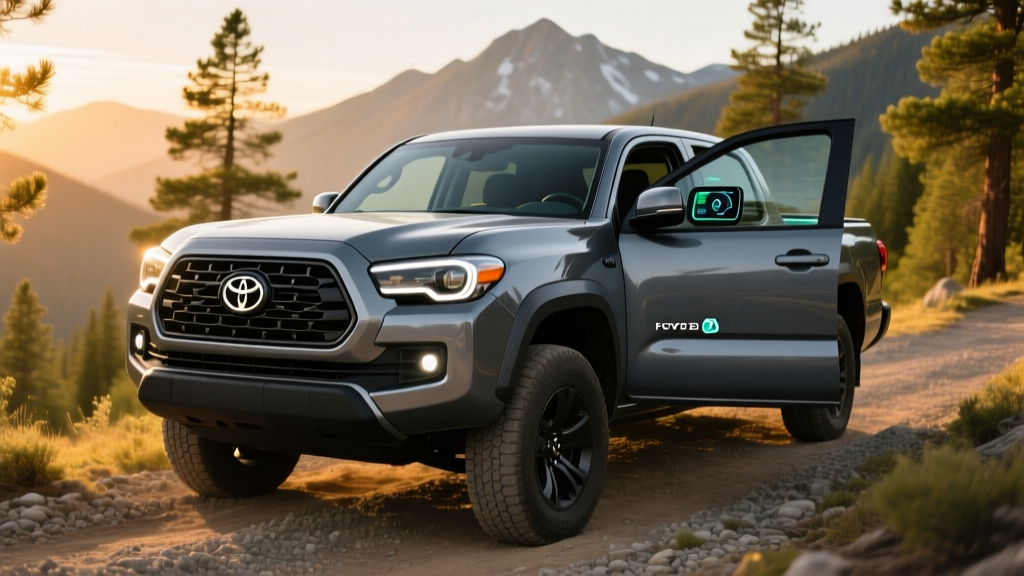
The 2025 Toyota Tacoma Hybrid at a Glance
The midsize truck segment finally got its hybrid moment. The 2025 Toyota Tacoma Hybrid pairs a turbocharged 2.4-liter four-cylinder with an electric motor integrated into an eight-speed automatic transmission, producing a combined 326 horsepower and 465 lb-ft of torque. Unlike the previous generation's V6, this i-FORCE MAX powertrain delivers substantially more low-end grunt — the electric motor fills in torque before the turbo spools — while trimming fuel consumption versus the gas-only 2.4L turbo.
Before we get into the numbers, a critical clarification: the 2025 Tacoma Hybrid is a conventional hybrid (HEV), not a plug-in hybrid (PHEV). There is no plug, no electric-only driving range, and no home charging requirement. The small hybrid battery recharges through regenerative braking and the gasoline engine. If you're looking for a Tacoma you can plug in, it doesn't exist yet — Toyota has not announced a Tacoma PHEV.
| Specification | Value |
|---|---|
| Powertrain | 2.4L Turbo I-4 + Electric Motor (i-FORCE MAX) |
| Combined Horsepower | 326 hp |
| Combined Torque | 465 lb-ft |
| Transmission | 8-Speed Automatic |
| Drivetrain | RWD or 4WD (trim-dependent) |
| Hybrid Battery | ~1.87 kWh (NiMH), self-charging |
| Max Towing Capacity | 6,000 lbs |
| Max Payload | ~1,705 lbs |
| Starting MSRP (SR5 i-FORCE MAX) | $40,945 |
| Battery Warranty | 10 years / 150,000 miles |
EPA Fuel Economy: What the Sticker Says
Fuel economy is the headline reason buyers cross-shop the Tacoma Hybrid against the gas-only model. The i-FORCE MAX hybrid system yields modest but meaningful gains, especially in combined and city driving where the electric motor does the most work.
| Configuration | City MPG | Highway MPG | Combined MPG |
|---|---|---|---|
| i-FORCE MAX 4x2 (SR5) | 23 | 27 | 24 |
| i-FORCE MAX 4x4 (SR5 / Trailhunter / TRD Pro) | 23 | 27 | 24 |
| Gas-only 2.4L Turbo 4x4 (for comparison) | 20 | 26 | 22 |
Source: EPA Fuel Economy Guide (fueleconomy.gov).
The hybrid gains roughly 2–3 MPG combined over the gas-only turbo four. On paper, that's not Prius-level transformation. But for a 4,500-pound body-on-frame truck producing 465 lb-ft, 24 MPG combined is competitive with the Ford Maverick Hybrid (which achieves 42 MPG combined but sacrifices towing capacity, ground clearance, and off-road capability).
Real-World MPG: What to Actually Expect
EPA estimates for conventional hybrids tend to be conservative in city driving and optimistic on sustained highway runs. Based on early owner reports and testing patterns from similar Toyota hybrid powertrains (Tundra i-FORCE MAX, RAV4 Hybrid), here's a realistic breakdown:
- City / suburban driving: Expect 24–27 MPG. The electric motor handles low-speed acceleration and the engine shuts off at stops, so hybrids thrive here. Light-footed drivers can push past the EPA city number.
- Highway cruising (70–75 mph): Expect 22–25 MPG. Aerodynamic drag dominates at speed, and the hybrid system offers less benefit. The Tacoma's boxy profile and available all-terrain tires hurt highway efficiency.
- Towing: Expect 12–16 MPG with a 4,000–5,000 lb trailer. The hybrid system helps marginally off the line, but towing fuel economy is dictated by weight and drag.
- Cold weather (below 30°F): Expect a 5–10% drop. The engine runs more often to generate cabin heat and warm up the catalytic converter, reducing the hybrid system's shut-off time.
For an owner driving 15,000 miles per year at 24 MPG combined, that's roughly 625 gallons annually. At $3.50/gallon, fuel costs about $2,188/year — compared to roughly $2,386/year for the gas-only 22 MPG model. The hybrid saves approximately $200/year in fuel. The math doesn't dramatically favor the hybrid at the pump, which brings us to the broader value question.
HEV vs PHEV vs EV: Which Tacoma Buyer Are You?
Conventional Hybrid (HEV) — The 2025 Tacoma Hybrid: No plug required. The battery is small (~1.87 kWh), recharges from braking and the engine, and provides electric assist during acceleration. You fuel up at gas stations. Best for buyers who want improved efficiency with zero lifestyle change.
Plug-in Hybrid (PHEV) — Not Available for Tacoma: A PHEV would have a larger battery (typically 15–20 kWh), offer 25–40 miles of electric-only driving, and require Level 2 home charging for maximum benefit. Vehicles like the Jeep Wrangler 4xe and Ford Escape PHEV follow this template. Toyota has not announced a Tacoma PHEV.
Battery Electric Vehicle (BEV): Zero tailpipe emissions, no gasoline, home charging possible, but requires access to reliable DC fast charging for road trips. The closest electric midsize trucks are the Rivian R1T (starting ~$71,700) and the Chevrolet Silverado EV (starting ~$55,000 for fleet-oriented trims). Neither matches the Tacoma's price point or dealership service network.
If you don't have access to home Level 2 charging, tow regularly, drive in remote areas, or need a sub-$50,000 truck, the Tacoma Hybrid is the pragmatic middle ground. If you have a garage charger, a short commute, and rarely tow, a PHEV from another brand (or a full EV) would save more fuel — but you'd be shopping outside the midsize truck segment.
Powertrain Deep Dive: How i-FORCE MAX Works
The i-FORCE MAX system places a 48-horsepower electric motor between the 2.4-liter turbocharged engine and the eight-speed automatic transmission. This "sandwich" configuration means the motor can assist during acceleration, enable brief engine-off coasting, and capture energy during deceleration — all without requiring an external power source.
The electric motor's primary contribution is low-end torque fill. Turbo lag, inherent to the 2.4L engine, is masked by instant electric torque from 0 RPM. The result is a truck that feels more responsive than its gas-only sibling around town and when merging onto highways, even though peak horsepower is only marginally higher (326 hp vs. 278 hp for the gas-only 2.4L turbo in higher-output tune).
The hybrid battery is a nickel-metal hydride (NiMH) pack mounted under the rear seat. Toyota chose NiMH over lithium-ion for its proven long-term durability and thermal stability — a pattern consistent with the company's hybrid strategy since the original Prius. The pack is small (~1.87 kWh usable) because the system doesn't need to store energy for electric-only driving; it only needs enough capacity to buffer regenerative braking energy and supply the 48-hp motor during assist phases.
Pricing, Trims, and Tax Credit Eligibility
The i-FORCE MAX hybrid powertrain is available across multiple Tacoma trims for 2025:
- SR5: Starting at $40,945 (4x2) / $42,545 (4x4)
- Limited: Starting at $52,155
- TRD Off-Road: Starting at $45,345
- TRD Pro: Starting at $64,830
- Trailhunter: Starting at $63,050
These prices represent a roughly $2,000–$3,000 premium over equivalent gas-only trims, depending on configuration.
Does the 2025 Tacoma Hybrid Qualify for a Federal Tax Credit?
No. The federal §30D Clean Vehicle Credit applies only to plug-in electric vehicles (PHEVs and BEVs) with battery capacities of at least 7 kWh. The Tacoma Hybrid's ~1.87 kWh NiMH battery and conventional HEV architecture make it ineligible. There is currently no federal tax credit for conventional hybrids.
Some states may offer rebates or incentives for hybrid vehicles through separate programs — check your state's energy office or department of environmental quality for current offerings. These vary by jurisdiction and change frequently.
For details on which vehicles do qualify for the federal credit, see the IRS §30D guidelines.
Battery Longevity, Warranty, and Replacement Cost
Hybrid battery anxiety is the single most common concern among first-time hybrid buyers. Here's the data:
Warranty: Toyota covers the Tacoma Hybrid's battery for 10 years or 150,000 miles (whichever comes first) under its Hybrid Battery Warranty. This applies in all 50 states. The hybrid system components (inverter, electric motor, control module) are covered under the same terms.
Expected lifespan: Toyota's NiMH hybrid batteries have a well-documented track record. The Prius, Camry Hybrid, and RAV4 Hybrid routinely exceed 200,000 miles on original battery packs. The NiMH chemistry degrades more gracefully than some early lithium-ion packs — capacity loss is slow and linear rather than sudden.
Replacement cost: If the battery fails outside of warranty, a new OEM replacement pack for Toyota's midsize hybrid system typically costs between $2,500 and $4,000 installed at a dealership. Third-party refurbished packs are available for $1,500–$2,500. Given the 10-year/150,000-mile warranty and the historical durability of Toyota NiMH packs, most owners will never face this expense.
Maintenance advantage: The hybrid system actually reduces certain maintenance costs. Regenerative braking extends brake pad life significantly (many Toyota hybrid owners report 80,000+ miles on original pads). The engine runs fewer hours over the vehicle's lifetime, reducing oil degradation. Toyota's recommended maintenance schedule for the Tacoma Hybrid is identical to the gas model — no special hybrid service intervals.
Pros
- 465 lb-ft of torque with less turbo lag than gas-only model
- 2–3 MPG combined improvement without plugging in
- 10-year/150,000-mile hybrid battery warranty
- Full towing (6,000 lbs) and off-road capability retained
- Toyota's long-term reliability track record with hybrid systems
- Wider trim availability than competitors' hybrid trucks
Cons
- Only 2–3 MPG gain — modest efficiency improvement for the price premium
- No electric-only driving mode; still 100% gasoline-dependent
- No federal tax credit eligibility
- ~$2,000–$3,000 premium over gas-only trims with slow fuel-cost payback
- Highway MPG barely improves over gas model (aerodynamics dominate)
- NiMH battery is proven but less energy-dense than lithium-ion alternatives
Who Should Buy the 2025 Tacoma Hybrid?
The Tacoma Hybrid makes the most sense for buyers who:
- Want a midsize truck with strong torque for towing, trailering, or off-road use and value the low-RPM electric assist
- Drive a mix of city and highway miles where the hybrid system's city MPG advantage compounds
- Plan to keep the truck 8–10+ years (the warranty covers the battery for the full ownership period)
- Cannot or do not want to install a Level 2 home charger, ruling out PHEVs and BEVs
- Want Toyota's dealership network and proven hybrid reliability over newer entrants like the Ford Maverick Hybrid or Rivian R1T
It's a less compelling choice if your driving is overwhelmingly highway (where the hybrid advantage shrinks), if you expected Prius-like fuel savings, or if you were hoping for any electric-only capability. For those needs, a PHEV SUV or a dedicated BEV would serve better — but neither currently exists in the midsize truck segment at this price.
Frequently Asked Questions
How many MPG does the 2025 Tacoma Hybrid get?
The EPA rates the Tacoma i-FORCE MAX at 23 city / 27 highway / 24 combined for both 4x2 and 4x4 configurations. Real-world city driving often yields 24–27 MPG; sustained highway driving at 75+ mph typically returns 22–25 MPG.
Can I plug in the 2025 Tacoma Hybrid?
No. The Tacoma Hybrid is a conventional (self-charging) hybrid. It has no plug, no charging port, and no electric-only driving mode. The battery recharges through regenerative braking and the gasoline engine.
Does the Tacoma Hybrid qualify for the $7,500 federal tax credit?
No. The federal §30D Clean Vehicle Credit requires a plug-in vehicle with at least 7 kWh of battery capacity. The Tacoma Hybrid's ~1.87 kWh NiMH battery does not qualify. No conventional hybrid currently qualifies for the federal EV tax credit.
Is the Tacoma Hybrid battery reliable? What does replacement cost?
Toyota covers the hybrid battery for 10 years/150,000 miles. Toyota's NiMH hybrid packs historically last 200,000+ miles. Out-of-warranty replacement costs $2,500–$4,000 for an OEM pack, though most owners never need one.
How much more does the hybrid cost versus the gas-only Tacoma?
The i-FORCE MAX hybrid carries roughly a $2,000–$3,000 premium over equivalent gas-only trims. At a savings of ~$200/year in fuel, the payback period is 10–15 years on fuel alone — but the hybrid also delivers more torque (465 vs. 317 lb-ft), which many buyers value independently of fuel savings.
Will Toyota release a Tacoma plug-in hybrid (PHEV)?
Toyota has not announced a Tacoma PHEV as of early 2025. The Tundra and Sequoia also use the same i-FORCE MAX conventional hybrid system without plug-in capability. If Toyota extends its PHEV lineup to trucks, a Tacoma PHEV would likely need a larger battery (15+ kWh) and a revised platform — making it a longer-term possibility rather than an imminent release.
How does the Tacoma Hybrid compare to the Ford Maverick Hybrid?
The Maverick Hybrid achieves 42 MPG combined — nearly double the Tacoma Hybrid's 24 MPG. However, the Maverick is a unibody compact truck with a 2,000-lb towing capacity, no 4WD option, and limited off-road capability. The Tacoma Hybrid tows 6,000 lbs, offers 4WD with locking differentials, and has significantly more ground clearance. They serve different buyers entirely.