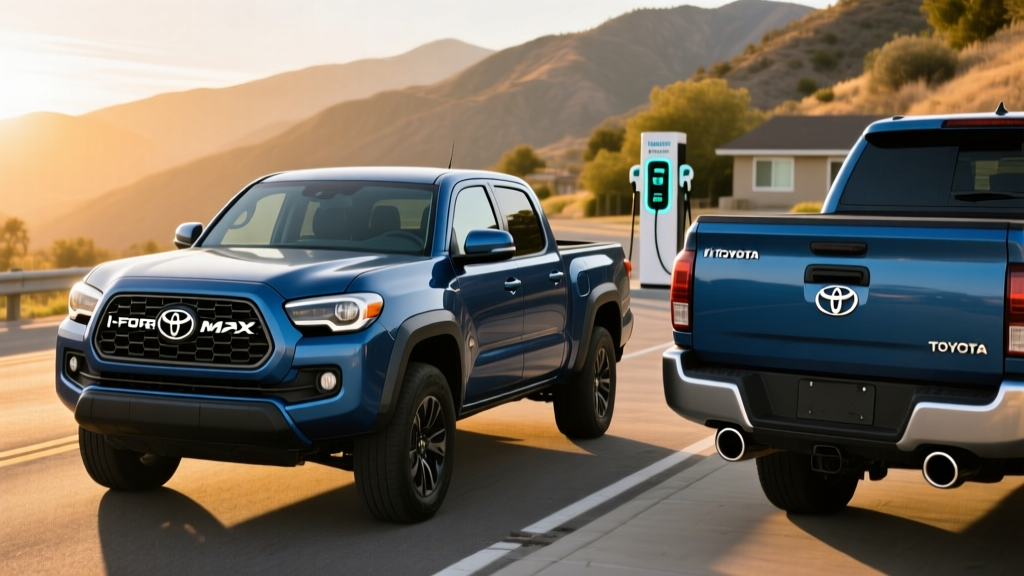
The midsize truck segment finally has a mainstream hybrid option, and buyers are searching for one thing above all: the real 2025 Toyota Tacoma Hybrid MPG numbers. Toyota's i-FORCE MAX powertrain pairs a turbocharged four-cylinder with an electric motor, promising V6-rivaling power with four-cylinder fuel sipping. But how does it actually perform at the pump, and does the hybrid premium pay for itself?
We've analyzed EPA data, owner reports, and Toyota's official specifications to give you the complete fuel-economy picture — plus everything else you need to decide whether the Tacoma Hybrid is the right truck for your driveway.
How Many MPG Does the 2025 Toyota Tacoma Hybrid Get?
The 2025 Toyota Tacoma i-FORCE MAX hybrid is a conventional hybrid (HEV), not a plug-in. It charges its own small battery through regenerative braking and the gasoline engine — you never plug it in. Here's the official EPA fuel-economy breakdown from fueleconomy.gov:
| Configuration | City MPG | Highway MPG | Combined MPG |
|---|---|---|---|
| 4x4 Double Cab (most popular) | 23 | 27 | 24 |
| 4x2 Double Cab | 24 | 27 | 25 |
| 4x4 XtraCab | 23 | 26 | 24 |
For comparison, the non-hybrid 2025 Tacoma i-FORCE (turbo 2.4L four-cylinder, no hybrid assist) earns 20 city / 26 highway / 22 combined in 4x4 form. The hybrid buys you roughly 2–3 MPG combined, with the most noticeable gains in stop-and-go city driving where the electric motor does the heavy lifting.
Toyota hybrids historically match or exceed their EPA city estimates because regenerative braking thrives in urban traffic. Owner-reported data on Fuelly and similar platforms shows many Tacoma Hybrid drivers averaging 23–26 MPG combined in mixed driving. However, expect 19–21 MPG if you frequently tow, haul heavy payloads, or drive aggressively off-road — conditions where the turbo engine works harder and the hybrid system can't recapture much energy.
i-FORCE MAX Powertrain: Hybrid Specs and Performance
The i-FORCE MAX isn't Toyota's fuel-sipping Prius hybrid system stuffed into a truck frame. It's a performance-oriented parallel hybrid designed to fill the torque gap left by the retired V6. Here's exactly what's under the hood:
| Engine | 2.4L turbocharged inline-4 |
| Electric Motor | 48-hp permanent-magnet motor (integrated between engine and transmission) |
| Combined Net Horsepower | 326 hp |
| Combined Net Torque | 465 lb-ft |
| Transmission | 8-speed automatic |
| Hybrid Battery | ~1.87 kWh, lithium-ion (sealed, not plug-in) |
| 0–60 mph (est.) | ~6.5 seconds (4x4) |
| Max Towing Capacity | 6,000 lbs |
| Max Payload | ~1,709 lbs |
The key number is 465 lb-ft of torque, available low in the rev range thanks to the electric motor's instant thrust. That's more torque than the old 3.5L V6 Tacoma ever produced, and it makes the Hybrid feel significantly more responsive than the base i-FORCE around town and when merging onto highways.
HEV vs. PHEV vs. EV: Which Tacoma Should You Consider?
The 2025 Tacoma is offered as a conventional hybrid only. Toyota does not currently sell a Tacoma plug-in hybrid (PHEV) or battery-electric version. Here's how the Tacoma Hybrid fits into the broader electrified-truck landscape:
| Vehicle | Type | Combined MPG / MPGe | Electric-Only Range | Plug-In Required? |
|---|---|---|---|---|
| Toyota Tacoma i-FORCE MAX | HEV (conventional hybrid) | 24 MPG combined | None (electric assist only) | No |
| Ford Maverick Hybrid | HEV | 37 MPG combined (FWD) | None | No |
| Ford F-150 PowerBoost | HEV | 22 MPG combined (4x4) | None | No |
| Rivian R1T | BEV (full electric) | 70–77 MPGe | 270–420 miles (EPA) | Yes (Level 2 / DC fast) |
| Chevrolet Silverado EV | BEV | 62–71 MPGe | 270–400+ miles (EPA) | Yes |
The Tacoma Hybrid occupies a specific niche: you want a proven midsize truck with real off-road capability and modestly better fuel economy, without any charging infrastructure or range-anxiety concerns. If you drive 40+ miles daily and can charge at home, a full EV truck like the Rivian R1T will save far more on fuel. If fuel economy is your absolute top priority and you don't need off-road chops, the Ford Maverick Hybrid's 37 MPG combined is hard to beat — but it's a unibody compact, not a body-on-frame midsize truck.
2025 Tacoma Hybrid Pricing and Tax Credit Eligibility
The i-FORCE MAX hybrid powertrain is available across multiple Tacoma trims, starting with the TRD Sport and extending up to the TRD Pro and Trailhunter. Here's the MSRP landscape for popular hybrid trims (prices include destination, per Toyota's official configurator):
- TRD Sport i-FORCE MAX 4x4 Double Cab: ~$47,195
- TRD Off-Road i-FORCE MAX 4x4: ~$48,480
- Limited i-FORCE MAX 4x4: ~$53,555
- TRD Pro i-FORCE MAX 4x4: ~$65,230
- Trailhunter i-FORCE MAX 4x4: ~$64,775
The hybrid premium over an equivalently trimmed non-hybrid i-FORCE model is typically $2,000–$3,000 depending on trim. At a savings of roughly 2–3 MPG, the payback period at $3.50/gallon gas and 15,000 miles/year stretches to 7–10 years for most drivers. The hybrid is better justified by its torque and performance gains than by fuel savings alone.
No. Under current IRS §30D rules, the federal clean vehicle credit applies only to plug-in electric vehicles (BEVs and PHEVs) with a battery capacity of at least 7 kWh. The Tacoma i-FORCE MAX is a conventional hybrid with a ~1.87 kWh battery and no plug-in capability, so it does not qualify for the up-to-$7,500 federal tax credit. Check IRS.gov §30D guidelines for the latest eligibility rules. Some states may offer their own hybrid incentives — check your state energy office for details.
Battery Warranty, Reliability, and Replacement Costs
Hybrid battery longevity is consistently the top concern for truck buyers considering a hybrid for the first time. Toyota has the deepest hybrid track record in the industry — over 25 years since the original Prius — and the Tacoma Hybrid benefits from that institutional knowledge.
| Component | Warranty Period | Mileage Limit |
|---|---|---|
| Hybrid Battery (traction) | 10 years | 150,000 miles |
| Hybrid System Components (inverter, motor, ECU) | 8 years | 100,000 miles |
| Powertrain (engine, transmission) | 5 years | 60,000 miles |
| Bumper-to-Bumper | 3 years | 36,000 miles |
The 10-year/150,000-mile hybrid battery warranty is among the best in the industry and applies in all 50 states (it was previously limited to CARB states, but Toyota expanded it nationwide starting with 2020 models). If the hybrid battery fails within this window, Toyota covers the replacement at no cost.
Out of warranty, a Tacoma Hybrid battery replacement is estimated at $3,000–$5,000 based on current pricing for Toyota's comparable hybrid truck and SUV batteries. However, Toyota's hybrid batteries in the RAV4 Hybrid and Camry Hybrid have demonstrated strong longevity — many surpassing 150,000 miles with minimal degradation. The Tacoma's relatively small 1.87 kWh pack undergoes shallow charge/discharge cycles (it never fully depletes or fully charges), which is gentle on cell chemistry and extends lifespan.
Real-World Ownership: Who Should Buy the Tacoma Hybrid?
- 465 lb-ft torque makes it the most responsive Tacoma in the lineup
- 2–3 MPG improvement over non-hybrid, most noticeable in city driving
- No plug-in or charging infrastructure required
- Full towing (6,000 lbs) and payload capability retained
- 10-year/150,000-mile hybrid battery warranty
- Toyota's long-term reliability reputation and resale value
- Hybrid premium of $2,000–$3,000 isn't recouped by fuel savings alone
- No federal tax credit eligibility (HEV, not PHEV/BEV)
- Fuel economy still trails smaller hybrid trucks (Maverick Hybrid: 37 MPG)
- Hybrid system adds ~150 lbs of curb weight vs. non-hybrid
- Not available on base SR or SR5 trims — hybrid starts at TRD Sport
- You want a midsize body-on-frame truck with best-in-class low-end torque
- You drive a lot of city or suburban miles where hybrid regenerative braking shines
- You don't have access to home or workplace charging (ruling out PHEVs/BEVs)
- You plan to own the truck 8+ years (warranty coverage and Toyota reliability)
- Fuel economy is your #1 priority — look at the Ford Maverick Hybrid (37 MPG) or a full EV truck
- You want federal tax credit savings — you'll need a PHEV or BEV
- You primarily highway-tow heavy trailers — the MPG advantage shrinks significantly under load
Frequently Asked Questions
How many MPG does the 2025 Toyota Tacoma Hybrid get in real-world driving?
The EPA rates the Tacoma i-FORCE MAX 4x4 at 23 city / 27 highway / 24 combined MPG. Real-world owner reports cluster around 23–26 MPG combined for mixed driving. City-heavy commuters often match or slightly exceed the 23 MPG city estimate, while frequent towing or off-roading can drop economy to 18–21 MPG.
Do I need to plug in the Tacoma Hybrid?
No. The 2025 Tacoma i-FORCE MAX is a conventional hybrid (HEV). Its small lithium-ion battery recharges through regenerative braking and the gasoline engine. There is no plug, no charging cable, and no electric-only driving range to manage.
Does the 2025 Tacoma Hybrid qualify for any tax credits?
The Tacoma Hybrid does not qualify for the federal §30D clean vehicle credit, which is reserved for plug-in vehicles (BEVs and PHEVs). Some states may offer separate hybrid incentives — check your state's energy office or AFDC's state incentive database for current programs.
Is the Tacoma Hybrid battery reliable, and what does replacement cost?
Toyota covers the hybrid battery for 10 years or 150,000 miles nationwide. Based on Toyota's track record with the RAV4 Hybrid and Camry Hybrid — vehicles using similar hybrid architecture — these batteries routinely last well beyond 150,000 miles. Out-of-warranty replacement is estimated at $3,000–$5,000, though most owners will never need one.
How does the Tacoma Hybrid compare to a full electric truck?
Electric trucks like the Rivian R1T or Chevrolet Silverado EV deliver far lower per-mile energy costs (roughly equivalent to 60–77 MPGe), instant torque, and zero tailpipe emissions — but require reliable home or public charging and carry higher starting prices ($70,000+). The Tacoma Hybrid is the pragmatic middle ground: no charging needed, modest MPG gains, full truck capability, and a starting price around $47,000.
Can I tow with the Tacoma Hybrid without losing all my fuel economy?
The Tacoma Hybrid is rated to tow up to 6,000 lbs — the same as many non-hybrid trims. Expect fuel economy to drop to roughly 14–18 MPG while towing a mid-weight trailer (3,000–4,000 lbs), which is comparable to the non-hybrid Tacoma under similar loads. The hybrid's electric motor actually helps with low-speed trailer maneuvering and initial acceleration from stops.