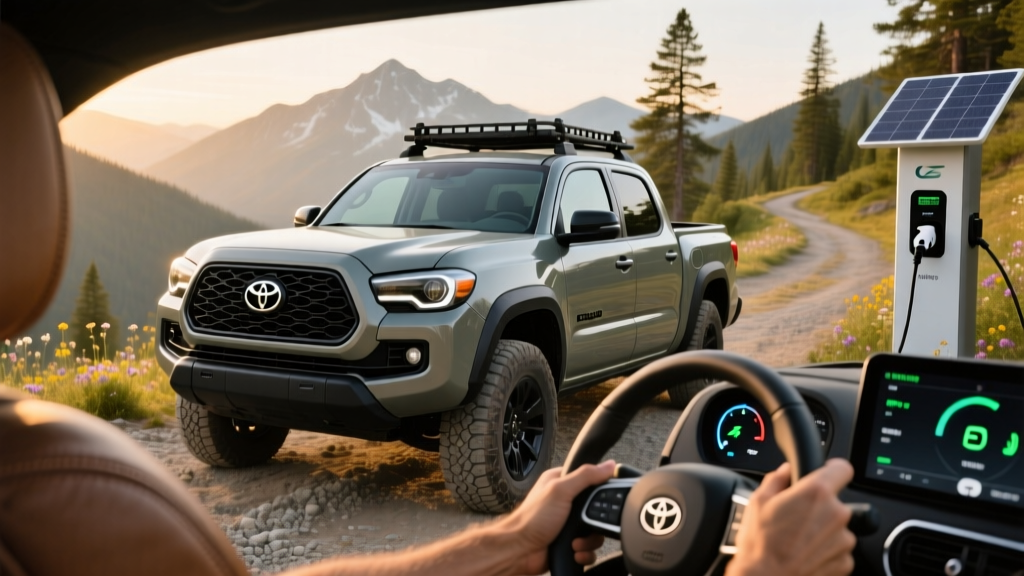
The 2025 Toyota Tacoma Hybrid arrives not as a plug-in efficiency play, but as a performance-oriented powertrain upgrade. Branded the i-FORCE MAX, this hybrid system pairs a turbocharged four-cylinder with an electric motor sandwiched between the engine and transmission. The result is 326 horsepower, 465 lb-ft of torque, and a modest but meaningful bump in fuel economy over the standard turbo four. For midsize truck buyers who want the torque of a V6 replacement without the fuel penalty, the Tacoma Hybrid makes a compelling case.
This guide breaks down everything you need to know: EPA fuel economy versus real-world expectations, hybrid battery longevity, pricing across trims, towing capacity, and how the Tacoma Hybrid stacks up against both full EVs and conventional gas trucks in 2025.
2025 Toyota Tacoma Hybrid: Key Specs at a Glance
| Specification | 2025 Tacoma i-FORCE MAX Hybrid |
|---|---|
| Powertrain | 2.4L turbocharged 4-cyl + electric motor (i-FORCE MAX) |
| Combined Horsepower | 326 hp |
| Combined Torque | 465 lb-ft |
| Transmission | 8-speed automatic |
| Drivetrain | 4WD (standard on Hybrid trims) |
| EPA MPG (City/Hwy/Combined) | 23 / 27 / 24 MPG (4WD, varies by trim) |
| Max Towing Capacity | 6,000 lbs (trim-dependent) |
| Hybrid Battery Type | Lithium-ion, ~1.87 kWh (performance-assist, not plug-in) |
| Hybrid Battery Warranty | 10 years / 150,000 miles |
| Base MSRP (TRD Sport Hybrid) | ~$41,830 (including destination) |
| Federal Tax Credit (§30D) | Not eligible (not a PHEV or BEV) |
Understanding the Tacoma Hybrid: HEV, Not PHEV
This distinction matters because it shapes ownership expectations. The 2025 Tacoma Hybrid is a conventional hybrid electric vehicle (HEV). It does not plug in. There is no charging port, no electric-only driving range, and no need to install a Level 2 home charger. The small lithium-ion battery charges through regenerative braking and the gasoline engine.
- HEV (Hybrid Electric Vehicle): No plug. Battery charges via regen and engine. Improves MPG modestly. No electric-only range. Example: Tacoma i-FORCE MAX, Toyota RAV4 Hybrid.
- PHEV (Plug-in Hybrid): Plugs in. Larger battery (typically 10–20 kWh). Offers 20–45 miles of electric-only driving before the gas engine kicks in. Eligible for federal tax credits (up to $7,500 under §30D). Example: Toyota RAV4 Prime, Ford Escape PHEV.
- BEV (Battery Electric Vehicle): No gas engine. Runs entirely on electricity. 200–400+ mile range. Plugs in at home or DC fast chargers. Example: Ford F-150 Lightning, Rivian R1T.
The Tacoma Hybrid's electric motor exists to fill in the torque curve of the turbocharged 2.4L engine, providing instant low-end thrust that eliminates the lag typical of small turbo fours. Toyota's goal here was performance augmentation first, fuel savings second.
Fuel Economy: EPA Ratings and Real-World MPG
| Trim / Config | City MPG | Highway MPG | Combined MPG |
|---|---|---|---|
| TRD Sport i-FORCE MAX 4WD | 23 | 27 | 24 |
| TRD Off-Road i-FORCE MAX 4WD | 22 | 26 | 24 |
| Limited i-FORCE MAX 4WD | 23 | 26 | 24 |
| Trailhunter i-FORCE MAX 4WD | 22 | 25 | 23 |
Source: EPA Fuel Economy (fueleconomy.gov)
Real-World MPG vs. EPA Estimates
Toyota's hybrid systems have historically performed close to or slightly above EPA city estimates because regenerative braking recaptures energy in stop-and-go traffic. On the highway, where regen opportunities are minimal, expect figures to land near the EPA sticker.
Based on owner-reported data and early reviews, Tacoma Hybrid owners typically see:
- City driving: 23–26 MPG (regen-heavy routes can push slightly above EPA)
- Highway driving (70–75 mph): 23–26 MPG
- Towing or hauling heavy loads: 14–18 MPG (hybrid system provides torque assist but does not eliminate the fuel cost of towing)
- Cold weather impact: Expect 1–2 MPG reduction in sub-freezing temperatures as the engine runs more frequently to maintain cabin heat and battery temperature
Compared to the standard 2.4L turbo i-FORCE (non-hybrid, 4WD), which returns roughly 20 city / 26 highway / 22 combined, the hybrid gains about 2 MPG combined. That's a 9% improvement — meaningful over 15,000 annual miles, saving approximately $120–$150 per year at $3.50/gallon.
Performance: Where the Hybrid System Shines
The i-FORCE MAX's 326 horsepower and 465 lb-ft of torque represent a significant jump over the standard i-FORCE 2.4L turbo (278 hp / 317 lb-ft). The electric motor, integrated into the bell housing between the engine and the 8-speed automatic, delivers peak torque from near-zero RPM.
This matters practically:
- 0–60 mph: Approximately 6.5–7.0 seconds (estimated, varies by trim weight)
- Highway passing: The instant electric torque eliminates the downshift-and-wait delay of the non-hybrid turbo
- Towing: Up to 6,000 lbs max (TRD Sport trim). The Trailhunter, with its off-road equipment weight, rates slightly lower. The hybrid's torque advantage makes trailer launches and hill climbs noticeably easier than the base engine
- Payload: Approximately 1,600–1,700 lbs depending on trim configuration
The hybrid system also enables low-speed electric-only crawling in off-road situations (Trailhunter and TRD Off-Road trims), allowing near-silent trail navigation at low speeds before the engine engages.
Hybrid Battery Longevity, Warranty, and Replacement Cost
Toyota covers the hybrid battery assembly for 10 years or 150,000 miles (whichever comes first) on all 2020+ model-year hybrids. This is one of the longest hybrid battery warranties in the industry. The warranty covers capacity loss below a defined threshold and component failure.
The Tacoma Hybrid uses a relatively small lithium-ion battery pack (~1.87 kWh). Unlike a full EV battery (60–100+ kWh), this pack is not subjected to deep charge-discharge cycles. It operates in a narrow state-of-charge window (roughly 40–80%), which dramatically reduces degradation stress.
Expected Battery Lifespan
Toyota's hybrid battery track record is among the best in the industry. Prius batteries from the early 2000s routinely lasted 200,000+ miles. Modern lithium-ion hybrid packs are expected to outlast the vehicle's practical lifespan in most cases.
- Typical degradation: Minimal — the battery management system prevents deep cycling
- Realistic replacement timeline: 15+ years or 200,000+ miles under normal use
- Out-of-warranty replacement cost: Estimated $3,000–$5,000 for the hybrid battery pack (based on current Toyota hybrid battery pricing for RAV4 Hybrid and Highlander Hybrid). Individual module replacement, if needed, can cost $500–$1,500
For comparison, a conventional truck transmission or turbo replacement can cost $3,000–$6,000. The hybrid system adds complexity but not necessarily long-term cost risk.
Hybrid System Reliability
Toyota has built millions of hybrids since the 1997 Prius. The i-FORCE MAX system is newer (debuted in the Tundra and Sequoia for 2022), but it shares the same fundamental architecture. Early Tundra i-FORCE MAX owners have reported strong reliability through the first 50,000–80,000 miles. The hybrid components (motor, inverter, battery) add weight but fewer wear items than a traditional drivetrain — no torque converter to fail, and regenerative braking extends brake pad life significantly.
Pricing, Trims, and Tax Credit Eligibility
The i-FORCE MAX hybrid powertrain is available on several Tacoma trims for 2025:
| Trim | Approx. MSRP (4WD, incl. destination) | Key Features |
|---|---|---|
| TRD Sport Hybrid | $41,830 | Sport-tuned suspension, 6,000-lb tow rating, 20" wheels |
| TRD Off-Road Hybrid | $43,330 | Locking rear diff, Crawl Control, Multi-Terrain Select |
| Trailhunter Hybrid | $53,330 | ARB steel bumpers, Old Man Emu suspension, 33" tires, integrated air compressor |
| TRD Pro Hybrid | $57,630 | FOX shocks, IsoDynamic seats, front skid plate, exclusive styling |
| Limited Hybrid | $48,830 | Leather, premium audio, adaptive cruise, power tailgate |
Federal Tax Credit: Not Eligible
The 2025 Tacoma Hybrid does not qualify for the federal §30D Clean Vehicle Credit. That credit applies exclusively to plug-in hybrid electric vehicles (PHEVs) with at least 7 kWh of battery capacity and battery electric vehicles (BEVs). The Tacoma's ~1.87 kWh battery and lack of a plug disqualify it entirely.
This is a common point of confusion. The IRS defines eligible vehicles under §30D rules, and conventional hybrids (HEVs) have not been eligible since the original Hybrid Tax Credit expired for Toyota in 2007.
No state-level hybrid-specific incentives currently exist in most jurisdictions, though a handful of states offer minor registration fee reductions or HOV lane access for hybrids. Check your state's DMV or energy office for local programs.
Tacoma Hybrid vs. Gas Truck vs. EV Truck: Which Fits You?
- You want more torque and slightly better fuel economy than the base turbo without plugging in
- You tow regularly and value low-end electric torque assist
- You don't have home charging access and don't want to rely on public infrastructure
- You want Toyota's proven hybrid reliability with a 10-year battery warranty
- You want a midsize truck with no range compromise for remote/off-grid use
- You have Level 2 home charging and want near-zero fuel cost for daily driving
- You want 230–350+ miles of range with no gasoline dependency
- You qualify for the up-to-$7,500 federal tax credit (§30D) and your income/MSRP meet requirements
- You prioritize instant torque, quiet operation, and V2L (vehicle-to-load) capability
- You don't tow heavy loads frequently (EV range drops 40–60% when towing at max capacity)
- Budget is the top priority (saves $2,000–$4,000 vs. Hybrid trims)
- You drive mostly highway miles where the hybrid's MPG advantage is smallest
- You want the lightest curb weight for maximum payload
Towing Comparison: Hybrid Advantage
The i-FORCE MAX Hybrid's 465 lb-ft of torque peaks lower in the rev range than the standard i-FORCE (317 lb-ft). When pulling a 4,000–5,000 lb trailer up a grade, the hybrid system's electric assist reduces transmission hunting and keeps the engine in its most efficient band. Fuel economy while towing won't match unladen driving — expect 14–18 MPG — but the drivability improvement is tangible.
Ownership Costs: 5-Year Outlook
Here's a rough 5-year/75,000-mile ownership comparison for the Tacoma Hybrid vs. the standard turbo vs. an EV truck (assuming 15,000 miles/year):
| Cost Category | Tacoma Hybrid (i-FORCE MAX) | Tacoma Gas (i-FORCE) | EV Truck (e.g., F-150 Lightning) |
|---|---|---|---|
| Purchase Price (approx.) | $43,000 | $39,000 | $55,000 (before $7,500 credit) |
| Federal Tax Credit | $0 | $0 | Up to $7,500 (§30D, if eligible) |
| Fuel/Energy (5 yr) | ~$10,900 (24 MPG, $3.50/gal) | ~$11,900 (22 MPG, $3.50/gal) | ~$4,700 (home charging, $0.14/kWh) |
| Maintenance (5 yr) | ~$2,800 | ~$3,200 | ~$1,800 |
| Insurance (5 yr avg) | ~$9,500 | ~$9,000 | ~$11,000 |
| Estimated 5-Yr Total | ~$66,200 | ~$63,100 | ~$65,000 (after credit) |
The Tacoma Hybrid saves roughly $1,000 in fuel over five years compared to the gas model — enough to partially offset its higher MSRP. The EV truck wins on operating costs but requires home charging infrastructure and may not match the Tacoma's off-road capability or midsize footprint.
Pros and Cons: 2025 Tacoma Hybrid
- 465 lb-ft of torque from near-zero RPM — excellent for towing and trail use
- 24 MPG combined beats the non-hybrid by ~2 MPG
- 10-year / 150,000-mile hybrid battery warranty
- No plug-in required — zero lifestyle change from a gas truck
- Proven Toyota hybrid architecture with millions of units in the field
- Regenerative braking extends brake pad life
- Available on off-road-oriented trims (TRD Off-Road, Trailhunter, TRD Pro)
- Only ~2 MPG improvement over the standard turbo — modest fuel savings
- No federal tax credit eligibility
- Hybrid system adds ~150 lbs of curb weight, slightly reducing payload
- Not a PHEV — no electric-only driving mode for daily commutes
- TRD Pro and Trailhunter hybrid trims push past $55,000
- MPG gains diminish significantly when towing or off-roading
Frequently Asked Questions
How many MPG does the 2025 Toyota Tacoma Hybrid get?
The EPA rates the Tacoma i-FORCE MAX Hybrid at 23 city / 27 highway / 24 combined MPG (4WD, TRD Sport trim). Off-road-oriented trims like the Trailhunter drop slightly to 22 city / 25 highway / 23 combined. Real-world results typically land within 1–2 MPG of these figures, with city driving sometimes exceeding EPA thanks to regenerative braking.
Does the Tacoma Hybrid need to be plugged in?
No. The Tacoma i-FORCE MAX is a conventional hybrid (HEV). The battery charges through regenerative braking and the gasoline engine. There is no plug, no charging port, and no electric-only driving range.
How far can the Tacoma Hybrid drive on electric power alone?
It cannot. Unlike a PHEV (plug-in hybrid), the Tacoma Hybrid has no meaningful electric-only range. The electric motor assists the gasoline engine but does not propel the truck independently except at very low speeds in specific off-road crawl modes.
Is the Tacoma Hybrid reliable?
Toyota's hybrid systems have an exceptional reliability record spanning over 25 years and millions of vehicles. The i-FORCE MAX system in the Tacoma shares architecture with the Tundra and Sequoia hybrids, which have performed well in early ownership. The hybrid battery is warranted for 10 years / 150,000 miles, and out-of-warranty replacement is estimated at $3,000–$5,000 — comparable to a conventional transmission replacement.
Does the 2025 Tacoma Hybrid qualify for a federal tax credit?
No. The federal §30D Clean Vehicle Credit applies only to plug-in hybrids (PHEVs) and battery electric vehicles (BEVs). The Tacoma Hybrid is a conventional HEV with a small battery that does not plug in, making it ineligible. Check the IRS Clean Vehicle Credit page for current eligibility rules.
How does the Tacoma Hybrid compare to the Ford F-150 Lightning?
These trucks serve different buyers. The Tacoma Hybrid is a midsize truck with no plug, ~6,000-lb towing, and 24 MPG combined. The F-150 Lightning is a full-size EV truck with 230–320 miles of range, 7,700–10,000-lb towing, and near-zero fuel cost when charged at home. If you need midsize dimensions, off-road capability, and no charging dependency, the Tacoma Hybrid wins. If you want maximum fuel savings, have home charging, and need full-size capability, the Lightning is the stronger choice.
What is the towing capacity of the Tacoma Hybrid?
The TRD Sport i-FORCE MAX Hybrid rates up to 6,000 lbs when properly equipped. Off-road trims (TRD Off-Road, Trailhunter) and the TRD Pro rate slightly lower due to suspension tuning and added equipment weight. Always consult Toyota's official towing guide for your specific trim and configuration.
Specifications sourced from fueleconomy.gov and Toyota's official 2025 Tacoma specifications. Pricing reflects MSRP including destination charges and is subject to change. Tax credit rules per IRS §30D; consult a tax professional for personal eligibility.