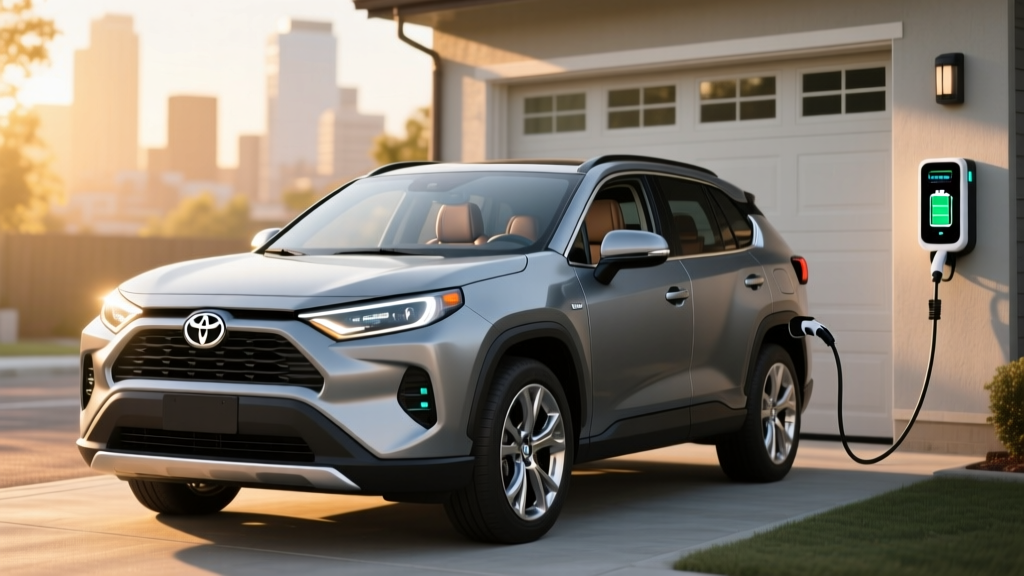
The 2025 Toyota RAV4 XSE Hybrid occupies a specific niche in Toyota's best-selling SUV lineup: it's the sport-tuned trim of the conventional hybrid (HEV) powertrain. Unlike the RAV4 Prime plug-in hybrid, the XSE Hybrid never needs to be plugged in—it regenerates energy through braking and the gas engine to charge its small battery. For buyers who want the fuel savings of electrification without changing their refueling habits, this trim delivers a compelling package with a 219-horsepower powertrain, an EPA-estimated 39 MPG combined, and Toyota's reputation for hybrid longevity.
In this review, we break down exactly what the XSE Hybrid delivers in real-world driving, how it compares to the RAV4 Prime PHEV and a full EV, and whether its battery warranty and ownership economics justify the $38,470 starting price.
2025 RAV4 XSE Hybrid: Key Specifications at a Glance
| Specification | 2025 RAV4 XSE Hybrid (HEV) |
|---|---|
| Powertrain | 2.5L 4-cyl + 3 electric motors (AWD) |
| Combined Horsepower | 219 hp |
| 0–60 mph | ~7.4 seconds |
| EPA Fuel Economy (City / Hwy / Combined) | 41 / 38 / 39 MPG |
| Drivetrain | Electronic AWD (eAWD) |
| Hybrid Battery | 1.6 kWh (sealed NiMH), self-charging |
| Plug-In Required? | No — conventional HEV |
| Fuel Tank | 14.5 gallons |
| Total Range | ~565 miles |
| Cargo Volume (rear seats up / down) | 37.5 / 69.8 cu ft |
| Towing Capacity | 1,750 lbs |
| Starting MSRP | $38,470 |
| Hybrid Battery Warranty | 10 years / 150,000 miles |
Fuel Economy: EPA Estimates vs. Real-World MPG
The EPA rates the 2025 RAV4 Hybrid AWD at 41 MPG city, 38 MPG highway, and 39 MPG combined, according to fueleconomy.gov. The XSE trim, with its 18-inch wheels and sport-tuned suspension, carries the same EPA ratings as other RAV4 Hybrid AWD trims (LE, SE, XLE, etc.).
Toyota's hybrid system excels in stop-and-go driving because the electric motors handle low-speed propulsion and regenerative braking recovers energy that a conventional car wastes as heat. In real-world testing, many owners report exceeding the EPA city figure—42 to 45 MPG is common in urban driving with moderate temperatures. Highway driving at 75+ mph tends to return 34 to 37 MPG, since the gasoline engine does the bulk of the work at sustained high speeds where regenerative braking contributes less.
| Driving Scenario | EPA Estimate | Real-World Expectation |
|---|---|---|
| City (stop-and-go, under 45 mph) | 41 MPG | 42–45 MPG |
| Highway (70–80 mph sustained) | 38 MPG | 34–37 MPG |
| Combined (mixed driving) | 39 MPG | 37–41 MPG |
| Cold Weather (below 32°F, short trips) | — | 32–36 MPG |
Cold weather reduces MPG in all vehicles, but hybrids see a more pronounced drop on short trips because the engine must run longer to heat the cabin and bring the catalytic converter to operating temperature. On a 3-mile commute in 20°F weather, expect closer to 30–33 MPG. On longer drives where the system reaches thermal equilibrium, the penalty shrinks to 2–4 MPG below the EPA combined figure.
How the XSE Hybrid Powertrain Works
The RAV4 XSE Hybrid pairs a 2.5-liter Atkinson-cycle four-cylinder engine (176 hp, 163 lb-ft) with three electric motor-generators: one integrated into the transaxle for front-wheel drive, one that acts as a generator/starter, and a rear-mounted motor (54 hp) that provides electronic all-wheel drive. Combined system output is 219 horsepower.
The 1.6 kWh nickel-metal hydride (NiMH) battery pack is small by EV standards—it stores roughly enough energy to propel the vehicle for about one mile on electric power alone at low speeds. But that's by design. In a conventional hybrid, the battery functions as a buffer, capturing energy from regenerative braking and engine excess, then deploying it for acceleration assist and low-speed electric-only crawling. The system manages charge state automatically; the driver never thinks about it.
The XSE trim adds sport-tuned shock absorbers, paddle shifters for simulated gear holding, and a slightly firmer steering calibration compared to the XLE Hybrid. It does not change the powertrain output or fuel economy.
HEV vs. PHEV: RAV4 Hybrid vs. RAV4 Prime
A common source of confusion is the difference between the RAV4 Hybrid (HEV) and the RAV4 Prime (PHEV). Here's how they compare:
| Feature | RAV4 XSE Hybrid (HEV) | RAV4 Prime SE (PHEV) |
|---|---|---|
| Plug-in Required? | No | Yes (Level 1 or Level 2) |
| Battery Size | 1.6 kWh (NiMH) | 18.1 kWh (lithium-ion) |
| Electric-Only Range | ~1 mile (low-speed assist) | 42 miles (EPA) |
| Combined Horsepower | 219 hp | 302 hp |
| 0–60 mph | ~7.4 sec | 5.7 sec |
| MPG (after EV range depleted) | 39 combined | 38 combined (gas mode) |
| MPGe (with full charge) | N/A | 94 MPGe |
| DC Fast Charging | N/A | No (Level 2 AC only) |
| Level 2 Charge Time (0–100%) | N/A | ~2.5 hours (6.6 kW) |
| Starting MSRP | $38,470 | $43,690 |
| Federal Tax Credit (§30D) | Not eligible | Eligibility varies by sourcing |
Key distinction: The RAV4 Prime's 18.1 kWh lithium-ion battery gives it 42 miles of genuine electric-only range at highway speeds—enough for most daily commutes without burning gas. But it costs $5,220 more, requires access to a plug to realize its efficiency advantage, and its federal tax credit eligibility depends on current-year battery sourcing requirements under IRS §30D rules.
Pricing, Trims, and Tax Credit Eligibility
The 2025 RAV4 XSE Hybrid starts at $38,470 (including destination). Key standard equipment includes:
- Toyota Safety Sense 2.5+ (pre-collision, lane tracing, adaptive cruise, blind-spot monitor)
- 8-inch touchscreen with wireless Apple CarPlay and Android Auto
- SofTex synthetic leather seats with sport bolsters
- 18-inch black alloy wheels
- Dual-zone automatic climate control
- LED headlights and taillights
Options that push the price higher include the Premium Audio with JBL ($1,620), a panoramic moonroof ($1,400), and the Technology Package with a 10.5-inch display and digital rearview mirror. A fully loaded XSE Hybrid can reach approximately $44,000.
Does the RAV4 XSE Hybrid qualify for a federal tax credit?
No. The conventional RAV4 Hybrid (HEV) does not qualify for the federal §30D Clean Vehicle Credit. That credit is reserved for plug-in electric vehicles (BEVs and PHEVs) that meet battery capacity, sourcing, MSRP, and buyer income requirements. The RAV4 Prime PHEV may qualify for up to $7,500 depending on current-year critical mineral and battery component sourcing rules, but the standard hybrid does not have a large enough battery or plug-in capability to be eligible.
Some states and local utilities offer rebates for conventional hybrids, but these vary widely by jurisdiction. Check your state energy office or utility provider for current programs.
Battery Warranty, Reliability, and Replacement Cost
Toyota Hybrid Battery Coverage
Toyota covers the 2025 RAV4 Hybrid's battery pack for 10 years or 150,000 miles, whichever comes first. This is one of the longest hybrid battery warranties in the industry and applies to all US states (California's emissions warranty extends this further in some cases).
Toyota's hybrid system is among the most proven in the automotive industry. The Prius has used a similar planetary-gear hybrid synergy drive since 1997, and the RAV4 Hybrid has been in production since 2016. Real-world data from fleet operators and high-mileage owners shows that Toyota's NiMH hybrid batteries routinely last 150,000 to 200,000+ miles before significant capacity loss.
If replacement is needed outside warranty, a new OEM hybrid battery for the RAV4 Hybrid costs approximately $3,000 to $4,500 including labor. Third-party refurbishment shops offer reconditioned packs for $1,500 to $2,500. Because the battery is small (1.6 kWh) and the system doesn't deep-cycle it heavily—Toyota's software keeps the state of charge between roughly 40% and 80% to maximize longevity—degradation is slow and gradual. Most owners will never need a replacement during typical ownership.
The broader powertrain, including the gasoline engine, electric motor-generators, and transaxle, is covered under Toyota's 5-year/60,000-mile powertrain warranty, with the hybrid-specific components (inverter, control module) falling under the 10-year/150,000-mile hybrid system warranty.
Driving Impressions: Sport-Tuned Hybrid
The XSE trim's sport suspension tuning is noticeable but subtle. The shocks are firmer than the XLE Hybrid, reducing body roll in corners and giving the SUV a more planted feel on winding roads. The trade-off is a slightly more reactive ride over sharp pavement imperfections—expansion joints and potholes transmit more impact to the cabin than in the softer XLE or LE trims.
The 219-hp combined output provides confident merging and passing power. The electric motors deliver instant torque from a stop, which makes the RAV4 Hybrid feel quicker in city driving than its 7.4-second 0–60 time suggests. The eCVT (planetary gearset, not a belt-driven CVT) operates smoothly without the rubber-band sensation some drivers associate with continuously variable transmissions.
The eAWD system engages the rear electric motor automatically when front-wheel slip is detected or during hard acceleration. It's not a dedicated off-road system—the RAV4 Hybrid's ground clearance (8.1 inches) and lack of low-range gearing limit serious trail use—but it handles rain, snow, and gravel roads competently.
RAV4 XSE Hybrid vs. Full EV vs. Gas RAV4: Which Fits You?
Choose the RAV4 XSE Hybrid If:
- You don't have reliable access to home or workplace charging
- You want 39+ MPG without any behavior change
- You drive a mix of city and highway miles
- You want AWD capability with lower fuel costs
- You plan to keep the vehicle 8–10+ years (warranty coverage)
- Your budget is under $40,000 for a hybrid SUV
Consider a Full EV (e.g., Tesla Model Y, Hyundai Ioniq 5) If:
- You can install a Level 2 home charger
- Your daily commute is under 60 miles round-trip
- You want near-zero maintenance (no oil changes, fewer brake replacements)
- You qualify for the $7,500 federal tax credit
- You want instant torque and one-pedal driving
Compared to the gas-only RAV4 (28 MPG combined EPA), the XSE Hybrid saves approximately $500 to $700 per year in fuel costs at 15,000 miles driven annually and $3.50/gallon regular unleaded. The hybrid's $3,000 to $4,000 price premium over a similarly equipped gas RAV4 XLE pays back in roughly 5 to 7 years depending on driving patterns and fuel prices.
Compared to a full EV like the Hyundai Ioniq 5 (303 miles EPA range, ~$42,000 before credits), the RAV4 Hybrid avoids range anxiety and charging infrastructure dependence but sacrifices the lower per-mile energy cost and reduced maintenance of a battery-electric vehicle.
Ownership Costs: 5-Year Estimate
| Cost Category | RAV4 XSE Hybrid (5 yrs) | Gas RAV4 XLE (5 yrs) |
|---|---|---|
| Purchase Price (MSRP) | $38,470 | $35,500 |
| Fuel (15k mi/yr, $3.50/gal) | $6,730 | $9,375 |
| Maintenance (estimated) | $2,800 | $3,200 |
| Insurance (national avg) | $7,500 | $7,200 |
| Estimated Depreciation | $14,500 | $13,800 |
| 5-Year Total | ~$70,000 | ~$69,075 |
The hybrid's fuel savings nearly offset its higher purchase price over five years. Where the RAV4 Hybrid pulls ahead is in years 6 through 10, when fuel savings compound and Toyota's strong resale value—hybrids consistently retain more value than their gas counterparts in the used market—narrows the depreciation gap.
Frequently Asked Questions
How many MPG does the 2025 RAV4 XSE Hybrid get?
The EPA rates it at 41 MPG city, 38 MPG highway, and 39 MPG combined. In real-world driving, city-heavy commutes often return 42–45 MPG, while sustained highway driving at 75+ mph drops to 34–37 MPG. Cold weather on short trips can reduce efficiency to 30–33 MPG until the powertrain reaches operating temperature.
Do I need to plug in the RAV4 XSE Hybrid?
No. The RAV4 XSE Hybrid is a conventional hybrid (HEV), not a plug-in hybrid (PHEV). Its 1.6 kWh battery charges itself through regenerative braking and the gasoline engine. You refuel it like any other car—at a gas station. If you want plug-in capability with electric-only range, look at the RAV4 Prime PHEV instead.
Is the RAV4 Hybrid reliable, and what does battery replacement cost?
Toyota's hybrid powertrain has over 25 years of proven reliability. The hybrid battery is covered for 10 years / 150,000 miles. Real-world data shows most Toyota hybrid batteries last 150,000–200,000+ miles. Out-of-warranty replacement costs $3,000–$4,500 for a new OEM pack or $1,500–$2,500 for a refurbished unit. The planetary gearset eCVT has no belts or friction clutches to wear out, contributing to long-term durability.
Does the RAV4 XSE Hybrid qualify for any tax credit?
The conventional RAV4 Hybrid (HEV) does not qualify for the federal §30D Clean Vehicle Credit, which requires plug-in capability and minimum battery capacity. Some states or utilities may offer hybrid-specific rebates—check your local programs. The RAV4 Prime PHEV may qualify for up to $7,500 federally, subject to current-year battery sourcing and income requirements per IRS guidelines.
How does the XSE trim differ from the XLE or SE Hybrid?
The XSE adds sport-tuned shocks, 18-inch black alloy wheels, SofTex sport seats, paddle shifters, and unique exterior styling accents. The SE sits between the XLE and XSE with a sport appearance but standard suspension tuning. Fuel economy and powertrain output are identical across all RAV4 Hybrid AWD trims.
Can the RAV4 Hybrid tow, and is AWD standard on the XSE?
The RAV4 Hybrid has a maximum towing capacity of 1,750 pounds when properly equipped—adequate for a small utility trailer or a pair of dirt bikes, but not for a boat or camper. Electronic AWD (eAWD) is standard on all RAV4 Hybrid trims, including the XSE, using a dedicated rear electric motor that engages automatically.