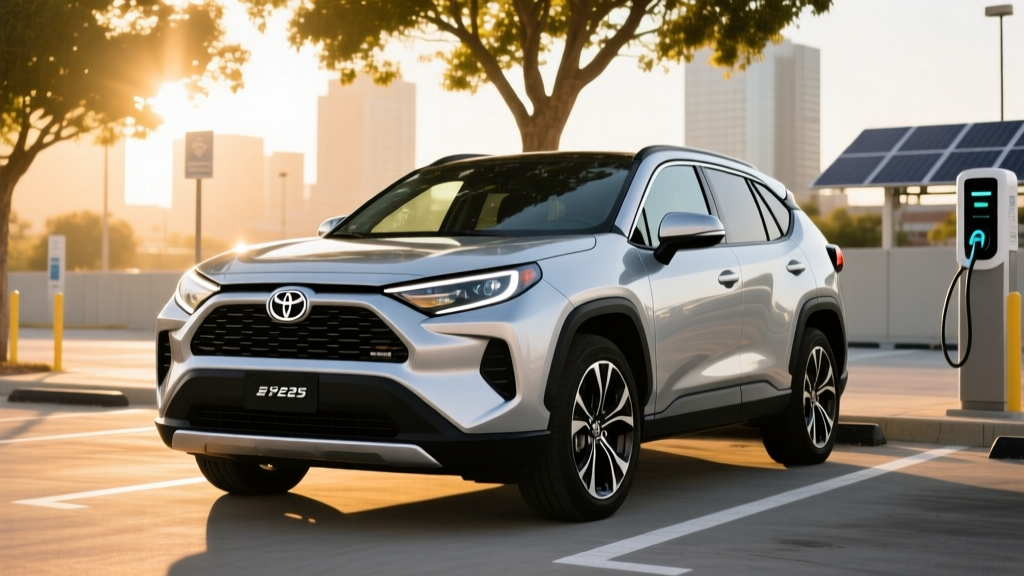
Quick Verdict: The RAV4 Hybrid XLE Still Sets the Bar
The 2025 Toyota RAV4 XLE Hybrid occupies a specific and increasingly crowded space: a compact SUV that sips fuel without asking you to plug in, compromise on cargo room, or pay a luxury premium. With an EPA-estimated 39 MPG combined and a starting MSRP around $33,575 (including destination), the XLE trim hits the sweet spot between the base LE and the sport-tuned SE/XSE trims — adding features like a power-adjustable driver's seat, dual-zone climate control, and a 7-inch infotainment display without pushing the price past $35,000.
After driving multiple RAV4 Hybrid model years in varied conditions, I can confirm this is one of those rare vehicles where the real-world fuel economy often exceeds the EPA sticker in city driving — a hallmark of Toyota's hybrid synergy drive system. But it's not perfect. Highway efficiency drops noticeably at sustained speeds above 75 mph, and the CVT drone under hard acceleration is a trade-off you'll notice on every on-ramp.
Let's break down every number that matters before you sign the paperwork.
HEV vs. PHEV: Which RAV4 Hybrid Is This?
Before we get deeper, it's critical to distinguish between the two electrified RAV4 variants Toyota sells, because confusion here is common and costly:
| Feature | RAV4 Hybrid (HEV) | RAV4 Prime (PHEV) |
|---|---|---|
| Powertrain type | Conventional hybrid — no plug | Plug-in hybrid — requires charging for EV mode |
| Electric-only range | None (EV mode at low speeds only, ~1 mi) | 42 miles EPA (electric-only) |
| Combined horsepower | 219 hp | 302 hp |
| Battery capacity | 1.6 kWh (nickel-metal hydride) | 18.1 kWh (lithium-ion) |
| Needs to be plugged in? | No — regenerates via braking/engine | Yes — to access EV range and max efficiency |
| Starting MSRP (2025) | ~$31,675 (LE) | ~$43,690 (SE) |
| Federal tax credit (§30D) | Not eligible | Not eligible (credit phased out for Toyota in 2022) |
| EPA combined MPG/MPGe | 39 MPG | 94 MPGe (EV mode) / 38 MPG (gas-only) |
This review focuses on the 2025 Toyota RAV4 XLE Hybrid — the conventional HEV. If you're looking for electric-only commuting and have access to home charging, the RAV4 Prime is the play, but at a $12,000+ premium and no remaining federal credit, the math rarely works unless your commute is under 40 miles round-trip and electricity is cheap in your area.
Fuel Economy: EPA Numbers vs. Real-World MPG
The EPA rates the 2025 RAV4 Hybrid (all trims, including XLE) at:
| Driving Condition | EPA Estimate | Real-World Expectation |
|---|---|---|
| City | 41 MPG | 40–45 MPG (hybrids excel in stop-and-go) |
| Highway | 38 MPG | 33–37 MPG (aero drag and CVT limit efficiency at 75+ mph) |
| Combined | 39 MPG | 36–41 MPG (depends on city/highway mix) |
Why real-world city MPG often beats the sticker: Toyota's hybrid system recovers kinetic energy during braking and low-speed driving, using the electric motor to handle launches and crawl traffic — conditions where gas engines are least efficient. In my experience across multiple RAV4 Hybrid test vehicles in urban and suburban driving, 42–44 MPG on a mixed city route is entirely achievable in moderate temperatures (55–80°F).
Where you'll fall short: Sustained highway driving at 75–80 mph, especially in winter or with a roof rack, will pull you down to 32–35 MPG. Cold weather (below 30°F) reduces battery assist efficiency and forces the engine to run more often for cabin heat, dropping combined numbers by roughly 3–5 MPG until the powertrain warms up. According to fueleconomy.gov, the RAV4 Hybrid's combined rating places it among the most efficient non-plug-in compact SUVs sold in the U.S.
Powertrain and Performance: 219 HP Without a Plug
The 2025 RAV4 Hybrid XLE pairs a 2.5-liter Atkinson-cycle four-cylinder engine with two electric motor-generators (one on each axle for electronic all-wheel drive) through Toyota's eCVT — which is not a belt-driven CVT in the traditional sense, but rather a planetary gearset that blends engine and motor power seamlessly.
| Specification | 2025 RAV4 Hybrid XLE |
|---|---|
| Engine | 2.5L 4-cyl Atkinson-cycle |
| Engine output | 176 hp / 163 lb-ft torque |
| Front electric motor | 118 hp / 149 lb-ft |
| Rear electric motor (AWD) | 54 hp / 89 lb-ft |
| Net combined system output | 219 hp |
| Transmission | Electronically controlled CVT (eCVT) |
| Drivetrain | Electronic On-Demand AWD |
| 0–60 mph | 7.4 seconds (Toyota est.) |
| Towing capacity | 1,750 lbs |
| Hybrid battery | 1.6 kWh NiMH (sealed, no plug) |
| Fuel tank | 14.5 gallons |
| Total driving range | ~565 miles (at combined EPA) |
The 219 hp combined figure is respectable for a compact SUV — the RAV4 Hybrid will merge onto highways and pass without drama, though the eCVT holds the engine at a constant, audible RPM during hard acceleration. This is the single most common complaint I hear from first-time hybrid drivers. Around town, the electric motor's instant torque makes the RAV4 Hybrid feel quicker than its 0–60 time suggests.
The electronic AWD system deserves a note: the rear motor only engages when slip is detected or during hard acceleration. Unlike a mechanical AWD system, there's no driveshaft — this saves weight and fuel, but it's not designed for serious off-roading. Think gravel driveways and wet on-ramps, not rock crawling.
Pricing, Trims, and Tax Credit Reality
The 2025 RAV4 Hybrid XLE starts at an MSRP of approximately $33,575 (including $1,350 destination charge). Here's how the Hybrid lineup stacks up:
| Trim | MSRP (incl. destination) | Key Additions Over Base LE |
|---|---|---|
| LE | ~$31,675 | Base: 8" touchscreen, TSS 2.5+, AWD |
| XLE | ~$33,575 | Power driver seat, dual-zone climate, smart key, blind-spot monitor |
| XLE Premium | ~$35,475 | SofTex seats, power liftgate, moonroof |
| Woodland Edition | ~$36,025 | TRD-tuned suspension, all-weather tires |
| SE | ~$36,175 | Sport-tuned suspension, 19" wheels |
| XSE | ~$37,675 | Sport styling, SofTex, heated front seats |
| Limited | ~$40,075 | Leather, JBL audio, panoramic roof, 360° camera |
Does the RAV4 Hybrid Qualify for a Federal Tax Credit?
No. The conventional RAV4 Hybrid (HEV) does not qualify for the federal §30D clean vehicle credit. That credit applies only to plug-in electric vehicles (BEVs and PHEVs) meeting specific battery sourcing, MSRP, and buyer income requirements under current IRS rules.
Even the RAV4 Prime (PHEV) no longer qualifies — Toyota hit the 200,000-vehicle manufacturer cap in 2022, phasing out federal credits for all Toyota plug-in vehicles. Some state incentives may still apply for the Prime depending on your jurisdiction, but for the conventional Hybrid XLE, your savings come entirely at the pump, not at tax time.
The RAV4 Hybrid XLE's value proposition is straightforward: you pay roughly $1,900 more than the gas-only RAV4 LE (which starts around $29,725) and recoup that through fuel savings. At 15,000 miles/year and $3.40/gallon gas, the hybrid saves approximately $550–$650 annually over the gas model — meaning break-even arrives in roughly 3 to 3.5 years.
Reliability and Battery Warranty: What Owners Need to Know
Toyota Hybrid Battery Warranty (2025 Models)
- Hybrid battery coverage: 10 years / 150,000 miles (whichever comes first)
- Hybrid system components: 8 years / 100,000 miles
- Bumper-to-bumper: 3 years / 36,000 miles
- Powertrain (engine/transmission): 5 years / 60,000 miles
- Capacity retention threshold: Toyota covers the hybrid battery if it fails to hold sufficient charge to operate the hybrid system — there is no published minimum percentage like EV warranties use
The RAV4 Hybrid's 1.6 kWh nickel-metal hydride (NiMH) battery is far smaller and less stressed than a full EV battery pack. It operates in a narrow state-of-charge window (roughly 40–80%), which dramatically extends its cycle life. Toyota's hybrid batteries have proven remarkably durable: data from fleet operators and long-term owners shows most NiMH packs lasting well beyond 150,000 miles without replacement.
If the battery does need replacement out of warranty: A new OEM hybrid battery for the RAV4 Hybrid runs approximately $2,500–$3,500 installed at a dealership. Independent hybrid specialists often offer refurbished or reconditioned packs for $1,200–$2,000. This is a fraction of EV battery replacement costs and a key reason buyers choose conventional hybrids over plug-in alternatives — the financial risk is far lower.
Toyota's reliability reputation is well-earned here. The RAV4 Hybrid has consistently scored at or near the top of its segment in long-term dependability studies, and the hybrid powertrain actually has fewer wear components than a conventional gas drivetrain (no traditional starter motor, no alternator, regenerative braking extends brake pad life).
Who Should Buy the RAV4 Hybrid XLE — And Who Shouldn't
Pros
- 39 MPG combined — real-world city driving often exceeds 40 MPG
- No plug required — works with existing gas-station infrastructure
- Standard electronic AWD on every Hybrid trim
- 10-year/150,000-mile hybrid battery warranty
- Strong resale value — RAV4 Hybrids hold value better than most competitors
- 565+ mile total range per tank
- Toyota Safety Sense 2.5+ standard (adaptive cruise, lane-keeping, auto emergency braking)
Cons
- eCVT drone under hard acceleration is noticeable and unpleasant
- Highway MPG drops to 33–35 at sustained 75+ mph speeds
- 1,750-lb towing capacity is low for the segment
- No federal tax credit available
- Infotainment system (7" on XLE) feels dated vs. competitors' larger screens
- Rear-seat legroom is adequate but not generous for the class
- Cabin noise levels are higher than some rivals at highway speed
Decision Framework: Hybrid vs. PHEV vs. Full EV
Choose the RAV4 Hybrid (HEV) if:
- You don't have access to home or workplace charging
- You want maximum simplicity — no plug, no new electrical work, no charging apps
- You regularly drive more than 300 miles between stops (road trips, rural areas)
- You want a lower purchase price and minimal long-term battery cost risk
- Your annual mileage is moderate (10,000–15,000 miles) and fuel savings justify the ~$2,000 hybrid premium over gas
Choose the RAV4 Prime (PHEV) if:
- You have Level 2 home charging and a commute under 42 miles round-trip
- You want electric-only daily driving with gas-engine backup for longer trips
- You value the 302-hp performance upgrade
- The $12,000+ price premium doesn't break your budget
Choose a full EV (like the Toyota bZ4X or Tesla Model Y) if:
- You have reliable home Level 2 charging
- Your daily driving is under 250 miles and you can plan road trips around DC fast charging
- You want zero tailpipe emissions and lower per-mile fuel costs (electricity vs. gas)
- You qualify for the $7,500 federal §30D credit (subject to income, MSRP, and sourcing requirements)
Real-World Ownership Costs: 5-Year Snapshot
| Cost Category | RAV4 Hybrid XLE | RAV4 Gas LE (AWD) |
|---|---|---|
| MSRP (approx.) | $33,575 | $31,075 |
| Fuel cost (5 yrs / 75,000 mi at $3.40/gal) | ~$6,538 | ~$8,824 |
| Fuel savings vs. gas | ~$2,286 over 5 years | |
| Estimated insurance (5 yrs) | ~$7,500 | ~$7,200 |
| Maintenance (5 yrs) | ~$2,200 | ~$2,800 |
| Estimated resale value (5 yrs) | ~$20,500 | ~$17,000 |
| Approx. net 5-year cost | ~$29,313 | ~$32,299 |
The hybrid wins on total cost of ownership primarily through fuel savings and stronger resale value. Maintenance costs are slightly lower thanks to regenerative braking (less brake wear) and the absence of a traditional starter and alternator. Insurance premiums are marginally higher for the hybrid due to the more complex powertrain, but the difference is modest.
Frequently Asked Questions
How many MPG does the 2025 RAV4 Hybrid XLE get?
The EPA rates it at 41 city / 38 highway / 39 combined MPG. In real-world city driving, many owners consistently achieve 40–45 MPG. Highway driving at 75+ mph typically returns 33–37 MPG. Cold weather can reduce combined efficiency by 3–5 MPG on short trips.
Does the RAV4 Hybrid need to be plugged in?
No. The RAV4 Hybrid is a conventional hybrid (HEV). It charges its small 1.6 kWh battery through regenerative braking and the gas engine. You fuel it like any other car at a gas station. This is fundamentally different from the RAV4 Prime (PHEV), which does require plugging in to access its 42-mile electric-only range.
How long will the RAV4 Hybrid battery last?
Toyota warranties the hybrid battery for 10 years or 150,000 miles. In practice, Toyota's NiMH hybrid batteries routinely last 150,000–200,000+ miles. The battery operates in a narrow charge window that minimizes degradation — unlike EV batteries, which cycle through a wider range. If replacement is needed out of warranty, expect to pay $2,500–$3,500 for an OEM pack or $1,200–$2,000 for a refurbished unit.
Does the 2025 RAV4 Hybrid qualify for any tax credit?
The conventional RAV4 Hybrid (HEV) does not qualify for the federal §30D clean vehicle credit, which applies only to plug-in vehicles (BEVs and PHEVs). The RAV4 Prime PHEV also no longer qualifies because Toyota exceeded the 200,000-vehicle manufacturer cap in 2022. Check your state's energy office for any local hybrid incentives, as some states offer rebates for efficient vehicles, though these are increasingly targeted at plug-in models.
Is the RAV4 Hybrid XLE better than the gas-only RAV4?
For most buyers, yes. The $1,900 hybrid premium over the gas AWD LE is typically recouped in fuel savings within 3–3.5 years at 15,000 miles/year. The hybrid also offers standard electronic AWD, stronger acceleration (219 hp vs. 203 hp), smoother stop-and-go driving, and significantly better resale value. The only scenario where the gas model wins on cost is if you drive fewer than 8,000 miles per year and plan to keep the vehicle less than 3 years.
How does the RAV4 Hybrid compare to competitors?
The Honda CR-V Hybrid (37 MPG combined, ~$35,395 starting) is the closest rival, offering slightly more rear-seat room but lower fuel economy. The Hyundai Tucson Hybrid (38 MPG combined, ~$34,460) provides more standard features at a similar price but has a less proven long-term reliability track record. The RAV4 Hybrid's combination of efficiency, AWD standard, and resale value keeps it at the segment's top. For official efficiency data, see the EPA's comparison tool on fueleconomy.gov.
What's the towing capacity of the RAV4 Hybrid?
1,750 pounds across all Hybrid trims. This is adequate for a small utility trailer or a couple of dirt bikes but not enough for most boat trailers or campers. If you need serious towing, neither the Hybrid nor the gas RAV4 is ideal — you'll want a body-on-frame SUV. The RAV4's official specifications page confirms this rating across the lineup.