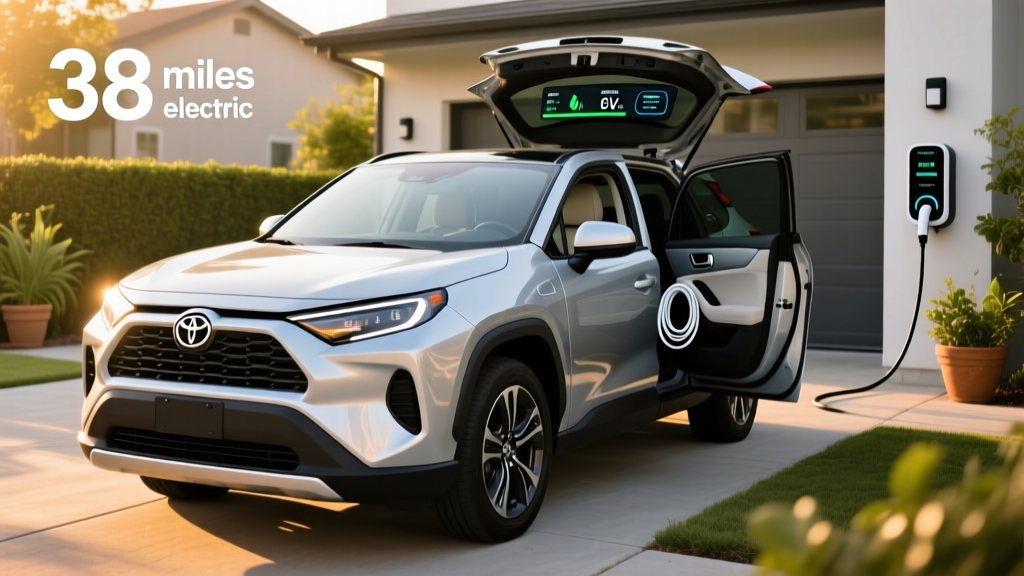
The Toyota RAV4 Prime — now officially restructured for the 2025 model year with the SE trim as the entry point for Toyota's most powerful RAV4 — occupies a rare sweet spot in the electrified SUV market. It delivers genuine electric-only commuting range, all-wheel-drive traction, and 302 combined horsepower, all without the range anxiety of a full battery-electric vehicle. For buyers who want to plug in most weekdays but still road-trip on gas without planning charger stops, the 2025 Toyota RAV4 Plug-In Hybrid SE makes a compelling case.
But does the math work in 2026, with federal tax credit rules tightening and competitive PHEVs arriving from Hyundai, Kia, and Chrysler? This guide breaks down every number that matters — from real-world MPG to battery warranty — so you can decide whether this PHEV fits your driveway.
HEV vs PHEV: Understanding What the RAV4 Plug-In Hybrid SE Actually Is
Before diving into specs, it's critical to distinguish the two RAV4 electrified powertrains Toyota sells, because the differences affect your wallet and your daily routine:
| Feature | RAV4 Hybrid (HEV) | RAV4 Plug-In Hybrid SE (PHEV) |
|---|---|---|
| Plug-in charging required? | No — self-charging via regenerative braking | Yes — plug in to unlock electric-only range |
| Battery capacity | ~1.6 kWh (small buffer) | 18.1 kWh usable (lithium-ion) |
| Electric-only range | None (EV mode limited to ~1 mi at low speed) | 42 miles (EPA) |
| Combined horsepower | 219 hp | 302 hp |
| EPA combined MPG (gas) | 41 MPG | 38 MPG (after battery depletes) |
| MPGe (electric + gas combined) | N/A | 94 MPGe |
| Starting MSRP | ~$33,000 | ~$48,300 |
| Federal tax credit eligible? | No | No (§30D sourcing rules) |
The conventional RAV4 Hybrid is a gas-electric system that never plugs in. Its small battery assists the engine during acceleration and captures energy during braking, but it cannot drive on electricity alone for meaningful distances. The RAV4 Plug-In Hybrid SE carries a much larger 18.1 kWh battery pack, a more powerful electric motor on the rear axle, and the ability to travel up to 42 miles without burning a drop of gasoline — provided you plug it in.
If you can't or won't charge at home, the PHEV still functions as a very efficient 38 MPG hybrid once the battery depletes. But you'd be paying a ~$15,000 premium over the HEV without capturing the electric-range benefit. Plug-in access is the dividing line.
Electric-Only Range, MPGe, and Real-World MPG
The EPA rates the 2025 RAV4 Plug-In Hybrid SE at 42 miles of electric-only range and 94 MPGe when operating in blended electric-gas mode. Once the battery is depleted, it reverts to conventional hybrid operation rated at 38 MPG combined (40 city / 36 highway), per fueleconomy.gov.
| Driving Mode | EPA City | EPA Highway | EPA Combined |
|---|---|---|---|
| Electric-only (first 42 mi) | 94 MPGe combined | ||
| Hybrid (battery depleted) | 40 MPG | 36 MPG | 38 MPG |
Real-World MPG and Range Expectations
Toyota's PHEV powertrain tends to deliver close to its EPA numbers in mixed driving, but several real-world factors shift the picture:
- City driving after depletion: Expect 40-43 MPG. Hybrids excel in stop-and-go traffic where regenerative braking recaptures energy frequently. Many owners report beating the 40 MPG city EPA figure by 2-3 MPG on urban commutes.
- Highway driving after depletion: Expect 33-36 MPG. At sustained 70+ mph speeds, the 2.5L four-cylinder engine does most of the work, and aerodynamic drag reduces efficiency below the EPA highway estimate.
- Cold-weather electric range: The 42-mile EPA electric range can drop to 30-35 miles in freezing temperatures. Lithium-ion batteries lose capacity in cold weather, and cabin heating draws from the pack unless you precondition while plugged in.
- Electric range at highway speed: If your "electric-only" commute includes 15 miles of 70 mph freeway, expect closer to 32-36 miles of electric range rather than 42. The EPA cycle includes low-speed segments that flatter the number.
Real-world expectation: 35-42 miles depending on temperature, speed, and terrain. Highway-heavy or cold-weather commutes: plan for ~32-35 miles.
For a typical 20-mile round-trip commute, the RAV4 PHEV SE can cover it entirely on electricity with margin to spare — meaning zero gasoline consumption on most workdays.
Powertrain, Performance, and Drivetrain Specs
| Specification | 2025 RAV4 Plug-In Hybrid SE |
|---|---|
| Engine | 2.5L inline-4 Atkinson-cycle |
| Front electric motor | 134 kW (180 hp) |
| Rear electric motor | 40 kW (54 hp) — electronic AWD |
| Combined system output | 302 hp |
| 0-60 mph | 5.7 seconds |
| Drivetrain | Electronic on-demand AWD (eAWD) |
| Battery capacity | 18.1 kWh usable (lithium-ion, NMC chemistry) |
| EPA electric range | 42 miles |
| Total range (EV + gas) | ~440 miles |
| Towing capacity | 1,500 lbs |
The 302-horsepower combined output makes the RAV4 PHEV the quickest RAV4 Toyota sells — faster than the turbo-four in the RAV4 Adventure and dramatically quicker than the 219-hp standard hybrid. The 5.7-second 0-60 time puts it in the company of sport compacts, not family crossovers, and the instant torque from the front electric motor makes highway merging effortless.
The electronic AWD system uses a dedicated rear motor rather than a mechanical driveshaft, so rear-axle torque is available only when the battery has charge or during hard acceleration. On slippery surfaces, the system reacts quickly, but it's not designed for serious off-roading — think snow-covered suburban driveways, not mountain trails.
Charging: Level 1, Level 2, and the DC Fast-Charging Gap
Charging capability is where the RAV4 PHEV SE reveals its most significant limitation versus newer competitors.
| Charging Level | Power | Time (0-100%) | Notes |
|---|---|---|---|
| Level 1 (120V household outlet) | ~1.4 kW | ~12 hours | Included cord; adequate for overnight if you drive <42 mi/day |
| Level 2 (240V home/public) | ~3.3 kW (SE trim) | ~5.5 hours | SE trim limited to 3.3 kW onboard charger |
| DC fast charging | Not supported | N/A | No CCS or CHAdeMO port |
The SE trim includes a 3.3 kW onboard charger, meaning a full recharge from a 240V Level 2 source takes approximately 5.5 hours. The higher XSE trim with the Premium package offers a 6.6 kW onboard charger that cuts that to ~2.5 hours — a meaningful upgrade if you need midday top-ups or have a short charging window at night.
No DC fast charging. The RAV4 PHEV cannot accept DC fast charging at any rate. This is standard for most PHEVs in this class — the Hyundai Tucson PHEV and Kia Sportage PHEV also lack DC fast charging — but it means all charging happens at home or at Level 2 public stations. You won't top up at a highway rest stop in 20 minutes.
For most PHEV owners, this isn't a dealbreaker. The use case is: plug in at home overnight, wake up to a full 42-mile electric budget, and drive your commute without touching gas. A standard 120V outlet can replenish the battery in about 12 hours, which works if your daily electric driving is under 20 miles and the car sits plugged in from 7 PM to 7 AM.
Home Charging Setup Cost
Most RAV4 PHEV owners will want a 240V Level 2 home charger for convenience. Budget $500-$800 for a quality Level 2 EVSE (ChargePoint Home Flex, Emporia Vue, or similar) and $500-$2,000 for electrician installation, depending on whether your electrical panel needs an upgrade. If you already have a 240V outlet (dryer, welder), a portable Level 2 cord with the right adapter can reduce cost significantly.
Pricing, Trims, and Federal Tax Credit Eligibility
The 2025 Toyota RAV4 Plug-In Hybrid SE starts at an MSRP of approximately $48,300 (including destination charge). This positions it as the value entry point in the RAV4 PHEV lineup:
- SE: ~$48,300 — SofTex seats, 8-inch touchscreen, wireless Apple CarPlay/Android Auto, Toyota Safety Sense 2.5+, heated front seats
- XSE: ~$51,300 — sport-tuned suspension, 9-inch screen, available 6.6 kW charger, panoramic roof option
- XSE Premium: ~$55,000+ — JBL audio, ventilated seats, head-up display, 6.6 kW charger standard
Does the 2025 RAV4 Plug-In Hybrid SE Qualify for the Federal Tax Credit?
No. Under current IRS §30D rules, the RAV4 Plug-In Hybrid does not qualify for the up-to-$7,500 federal Clean Vehicle Credit. The primary reason: the battery's critical minerals and component sourcing do not meet the domestic-content thresholds enacted under the Inflation Reduction Act. Toyota has not announced plans to shift RAV4 PHEV battery sourcing to qualifying suppliers.
Additional §30D restrictions that would apply even if sourcing qualified:
- MSRP must not exceed $80,000 for SUVs (RAV4 PHEV passes this)
- Buyer AGI must not exceed $150K single / $300K joint (varies by buyer)
- Battery capacity must be ≥7 kWh (RAV4 PHEV's 18.1 kWh qualifies)
- Critical minerals and battery components must meet domestic-sourcing thresholds (RAV4 PHEV fails this)
- Credit can be transferred to dealer at point of sale for qualifying vehicles
Some states offer their own PHEV incentives — California's CVRP has been restructured, but states like Colorado, Oregon, and Massachusetts may offer rebates for PHEVs. Check your state energy office or the AFDC state incentives database for current programs. A tax professional can confirm your specific eligibility.
Battery Warranty, Reliability, and Replacement Cost
Hybrid system warranty: 8 years / 100,000 miles for related components (inverter, electric motors, control modules).
Basic vehicle warranty: 3 years / 36,000 miles bumper-to-bumper; 5 years / 60,000 miles powertrain.
Toyota's hybrid reliability track record is among the strongest in the industry. The Prius has been in production since 1997, and the hybrid synergy drive system in the RAV4 PHEV is a mature, well-proven architecture. Third-party data from Consumer Reports and J.D. Power consistently rank Toyota at or near the top for long-term hybrid reliability.
For the PHEV battery specifically, the 18.1 kWh pack uses a conservative state-of-charge buffer — Toyota does not allow the battery to charge to true 100% or discharge to true 0%, which reduces degradation. Owners of earlier RAV4 Primes (2021-2024) report minimal electric-range loss over 3-5 years of ownership, typically under 5%.
Battery Replacement Cost
Out-of-warranty PHEV battery replacement for the RAV4 is estimated at $4,000-$6,500 including parts and labor at a Toyota dealer, based on current pricing for the hybrid battery assembly. This is significantly less than full EV battery replacements ($10,000-$20,000+) because the PHEV pack is smaller. However, given Toyota's warranty coverage and the proven longevity of their hybrid batteries, out-of-pocket replacement during typical ownership is uncommon.
The 12V auxiliary battery (a standard lead-acid or AGM unit) is separate from the traction battery and will need replacement every 4-6 years at a cost of $150-$300 — same as any conventional vehicle.
RAV4 PHEV SE vs Full EV vs Gas RAV4: Which Fits You?
Choose the RAV4 Plug-In Hybrid SE if:
- Your daily commute is under 40 miles round-trip and you can charge at home
- You take 3+ road trips per year where EV charging infrastructure is sparse
- You want electric commuting without committing to a full EV
- You value AWD and 302 hp in a compact SUV
- You live in an apartment or area where public charging is unreliable
Choose a full EV (Tesla Model Y, Hyundai Ioniq 5, Toyota bZ4X) if:
- You have reliable home Level 2 charging
- Your daily driving rarely exceeds 250 miles
- You want zero tailpipe emissions and minimal maintenance (no oil changes, no gas engine)
- You qualify for the $7,500 federal tax credit on a qualifying EV
Choose the conventional RAV4 Hybrid (HEV) if:
- You cannot charge at home (no garage, no outlet access)
- Your budget is closer to $35,000-$40,000
- You want strong fuel economy (41 MPG) without plug-in complexity
- You drive more than 42 miles daily and wouldn't benefit from the PHEV's electric range
Pros and Cons at a Glance
Pros
- 42 miles of real, usable electric range covers most commutes
- 302 hp and 5.7-second 0-60 — the quickest RAV4 available
- 38 MPG hybrid mode after battery depletion (no range cliff)
- 10-year/150,000-mile hybrid battery warranty
- Proven Toyota reliability and strong resale value
- Standard AWD with dedicated rear electric motor
Cons
- No DC fast charging — home and Level 2 only
- 3.3 kW onboard charger on SE trim (slow Level 2 top-up)
- Does not qualify for the $7,500 federal tax credit
- $48,300 starting price — ~$15K premium over the RAV4 Hybrid
- Only 42 miles electric — shorter than newer PHEVs (Jeep Wrangler 4xe: 22 mi; Chrysler Pacifica PHEV: 32 mi; but less than some upcoming competitors)
- Cargo space slightly reduced vs gas RAV4 due to battery placement
Frequently Asked Questions
How many MPG does the 2025 Toyota RAV4 Plug-In Hybrid SE get?
After the 42-mile electric range is depleted, the RAV4 PHEV SE delivers an EPA-rated 38 MPG combined (40 city / 36 highway). In real-world city driving, many owners report 40-43 MPG thanks to regenerative braking. Highway driving at sustained speeds typically yields 33-36 MPG.
How far can the RAV4 Plug-In Hybrid go on electric only?
The EPA rates it at 42 miles of electric-only range. In real-world conditions — cold weather, highway speeds, hilly terrain — expect 32-42 miles. For a 20-mile daily commute, you'll rarely use gasoline if you charge nightly.
Can I charge the RAV4 PHEV at a DC fast charger?
No. The RAV4 Plug-In Hybrid does not support DC fast charging. All charging must be done via Level 1 (120V) or Level 2 (240V). A full Level 2 charge takes about 5.5 hours on the SE's 3.3 kW onboard charger.
Is the RAV4 Plug-In Hybrid reliable?
Toyota's hybrid system is one of the most proven in the industry, with over 25 years of Prius-derived technology. The PHEV battery carries a 10-year/150,000-mile warranty. Long-term data from earlier RAV4 Prime models shows minimal battery degradation. Toyota consistently ranks at the top of Consumer Reports and J.D. Power reliability surveys.
What does it cost to replace the PHEV battery?
Out-of-warranty replacement is estimated at $4,000-$6,500 at a Toyota dealer. Given the 10-year/150,000-mile warranty and Toyota's conservative battery management, most owners will never face this cost during their ownership period.
Does the RAV4 PHEV qualify for any tax credit in 2026?
The RAV4 Plug-In Hybrid does not qualify for the federal §30D Clean Vehicle Credit due to battery sourcing requirements. Some state-level incentives may apply — check the AFDC state laws database and consult a tax professional for your specific situation. Full credit rules are available at IRS.gov.
Should I get the SE or XSE trim?
The SE at ~$48,300 offers the best value if you want the PHEV powertrain at the lowest price. Upgrade to the XSE (~$51,300) if you want the available 6.6 kW onboard charger (halves Level 2 charge time to ~2.5 hours), the 9-inch infotainment screen, and sport-tuned suspension. The 6.6 kW charger alone is worth considering if your charging window is tight.
How does the RAV4 PHEV compare to a full EV like the Tesla Model Y?
The Model Y offers ~310 miles of range, DC fast charging, and eligibility for the $7,500 federal credit, bringing its effective price closer to the RAV4 PHEV. But the Model Y requires commitment to electric-only driving and access to charging. The RAV4 PHEV gives you electric commuting with a gas-engine safety net — ideal if you road-trip frequently or lack reliable public charging.