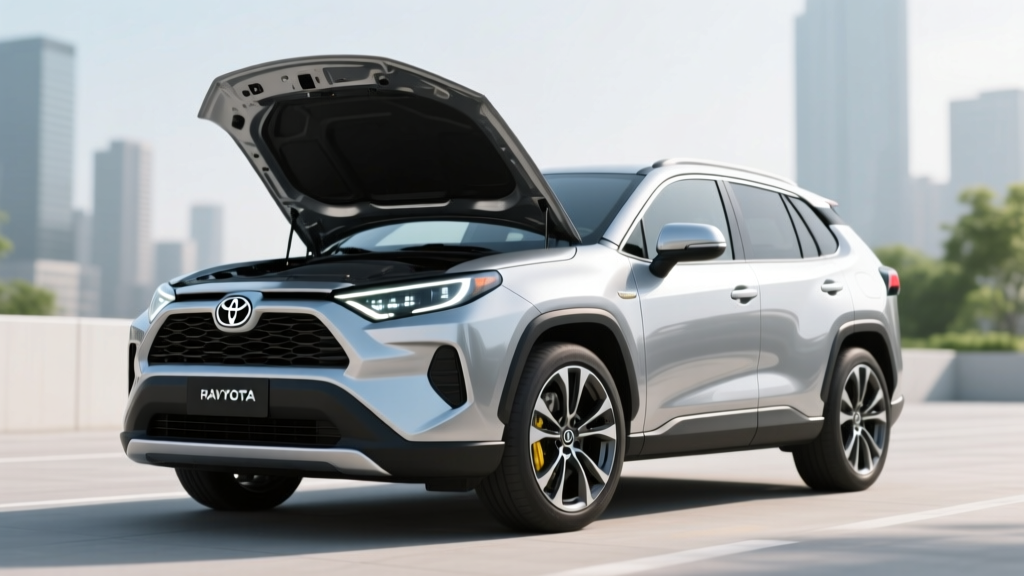
The Toyota RAV4 Hybrid remains one of the best-selling electrified vehicles in the United States, and for good reason: it delivers SUV practicality with fuel economy that undercuts most compact sedans. But with multiple trims, a plug-in variant in the lineup, and shifting incentive rules, pinning down the exact 2025 Toyota RAV4 Hybrid MSRP and what you actually get for the money requires a careful look at the numbers.
This guide breaks down every 2025 RAV4 Hybrid trim, its EPA-rated fuel economy, real-world efficiency expectations, powertrain details, battery warranty coverage, and how it stacks up against the RAV4 Prime (PHEV) and a full battery-electric alternative.
2025 Toyota RAV4 Hybrid MSRP by Trim Level
Toyota offers the 2025 RAV4 Hybrid across a wide trim range, from the value-oriented LE to the adventure-capable Woodland Edition. All trims come standard with all-wheel drive (AWD) — there is no front-wheel-drive hybrid variant for this model year.
| Trim | MSRP | Key Additions Over Lower Trim |
|---|---|---|
| LE | $33,845 | Base hybrid AWD, Toyota Safety Sense 2.5, 8-inch touchscreen |
| XLE | $35,395 | Dual-zone climate, blind-spot monitoring, smart key, alloy wheels |
| XLE Premium | $37,345 | SofTex seats, moonroof, power liftgate |
| SE | $37,545 | Sport-tuned suspension, unique styling, paddle shifters |
| Woodland Edition | $38,425 | TRD-tuned suspension, all-terrain tires, roof rack |
| XSE | $38,995 | Sport appearance, heated front seats, larger 10.5-inch display |
| Limited | $41,695 | Leather, premium JBL audio, panoramic moonroof, digital rearview mirror |
Destination and delivery fees are included in the figures above. Popular options such as the Advanced Technology Package on the Limited trim can push the final sticker price past $44,000. Always verify window-sticker pricing with your dealer, as regional adjustments and dealer markups can affect the final transaction price.
EPA MPG Ratings and Real-World Fuel Economy
The 2025 RAV4 Hybrid carries a single powertrain configuration across all trims, so EPA ratings are consistent regardless of which model you choose.
| Metric | Rating |
|---|---|
| City | 41 MPG |
| Highway | 38 MPG |
| Combined | 39 MPG |
| Fuel Tank Capacity | 14.5 gallons |
| Total Driving Range | ~565 miles |
Source: EPA Fuel Economy Guide
Real-World MPG: What Owners Actually See
The RAV4 Hybrid is one of the vehicles where real-world results often exceed the EPA sticker — particularly in city driving. Toyota's hybrid system recovers significant energy through regenerative braking, meaning stop-and-go traffic actually improves efficiency rather than hurting it. Many owners report 42–44 MPG in mixed suburban driving.
Highway-heavy commutes at 75+ mph will typically yield 34–37 MPG, as the electric motor contributes less at sustained high speeds and the 2.5-liter engine carries most of the load. In cold weather (below 30°F), expect a 5–10% efficiency reduction due to increased engine idling for cabin heat and reduced battery efficiency — bringing combined figures closer to 35–37 MPG.
Powertrain Specifications: Engine, Motors, and Horsepower
| Component | Specification |
|---|---|
| Engine | 2.5L 4-cylinder Dynamic Force (A25A-FXS) |
| Engine Output | 176 hp / 163 lb-ft torque |
| Front Electric Motor | 118 hp / 149 lb-ft |
| Rear Electric Motor (AWD-i) | 54 hp / 89 lb-ft |
| Net Combined Horsepower | 219 hp |
| Transmission | Continuously Variable (eCVT) |
| 0–60 mph | 7.4 seconds |
| Drivetrain | Electronic On-Demand AWD (standard all trims) |
| Towing Capacity | 1,750 lbs |
The RAV4 Hybrid uses Toyota's fourth-generation hybrid system. The rear axle is driven entirely by the electric motor — there is no mechanical driveshaft connecting the engine to the rear wheels. This "AWD-i" system engages the rear motor on demand during acceleration, low-traction conditions, and from a stop, then disengages at cruising speed to maximize efficiency.
Hybrid (HEV) vs. Plug-In Hybrid (PHEV): RAV4 Hybrid vs. RAV4 Prime
Toyota sells two electrified RAV4 variants. The conventional RAV4 Hybrid (HEV) never needs to be plugged in — it charges its small battery through regenerative braking and engine power. The RAV4 Prime (PHEV) has a larger battery that can be charged from a wall outlet or charger, enabling electric-only driving before the hybrid system kicks in.
| Feature | RAV4 Hybrid (HEV) | RAV4 Prime (PHEV) |
|---|---|---|
| Needs to be plugged in? | No — self-charging | Yes, for electric-only range |
| Electric-Only Range | N/A (EV mode is very limited, under 1 mile at low speed) | 42 miles (EPA) |
| Combined MPG / MPGe | 39 MPG combined | 94 MPGe (electric+gas) / 38 MPG (gas only) |
| Battery Capacity | 1.6 kWh (nickel-metal hydride) | 18.1 kWh (lithium-ion) |
| Net Horsepower | 219 hp | 302 hp |
| 0–60 mph | 7.4 seconds | 5.7 seconds |
| Level 2 Charge Time (0–100%) | N/A | ~2.5 hours (3.3 kW) / ~4.5 hours (120V) |
| DC Fast Charging | N/A | No DC fast charge capability |
| Starting MSRP | $33,845 | $44,590 |
| Federal Tax Credit (§30D) | Not eligible | Up to $7,500 (subject to eligibility rules) |
Does the RAV4 Prime Qualify for the Federal Tax Credit?
The RAV4 Prime is eligible for the IRS §30D Clean Vehicle Credit of up to $7,500, but eligibility depends on several factors that change annually:
- MSRP cap: SUVs must have an MSRP at or below $80,000 (RAV4 Prime qualifies).
- Buyer income cap: Modified AGI must not exceed $150,000 (single) / $300,000 (joint).
- Battery sourcing: The critical minerals and battery component requirements phase in more strictly each year. Verify current-year compliance on the IRS qualified vehicle list before purchasing.
- Point-of-sale transfer: As of 2024, buyers can transfer the credit to the dealer for an immediate price reduction, if eligible.
The conventional RAV4 Hybrid does not qualify for the federal §30D credit because it lacks sufficient plug-in electric range. Some states offer separate incentives for conventional hybrids — check your state energy office or AFDC state incentive database for details.
Battery Warranty, Reliability, and Replacement Costs
How Long Do Toyota Hybrid Batteries Last?
Toyota's hybrid battery track record is among the best in the industry. The RAV4 Hybrid uses a relatively small 1.6 kWh nickel-metal hydride (NiMH) battery that operates within a narrow state-of-charge window — Toyota's battery management system prevents deep discharge and overcharge, which are the primary causes of lithium-ion degradation. In practice, many Toyota hybrid batteries outlast 150,000–200,000 miles without replacement.
If a replacement is needed outside of warranty, expect the following approximate costs:
- RAV4 Hybrid (HEV) battery replacement: $3,000–$4,500 (parts and labor at a dealer; refurbished units may be less)
- RAV4 Prime (PHEV) battery replacement: $8,000–$12,000 (larger 18.1 kWh lithium-ion pack)
The conventional hybrid's smaller, simpler NiMH pack is significantly cheaper to replace than the Prime's larger lithium-ion battery — a factor worth considering for buyers planning 15+ year ownership.
Overall Reliability
Toyota consistently ranks at or near the top of long-term reliability surveys, and the RAV4 Hybrid's powertrain is one of the brand's most proven setups. The eCVT transmission has no traditional gears or belts — it uses a planetary gearset that is mechanically simple and extremely durable. There are no timing belts to replace, and regenerative braking significantly extends brake pad life (many owners report 80,000+ miles on original pads).
Who Should Buy the RAV4 Hybrid vs. a PHEV or Full EV?
Choose the RAV4 Hybrid (HEV) if:
- You cannot install a home charger (apartment, street parking, no garage)
- You want maximum simplicity — no plugs, no charging routines
- Your budget is under $40,000 and you need a compact SUV now
- You drive 12,000–15,000 miles/year and want ~$600–$800/year in fuel savings vs. a gas-only RAV4
Choose the RAV4 Prime (PHEV) if:
- You have Level 2 home charging and a commute under 42 miles
- You want electric-only daily driving with gas flexibility for road trips
- You qualify for the §30D tax credit (effectively reducing the price gap with the HEV)
- You value the 302 hp performance upgrade
Choose a full EV (e.g., Tesla Model Y, Hyundai Ioniq 5) if:
- You have reliable home Level 2 charging
- Your daily driving is under 250 miles and you road-trip infrequently
- You want zero tailpipe emissions and the lowest per-mile energy cost
- You're ready to use public DC fast charging on longer trips
5-Year Ownership Cost Snapshot
Below is an estimated 5-year/75,000-mile ownership cost comparison between the RAV4 Hybrid LE ($33,845 MSRP), a gas-only RAV4 LE (~$30,000 MSRP, 30 MPG combined), and the RAV4 Prime SE ($44,590 MSRP, assuming $7,500 credit applied).
| Cost Factor | RAV4 Hybrid LE | RAV4 Gas LE | RAV4 Prime SE |
|---|---|---|---|
| Purchase Price (after credit) | $33,845 | $30,000 | $37,090 |
| Fuel / Electricity (75K mi) | ~$5,770 | ~$7,500 | ~$3,200 |
| Maintenance (est.) | ~$2,800 | ~$3,400 | ~$2,800 |
| Insurance (est. avg) | ~$7,500 | ~$7,000 | ~$7,800 |
| Estimated Depreciation | ~$12,200 | ~$12,000 | ~$14,800 |
| 5-Year Total | ~$62,115 | ~$59,900 | ~$65,690 |
Assumptions: $3.50/gallon gas, $0.14/kWh electricity, 75/25 electric/gas split for Prime. Actual costs vary by region, driving habits, and electricity rates. Insurance estimates are national averages — get quotes for your ZIP code.
The Hybrid's fuel savings over the gas model add up to roughly $1,730 over five years, partially offsetting the ~$3,845 price premium. The Prime's advantage is largest when you maximize electric-only commuting and qualify for the full tax credit.
Pros and Cons of the 2025 RAV4 Hybrid
Pros
- Standard AWD on every trim
- 41 MPG city / 39 MPG combined — real-world often higher
- Strong reliability record, 10-year/150K-mile hybrid warranty
- No plug-in charging required — zero lifestyle change
- Wide trim range from $33,845 to $41,695
- Excellent cargo space (37.6 cu ft behind rear seats)
- Proven Toyota Safety Sense 2.5 suite standard
Cons
- No federal tax credit for the HEV variant
- eCVT can feel rubbery under hard acceleration
- 1,750-lb towing capacity lags some turbocharged competitors
- Road noise at highway speeds is noticeable
- Infotainment is functional but not class-leading
- 14.5-gallon fuel tank limits total range vs. some competitors
- Dealer markups still common on popular trims
Frequently Asked Questions
How many MPG does the 2025 RAV4 Hybrid get?
The EPA rates it at 41 city / 38 highway / 39 combined MPG. In real-world driving, owners commonly achieve 38–44 MPG depending on driving mix, with city-heavy routes favoring the higher end of that range thanks to regenerative braking.
Does the RAV4 Hybrid need to be plugged in?
No. The conventional RAV4 Hybrid is a self-charging hybrid. Its 1.6 kWh battery is charged entirely through regenerative braking and the gasoline engine. You never plug it in. If you want plug-in capability, look at the RAV4 Prime (PHEV).
Does the 2025 RAV4 Hybrid qualify for any tax credit?
The conventional RAV4 Hybrid does not qualify for the federal §30D Clean Vehicle Credit. The RAV4 Prime (PHEV) may qualify for up to $7,500 depending on your income, the vehicle's battery sourcing compliance, and current-year IRS rules. Check the IRS qualified vehicles list before purchasing. Some states offer additional hybrid incentives — check your local programs.
What is the hybrid battery replacement cost?
For the RAV4 Hybrid (HEV), a replacement NiMH hybrid battery typically costs $3,000–$4,500 installed at a dealer. The RAV4 Prime's larger lithium-ion pack runs $8,000–$12,000. However, Toyota's 10-year/150,000-mile hybrid warranty covers the battery, and most Toyota hybrid batteries last well beyond 150,000 miles without replacement.
Is the RAV4 Hybrid better than a full EV for my situation?
If you lack home charging access, frequently drive more than 300 miles between stops, or live in an area with sparse public charging infrastructure, the RAV4 Hybrid offers electrified efficiency with zero range anxiety. If you have reliable home Level 2 charging and mostly drive under 250 miles daily, a full EV like the Tesla Model Y or Hyundai Ioniq 5 will deliver lower per-mile energy costs and zero tailpipe emissions.
How does the RAV4 Hybrid AWD system work?
The RAV4 Hybrid uses Toyota's AWD-i system, where a dedicated rear electric motor powers the rear axle independently. There is no mechanical driveshaft. The system engages the rear motor automatically during acceleration, from a stop, and when front-wheel slip is detected. At steady highway cruising, only the front wheels are driven to maximize fuel economy.