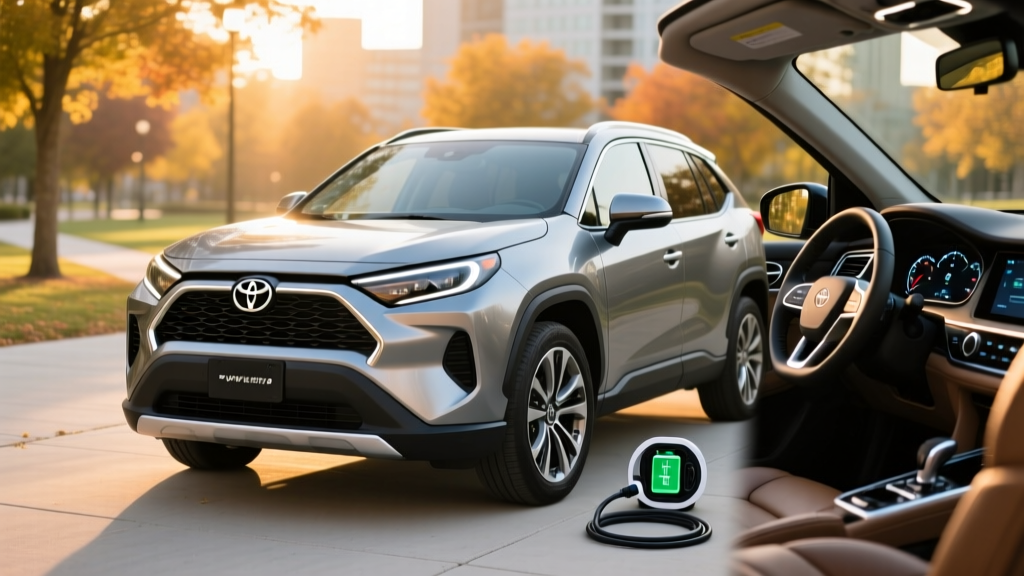
Quick Verdict: The RAV4 Hybrid Limited at a Glance
The 2025 Toyota RAV4 Hybrid Limited sits at the top of Toyota's conventional hybrid (HEV) lineup for its best-selling compact SUV. It pairs a 2.5-liter four-cylinder engine with dual electric motors for 219 combined horsepower and standard electronic all-wheel drive — all without ever needing to plug in. For buyers who want the efficiency gains of electrification without changing their fueling habits, this trim delivers premium features, proven reliability, and an EPA-estimated 39 MPG combined.
But the Limited trim's $40,360 starting MSRP pushes it into territory where plug-in hybrids and even some battery-electric vehicles start competing. This review breaks down exactly what you get, what the real-world fuel economy looks like, and whether the Hybrid Limited is the right call versus the RAV4 Prime PHEV or a full BEV.
The RAV4 Hybrid is a conventional hybrid (HEV). It generates electricity from the gas engine and regenerative braking. You never plug it in. The RAV4 Prime is a plug-in hybrid (PHEV) with a larger 18.1 kWh battery that provides 42 miles of electric-only driving before the gas engine kicks in. The Prime requires plugging in to capture its full efficiency benefit and carries a significantly higher starting price ($43,690 for the SE trim). This review focuses on the conventional RAV4 Hybrid Limited (HEV).
Powertrain and Performance Specs
| Specification | Value |
|---|---|
| Powertrain Type | Conventional Hybrid (HEV), self-charging |
| Engine | 2.5L inline-4 (176 hp / 163 lb-ft) + dual electric motors |
| Combined System Horsepower | 219 hp |
| Drivetrain | Electronic AWD (eAWD) standard |
| Transmission | Electronically controlled CVT (eCVT) |
| Hybrid Battery | 1.6 kWh lithium-ion (sealed, not plug-in) |
| 0–60 mph | 7.4 seconds (Toyota estimate) |
| Towing Capacity | 1,750 lbs |
| Cargo Volume | 37.6 cu ft (rear seats up) / 69.8 cu ft (folded) |
| Base MSRP (Limited trim) | $40,360 (destination included) |
The Hybrid powertrain uses Toyota's fourth-generation hybrid system. The front axle is driven by a combination of the 2.5L Atkinson-cycle engine and a primary electric motor, while a separate rear-mounted motor powers the rear wheels on demand. This electronic AWD system doesn't use a mechanical driveshaft — instead, the rear motor engages automatically during acceleration, low-traction conditions, or when the system detects front-wheel slip.
Acceleration is adequate for highway merging and passing. The 7.4-second 0–60 time won't feel sporty, but the electric motor's instant torque gives the RAV4 Hybrid a responsive feel around town that the gas-only RAV4 (with its 203 hp and 8.2-second 0–60) can't match.
Fuel Economy: EPA Ratings vs. Real-World MPG
| Driving Cycle | EPA Estimate |
|---|---|
| City | 41 MPG |
| Highway | 38 MPG |
| Combined | 39 MPG |
Source: fueleconomy.gov
One of the defining traits of Toyota's hybrid system is that it tends to exceed EPA city estimates in real-world driving. The hybrid system leans heavily on electric motor assist at low speeds and in stop-and-go traffic, where conventional gas engines are least efficient. Owners who do a lot of city and suburban driving regularly report 42–44 MPG in warm weather.
- City / suburban (warm weather): 41–44 MPG — often meets or beats EPA
- Highway cruising (70–75 mph): 34–37 MPG — hybrid advantage diminishes at sustained high speed
- Cold weather (below 32°F, mixed driving): 33–36 MPG — engine runs more often for cabin heat and battery warmup
- Overall annual average (mixed driving, all seasons): 37–40 MPG
Highway fuel economy is where the hybrid system's advantage narrows. At sustained 70+ mph speeds, the electric motor provides minimal assist and the 2.5L engine does most of the work. If your commute is 90% highway miles, the efficiency gap between the RAV4 Hybrid and the gas-only RAV4 (EPA 30 MPG combined) shrinks — though the hybrid still wins by roughly 7–9 MPG.
2025 RAV4 Hybrid Limited: Pricing, Features, and Value
The Limited is the top trim in the RAV4 Hybrid lineup. Here's what the pricing ladder looks like across the 2025 Hybrid trims for context:
| Trim | MSRP (incl. destination) | Key Additions Over Base LE |
|---|---|---|
| LE | $33,575 | Base hybrid with eAWD, Toyota Safety Sense 2.5 |
| XLE | $35,075 | Dual-zone climate, blind-spot monitor, power liftgate |
| XLE Premium | $37,075 | SofTex seats, moonroof, 19-inch wheels |
| Woodland Edition | $37,475 | TRD-tuned suspension, all-terrain tires, roof rack |
| SE | $38,075 | Sport-tuned suspension, paddle shifters |
| XSE | $39,075 | Sport styling, heated front seats, ambient lighting |
| Limited | $40,360 | Leather, heated/ventilated front seats, 12.3-inch digital cluster, JBL audio, panoramic moonroof, 360-degree camera |
At $40,360, the Limited commands a $6,785 premium over the base LE. You gain genuine luxury features: perforated leather-trimmed seats, ventilated front seats (a rarity at this price point), a 12.3-inch digital instrument cluster, a 10.5-inch touchscreen with wireless Apple CarPlay and Android Auto, an 11-speaker JBL premium audio system, a panoramic glass moonroof, and a bird's-eye-view camera system.
The question becomes whether those premium features justify the cost when the powertrain, fuel economy, and AWD system are identical across all Hybrid trims. The LE delivers the same 39 MPG combined and 219 hp for nearly $7,000 less. The Limited is for buyers who want the full-featured experience and plan to keep the vehicle long enough to absorb the higher upfront cost.
Federal and State Tax Credit Eligibility
The conventional RAV4 Hybrid (HEV) does not qualify for the federal §30D Clean Vehicle Credit. That credit — up to $7,500 — is reserved for plug-in electric vehicles (BEVs and PHEVs) that meet battery sourcing, MSRP caps, and buyer income requirements per current IRS rules.
The RAV4 Prime (PHEV) may qualify for a partial or full federal credit depending on your income, filing status, and the vehicle's battery component sourcing — but eligibility changes and should be verified with a tax professional before purchase.
Some states offer separate rebates or tax incentives for conventional hybrids. These vary widely by jurisdiction and are often structured as reduced registration fees, HOV lane access, or modest rebates ($250–$1,000). Check your state's energy or environmental agency website for current programs.
Hybrid Battery Warranty, Reliability, and Replacement Cost
Toyota covers the hybrid battery and hybrid system components for 10 years or 150,000 miles (whichever comes first) on 2020 and newer models. This is one of the strongest hybrid warranties in the industry and applies to the battery pack, inverter, and related control modules.
The 1.6 kWh lithium-ion hybrid battery in the RAV4 Hybrid is small compared to a full EV's pack, and it operates within a narrow state-of-charge window (typically 40–80% SoC). Toyota's hybrid system never fully charges or fully depletes the battery, which dramatically reduces degradation stress. This is a key engineering reason why Toyota hybrid batteries routinely last 150,000–200,000+ miles without needing replacement.
Real-world failure data supports this. Toyota's hybrid system, now in its fourth generation, has been in production since 1997 (Prius). Independent surveys from Consumer Reports and J.D. Power consistently rank the RAV4 Hybrid among the most reliable compact SUVs. The hybrid components are statistically less likely to fail than a conventional automatic transmission over equivalent mileage.
Hybrid Battery Replacement Cost
If the hybrid battery does fail outside warranty, replacement costs for the RAV4 Hybrid typically fall in the $3,000–$5,000 range (parts and labor at a dealership). Independent hybrid specialists often offer refurbished battery packs for $2,000–$3,500. Given the 10-year/150,000-mile warranty and the battery's track record, this is a low-probability expense for most owners.
For comparison, the 12-volt auxiliary battery (a standard lead-accent or AGM battery that powers the electronics) will need replacement every 4–6 years at a typical cost of $150–$250 — the same as any conventional vehicle.
RAV4 Hybrid (HEV) vs. RAV4 Prime (PHEV) vs. Full EV
| Factor | RAV4 Hybrid (HEV) | RAV4 Prime (PHEV) | Full EV (e.g., Tesla Model Y, Ioniq 5) |
|---|---|---|---|
| Plugging in required? | No — gas only | Yes, to get electric range | Yes — sole energy source |
| Electric-only range | None (EV assist only) | 42 miles (EPA) | 260–330 miles (model-dependent) |
| Combined efficiency | 39 MPG | 94 MPGe (electric) / 38 MPG (gas) | 110–130 MPGe |
| Total range | ~580 miles | ~600 miles (electric + gas) | 260–330 miles |
| Starting MSRP | $33,575 (LE) | $43,690 (SE) | $40,000–$55,000+ |
| Federal tax credit (§30D) | Not eligible | Up to $7,500 (eligibility varies) | Up to $7,500 (eligibility varies) |
| Home charging needed? | No | Recommended (Level 2 for 2.5-hr charge) | Essential (Level 2 strongly recommended) |
| Maintenance cost | Low (oil changes, no plug-in system) | Moderate (gas engine + EV systems) | Lowest (no oil, fewer moving parts) |
| Best for | No home charging access; mostly gas-station convenience | Home charging + short daily commute + road trips | Home charging + daily driving under 250 mi |
Who Should Choose the RAV4 Hybrid (HEV)?
The RAV4 Hybrid is the right call if:
- You cannot charge at home (apartment, street parking, no garage) and don't want to rely on public charging.
- Your daily driving is a mix of city and highway, and you want 39+ MPG without behavioral changes.
- You regularly take long road trips and don't want to plan around charging stops.
- You want the lowest upfront price among electrified SUVs with AWD.
- You plan to keep the vehicle 8–10+ years and value Toyota's long-term reliability track record.
Who Should Look at the RAV4 Prime (PHEV) Instead?
If you have a garage or driveway where you can install a Level 2 charger, and your daily commute is under 40 miles round-trip, the RAV4 Prime lets you drive almost entirely on electricity during the week while retaining gas-engine range for weekend trips. The Prime's combined 304 hp also makes it significantly quicker (5.7-second 0–60). The tradeoff is a $10,000+ higher starting price, partially offset by potential federal tax credits.
Who Should Consider a Full EV Instead?
If you have reliable home Level 2 charging, your daily driving is under 250 miles, and you want the lowest per-mile energy cost and minimal maintenance, a battery-electric SUV like the Hyundai Ioniq 5 or Tesla Model Y will save more over five years — especially with the $7,500 federal credit (if you qualify). But you accept range planning on road trips and a higher purchase price.
Ownership Costs: 5-Year Fuel Savings vs. Gas RAV4
Let's run the numbers on what the Hybrid Limited actually saves versus the gas-only RAV4 Limited (MSRP ~$39,665, EPA 30 MPG combined) over five years and 75,000 miles:
| Metric | RAV4 Hybrid Limited | Gas RAV4 Limited (AWD) |
|---|---|---|
| EPA Combined MPG | 39 MPG | 30 MPG |
| Gallons consumed (75K mi) | 1,923 gal | 2,500 gal |
| Total fuel cost @ $3.50/gal | $6,731 | $8,750 |
| 5-year fuel savings | $2,019 | |
| Annual fuel cost | ~$1,346 | ~$1,750 |
The Hybrid saves roughly $2,000 in fuel over five years at current gas prices. That doesn't fully offset the Hybrid Limited's $705 price premium over the gas Limited — but the Hybrid also benefits from lower brake wear (regenerative braking extends pad life significantly) and marginally lower engine wear due to the electric motor sharing the load. Factor in those maintenance savings and the Hybrid's total-cost-of-ownership advantage grows modestly.
If gas prices rise to $4.50/gallon, the five-year fuel savings increase to approximately $2,600. If you drive more than 15,000 miles per year, the savings scale proportionally.
Pros and Cons of the RAV4 Hybrid Limited
- 39 MPG combined with no plugging in required
- Standard eAWD across all Hybrid trims
- Excellent reliability record; 10-yr/150K-mi hybrid warranty
- Strong resale value (RAV4 Hybrid retains ~60% at 5 years)
- Limited trim includes premium features (ventilated seats, JBL, pano roof)
- City MPG often exceeds EPA estimate in real-world driving
- No federal tax credit (HEV not eligible for §30D)
- Limited trim at $40,360 approaches PHEV and EV pricing territory
- Highway MPG drops to mid-30s at sustained 70+ mph speeds
- CVT drone under hard acceleration (common Toyota hybrid trait)
- 1,750-lb towing capacity is low for the segment
- Infotainment still uses Toyota's older interface (functional but dated)
Frequently Asked Questions
How many MPG does the 2025 RAV4 Hybrid Limited get?
The EPA rates the RAV4 Hybrid (all AWD trims, including Limited) at 41 MPG city, 38 MPG highway, and 39 MPG combined. In real-world city and suburban driving, many owners report 42–44 MPG. Highway-only driving at 70+ mph typically yields 34–37 MPG. Cold weather reduces efficiency by roughly 3–5 MPG due to increased engine runtime for cabin heating.
Does the RAV4 Hybrid need to be plugged in?
No. The RAV4 Hybrid is a conventional hybrid (HEV). Its small 1.6 kWh battery is charged by the gas engine and through regenerative braking. You fuel it exclusively at gas stations, exactly like a conventional car. If you want plug-in capability with electric-only driving, you'd need the RAV4 Prime (PHEV).
Is the RAV4 Hybrid reliable, and what does battery replacement cost?
Toyota's hybrid system has an exceptional reliability record spanning over 25 years of production. The hybrid battery is covered by a 10-year/150,000-mile warranty. Out-of-warranty replacement typically costs $3,000–$5,000 at a dealership, though refurbished options exist for less. In practice, Toyota hybrid batteries routinely last 150,000–200,000+ miles without replacement due to the system's conservative charge-window management.
Does the 2025 RAV4 Hybrid qualify for any federal tax credit?
No. The federal §30D Clean Vehicle Credit applies only to plug-in electric vehicles (BEVs and PHEVs) that meet specific battery sourcing, MSRP, and buyer income requirements. The conventional RAV4 Hybrid (HEV) is not eligible. The RAV4 Prime (PHEV) may qualify depending on your circumstances — verify current eligibility at IRS.gov or with a tax professional. Some states offer modest incentives for hybrids; check your local programs.
Should I get the RAV4 Hybrid Limited or save money with a lower trim?
Every RAV4 Hybrid trim shares the same 219 hp powertrain, eAWD system, and 39 MPG combined rating. The $6,785 gap between the LE ($33,575) and the Limited ($40,360) buys you leather, ventilated seats, a panoramic moonroof, JBL audio, and a 360-degree camera — none of which affect efficiency or performance. If you value those luxury features, the Limited delivers them at a price still below most luxury compact SUVs. If you're optimizing purely for value, the XLE ($35,075) offers the best balance of features and price.
How does the RAV4 Hybrid compare to a full EV for daily driving?
If you have home charging and drive under 250 miles daily, a full EV like the Hyundai Ioniq 5 or Tesla Model Y offers lower per-mile energy costs (electricity is typically equivalent to $1.00–$1.50/gallon), near-silent operation, and stronger acceleration. But EVs require charging infrastructure, cost more upfront, and demand road-trip planning around DC fast chargers. The RAV4 Hybrid eliminates all of those friction points while still cutting your fuel consumption by 25–30% versus the gas RAV4.