The 2025 Toyota RAV4 Hybrid Lease: What Buyers Need to Know
If you've searched for a 2025 Toyota RAV4 Hybrid lease, you're not alone. The RAV4 Hybrid remains one of the most leased compact SUVs in the U.S., and for good reason: it delivers near-40 MPG combined without ever needing to be plugged in. But before you sign a lease agreement, you need to understand exactly what you're getting — the real-world fuel economy, the distinction between the standard hybrid (HEV) and the plug-in RAV4 Prime (PHEV), battery longevity, and whether leasing or buying makes financial sense in today's incentive landscape.
This guide covers every critical spec, cost factor, and ownership consideration for the 2025 RAV4 Hybrid lineup, written from the perspective of someone who has tracked Toyota's hybrid powertrains across multiple model years.
HEV vs PHEV: Which RAV4 Hybrid Are You Actually Leasing?
Toyota sells two electrified RAV4 variants, and confusing them is the single most common mistake shoppers make:
| Feature | RAV4 Hybrid (HEV) | RAV4 Prime (PHEV) |
|---|---|---|
| Powertrain Type | Conventional hybrid — no plug | Plug-in hybrid — charges via outlet |
| Combined Horsepower | 219 hp | 302 hp |
| Electric-Only Range | N/A (motor assists engine) | 42 miles (EPA) |
| Battery Capacity | 1.6 kWh (NiMH) | 18.1 kWh (lithium-ion) |
| EPA Combined MPG / MPGe | 39 MPG | 94 MPGe (electric) / 38 MPG (gas-only) |
| DC Fast Charging | No | No (Level 2 AC only) |
| Starting MSRP (2025) | ~$33,550 (LE AWD) | ~$44,515 (SE) |
| Federal Tax Credit (§30D) | Not eligible | Up to $7,500 (eligibility varies) |
The RAV4 Hybrid (HEV) uses a small battery that recharges through regenerative braking and the gasoline engine. You never plug it in. The electric motor assists the 2.5L four-cylinder engine during acceleration and enables low-speed electric-only driving in stop-and-go traffic, but it cannot sustain highway speeds on electricity alone.
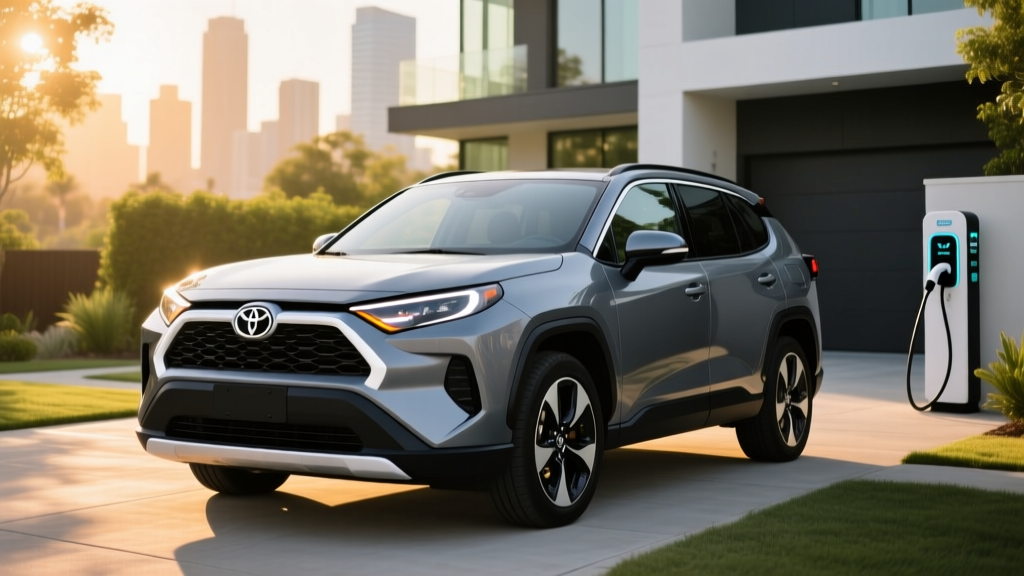
The RAV4 Prime (PHEV) carries a much larger 18.1 kWh lithium-ion battery. Plug it into a standard 120V outlet overnight (roughly 12 hours for a full charge) or a 240V Level 2 charger (about 2.5 hours per Toyota's specifications). It delivers 42 miles of electric-only range before the gasoline engine kicks in — enough for most daily commutes without burning a drop of fuel.
Fuel Economy: EPA Ratings vs Real-World MPG
Here's the official EPA fuel economy breakdown for the 2025 RAV4 Hybrid, sourced from fueleconomy.gov:
| Trim / Drivetrain | City MPG | Highway MPG | Combined MPG |
|---|---|---|---|
| LE / XLE / XSE / Limited (AWD) | 41 | 38 | 39 |
| Woodland Edition (AWD) | 38 | 35 | 37 |
Real-world expectation: Toyota's hybrid system excels in city driving, where regenerative braking and frequent engine-off coasting maximize efficiency. Many owners report exceeding the 41 MPG city EPA figure in moderate-temperature urban commuting — 43-45 MPG is common. Highway driving tells a different story: at sustained 70-75 mph speeds, expect 35-37 MPG. In cold weather (below 35°F), the engine runs more frequently to heat the cabin and warm the catalytic converter, dropping city MPG into the mid-30s.
For the RAV4 Prime in charge-depleting (electric) mode, the EPA rates it at 94 MPGe combined. Once the battery depletes, it operates as a conventional hybrid at 38 MPG combined — slightly less than the standard HEV due to the heavier battery pack.
Powertrain and Performance Specs
| Specification | RAV4 Hybrid (HEV) | RAV4 Prime (PHEV) |
|---|---|---|
| Engine | 2.5L inline-4 + 2 electric motors | 2.5L inline-4 + 2 electric motors (higher output) |
| Combined Horsepower | 219 hp | 302 hp |
| 0-60 mph | ~7.4 seconds | ~5.7 seconds |
| Drivetrain | AWD (electronic rear motor) | AWD (electronic rear motor) |
| Towing Capacity | 1,750 lbs | 2,500 lbs |
| Cargo Volume (behind rear seats) | 37.6 cu ft | 33.5 cu ft |
The RAV4 Prime's 5.7-second 0-60 time makes it the quickest RAV4 Toyota sells — quicker than the gas-only model and substantially quicker than the standard hybrid. That performance advantage comes from the larger, more powerful electric motors paired with the 18.1 kWh battery's ability to deliver sustained current.
Neither variant supports DC fast charging. The RAV4 Prime charges exclusively via AC: Level 1 (120V, ~1.4 kW) takes about 12 hours; Level 2 (240V, ~6.6 kW) takes approximately 2.5 hours. For a PHEV with 42 miles of range, overnight Level 2 charging is the practical standard.
Lease Pricing, MSRP, and Tax Credit Eligibility
As of early 2026, lease deals on the 2025 RAV4 Hybrid (HEV) vary significantly by region and dealer. Typical advertised lease structures have looked like:
- RAV4 Hybrid LE (AWD): ~$399-$449/month, 36 months, $3,000-$3,500 due at signing
- RAV4 Hybrid XLE (AWD): ~$439-$489/month, 36 months, $3,000-$3,500 due at signing
- RAV4 Prime SE: ~$549-$629/month, 36 months, $4,000-$5,000 due at signing (limited allocation)
These figures fluctuate with money factor (lease interest rate), residual value, and regional incentives. Always request the full lease disclosure showing the capitalized cost, money factor, residual percentage, and all fees before signing.
Tax Credit Reality
The standard RAV4 Hybrid (HEV) does not qualify for the federal §30D clean vehicle credit. That credit applies only to plug-in vehicles (PHEVs and BEVs) with sufficient battery capacity.
The RAV4 Prime (PHEV) has historically qualified for up to $7,500 under §30D, but eligibility is governed by complex rules that shift frequently. Under current IRS guidelines, qualification depends on:
- Buyer income caps: Modified AGI must not exceed $150,000 (single), $225,000 (head of household), or $300,000 (joint)
- MSRP cap: SUVs must have an MSRP at or below $80,000 (RAV4 Prime clears this easily)
- Battery component and critical mineral sourcing: A percentage of battery components must be manufactured or assembled in North America, and critical minerals must be sourced from the U.S. or FTA partners — these thresholds tighten annually
- Point-of-sale transfer: As of 2024, buyers can transfer the credit to the dealer at purchase, reducing the upfront cost — but for leases, the credit typically goes to the lessor (Toyota Financial Services), who may pass it through as a capitalized cost reduction, but is not required to
Consult a tax professional before assuming credit eligibility. Battery sourcing rules in particular have disqualified previously eligible vehicles mid-year.
Battery Longevity, Warranty, and Replacement Cost
Hybrid Battery Warranty (2025 RAV4 Hybrid & RAV4 Prime):
- Coverage: 10 years / 150,000 miles (whichever comes first)
- What's covered: Hybrid battery pack, hybrid control module, and related hybrid system components
- Capacity retention threshold: Toyota warrants the battery against defects and abnormal loss of capacity — there is no published minimum SoH percentage, but dealers typically replace packs that fall below ~60-70% of original capacity under warranty
Toyota's hybrid battery track record is among the best in the industry. The Prius, which uses similar NiMH and lithium-ion hybrid batteries, routinely reaches 150,000-200,000 miles on the original pack. The RAV4 Hybrid's 1.6 kWh NiMH battery operates within a narrow state-of-charge window (roughly 40%-80%), which dramatically reduces stress and extends cycle life.
The RAV4 Prime's 18.1 kWh lithium-ion pack sees deeper cycling (you can deplete it fully in EV mode), but Toyota's thermal management system and conservative charge buffer protect long-term health.
Out-of-warranty replacement cost: If you keep the vehicle past the warranty period, a RAV4 Hybrid battery replacement runs approximately $2,000-$3,500 (parts and labor) at a Toyota dealer. The RAV4 Prime's larger pack is more expensive — estimated at $5,000-$8,000. Third-party refurbished packs are available for less, but dealer replacements preserve the remaining warranty.
Lease vs Buy: Which Makes Sense for the RAV4 Hybrid?
Lease the RAV4 Hybrid if:
- You drive fewer than 12,000-15,000 miles per year (most leases cap at 10k-12k/yr with per-mile overage fees of $0.15-$0.25)
- You want the latest Toyota Safety Sense features and infotainment updates every 3 years
- You don't want to worry about long-term battery degradation or resale value
- Your monthly budget favors lower payments over building equity
Buy the RAV4 Hybrid if:
- You drive more than 15,000 miles per year (lease overage penalties add up fast)
- You plan to keep the vehicle 7+ years — the hybrid battery warranty covers 10 years, and the HEV's low running costs shine over long ownership
- You want to modify the vehicle (roof racks, tow hitches, wraps — leases restrict modifications)
- You're considering the RAV4 Prime and want to capture the §30D tax credit at purchase (lease credit goes to the lessor)
RAV4 Hybrid vs RAV4 Prime vs Full EV: Which Fits You?
RAV4 Hybrid (HEV) — Choose if:
- You cannot charge at home (no garage, no outlet access)
- You want the lowest monthly payment in the electrified RAV4 lineup
- Your driving is a mix of city and highway with no predictable short-commute pattern
- You want proven reliability with zero lifestyle change
RAV4 Prime (PHEV) — Choose if:
- You can install a Level 2 charger at home and your daily commute is under 40 miles
- You want EV-like daily driving with gas-engine flexibility for road trips
- You want 302 hp and the quickest RAV4 in the lineup
- You may qualify for the §30D tax credit (check current IRS sourcing rules)
Consider a full BEV (like the Toyota bZ4X, Hyundai Ioniq 5, or Tesla Model Y) if: you have reliable home Level 2 charging, your daily driving stays under 250 miles, you want zero gasoline costs, and you're comfortable with public DC fast charging for road trips. A BEV eliminates oil changes and has far fewer moving parts — but requires charging infrastructure the RAV4 Hybrid does not.
Frequently Asked Questions
How many MPG does the 2025 RAV4 Hybrid actually get?
The EPA rates the 2025 RAV4 Hybrid AWD at 41 city / 38 highway / 39 combined MPG. In real-world city driving, many owners see 43-45 MPG. Highway driving at 70+ mph typically yields 35-37 MPG. Cold weather can drop city efficiency into the mid-30s.
How far can the RAV4 Prime go on electric only?
The EPA rates the RAV4 Prime at 42 miles of electric-only range. Real-world results vary: gentle city driving in mild weather can stretch it to 45-48 miles, while highway driving or cold weather may reduce it to 32-36 miles.
Does the RAV4 Hybrid need to be plugged in?
No. The standard RAV4 Hybrid (HEV) never plugs in. Its small battery recharges through regenerative braking and the gasoline engine. Only the RAV4 Prime (PHEV) requires plugging in to access its electric-only range.
Is the RAV4 Hybrid reliable? What does a battery replacement cost?
Toyota's hybrid system is among the most reliable in the industry, backed by a 10-year/150,000-mile hybrid battery warranty. Out-of-warranty replacement for the HEV battery costs approximately $2,000-$3,500; the RAV4 Prime's larger pack runs $5,000-$8,000. Most owners never need a replacement within normal ownership periods.
Does the 2025 RAV4 Hybrid qualify for any tax credit?
The standard RAV4 Hybrid (HEV) does not qualify for the federal §30D clean vehicle credit — it applies only to plug-in vehicles. The RAV4 Prime (PHEV) may qualify for up to $7,500, subject to buyer income limits, MSRP caps, and battery sourcing requirements. When leasing, the credit typically goes to the lessor and may or may not be passed on as a cost reduction. Check current IRS §30D guidelines before relying on credit eligibility.
Can the RAV4 Prime DC fast charge?
No. The RAV4 Prime supports Level 1 (120V) and Level 2 (240V) AC charging only. A full charge on Level 2 takes about 2.5 hours. Given the 42-mile electric range and 18.1 kWh battery, DC fast charging is not necessary for typical PHEV usage patterns.