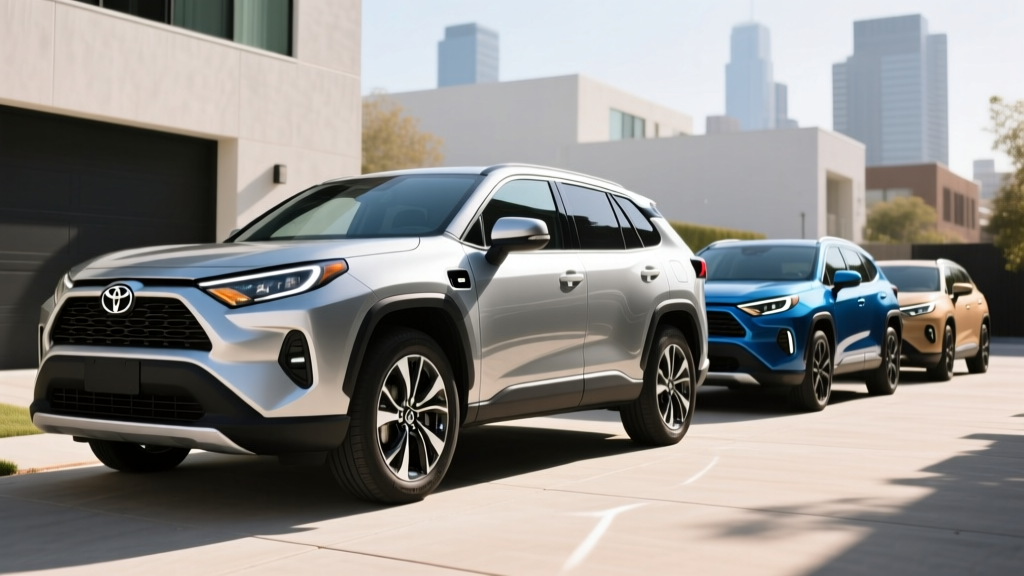
The Toyota RAV4 Hybrid remains one of the best-selling electrified vehicles in the United States, and for good reason: it delivers meaningful fuel savings without requiring a plug or a lifestyle change. But the RAV4 lineup now spans three distinct powertrains — a conventional gas model, a self-charging hybrid (HEV), and the plug-in hybrid RAV4 Prime (PHEV). Understanding the configurations for the 2025 Toyota RAV4 Hybrid is essential before you walk into a dealership, because the trims, pricing, and efficiency figures vary significantly across the lineup.
This guide breaks down every 2025 RAV4 Hybrid and RAV4 Prime configuration with exact EPA fuel economy data, real-world MPG expectations, powertrain specs, battery warranty details, and current federal tax credit rules. Whether you're cross-shopping a full EV like the Tesla Model Y or simply trying to decide between the RAV4 Hybrid LE and the RAV4 Prime XSE, the numbers below will clarify the decision.
HEV vs PHEV: Understanding the Two RAV4 Hybrid Powertrains
Before diving into trim-level details, it's critical to distinguish between the two electrified RAV4 variants. Toyota sells both under the "hybrid" umbrella, but they operate very differently.
| Feature | RAV4 Hybrid (HEV) | RAV4 Prime (PHEV) |
|---|---|---|
| Powertrain Type | Self-charging hybrid — no plug required | Plug-in hybrid — charges via outlet or charger |
| Battery Capacity | ~1.6 kWh (small, recharges via regen/engine) | 18.1 kWh usable (lithium-ion) |
| Electric-Only Driving | Very low speeds, short distances only | Up to 42 miles EPA electric-only |
| Combined Horsepower | 219 hp | 302 hp |
| Requires Plug-In Charging? | No | Yes (for maximum benefit) |
| DC Fast Charging? | N/A | No — Level 1/Level 2 AC only |
The conventional RAV4 Hybrid uses Toyota's fourth-generation Hybrid Synergy Drive. A 2.5-liter four-cylinder engine pairs with front and rear electric motors to deliver all-wheel drive without a mechanical driveshaft. The small battery charges itself through regenerative braking and engine power — you simply fill up at the gas station as usual.
The RAV4 Prime is a plug-in hybrid (PHEV) with a substantially larger 18.1 kWh battery pack. Plug it in at home overnight, and you'll wake up with roughly 42 miles of electric-only range — enough for most daily commutes without burning a drop of gasoline. Once the battery depletes, it seamlessly transitions into conventional hybrid mode, still delivering excellent MPG.
Fuel Economy: EPA MPG and Real-World Expectations
Fuel efficiency is the primary reason buyers choose the RAV4 Hybrid. Here's the complete EPA breakdown by configuration, sourced from fueleconomy.gov:
| Configuration | City MPG | Highway MPG | Combined MPG | MPGe (PHEV EV mode) |
|---|---|---|---|---|
| RAV4 Hybrid (all trims, AWD) | 41 | 38 | 39 | N/A |
| RAV4 Prime (PHEV, EV mode) | 42 miles electric range | 94 MPGe | ||
| RAV4 Prime (PHEV, hybrid mode) | 40 | 36 | 38 | N/A |
Real-world MPG reality check: Toyota hybrids consistently outperform their EPA city ratings in stop-and-go driving because the electric motor handles low-speed acceleration — where gas engines are least efficient. In our experience and consistent owner reports, the RAV4 Hybrid frequently achieves 42-44 MPG in urban driving. Highway fuel economy tends to land slightly below the EPA sticker, around 35-37 MPG at sustained 70+ mph speeds, because aerodynamic drag dominates and the electric motor contributes less at high speeds. Expect a combined real-world average of 38-41 MPG for most drivers — essentially matching or slightly beating the EPA combined figure.
For the RAV4 Prime, the 42-mile electric-only range is an EPA estimate achieved in moderate temperatures with mixed driving. In cold weather (below 32°F), expect that range to drop to roughly 32-36 miles due to cabin heating demands and reduced battery efficiency. In mild conditions with gentle acceleration, some owners report 44-45 electric-only miles.
2025 RAV4 Hybrid Trim Configurations and Pricing
The 2025 RAV4 Hybrid is offered in six trim levels, all equipped with standard all-wheel drive (AWD-i electronic on-demand). Here's the complete configuration breakdown:
| Trim | Base MSRP | Key Features | EPA MPG |
|---|---|---|---|
| LE | $33,595 | 8" touchscreen, Toyota Safety Sense 2.5+, wireless CarPlay/Android Auto | 41/38/39 |
| XLE | $35,095 | Dual-zone climate, blind-spot monitor, Smart Key, 18" alloy wheels | 41/38/39 |
| XLE Premium | $37,595 | SofTex seats, moonroof, 12.3" digital cluster | 41/38/39 |
| SE | $37,095 | Sport-tuned suspension, 19" wheels, paddle shifters | 41/38/39 |
| XSE | $38,595 | Bi-tone exterior, heated front seats, 9" touchscreen | 41/38/39 |
| Limited | $41,595 | Leather, JBL audio, panoramic moonroof, 360° camera | 41/38/39 |
All trims share the same 2.5L four-cylinder hybrid powertrain producing 219 combined horsepower. The 0-60 mph time is approximately 7.4 seconds — adequate for highway merging and confident around town. Cargo volume remains strong at 37.5 cubic feet behind the rear seats, essentially unchanged from the gas-only RAV4.
2025 RAV4 Prime (PHEV) Configurations
The RAV4 Prime is offered in two trims and represents the performance flagship of the RAV4 lineup:
| Trim | Base MSRP | Electric Range | Combined HP | 0-60 mph |
|---|---|---|---|---|
| SE | $44,695 | 42 miles (EPA) | 302 hp | 5.7 seconds |
| XSE | $48,095 | 42 miles (EPA) | 302 hp | 5.7 seconds |
The RAV4 Prime's 302 horsepower makes it the quickest RAV4 ever sold — faster than the V6 RAV4 of previous generations. The 18.1 kWh battery charges in approximately 2.5 hours on a 240V Level 2 charger (3.3 kW onboard charger) or about 10 hours on a standard 120V household outlet. Importantly, the RAV4 Prime does not support DC fast charging — this is AC-only charging, which is typical for PHEVs due to their smaller battery packs and cost/packaging constraints.
When the battery depletes, the Prime defaults to hybrid mode with 38 combined MPG — only slightly less than the standard RAV4 Hybrid, despite carrying several hundred pounds of additional battery weight. Total combined range (electric + gas tank) exceeds 520 miles.
Battery Warranty, Reliability, and Replacement Costs
Hybrid battery longevity is the single most common concern among first-time hybrid buyers. Toyota's track record here is among the best in the industry, dating back to the original Prius in 1997.
2025 RAV4 Hybrid Battery Warranty:
- Hybrid Battery (traction battery): 10 years / 150,000 miles (whichever comes first), transferable to subsequent owners
- Hybrid System Components: 8 years / 100,000 miles (includes inverter, control module, electric motors)
- Capacity Retention Threshold: Warranty covers defects and abnormal degradation — Toyota does not specify a fixed percentage threshold like EV manufacturers, but covers failures that impair hybrid function
Real-world reliability data: Toyota's hybrid battery packs use proven nickel-metal hydride (NiMH) chemistry in the standard RAV4 Hybrid and lithium-ion in the Prime. Failure rates across Toyota's hybrid fleet are exceptionally low. According to long-term owner surveys and repair data, hybrid battery replacement before 150,000 miles is uncommon. When replacement is needed out of warranty, a new RAV4 Hybrid battery pack costs approximately $3,000-$4,500 including labor at a dealership. Third-party refurbished packs are available for $1,500-$2,500.
The RAV4 Prime's larger lithium-ion pack carries the same 10-year/150,000-mile warranty. Replacement cost is higher due to the larger capacity — expect $5,000-$7,000 out of warranty, though failures within the warranty period are rare based on current data from Toyota's PHEV fleet.
Toyota's hybrid systems have consistently earned top marks from IIHS and the RAV4 has historically performed well in Consumer Reports reliability surveys. The hybrid powertrain adds complexity (two motors, inverter, battery) but eliminates the traditional transmission — Toyota's e-CVT power-split device has no clutch packs or bands to wear, contributing to long-term durability.
Tax Credits and Incentives for 2025
Tax credit eligibility is where the RAV4 Hybrid and RAV4 Prime diverge sharply, and where IRS rules under §30D require careful attention.
- RAV4 Hybrid (HEV): Does NOT qualify for the federal §30D clean vehicle tax credit. Conventional hybrids that cannot plug in are ineligible regardless of battery size or efficiency.
- RAV4 Prime (PHEV): The RAV4 Prime qualifies for a portion of the federal tax credit, but eligibility depends on multiple factors under current IRS rules: MSRP must not exceed $80,000 for SUVs (all Prime trims comply); buyer income must fall below $150,000 (single) / $300,000 (joint); and the vehicle must meet critical minerals and battery component sourcing requirements that have tightened significantly. As of 2025, the RAV4 Prime's credit amount may be reduced or eliminated depending on battery sourcing compliance — always verify current eligibility at IRS.gov before purchasing.
- Point-of-sale transfer: If eligible, the §30D credit can now be transferred to the dealer at the point of sale, reducing your purchase price directly rather than waiting for a tax refund.
- State incentives: Several states offer additional rebates for PHEVs (California, Colorado, New York, and others). Check your state energy office or DMV for current programs — these vary widely by jurisdiction and change frequently.
The standard RAV4 Hybrid's lack of federal tax credit eligibility is a notable disadvantage compared to the Prime and compared to full EVs. However, the Hybrid's lower starting price ($33,595 vs. $44,695 for the Prime) often makes the math work without incentives — the $11,100 price gap would take years of fuel savings to recoup, even with the Prime's electric-only commuting advantage.
Who Should Choose the RAV4 Hybrid vs. the Prime vs. a Full EV?
Choose the RAV4 Hybrid (HEV) if:
- You don't have access to home charging (apartment, street parking, no garage)
- You want maximum fuel efficiency without any behavior change — just drive and refuel normally
- Your budget is under $40,000 and you need a practical, reliable AWD crossover
- You drive 15,000+ miles per year and want consistently low fuel costs (~$1,350/year at 39 MPG and $3.50/gallon)
Choose the RAV4 Prime (PHEV) if:
- You can charge at home (Level 2 preferred, but even a 120V outlet works overnight for the 18.1 kWh pack)
- Your daily commute is under 40 miles round-trip — you could drive months between gas fill-ups
- You want the performance boost (302 hp, 5.7-second 0-60) alongside electric commuting
- You regularly take longer road trips where EV charging infrastructure is sparse
- You may qualify for the federal tax credit, narrowing the price gap with the standard Hybrid
Choose a full EV (Tesla Model Y, Hyundai Ioniq 5, etc.) if:
- You have reliable home Level 2 charging and your daily driving is under 250 miles
- You want zero tailpipe emissions and minimal maintenance (no oil changes, no gas engine)
- You qualify for the full $7,500 federal tax credit on a new EV
- You're comfortable with public DC fast charging for road trips
RAV4 Hybrid (HEV) Pros
- 39-41 MPG combined real-world with no plug-in required
- AWD standard on every trim
- Proven reliability with 10-year/150k-mile battery warranty
- Strong resale value — RAV4 Hybrids hold value exceptionally well
- Lower starting price than Prime or comparable EVs
RAV4 Hybrid (HEV) Cons
- No federal tax credit eligibility
- 219 hp is adequate but not quick (7.4s 0-60)
- CVT drone under hard acceleration
- Infotainment interface lags behind competitors
- No electric-only commuting capability
Frequently Asked Questions
How many MPG does the 2025 RAV4 Hybrid actually get?
The EPA rates all 2025 RAV4 Hybrid trims at 41 city / 38 highway / 39 combined MPG. In real-world driving, city MPG often exceeds the EPA rating (42-44 MPG) while highway driving at 75+ mph may drop to 35-37 MPG. Most owners report a combined average of 38-41 MPG across mixed driving conditions.
How far can the RAV4 Prime go on electric only?
The EPA rates the RAV4 Prime at 42 miles of electric-only range. In mild weather with gentle driving, expect 40-44 miles. In cold weather (below freezing), expect 32-36 miles due to battery efficiency loss and cabin heating demands. Once the battery depletes, the Prime operates as a conventional hybrid at 38 combined MPG.
Does the RAV4 Hybrid need to be plugged in?
No. The standard RAV4 Hybrid (HEV) charges its small battery entirely through regenerative braking and the gas engine. You never plug it in — just fill up at the gas station as you would with any conventional vehicle. Only the RAV4 Prime (PHEV) requires plug-in charging to access its electric-only range.
Is the RAV4 Hybrid reliable and what does battery replacement cost?
Toyota's hybrid systems are among the most reliable in the industry, with decades of proven durability. The hybrid battery carries a 10-year/150,000-mile warranty. Out-of-warranty replacement costs approximately $3,000-$4,500 for the standard Hybrid and $5,000-$7,000 for the Prime's larger lithium-ion pack. Premature battery failure is rare based on long-term fleet data.
Does the RAV4 Hybrid qualify for any tax credit?
The conventional RAV4 Hybrid (HEV) does not qualify for the federal §30D clean vehicle tax credit — only plug-in vehicles are eligible. The RAV4 Prime (PHEV) may qualify for a partial or full credit depending on your income, the vehicle's MSRP, and current battery-sourcing requirements. Always verify eligibility at IRS.gov before purchasing. Some states offer separate PHEV incentives.
How long does it take to charge the RAV4 Prime?
On a 240V Level 2 charger, the RAV4 Prime's 18.1 kWh battery charges from empty to full in approximately 2.5 hours (limited by its 3.3 kW onboard charger). On a standard 120V household outlet (Level 1), a full charge takes roughly 10 hours. The Prime does not support DC fast charging.
Should I buy the RAV4 Hybrid or a full EV like the Tesla Model Y?
If you have home charging, drive under 250 miles daily, and are comfortable with DC fast charging on road trips, a full EV offers lower operating costs, zero tailpipe emissions, and federal tax credit eligibility. If you lack home charging, frequently drive long distances in areas with sparse charging infrastructure, or simply want a no-compromise vehicle that works everywhere, the RAV4 Hybrid or Prime is the safer choice. The Prime specifically bridges both worlds — electric commuting with gas-powered road trip freedom.