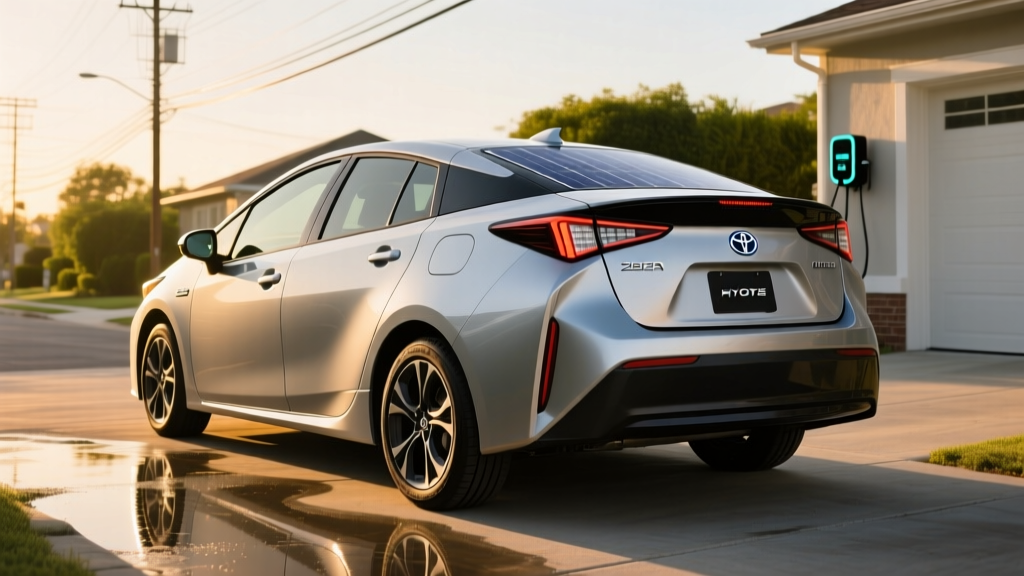
The fifth-generation Toyota Prius proved that a hybrid doesn't have to look like a science experiment to deliver exceptional efficiency. For the 2025 model year, Toyota carries forward the redesigned platform introduced in 2023 — a 196-horsepower powertrain wrapped in a sleek fastback body that finally shed the Prius's dowdy reputation. But the number that still matters most to buyers searching for the 2025 Toyota Prius hybrid MPG is the one on the window sticker: up to 57 MPG combined.
That figure isn't just impressive on paper. In real-world driving, the Prius consistently meets or exceeds its EPA estimates in city traffic, where regenerative braking and electric-motor assist do the heavy lifting. Highway efficiency drops somewhat — a characteristic of every hybrid — but the combined result remains among the best of any non-plug-in vehicle sold in the United States.
This guide covers every 2025 Prius trim, the difference between the conventional hybrid (HEV) and the plug-in variant (now called the Prius Plug-In, formerly Prius Prime), and what ownership actually looks like in terms of fuel cost, reliability, and long-term battery health.
2025 Toyota Prius Hybrid MPG by Trim: EPA Numbers
Toyota offers the 2025 Prius in three trims — LE, XLE, and Limited — and the MPG varies depending on wheel size and drivetrain. The LE trim rides on 16-inch wheels and is available with front-wheel drive (FWD) or all-wheel drive (AWD-e). The XLE and Limited step up to 19-inch alloy wheels, which add rolling resistance and reduce efficiency slightly.
| Trim | Drivetrain | City MPG | Highway MPG | Combined MPG |
|---|---|---|---|---|
| LE | FWD | 57 | 56 | 57 |
| LE | AWD-e | 53 | 54 | 54 |
| XLE | FWD | 52 | 52 | 52 |
| XLE | AWD-e | 49 | 50 | 49 |
| Limited | FWD | 52 | 52 | 52 |
| Limited | AWD-e | 49 | 50 | 49 |
Source: EPA fueleconomy.gov
The takeaway: if maximum MPG is the priority, the LE FWD is the clear choice. The AWD-e system — which uses a small rear-mounted electric motor for traction in slippery conditions — costs you roughly 3-5 MPG combined. The 19-inch wheels on XLE and Limited trims account for another 5 MPG penalty versus the LE's lighter 16-inch setup.
Real-World MPG: What Owners Actually See
EPA estimates are a useful baseline, but hybrids behave differently than gas cars in practice. The Prius's parallel hybrid system recovers kinetic energy during braking and deceleration, meaning stop-and-go city driving — where a conventional car is least efficient — is where the Prius shines brightest.
Owner-reported data and independent testing consistently show the LE FWD achieving 55-60 MPG in mixed city driving. Highway-only trips at 70-75 mph tend to drop into the 48-52 MPG range, as aerodynamic drag dominates and the electric motor contributes less. In cold weather (below 35°F), expect a 5-10% reduction across the board because the gasoline engine runs more frequently to provide cabin heat and maintain battery temperature.
The 2025 Prius LE FWD carries a 11.3-gallon fuel tank. At its EPA combined 57 MPG, that yields approximately 644 miles of total range. In real-world mixed driving, owners report 580-650 miles between fill-ups depending on conditions. Highway-heavy road trips may return closer to 540-560 miles on a tank.
Powertrain Specs: What Powers the 2025 Prius
The 2025 Prius uses Toyota's fifth-generation Hybrid Synergy Drive, pairing a 2.0-liter four-cylinder Atkinson-cycle engine with two motor-generators and a lithium-ion hybrid battery pack. Combined system output is 196 horsepower on FWD models and 196 horsepower on AWD-e models (the rear motor adds traction but is factored into the same net output figure).
| Specification | Detail |
|---|---|
| Engine | 2.0L 4-cyl Atkinson-cycle |
| Combined Net Horsepower | 196 hp |
| 0-60 mph (FWD) | 7.2 seconds |
| 0-60 mph (AWD-e) | 7.0 seconds |
| Hybrid Battery | Lithium-ion, ~1.0 kWh (HEV) |
| Transmission | eCVT (planetary gearset) |
| Fuel Tank | 11.3 gallons |
The 0-60 time of 7.2 seconds is a dramatic improvement over the previous generation's 10-second-plus slogs. The Prius now merges onto highways and passes with genuine confidence, even if it won't outrun a sporty EV. The eCVT — which is not a belt-driven CVT but rather a planetary gearset — delivers seamless power delivery without the rubber-band feeling some drivers associate with conventional continuously variable transmissions.
Prius HEV vs Prius Plug-In: Which One Fits You?
Toyota also sells the Prius Plug-In Hybrid (the successor to the Prius Prime), and it's important to understand the difference. A conventional hybrid (HEV) like the standard Prius never plugs in — it generates all electricity from the gasoline engine and regenerative braking. A plug-in hybrid (PHEV) has a larger battery that can be charged from a wall outlet or public charger, enabling a stretch of electric-only driving before the gas engine kicks in.
| Feature | Prius HEV | Prius Plug-In |
|---|---|---|
| Powertrain Type | Conventional Hybrid (HEV) | Plug-In Hybrid (PHEV) |
| Plugs In? | No | Yes (Level 1 / Level 2) |
| Battery Capacity | ~1.0 kWh | 13.6 kWh |
| Electric-Only Range | N/A | 44 miles (EPA, SE trim) |
| Combined MPG (gas only) | 49-57 MPG | 48 MPG (SE) / 45 MPG (XSE) |
| MPGe (electric + gas) | N/A | 114 MPGe |
| Total Range | ~644 miles | ~490 miles (combined EV + gas) |
| DC Fast Charging | No | No |
| Level 2 Charge Time (0-100%) | N/A | ~4 hours |
| Starting MSRP | $28,350 | $33,675 |
The Prius Plug-In's 44-mile electric-only range covers most daily commutes without using a drop of gasoline, provided you can charge at home overnight. But it costs roughly $5,300 more than the base Prius HEV. The math works if you have reliable home charging and a commute under 40 miles round-trip — you'll burn significantly less gasoline over the year. If you can't charge at home, the Plug-In's extra weight and cost work against you, and the conventional HEV is the smarter buy.
Neither the HEV nor the Plug-In supports DC fast charging. The Plug-In charges at up to 3.3 kW on Level 2 (240V), which is adequate for overnight replenishment but means a full charge from empty takes about four hours.
Pricing, Trims, and Tax Credit Eligibility
The 2025 Toyota Prius starts at $28,350 for the LE FWD (including destination charge) and climbs to approximately $36,765 for the Limited AWD-e. Here's the trim-level breakdown:
| Trim | Drivetrain | MSRP (incl. destination) |
|---|---|---|
| LE | FWD | $28,350 |
| LE | AWD-e | $29,750 |
| XLE | FWD | $31,695 |
| XLE | AWD-e | $33,095 |
| Limited | FWD | $34,765 |
| Limited | AWD-e | $36,165 |
Source: Toyota.com 2025 Prius
Does the 2025 Prius Qualify for a Federal Tax Credit?
The conventional Prius HEV does not qualify for the federal §30D Clean Vehicle Credit. That credit applies only to plug-in electric vehicles (BEVs and PHEVs) with sufficient battery capacity and compliant battery sourcing.
The Prius Plug-In Hybrid may qualify for up to $3,750 under current IRS rules, depending on battery-component and critical-mineral sourcing requirements that have tightened significantly since 2023. The full $7,500 credit requires meeting both sourcing thresholds; many PHEVs currently qualify for only half. Eligibility also depends on your adjusted gross income (capped at $150,000 single / $300,000 joint) and the vehicle's MSRP staying under the $80,000 cap for SUVs/pickups or $55,000 for sedans — the Prius Plug-In clears the MSRP cap easily.
Federal EV/PHEV credit rules under IRS §30D change frequently due to updated battery-sourcing requirements. Always verify current eligibility on IRS.gov or consult a tax professional before purchasing. Point-of-sale transfer is available if you qualify, reducing your dealer price directly.
Some states offer additional rebates or HOV-lane access for hybrids and PHEVs. California's Clean Vehicle Rebate Project (CVRP), for example, has historically offered rebates for PHEVs, though funding availability varies. Check your state energy office for current programs.
Battery Warranty, Reliability, and Replacement Cost
Hybrid battery longevity remains a top concern for first-time hybrid buyers, but the data is reassuring. Toyota's hybrid battery packs have an established track record of lasting well beyond their warranty periods, often exceeding 150,000-200,000 miles before any significant capacity loss.
Toyota covers the 2025 Prius hybrid battery for 10 years or 150,000 miles (whichever comes first) in all 50 states. This matches the longest hybrid battery warranties in the industry. The broader powertrain warranty covers 5 years / 60,000 miles, and the basic new-vehicle warranty is 3 years / 36,000 miles.
If the hybrid battery does eventually need replacement out of warranty, a new OEM battery from Toyota currently costs between $2,000 and $4,000 installed, depending on the dealer and whether you choose a new or refurbished unit. Third-party refurbishers offer replacements in the $1,500-$2,500 range. This is dramatically less expensive than EV traction battery replacements, which can exceed $10,000-$20,000.
Toyota's hybrid system has fewer wear items than a conventional powertrain. There's no traditional alternator, starter motor, or accessory belt to replace. Regenerative braking reduces wear on the friction brake pads, which commonly last 80,000-100,000+ miles on a Prius. The eCVT planetary gearset has no belts or clutches to wear out, contributing to Toyota's reputation for hybrid reliability.
According to long-term reliability data from sources including Consumer Reports and J.D. Power, the Prius consistently ranks among the most reliable vehicles in its class. The current-generation model carries forward the proven powertrain architecture that Toyota has refined over two decades of hybrid production.
Who Should Buy the Prius HEV — and Who Shouldn't
The 2025 Prius occupies a specific niche. It's the right vehicle for a specific set of use cases, and understanding where it fits helps avoid buyer's remorse.
Choose the Prius HEV If:
- You want maximum MPG without changing your fueling habits (no plugging in)
- Your commute involves heavy stop-and-go traffic where hybrids excel
- You need 600+ miles of total range for road trips
- You want low running costs with a sub-$30,000 starting price
- You don't have access to home or workplace charging
Consider a PHEV or Full EV Instead If:
- You have home charging and want electric-only daily driving (Prius Plug-In or a BEV)
- Your commute is under 30 miles round-trip and you want to minimize gas use
- You want to eliminate gasoline entirely (consider a BEV like the Tesla Model 3 or Hyundai Ioniq 6)
- You need more cargo space — the Prius's fastback roof limits rear cargo height
- You regularly tow — the Prius is not rated for towing
Operating Cost: Prius Hybrid vs Gas vs EV
To put the Prius's efficiency in financial terms, consider the annual fuel cost. The EPA estimates the 2025 Prius LE FWD will cost approximately $850-$950 per year in gasoline (based on 15,000 miles driven and current national average fuel prices of roughly $3.25/gallon). A comparable non-hybrid compact sedan averaging 30 MPG combined would cost roughly $1,625 annually — nearly double.
Compared to a battery-electric vehicle charging primarily at home on a national average electricity rate of $0.17/kWh, the EV's annual "fuel" cost runs approximately $500-$600 for the same mileage. The EV wins on operating cost, but the Prius eliminates range anxiety, charging infrastructure concerns, and the higher upfront purchase price of most BEVs.
Insurance costs for the Prius are generally moderate — typically $1,200-$1,600 annually depending on your profile and location. That's less than most EVs (which carry higher insurance premiums due to repair costs) and comparable to other compact sedans.
Frequently Asked Questions
How many MPG does the 2025 Toyota Prius get?
The 2025 Toyota Prius LE FWD achieves an EPA-estimated 57 MPG city, 56 MPG highway, and 57 MPG combined. AWD-e models drop to 54 MPG combined, and XLE/Limited trims with 19-inch wheels achieve 52 MPG combined (FWD) or 49 MPG combined (AWD-e).
Does the Toyota Prius need to be plugged in?
No. The standard Toyota Prius is a conventional hybrid (HEV). It charges its small battery entirely through regenerative braking and the gasoline engine. You never plug it in — you simply fill it with gasoline like any other car. Only the Prius Plug-In (PHEV) variant requires or benefits from plugging in.
How long does the Prius hybrid battery last?
Toyota's hybrid batteries routinely last 150,000-200,000+ miles based on long-term ownership data. Toyota warranties the hybrid battery for 10 years or 150,000 miles in all states. Out-of-warranty replacement costs approximately $2,000-$4,000 for an OEM unit.
Is the Prius better than a full electric vehicle?
It depends on your situation. A full EV (BEV) offers lower per-mile energy costs, zero tailpipe emissions, and less maintenance — but requires charging access, has a higher purchase price, and may involve range compromises on long road trips. The Prius HEV offers excellent efficiency with zero lifestyle change: no charging, 600+ mile range, and a lower starting price. If you lack reliable home charging or frequently drive long distances, the Prius HEV may be the more practical choice.
Does the 2025 Prius qualify for a federal tax credit?
The standard Prius HEV does not qualify for the federal §30D Clean Vehicle Credit — that credit applies only to plug-in vehicles. The Prius Plug-In Hybrid may qualify for up to $3,750 depending on current battery-sourcing rules and your income. Always verify eligibility at IRS.gov before purchasing.
What is the 0-60 time on the 2025 Prius?
The 2025 Prius FWD achieves 0-60 mph in 7.2 seconds. The AWD-e model is slightly quicker at 7.0 seconds thanks to the additional rear-axle motor providing traction off the line. Both represent a major performance improvement over the prior generation.