Quick Verdict: A Heritage Icon With Hybrid Efficiency
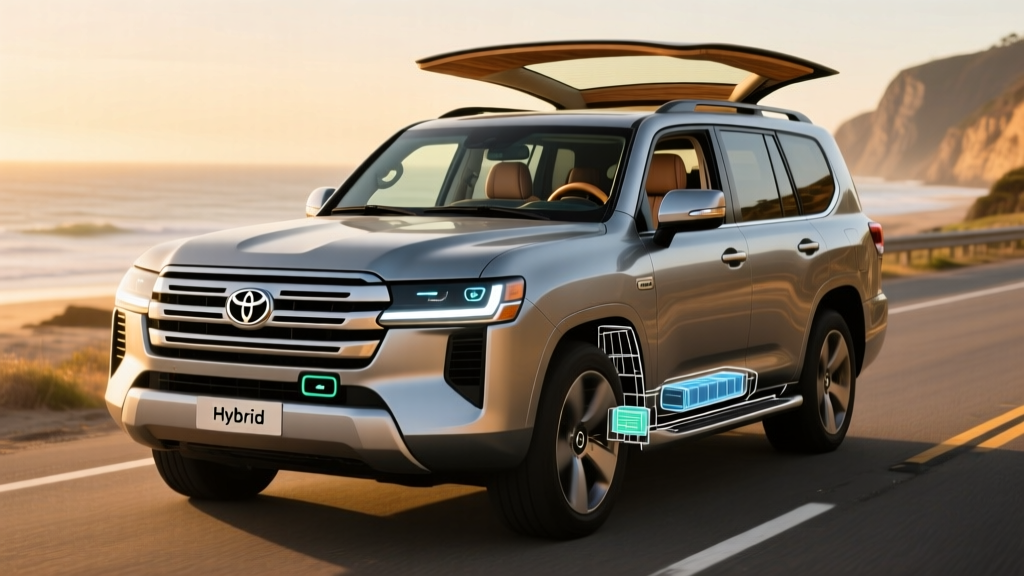
The 2025 Toyota Land Cruiser 1958 is the entry-level trim of Toyota's revived Land Cruiser lineup, and it runs exclusively on the i-FORCE MAX hybrid powertrain. This isn't a plug-in hybrid — it's a conventional self-charging hybrid (HEV) that pairs a turbocharged 2.4-liter inline-four with an electric motor integrated into the 8-speed automatic transmission. The result: 326 combined horsepower, 465 lb-ft of torque, and an EPA-estimated 23 MPG combined in a body-on-frame SUV that can tow 6,000 pounds.
At a starting MSRP of $56,450 (including destination), the 1958 trim is the most accessible way into the new Land Cruiser. But with hybrid efficiency that trails some unibody competitors and no federal tax credit eligibility, buyers need to weigh what they're really paying for: legendary off-road credibility, Toyota's hybrid reliability, and retro styling that turns heads.
| Specification | 2025 Land Cruiser 1958 |
|---|---|
| Powertrain | i-FORCE MAX 2.4L Turbo I-4 + Electric Motor (HEV) |
| Combined Output | 326 HP / 465 lb-ft torque |
| Transmission | 8-speed automatic (Direct Shift) |
| Drivetrain | Full-time 4WD with center locking differential |
| EPA MPG (City / Hwy / Combined) | 23 / 24 / 23 |
| Fuel Tank | 17.9 gallons |
| Total Driving Range | ~411 miles |
| Towing Capacity | 6,000 lbs |
| 0-60 mph | ~6.4 seconds (est.) |
| Curb Weight | ~4,985 lbs |
| Base MSRP | $56,450 |
| Hybrid Battery Warranty | 10 years / 150,000 miles |
HEV vs. PHEV: What the Land Cruiser 1958 Actually Is
This is a critical distinction that trips up many shoppers. The 2025 Land Cruiser 1958 is a conventional hybrid electric vehicle (HEV). It does not have a plug, it does not charge from a wall outlet, and it has no electric-only driving range. The hybrid battery (a compact nickel-metal hydride pack located under the rear seat) charges solely through regenerative braking and the gasoline engine.
| Feature | HEV (Land Cruiser 1958) | PHEV (e.g., RAV4 Prime) | BEV (e.g., Rivian R1S) |
|---|---|---|---|
| Plug-in charging? | No — self-charging | Yes — plug in for EV range | Yes — plug in only |
| Electric-only range | None (motor assists engine) | ~42 miles (RAV4 Prime) | 300+ miles |
| Fuel/energy source | Gasoline only | Gasoline + electricity | Electricity only |
| Federal tax credit | Not eligible (§30D) | Up to $7,500 (if eligible) | Up to $7,500 (if eligible) |
| Home charging needed? | No | Recommended (Level 2) | Essential (Level 2) |
If you're looking for a Toyota SUV with plug-in capability and electric-only commuting, the RAV4 Prime (42 miles of EV range, eligible for the federal credit when available) or the upcoming bZ-series models are where to look. The Land Cruiser 1958 is designed for buyers who want hybrid efficiency gains without any change to their fueling habits.
Fuel Economy: EPA Numbers and Real-World MPG
The EPA rates the 2025 Toyota Land Cruiser (all trims, including the 1958) at 23 MPG city / 24 MPG highway / 23 MPG combined, per fueleconomy.gov. For a 4,985-pound body-on-frame SUV with all-terrain tires and full-time 4WD, that's a meaningful improvement over the outgoing V8 Land Cruiser 200, which managed just 14 MPG combined.
| Driving Scenario | EPA Estimate | Real-World Expectation |
|---|---|---|
| City (stop-and-go) | 23 MPG | 23-25 MPG (hybrids often match or beat EPA in city) |
| Highway (70-80 mph) | 24 MPG | 20-22 MPG (boxy aero, heavy weight, A/T tires) |
| Combined | 23 MPG | 21-23 MPG |
| Off-road / low-speed trail | N/A | 12-16 MPG (low-range, heavy throttle) |
| Cold weather (below 30°F) | N/A | 18-20 MPG (engine runs more for heat, battery less efficient) |
Real-world note: The Land Cruiser's boxy shape and aggressive all-terrain tires hurt it on the highway. In our experience with similar i-FORCE MAX powertrains (the Tacoma and 4Runner), highway fuel economy tends to fall 2-4 MPG below the EPA sticker at sustained speeds above 70 mph. City driving is where the hybrid system earns its keep — the electric motor handles low-speed crawling and regenerative braking recaptures energy in stop-and-go traffic. Expect 23-25 MPG in urban conditions, which is genuinely impressive for this vehicle class.
i-FORCE MAX Powertrain: How the Hybrid System Works
Toyota's i-FORCE MAX is a parallel hybrid system. The 2.4-liter turbocharged inline-four produces 278 HP and 317 lb-ft on its own. A 48-HP electric motor/generator sits between the engine and the 8-speed automatic transmission, adding torque fill and enabling regenerative braking. Combined system output is 326 HP and 465 lb-ft of torque — with peak torque arriving at just 1,700 RPM, which is excellent for off-road crawling and towing.
The hybrid battery is a 1.87 kWh nickel-metal hydride (NiMH) pack. This is tiny compared to a PHEV or BEV — it's not designed to store meaningful energy for electric-only driving. Instead, it acts as a buffer: capturing braking energy, smoothing out torque delivery, and allowing the engine to shut off at stops and during low-load coasting. The engine cycles on and off seamlessly, something Toyota has refined over 25+ years of hybrid production since the original Prius.
The 8-speed Direct Shift automatic is a conventional torque-converter transmission (not a CVT), which is the right choice for a heavy off-road SUV. It handles the torque multiplication needed for towing and low-range crawling far better than the e-CVT found in the RAV4 Hybrid.
Pricing, Trims, and Tax Credit Eligibility
The 2025 Land Cruiser 1958 starts at $56,450 (including $1,895 destination). It's the base trim, but it's far from stripped — standard equipment includes the i-FORCE MAX hybrid, full-time 4WD with locking center differential, 18-inch alloy wheels with all-terrain tires, Toyota Safety Sense 3.0, an 8-inch touchscreen with wireless Apple CarPlay/Android Auto, and heated front seats.
For context, the higher Land Cruiser trim (simply called "Land Cruiser") starts at $61,450 and adds features like a 12.3-inch touchscreen, Multi-Terrain Monitor cameras, and stabilizer bar disconnect (Sway Bar Disconnect) for improved off-road articulation.
Federal tax credit status: The 2025 Toyota Land Cruiser 1958 does not qualify for the IRS §30D Clean Vehicle Credit (up to $7,500). Under current rules, only plug-in electric vehicles (PHEVs and BEVs) with battery capacity of at least 7 kWh are eligible. The Land Cruiser's 1.87 kWh NiMH pack falls well below this threshold. This is a conventional hybrid, and the §30D credit has never applied to non-plug-in HEVs.
Source: IRS Clean Vehicle Credits
Some states offer separate incentives for conventional hybrids, but these are increasingly rare as state programs shift toward plug-in vehicles. Check your state's energy or DMV website for current programs.
Reliability, Battery Lifespan, and Replacement Costs
This is where the Land Cruiser 1958 makes its strongest case. Toyota's hybrid system is one of the most proven in the industry, with over 25 years of continuous production and tens of millions of units on the road. The NiMH battery chemistry in the Land Cruiser is particularly robust — NiMH cells degrade more slowly than lithium-ion and are less sensitive to heat and deep cycling.
Toyota Hybrid Battery Warranty: 10 years or 150,000 miles (whichever comes first), covering defects and capacity loss below a defined threshold. This applies in all 50 states. Powertrain warranty: 5 years / 60,000 miles. Basic bumper-to-bumper: 3 years / 36,000 miles.
What does a replacement cost if the hybrid battery fails out of warranty? Based on current Toyota hybrid battery replacement pricing (the Highlander Hybrid uses a similar system), expect $3,000-$4,500 for a new OEM NiMH battery pack including labor at a dealership. Independent hybrid specialists can sometimes source refurbished packs for $1,500-$2,500. However, real-world failure rates on Toyota's NiMH hybrid batteries are extremely low — many first-generation Prius batteries lasted well past 200,000 miles.
The Land Cruiser badge itself carries additional reliability weight. Toyota engineers this nameplate for 25-year service life in developing-world conditions. The 1958 is built on the TNGA-F body-on-frame platform shared with the 4Runner, Sequoia, and Lexus GX — all known for longevity. According to IIHS, the Land Cruiser earned Good ratings in tested crashworthiness categories.
Who Should Buy the Land Cruiser 1958 Hybrid?
Pros
- 23 MPG combined is excellent for a 5,000-lb body-on-frame SUV
- 465 lb-ft of torque at 1,700 RPM — ideal for towing and trail crawling
- Toyota's proven hybrid reliability with 10yr/150k-mile battery warranty
- Full-time 4WD with locking center diff and available rear locker
- No plug-in charging required — no behavior change from gas vehicles
- Strong resale value (Land Cruiser historically holds value well)
- Retro heritage styling stands out in a sea of crossovers
Cons
- No federal tax credit (conventional HEV, not a PHEV)
- Highway MPG drops to 20-22 in real-world driving
- $56,450 starting price is steep for a "base" trim
- Small 8-inch screen on the 1958 trim feels dated at this price
- No third-row seating (2-row, 5-passenger only)
- Ride quality is truck-like — expected for body-on-frame, but firm
- 17.9-gallon fuel tank limits total range to ~411 miles
Decision Framework: Is the Land Cruiser 1958 Right for You?
Choose the Land Cruiser 1958 if: You need a genuinely capable off-road SUV that will last 15+ years, you tow up to 6,000 lbs, you want hybrid efficiency without plugging in, and you value Toyota's reliability track record over flashy tech.
Choose a PHEV instead (e.g., Jeep Wrangler 4xe) if: You have home charging, want 20+ miles of electric-only commuting, and want to qualify for the $7,500 federal tax credit.
Choose a full EV (e.g., Rivian R1S) if: You have reliable home Level 2 charging, drive mostly under 300 miles between charges, want maximum acceleration and lowest running costs, and don't need extreme off-road durability.
Choose the higher Land Cruiser trim if: You want the larger 12.3-inch screen, Multi-Terrain Monitor, and front stabilizer disconnect for serious rock crawling.
Frequently Asked Questions
How many MPG does the 2025 Toyota Land Cruiser 1958 hybrid get?
The EPA rates it at 23 MPG city, 24 MPG highway, and 23 MPG combined. In real-world driving, expect 23-25 MPG in city traffic (hybrids excel here) and 20-22 MPG on the highway due to the boxy shape and all-terrain tires.
Does the Land Cruiser 1958 need to be plugged in?
No. This is a conventional hybrid (HEV), not a plug-in hybrid (PHEV). The battery charges through regenerative braking and the gasoline engine. You fuel it like any other gas vehicle — just with better MPG than a non-hybrid equivalent.
Does the 2025 Land Cruiser qualify for a federal tax credit?
No. The IRS §30D Clean Vehicle Credit applies only to plug-in vehicles (PHEVs and BEVs) with at least 7 kWh of battery capacity. The Land Cruiser's 1.87 kWh pack doesn't qualify. No federal incentive is available for conventional hybrids under current law.
Is the Land Cruiser 1958 hybrid reliable? What will battery replacement cost?
Toyota's hybrid system is among the most reliable in the industry, backed by a 10-year/150,000-mile hybrid battery warranty. If the NiMH battery does eventually need replacement (typically well past 200,000 miles based on Toyota hybrid history), expect $3,000-$4,500 at a dealer, or $1,500-$2,500 from an independent hybrid specialist using a refurbished pack.
Hybrid vs PHEV vs EV — which powertrain fits my lifestyle?
HEV (Land Cruiser 1958): Best if you can't charge at home, drive long distances frequently, or need maximum off-road/towing capability without range limitations. No behavior change from gas.
PHEV: Best if you have home charging and a short commute (under 30 miles) but still want gas flexibility for road trips. Eligible for federal tax credits.
BEV: Best if you have reliable home Level 2 charging, mostly drive under 300 miles daily, and want the lowest per-mile fuel cost and zero tailpipe emissions.
Can the Land Cruiser 1958 tow? What's the payload?
Yes — it's rated to tow 6,000 pounds with a proper hitch setup, which covers most boat trailers, small campers, and utility trailers. Payload capacity is approximately 1,300 pounds. The i-FORCE MAX's 465 lb-ft of torque at low RPM makes it a confident tow vehicle.
What's the difference between the 1958 trim and the standard Land Cruiser trim?
The 1958 ($56,450) is the base trim with an 8-inch screen, round LED headlights, and 18-inch wheels. The standard Land Cruiser ($61,450) adds a 12.3-inch touchscreen, rectangular LED headlights, 20-inch wheels, Multi-Terrain Monitor, front stabilizer bar disconnect, and additional drive modes. Both share the identical i-FORCE MAX hybrid powertrain and 23 MPG combined rating.