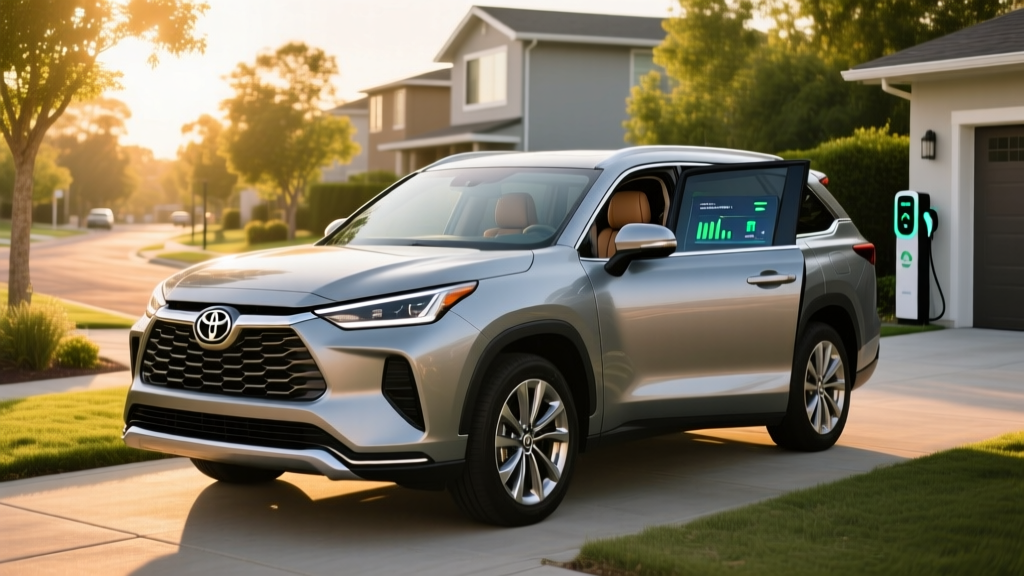
The 2025 Toyota Highlander Hybrid XLE occupies a specific niche in the three-row SUV market: a conventional hybrid (HEV) that delivers meaningful fuel savings over its gas-only sibling without requiring a plug, a charging routine, or a lifestyle change. For families weighing electrification but lacking home charging access, or those who regularly exceed 400 miles between stops, the Highlander Hybrid remains one of the most pragmatic choices on the market. Here's a data-driven look at what the XLE trim actually delivers — and where it falls short against plug-in hybrid and full-electric alternatives.
2025 Toyota Highlander Hybrid XLE: Core Specifications
| Specification | Value |
|---|---|
| Powertrain | 2.5L 4-cylinder + 3 electric motors (eAWD) |
| Combined Horsepower | 243 HP net |
| Drivetrain | Electronic AWD (eAWD) — rear motor-driven |
| Transmission | eCVT (planetary gearset, no belt) |
| Hybrid Battery | 1.87 kWh (net), Nickel-Metal Hydride (NiMH) |
| EPA MPG (City / Hwy / Combined) | 35 / 35 / 35 |
| Fuel Tank Capacity | 17.9 gallons |
| EPA Estimated Range | ~626 miles |
| 0–60 MPH | ~7.8 seconds |
| Seating Capacity | 7 passengers (2nd-row captain's chairs) |
| Cargo Volume (behind 3rd / 2nd / 1st row) | 16.1 / 48.4 / 84.3 cu ft |
| Towing Capacity | 3,500 lbs (with tow prep package) |
| XLE MSRP (incl. destination) | $44,070 |
| Hybrid Battery Warranty | 10 years / 150,000 miles |
Fuel Economy: EPA Numbers vs. Real-World MPG
The EPA rates the 2025 Highlander Hybrid at 35 MPG across the board — city, highway, and combined — for the all-wheel-drive configuration, which is the only drivetrain offered on the hybrid (fueleconomy.gov). This uniformity is typical of Toyota's hybrid synergy drive system: the electric motors handle low-speed city driving where internal combustion engines are least efficient, while the gas engine dominates at highway cruising speeds.
| Driving Scenario | EPA MPG | Real-World Expectation |
|---|---|---|
| City (stop-and-go, suburban) | 35 | 34–38 MPG (hybrids often exceed EPA in city) |
| Highway (70+ MPH sustained) | 35 | 30–33 MPG (aero drag limits regen benefit) |
| Mixed commuting | 35 combined | 33–36 MPG |
| Cold weather (below 30°F) | — | 28–32 MPG (engine runs more for cabin heat) |
The key insight for hybrid buyers: unlike gas-only vehicles, which get significantly worse city MPG, the Highlander Hybrid actually matches or slightly exceeds its EPA city rating in stop-and-go traffic thanks to frequent regenerative braking and electric-only low-speed operation. Highway driving is where you'll see the biggest shortfall from the sticker number, especially at 75–80 MPH or with a full load of passengers and cargo.
Annual fuel cost, per EPA estimates, runs approximately $1,750 based on 15,000 miles/year and $3.50/gallon regular unleaded — roughly $800–$1,000 less per year than the gas-only Highlander's 24 MPG combined rating.
HEV vs. PHEV vs. EV: Which Powertrain Fits Your Family?
The Highlander lineup currently offers only a conventional hybrid (HEV). Toyota discontinued the gas-only Highlander for the 2025 model year, making every new Highlander a hybrid. There is no Highlander PHEV (plug-in hybrid) sold in the US market. This is an important distinction — and it shapes who this vehicle is actually for.
| Factor | HEV (Highlander Hybrid) | PHEV (e.g., RAV4 Prime) | BEV (e.g., Kia EV9) |
|---|---|---|---|
| Plug-in required? | No — self-charging via regen + engine | Yes — for electric-only range | Yes — sole energy source |
| Electric-only range | ~1 mile at low speed | 30–42 miles typical | 230–310 miles (EPA) |
| Total range | ~626 miles | ~550–600+ miles (EV + gas) | 230–310 miles |
| Home charging needed? | No | Recommended for EV benefit | Essential |
| Federal tax credit (§30D) | Not eligible | Up to $7,500 (if eligible) | Up to $7,500 (if eligible) |
| Best for | No charging access, long trips, simplicity | Short commute + long trips, has home charging | Home charging, daily driving, lowest operating cost |
| 3-row availability | Yes (Highlander, Grand Highlander) | Limited (no RAV4 Prime 3rd row) | Yes (EV9, TX, etc.) |
Choose the Highlander Hybrid (HEV) if:
- You lack access to Level 2 home or workplace charging
- You regularly drive 400+ miles without stopping (road trips, towing)
- You want three rows and AWD without range limitations
- You prefer the simplicity of a gas-station-only refueling routine
- Your annual mileage is moderate (10,000–15,000 mi/yr), reducing the payback urgency of a BEV
Consider a PHEV or BEV instead if:
- You have Level 2 charging at home and a commute under 40 miles (PHEV covers this on electricity alone)
- You want to minimize or eliminate gasoline use and tailpipe emissions
- You qualify for the $7,500 federal tax credit, which can offset a BEV's higher MSRP
- You live in a state with low electricity rates and high gas prices (BEV economics improve dramatically)
Powertrain Deep Dive: How Toyota's Hybrid Synergy Drive Works Here
The 2025 Highlander Hybrid uses Toyota's fourth-generation hybrid system, pairing a 2.5-liter Atkinson-cycle four-cylinder engine (186 HP alone) with three electric motor-generators. Two motors drive the front axle, while a third motor powers the rear axle for electronic AWD — there is no mechanical driveshaft connecting front and rear. Combined net output is 243 HP.
The eCVT transmission is not a traditional belt-driven CVT. It uses a planetary gearset that seamlessly blends engine and motor power. This design is one reason Toyota hybrids have earned a reputation for durability: there are no belts to wear, no clutch packs to burn out, and fewer moving parts than a conventional automatic transmission.
The 1.87 kWh NiMH (nickel-metal hydride) battery pack is modest by electrified-vehicle standards. It doesn't enable meaningful electric-only driving at highway speeds, but it buffers energy for acceleration assist and captures regenerative braking energy during deceleration. Toyota has stuck with NiMH chemistry in the Highlander Hybrid rather than switching to lithium-ion — a choice that prioritizes proven longevity and thermal stability over energy density.
Pricing, Trim Value, and Tax Credit Reality
The 2025 Toyota Highlander Hybrid XLE carries an MSRP of $44,070, including destination charges. This positions it between the base LE ($40,970) and the Limited ($49,075). The XLE adds SofTex-trimmed heated front seats, a power liftgate, wireless charging pad, second-row sunshades, and a 7-inch digital cluster over the LE.
Federal tax credit status: The Highlander Hybrid does not qualify for the IRS §30D Clean Vehicle Credit. This credit applies only to plug-in electric vehicles (PHEVs and BEVs) with battery capacities of at least 7 kWh. The Highlander Hybrid's 1.87 kWh NiMH pack falls well below this threshold. There is no federal incentive for conventional hybrids under current IRS rules.
Some states offer hybrid-specific incentives (Oregon's Clean Vehicle Rebate, for instance, has included HEVs in past programs), but these vary by jurisdiction and change frequently. Check your state energy office or department of environmental quality for current programs.
For buyers who want a Toyota three-row hybrid with federal tax credit eligibility, no such vehicle currently exists in Toyota's US lineup. The Grand Highlander Hybrid is also an HEV without plug-in capability. Toyota has not announced a Highlander or Grand Highlander PHEV for the US market.
Battery Warranty, Longevity, and Replacement Costs
Toyota Hybrid Battery Warranty: 10 years or 150,000 miles (whichever comes first), covering capacity loss below a defined threshold and defects. This warranty is transferable to subsequent owners.
Hybrid System Components Warranty: 8 years / 100,000 miles for the inverter, transaxle, and ECU.
Toyota's hybrid battery track record is among the strongest in the industry. Data from fleet operators and long-term owners shows that Toyota NiMH hybrid batteries routinely last 150,000–200,000+ miles with minimal degradation. Unlike the larger lithium-ion packs in BEVs, the Highlander Hybrid's small NiMH pack operates within a narrow state-of-charge window (roughly 40–80%), which dramatically reduces stress on the cells.
Should the hybrid battery need replacement outside of warranty, expect a cost of approximately $3,000–$4,500 for a new OEM battery pack installed at a Toyota dealer. Refurbished/reconditioned packs are available from third-party suppliers for $1,500–$2,500 installed. Individual module replacement (only the degraded cells) can bring the cost down to $500–$1,000 at a hybrid-specialist shop.
For context, this is significantly less than a BEV battery replacement ($10,000–$20,000+ for large packs), and the hybrid battery's smaller size and proven NiMH chemistry make catastrophic failure rare. Most Highlander Hybrids will outlive their ownership tenure without a battery replacement.
XLE Trim: What You Get and What's Missing
The XLE sits in the middle of the Highlander Hybrid lineup and is the volume trim for good reason. Key XLE equipment includes:
- Toyota Safety Sense 3.0 (pre-collision, lane tracing, adaptive cruise, road sign assist)
- 8-inch touchscreen with wireless Apple CarPlay and Android Auto
- SofTex synthetic leather seating, heated front seats
- Second-row captain's chairs (7-passenger layout)
- Power liftgate, auto-dimming rearview mirror
- 5 USB-C ports across three rows
- 18-inch alloy wheels with all-season tires
What the XLE doesn't include that competitors or higher trims offer: a panoramic sunroof (Limited+), a 12.3-inch touchscreen upgrade (Limited), ventilated front seats (Platinum), or a premium audio system beyond the standard 6-speaker setup. The XLE's infotainment screen, at 8 inches, is undersized for a vehicle in the mid-$40K range, especially when rivals like the Hyundai Palisade and Kia Telluride offer larger displays at lower prices.
| Pros | Cons |
|---|---|
|
|
How the Highlander Hybrid XLE Stacks Up Against the Competition
The midsize three-row hybrid SUV segment is competitive. Here's how the Highlander Hybrid XLE compares on key metrics:
- Hyundai Palisade Hybrid: Not yet available in the US for 2025; the gas-only Palisade rates 22 MPG combined.
- Kia Sorento Hybrid: 34 MPG combined, but smaller overall — the third row is best for children only. Starts ~$5K lower.
- Toyota Grand Highlander Hybrid: 34 MPG combined (AWD), significantly more cargo and third-row space, but starts at $46,170.
- Mazda CX-90 PHEV: 25 MPG combined (gas) + 26 miles electric-only. Qualifies for partial federal credit. More engaging to drive but less efficient as a hybrid.
The Highlander Hybrid's 35 MPG combined is still the benchmark for a true three-row, AWD SUV. The Grand Highlander trades 1 MPG for substantially more interior volume — a worthwhile trade if you regularly carry adults in the third row or need the extra 21 cu ft of cargo space.
Frequently Asked Questions
How many MPG does the 2025 Toyota Highlander Hybrid XLE get?
The EPA rates it at 35 MPG city, 35 MPG highway, and 35 MPG combined. In real-world driving, expect 34–38 MPG in city and suburban conditions, 30–33 MPG at sustained highway speeds above 70 MPH, and 28–32 MPG in cold weather below 30°F when the engine runs more frequently for cabin heating.
Does the Highlander Hybrid need to be plugged in?
No. The Highlander Hybrid is a conventional hybrid (HEV), not a plug-in hybrid (PHEV). Its small 1.87 kWh battery charges itself through regenerative braking and the gasoline engine. You refuel exclusively at gas stations — no charging cable, no home charger installation, no public charging network dependency.
Does the 2025 Highlander Hybrid qualify for any tax credit?
The Highlander Hybrid does not qualify for the federal §30D Clean Vehicle Credit, which requires a battery capacity of at least 7 kWh and plug-in capability. Only PHEVs and BEVs are eligible under current IRS rules. Some states may offer hybrid-specific rebates — check your state's energy or environmental agency for current programs.
Is the Highlander Hybrid reliable, and what does battery replacement cost?
Toyota's hybrid system has one of the strongest long-term reliability records in the industry. The NiMH battery pack is warrantied for 10 years / 150,000 miles, and real-world data shows these packs routinely lasting 150,000–200,000+ miles. If replacement is needed out of warranty, expect $3,000–$4,500 for a new OEM pack, or $1,500–$2,500 for a refurbished unit. The eCVT transmission has no belts or clutch packs, contributing to its durability.
How far can the Highlander Hybrid go on electric only?
Less than one mile at very low speeds (under 25 MPH in ideal conditions). This is a conventional hybrid — its electric motors assist the gas engine and capture braking energy, but the battery is too small (1.87 kWh) for meaningful electric-only driving. If you want 30–40 miles of electric-only range, you need a PHEV like the Mazda CX-90 PHEV or Toyota RAV4 Prime (though neither offers three rows).
Should I buy the Highlander Hybrid or wait for a three-row electric SUV?
If you have reliable Level 2 home charging, a predictable daily commute under 300 miles, and don't tow frequently, a BEV like the Kia EV9 (304 miles EPA, 3 rows) could save you $1,000+/year in fuel and eliminate oil changes. But if you regularly drive in areas with sparse charging infrastructure, take long road trips, tow, or simply want zero lifestyle change from your current gas vehicle, the Highlander Hybrid is the lower-risk path to better fuel economy today.
How does the XLE trim compare to the LE and Limited?
The XLE ($44,070) adds heated SofTex seats, a power liftgate, second-row sunshades, and wireless charging over the LE ($40,970). The Limited ($49,075) adds a 12.3-inch touchscreen, panoramic moonroof, ventilated front seats, and a hands-free liftgate. For most families, the XLE hits the value sweet spot — the LE's cloth seats and manual liftgate feel basic at this price point, while the Limited's $5K premium buys comfort features, not efficiency or safety gains.
The 2025 Toyota Highlander Hybrid XLE won't earn you a tax credit or let you drive on electricity alone. What it does deliver is 35 MPG in a three-row AWD SUV with no behavioral changes required — no plug, no app, no range calculation. For families who want to cut fuel costs by a third without compromising road-trip flexibility or taking on charging logistics, it remains the default choice in its class.