Quick Verdict: The Family SUV That Sips Fuel Like a Sedan
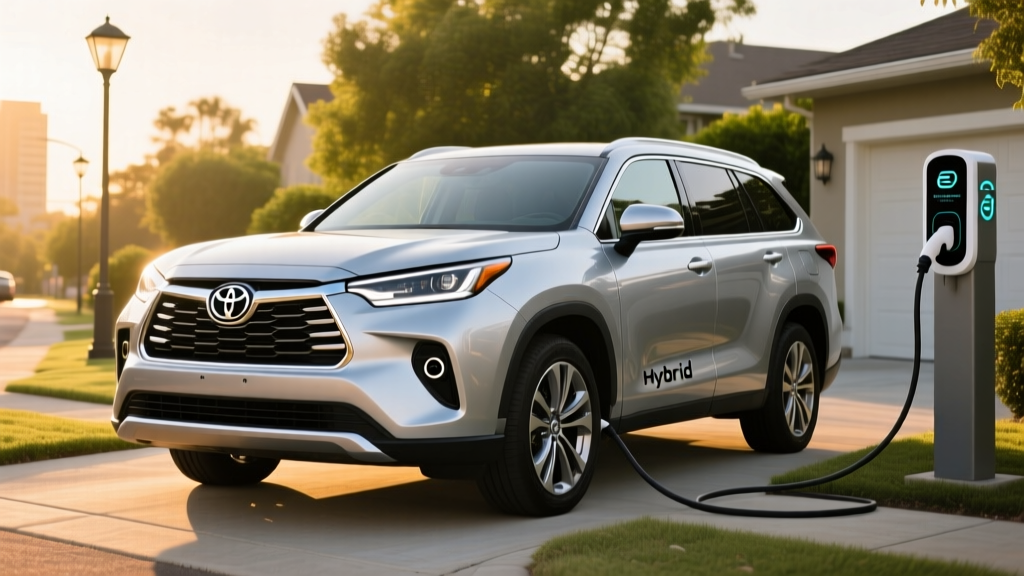
The 2025 Toyota Highlander Hybrid remains one of the most practical three-row SUVs for buyers who want meaningful fuel savings without plugging in. As a conventional hybrid (HEV), it requires zero behavioral change — no charging cables, no range anxiety, no hunting for public chargers on road trips. You just drive it like any other vehicle and watch the fuel bills drop.
Toyota's fourth-generation hybrid powertrain pairs a 2.5-liter four-cylinder engine with two electric motors (three on AWD trims) to deliver 243 combined horsepower and an EPA-estimated 35 MPG combined. That's roughly a 40% improvement over the gas-only Highlander's 24 MPG combined, translating to real savings at the pump for families logging 15,000+ miles per year.
This guide breaks down every critical spec — from powertrain details to battery longevity — so you can decide whether the Highlander Hybrid fits your garage or whether a PHEV or full BEV makes more sense.
2025 Toyota Highlander Hybrid: Core Specifications at a Glance
| Specification | Detail |
|---|---|
| Powertrain Type | Conventional Hybrid (HEV) — no plug-in required |
| Engine | 2.5L 4-cylinder DOHC 16-valve D-4S injection |
| Combined System Horsepower | 243 hp |
| Electric Motors | 2 (FWD) / 3 (AWD — rear-axle motor added) |
| Transmission | Electronically controlled CVT (eCVT) |
| Drivetrain | FWD or Electronic On-Demand AWD |
| Hybrid Battery | 1.87 kWh (sealed nickel-metal hydride) |
| EPA Fuel Economy (AWD) | 35 city / 35 hwy / 35 combined MPG |
| EPA Fuel Economy (FWD) | 36 city / 35 hwy / 36 combined MPG |
| Fuel Tank Capacity | 17.1 gallons |
| Total Driving Range | ~598 miles (FWD) / ~598 miles (AWD) |
| 0–60 mph (est.) | ~7.8 seconds |
| Towing Capacity | 3,500 lbs |
| Seating | 7 or 8 passengers |
| Cargo Volume (behind 3rd/2nd/1st row) | 16.1 / 48.4 / 84.3 cu ft |
| Base MSRP (LE FWD) | $40,970 |
| Top Trim MSRP (Platinum AWD) | $53,075 |
| Hybrid Battery Warranty | 10 years / 150,000 miles |
Source: fueleconomy.gov and Toyota Motor Corporation specifications.
HEV vs. PHEV: Why the Highlander Hybrid Doesn't Plug In
Understanding the distinction is essential before you shop:
Conventional Hybrid (HEV) — This is what the Highlander Hybrid is. The small 1.87 kWh battery recharges itself through regenerative braking and the gasoline engine. You never plug it in. There is no electric-only driving mode of any meaningful distance. The electric motors assist the gas engine during acceleration, low-speed crawling, and coasting — cutting fuel consumption without requiring any infrastructure or habit change.
Plug-In Hybrid (PHEV) — Vehicles like the Toyota RAV4 Prime or Chrysler Pacifica Hybrid carry much larger batteries (typically 14–20 kWh) that you plug into a wall outlet or charger. They offer 25–45 miles of electric-only driving before the gas engine kicks in. Once the battery is depleted, they operate as conventional hybrids. PHEVs require access to charging — ideally a home Level 1 or Level 2 outlet — to capture their full efficiency benefit.
Full Battery Electric (BEV) — Vehicles like the Kia EV9 or Tesla Model X run entirely on electricity with zero gasoline backup. They require reliable home or public charging infrastructure and involve range planning on longer trips.
The Highlander Hybrid is an HEV. Toyota does not currently offer a plug-in hybrid (PHEV) version of the Highlander. If you need plug-in electric range in a three-row Toyota, you'd need to look at the Sienna (also an HEV, not a PHEV) or step outside Toyota to vehicles like the Chrysler Pacifica Hybrid. For a three-row PHEV, options remain very limited in 2025 — the Mitsubishi Outlander PHEV only seats five comfortably, and the Jeep Grand Cherokee 4xe seats five.
Fuel Economy Breakdown: EPA Numbers vs. Real-World MPG
| Trim/Drivetrain | City MPG | Highway MPG | Combined MPG |
|---|---|---|---|
| LE / XLE / Limited (FWD) | 36 | 35 | 36 |
| LE / XLE / Limited / Platinum (AWD) | 35 | 35 | 35 |
Data from fueleconomy.gov.
Real-World MPG: What Owners Actually Report
Toyota hybrids historically perform close to — and sometimes exceed — their EPA estimates in mixed driving, particularly in city conditions where regenerative braking recaptures the most energy. Based on aggregated owner data and independent testing:
- City / suburban driving: 34–38 MPG. Stop-and-go traffic is where the hybrid system shines — the electric motor handles low-speed propulsion while the engine stays off or operates at peak efficiency.
- Highway cruising (70–75 mph): 30–33 MPG. Hybrids lose some advantage at sustained highway speeds because regenerative braking opportunities are minimal and aerodynamic drag dominates.
- Cold weather (below 30°F): Expect a 5–10% reduction, roughly 31–33 MPG combined. The engine runs more frequently to generate cabin heat and warm the catalytic converter.
- Mountainous terrain / heavy cargo: 28–32 MPG. Climbing grades demand sustained engine output, and the added weight of a full load of passengers and cargo works against efficiency.
What Does 35 MPG Actually Save You?
Compared to the gas-only 2025 Highlander (24 MPG combined with the 2.4L turbo), the hybrid saves approximately 162 gallons per year at 15,000 miles annually. At $3.50 per gallon, that's roughly $567 in annual fuel savings, or about $2,835 over five years. The hybrid's ~$4,000 price premium over an equivalent gas trim pays back in roughly seven years at current fuel prices — though many buyers also value the smoother, quieter powertrain and reduced emissions.
Powertrain Deep Dive: How the 243-HP Hybrid System Works
The Highlander Hybrid uses Toyota's proven series-parallel hybrid architecture, now in its fourth generation:
- 2.5L Dynamic Force engine (A25A-FXS): Produces 186 hp and 175 lb-ft of torque on its own. This Atkinson-cycle engine prioritizes thermal efficiency (41%) over peak power.
- Front electric motor: Integrated into the transaxle, it assists during acceleration, provides silent low-speed propulsion, and acts as a generator during braking.
- Rear electric motor (AWD trims only): A separate 54 hp motor on the rear axle provides electronic on-demand AWD. There's no mechanical driveshaft — the rear wheels are powered purely by electricity when traction is needed.
- NiMH battery pack (1.87 kWh): Located under the second-row seats, it's compact enough to preserve full cargo and passenger space. The nickel-metal hydride chemistry is chosen for durability and thermal stability over the higher energy density of lithium-ion.
- eCVT transmission: Not a belt-driven CVT — Toyota's eCVT uses a planetary gearset to seamlessly blend engine and motor power. It's mechanically simpler and more reliable than traditional transmissions.
The result is seamless, quiet acceleration from stoplights (the electric motor delivers instant torque), unobtrusive engine engagement, and strong passing power at highway speeds. The 0–60 mph time of approximately 7.8 seconds is adequate for a three-row family hauler — it won't win drag races, but it merges onto highways with confidence.
Battery Warranty, Lifespan, and Replacement Cost
How Long Do Toyota Hybrid Batteries Last?
Toyota's hybrid battery track record is among the best in the industry. Data from millions of Prius, Camry Hybrid, and Highlander Hybrid vehicles on the road shows:
- Typical lifespan: 12–15 years or 150,000–200,000+ miles before significant degradation.
- Failure rate within warranty: Low. Toyota's NiMH packs degrade gradually rather than failing catastrophically. Most owners never replace the battery.
- Capacity loss: Expect 10–15% capacity reduction over 10 years. Because the battery is small (1.87 kWh) and the system never fully charges or discharges it (operating in a 40–80% state-of-charge window), stress on the cells is minimal.
Hybrid Battery Replacement Cost
If the battery does eventually need replacement outside warranty:
- Toyota dealer replacement: $3,000–$4,500 (parts + labor) for a new OEM NiMH pack.
- Refurbished / aftermarket: $1,500–$2,500 for a reconditioned unit from a specialist shop.
- Individual cell module replacement: Some independent hybrid specialists can replace failed modules within the pack for $500–$1,200, extending the pack's life at a fraction of full replacement cost.
For context, most Highlander Hybrid owners will sell or trade the vehicle before battery replacement becomes necessary. And the 10-year/150,000-mile warranty provides coverage well beyond the typical first-ownership period.
2025 Highlander Hybrid Trim Pricing and Tax Credit Eligibility
The 2025 Highlander Hybrid is available across six trims, with pricing that reflects Toyota's positioning as a mainstream family SUV:
| Trim | Drivetrain | MSRP |
|---|---|---|
| LE | FWD | $40,970 |
| LE | AWD | $42,570 |
| XLE | FWD / AWD | $43,970 / $45,570 |
| XLE Nightshade | AWD | $47,470 |
| Limited | FWD / AWD | $48,670 / $50,270 |
| Platinum | AWD | $53,075 |
Does the Highlander Hybrid Qualify for a Federal Tax Credit?
No. Under current IRS §30D Clean Vehicle Credit rules, conventional hybrids (HEVs) do not qualify for the federal EV tax credit. The §30D credit of up to $7,500 applies only to plug-in electric vehicles (PHEVs and BEVs) that meet battery capacity, critical mineral sourcing, and battery component requirements.
The Highlander Hybrid also does not qualify for the Used Clean Vehicle Credit (§25E), which requires a plug-in vehicle with at least 4 kWh of battery capacity.
State incentives: A handful of states offer rebates or HOV-lane access for hybrids, but these programs are increasingly focused on PHEVs and BEVs. Check your state's energy or environmental agency website for current programs, as they change frequently.
Highlander Hybrid vs. PHEV vs. Full EV: Which Fits Your Family?
Choose the Highlander Hybrid (HEV) if:
- You don't have access to home charging (apartment, street parking, no garage outlet)
- You want three-row seating with no compromises on cargo or passenger space
- You take frequent long road trips and don't want to plan around charging stops
- You want fuel savings with zero lifestyle or habit changes
- You plan to keep the vehicle 8–10+ years and value Toyota's reliability track record
Choose a three-row PHEV (e.g., Chrysler Pacifica Hybrid) if:
- You can charge at home (even a standard 120V outlet adds ~4 miles/hr)
- Most of your daily driving is under 30 miles (the Pacifica Hybrid offers 32 miles electric-only)
- You want some electric-only driving for school runs and commutes while retaining gas range for trips
Choose a three-row full EV (e.g., Kia EV9, Rivian R1S) if:
- You have reliable Level 2 home charging installed
- Your daily driving is under 250 miles and you're comfortable with DC fast-charging on road trips
- You want to eliminate gasoline costs entirely and qualify for the up-to-$7,500 federal tax credit
- You're ready to invest in a higher upfront purchase price for lower operating costs
Reliability, Safety, and Ownership Costs
Toyota's hybrid system is among the most proven electrified powertrains on the road, with over 25 years of continuous refinement since the original Prius. The Highlander Hybrid specifically benefits from:
- No turbocharger (the gas Highlander uses a turbocharged 2.4L) — fewer high-stress components to maintain.
- eCVT planetary gearset — no clutch packs, belts, or traditional transmission fluid changes.
- Regenerative braking — reduces wear on friction brake pads. Many Toyota hybrid owners report original brake pads lasting 80,000–100,000+ miles.
- Proven NiMH chemistry — less energy-dense than lithium-ion but exceptionally durable and thermally stable.
Safety ratings reinforce the Highlander's family-SUV credentials. The 2025 Highlander earned a TOP SAFETY PICK designation from the IIHS, and Toyota Safety Sense 3.0 comes standard on every trim — including pre-collision braking with pedestrian detection, full-speed adaptive cruise control, lane-departure alert with steering assist, and automatic high beams.
Insurance costs for the Highlander Hybrid run slightly higher than the gas version (typically 5–10% more) due to the higher MSRP and hybrid-system repair considerations, though rates remain competitive within the midsize SUV segment.
- 35 MPG combined — class-leading for a three-row SUV
- No plug-in required — zero infrastructure dependency
- Smooth, quiet hybrid powertrain with adequate passing power
- 10-year / 150,000-mile hybrid battery warranty
- Strong resale value and Toyota reliability reputation
- 3,500-lb towing capacity (sufficient for small boats and utility trailers)
- Standard Toyota Safety Sense 3.0 on every trim
- No PHEV variant available — can't drive on electric-only power
- ~$4,000 price premium over equivalent gas trims
- No federal tax credit eligibility for HEVs
- Four-cylinder engine can sound strained under hard acceleration
- AWD is electronic (rear motor), not a true mechanical system — limited off-road capability
- Third row is tight for adults on long trips
- Infotainment system lags behind competitors in responsiveness
Frequently Asked Questions
How many MPG does the 2025 Toyota Highlander Hybrid get?
The EPA rates the 2025 Highlander Hybrid at 35 city / 35 highway / 35 combined MPG with AWD, and 36 city / 35 highway / 36 combined with FWD. Real-world mixed driving typically yields 33–37 MPG depending on conditions, with city driving often matching or exceeding the EPA estimate and highway-only driving returning 30–33 MPG.
Does the Highlander Hybrid need to be plugged in?
No. The Highlander Hybrid is a conventional hybrid (HEV). Its 1.87 kWh battery recharges automatically through regenerative braking and the gasoline engine. You never plug it in, and there is no electric-only driving mode. Just fill it with regular unleaded gasoline and drive.
Is there a plug-in hybrid (PHEV) Toyota Highlander?
As of the 2025 model year, Toyota does not offer a PHEV version of the Highlander. If you need a plug-in Toyota with three rows, the closest option in Toyota's lineup is the Grand Highlander Hybrid (also an HEV, 34 MPG combined). For a true three-row PHEV, you'd need to look at the Chrysler Pacifica Hybrid (32 miles electric-only, but minivan body style).
How long will the Highlander Hybrid battery last?
Toyota's NiMH hybrid batteries typically last 12–15 years or 150,000–200,000+ miles. The battery is covered by a 10-year / 150,000-mile warranty. Because the system keeps the battery in a partial state-of-charge window (roughly 40–80%), stress on the cells is minimized, contributing to long service life.
What does it cost to replace the hybrid battery?
A new OEM replacement through a Toyota dealer typically costs $3,000–$4,500 including labor. Refurbished units from hybrid specialists run $1,500–$2,500, and individual cell module replacements can cost as little as $500–$1,200. Most owners never need to replace the battery within the vehicle's typical ownership period.
Does the 2025 Highlander Hybrid qualify for any tax credit?
No. Under current IRS §30D rules, conventional hybrids (HEVs) do not qualify for the federal Clean Vehicle Credit. Only plug-in electric vehicles (PHEVs and BEVs) with sufficient battery capacity and compliant battery sourcing are eligible. Some states may offer minor incentives for hybrids — check your state energy office for current programs.
Can the Highlander Hybrid tow?
Yes. The 2025 Highlander Hybrid is rated to tow up to 3,500 pounds across all trims — sufficient for a small boat, jet skis, or a light utility trailer. This is less than the gas-only Highlander's former 5,000-lb rating, so if you regularly tow heavy loads, the hybrid may not be the right fit.
Is the Highlander Hybrid good in snow?
The electronic on-demand AWD system (AWD trims) provides competent traction in snow and ice for typical winter driving. The rear electric motor engages automatically when front-wheel slip is detected. It's not a substitute for a dedicated off-road or heavy-duty AWD system, but paired with winter tires, the Highlander Hybrid handles snowy commutes and moderate winter conditions well.