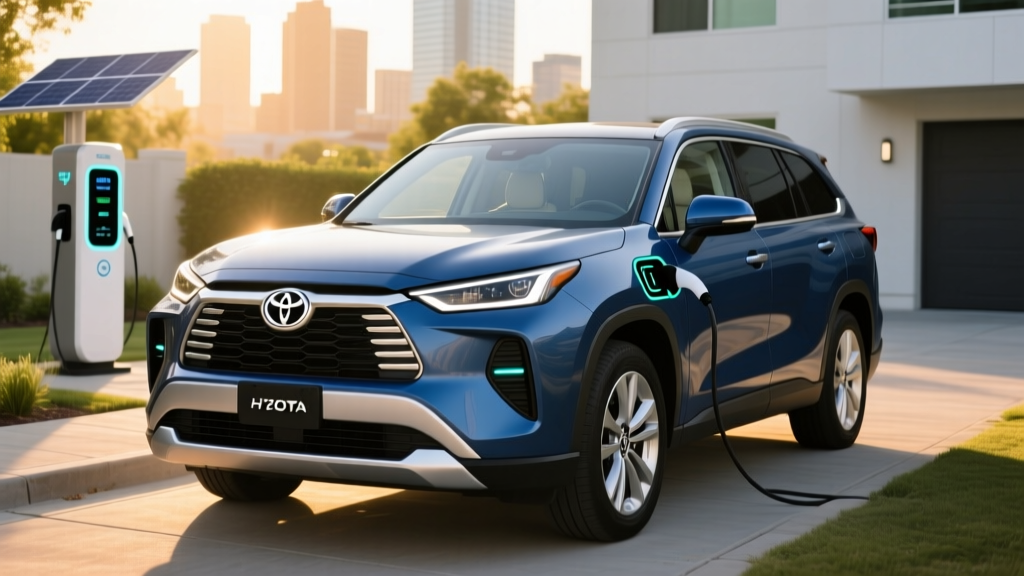
The 2025 Toyota Grand Highlander Hybrid SUV occupies a rare niche: a three-row family hauler that sips fuel like a compact sedan while offering genuine adult-sized third-row seating and a powertrain lineup that ranges from efficiency-focused to surprisingly quick. After analyzing EPA data, real-world owner reports, and Toyota's current pricing structure, here's everything buyers need to know before signing paperwork.
Hybrid vs. Hybrid MAX: Two Very Different Powertrains
Toyota offers the Grand Highlander in two distinct hybrid configurations for 2025, and confusing them is the most common buyer mistake. Understanding the difference is critical to choosing the right trim.
Standard Hybrid (LE, XLE, Limited)
A conventional self-charging hybrid (HEV) — no plug required, no electric-only range. The 2.5-liter four-cylinder engine pairs with front and rear electric motors via Toyota's eCVT. It prioritizes fuel economy above all else.
Hybrid MAX (Limited, Platinum)
Also a conventional hybrid (HEV), but tuned for performance. A turbocharged 2.4-liter four-cylinder teams with a more powerful electric motor through a traditional 6-speed automatic transmission. You get substantially more horsepower and torque at a modest fuel-economy penalty. Neither variant is a plug-in hybrid (PHEV).
Neither powertrain requires a charger, a wall outlet, or any change to your daily routine. The hybrid battery charges itself through regenerative braking and engine operation. If you want electric-only commuting in a three-row Toyota SUV, the closest option remains the Highlander Hybrid (smaller, less third-row space) or stepping into a full BEV like the Kia EV9.
Fuel Economy: EPA Numbers and Real-World MPG
The headline figure for the standard Grand Highlander Hybrid is an EPA-estimated 36 MPG combined — remarkable for a vehicle with over 130 cubic feet of passenger and cargo volume. Here's the full breakdown by powertrain and drivetrain:
| Powertrain | Drivetrain | City MPG | Highway MPG | Combined MPG |
|---|---|---|---|---|
| 2.5L Hybrid | FWD | 37 | 34 | 36 |
| 2.5L Hybrid | AWD (AWD-i) | 35 | 34 | 35 |
| 2.4L Turbo Hybrid MAX | AWD | 26 | 27 | 27 |
Source: EPA Fuel Economy
Real-World MPG Reality Check
Toyota's hybrid system tends to exceed EPA city estimates in stop-and-go driving because regenerative braking recovers energy that gas-only vehicles waste as heat. Owners in suburban and city-heavy commutes regularly report 38-40 MPG in the standard hybrid. Highway-only driving at 75+ MPH typically yields 31-33 MPG — slightly below the EPA sticker due to the boxy aerodynamic profile. Hybrid MAX owners should expect 24-26 MPG in mixed driving, especially with enthusiastic throttle use. Cold weather (below 30°F) reduces MPG by roughly 8-12% as the engine runs more frequently for cabin heat.
Powertrain Specs and Performance
| Specification | 2.5L Hybrid | 2.4L Hybrid MAX |
|---|---|---|
| Engine | 2.5L inline-4 + 2 electric motors (3 with AWD) | 2.4L turbo inline-4 + 1 electric motor |
| Combined Horsepower | 245 HP | 362 HP |
| Combined Torque | 173 lb-ft (engine) + motor torque | 400 lb-ft |
| Transmission | eCVT | 6-speed automatic |
| 0-60 MPH | ~7.8 sec | ~5.6 sec |
| Towing Capacity | 3,500 lbs | 5,000 lbs |
| Drivetrain | FWD or AWD-i (electronic rear motor) | AWD standard (Full-Time AWD) |
The standard hybrid's 245 HP is adequate for merging and passing but feels strained when fully loaded with passengers and cargo on steep grades. The Hybrid MAX's 362 HP and 400 lb-ft of torque transform the driving experience — this is a genuinely quick three-row SUV that can hit 60 MPH in the mid-five-second range, rivaling some sport sedans. The trade-off is a 9 MPG combined penalty and a ~$5,000-$7,000 price premium depending on trim.
Pricing by Trim and Tax Credit Eligibility
For 2025, the Grand Highlander Hybrid starts at $45,020 (including destination) for the LE trim and climbs to approximately $59,000+ for the Hybrid MAX Platinum. Here's the approximate trim-by-trim breakdown:
- Hybrid LE (FWD/AWD): ~$45,020 – $46,620
- Hybrid XLE (AWD): ~$48,420
- Hybrid Limited (AWD): ~$52,520
- Hybrid MAX Limited (AWD): ~$54,920
- Hybrid MAX Platinum (AWD): ~$59,070
Federal Tax Credit: Not Eligible
Under IRS §30D rules, the federal EV tax credit applies only to plug-in electric vehicles (BEVs and PHEVs) with sufficient battery capacity. Because the Grand Highlander Hybrid is a conventional HEV — it has no plug, no meaningful electric-only range, and a small ~1.6 kWh battery — it does not qualify for the $7,500 federal tax credit. The same applies to Hybrid MAX variants. Some states offer modest hybrid rebates (check your state energy office), but the major federal incentive is reserved for plug-in vehicles. Always verify current rules at IRS.gov.
Hybrid vs. PHEV vs. Full EV: Which Powertrain Fits You?
Three-row family SUV buyers face a genuine powertrain decision in 2025. Here's a practical framework based on your driving habits, home charging access, and budget:
Choose the Grand Highlander Hybrid (HEV) if:
- You lack access to home or workplace Level 2 charging
- You want zero behavior change — just fill up at any gas station
- Your driving is mostly city/suburban (where hybrids shine)
- You tow occasionally (up to 5,000 lbs with Hybrid MAX)
- You want the lowest fuel cost without range anxiety
Choose a PHEV (like the Mazda CX-90 PHEV) if:
- You can install a Level 2 home charger
- Your daily commute is under 25-30 miles (covering most trips on electric)
- You want to reduce fuel consumption without committing to full electric
- You qualify for the §30D federal tax credit ($7,500 point-of-sale)
Choose a full EV (like the Kia EV9 or Tesla Model X) if:
- You have reliable home Level 2 charging
- You rarely tow heavy loads (EV towing drops range dramatically)
- You want the lowest per-mile energy cost and zero tailpipe emissions
- You drive in a region with robust DC fast-charging infrastructure
The Grand Highlander Hybrid's strongest argument is total range: with a 17.9-gallon fuel tank and 35 MPG combined, you're looking at roughly 625 miles between fill-ups — something no current three-row EV can match without multiple charging stops.
Battery Warranty, Lifespan, and Replacement Cost
Hybrid battery longevity remains the top concern for first-time hybrid buyers, and Toyota's track record here is among the best in the industry.
| Coverage | Duration | Details |
|---|---|---|
| Hybrid Battery Warranty | 10 years / 150,000 miles | Whichever comes first; covers capacity loss and defects |
| Hybrid System Components | 8 years / 100,000 miles | Inverter, motors, control modules |
| Basic New Vehicle | 3 years / 36,000 miles | Bumper-to-bumper |
| Powertrain | 5 years / 60,000 miles | Engine, transmission |
Toyota's nickel-metal hydride (NiMH) hybrid batteries in the standard 2.5L system have a proven track record spanning two decades — the Prius taxi fleet demonstrated these batteries routinely exceeding 200,000 miles with minimal degradation. The Grand Highlander's hybrid battery is relatively small (~1.6 kWh usable) and operates within a conservative state-of-charge window managed by Toyota's battery management system, which prevents the deep cycling that accelerates wear.
If replacement is needed outside warranty, expect $3,000-$4,500 for a new OEM hybrid battery pack including labor. Refurbished/remanufactured packs from third-party suppliers run $1,500-$2,500. Given Toyota's reliability data and the 10-year/150,000-mile warranty, most original owners will never face this cost.
Who Should Buy the 2025 Grand Highlander Hybrid?
Pros
- 36 MPG combined in a genuine three-row SUV is class-leading
- Third row fits adults — not just children — on long trips
- 625+ mile total range eliminates road-trip charging stops
- Hybrid MAX offers sports-sedan acceleration with 5,000-lb towing
- 10-year/150,000-mile hybrid battery warranty
- Strong Toyota resale value and dealer network
- No charging infrastructure required
Cons
- No federal tax credit eligibility (HEV, not PHEV)
- Standard hybrid feels underpowered when fully loaded
- Hybrid MAX fuel economy drops to 27 MPG combined
- Starting price ~$45,000 is steep vs. non-hybrid competitors
- No plug-in hybrid variant available
- eCVT drone under hard acceleration (standard hybrid)
- Third-row access still requires second-row seat folding
The ideal buyer is a family of five or six who drives 15,000+ miles annually in mixed city/highway conditions, wants to minimize fuel costs without managing charging logistics, and values Toyota's long-term reliability reputation. If your daily commute is short and you have home charging, a PHEV alternative may offer lower running costs with tax-credit savings. If you primarily drive in urban areas and rarely take road trips exceeding 300 miles, a full-electric three-row SUV could save more over five years — but at a higher upfront cost.
Frequently Asked Questions
How many MPG does the 2025 Toyota Grand Highlander Hybrid get?
The standard 2.5L hybrid achieves an EPA-estimated 37 city / 34 highway / 36 combined MPG with front-wheel drive, or 35/34/35 with AWD. The Hybrid MAX drops to 26/27/27 MPG. Real-world city driving often exceeds EPA estimates by 2-4 MPG thanks to regenerative braking, while sustained highway speeds above 75 MPH typically yield 31-33 MPG.
Is there a plug-in hybrid (PHEV) version of the Grand Highlander?
No. For 2025, Toyota offers the Grand Highlander exclusively as a conventional hybrid (HEV) in two powertrain configurations. There is no plug-in variant with electric-only range. Buyers seeking a Toyota PHEV with three rows should look at the current Highlander lineup or consider competitors like the Mazda CX-90 PHEV.
Does the Grand Highlander Hybrid qualify for any tax credits?
The Grand Highlander Hybrid does not qualify for the federal §30D clean vehicle tax credit because it is a conventional hybrid, not a plug-in vehicle. Some states may offer small hybrid incentives — check your state's energy department website. The full $7,500 federal credit is reserved for BEVs and qualifying PHEVs that meet battery sourcing, MSRP caps, and buyer income limits.
How long will the hybrid battery last?
Toyota covers the hybrid battery for 10 years or 150,000 miles. Based on historical data from Toyota's hybrid fleet (Prius, Camry Hybrid, RAV4 Hybrid), these batteries commonly last 150,000-250,000 miles before significant capacity loss. The battery management system keeps the state of charge in a conservative 40-80% window, which dramatically extends cell life.
What does a hybrid battery replacement cost?
Outside of warranty, a new OEM hybrid battery for the Grand Highlander is estimated at $3,000-$4,500 installed. Third-party refurbished packs cost $1,500-$2,500. Given the 10-year/150,000-mile warranty and Toyota's hybrid battery longevity record, most owners will never need a replacement during their ownership period.
Is the Hybrid MAX worth the extra cost?
If you regularly carry a full load of passengers and cargo, tow near the 5,000-lb limit, or simply want effortless highway passing power, the Hybrid MAX's 362 HP and 400 lb-ft of torque transform the driving experience. The trade-off is roughly 9 fewer MPG combined and a higher purchase price. For budget-focused buyers who prioritize fuel economy, the standard hybrid's 245 HP is adequate for most driving scenarios.
How does the Grand Highlander Hybrid compare to a full EV for family road trips?
For road trips exceeding 300 miles, the Grand Highlander Hybrid's 625-mile total range and 5-minute gas fill-ups are a significant convenience advantage over current three-row EVs, which typically require 20-40 minute DC fast-charging stops every 250-300 miles. However, for daily commuting under 40 miles, a full EV offers dramatically lower per-mile energy costs and zero tailpipe emissions.