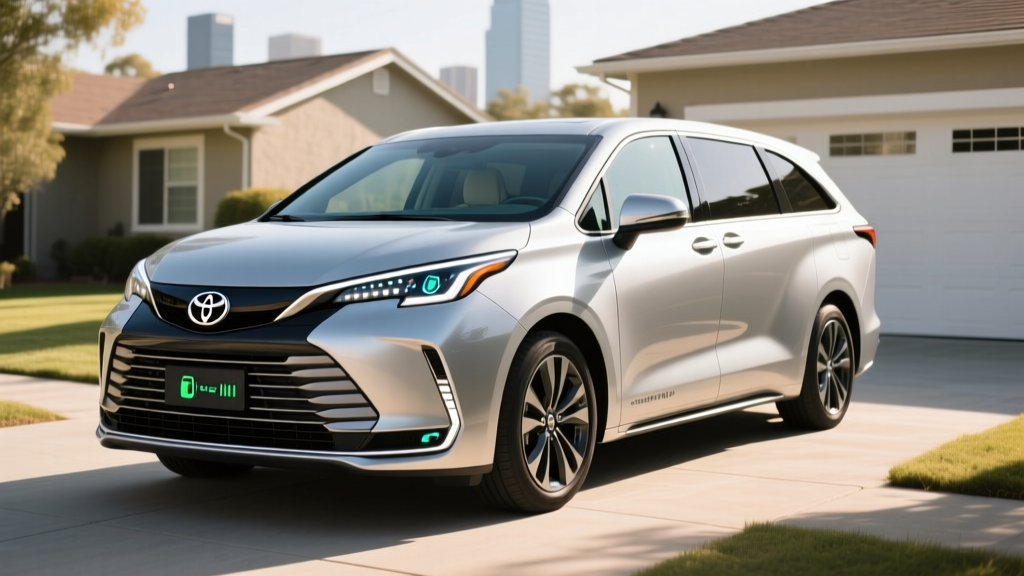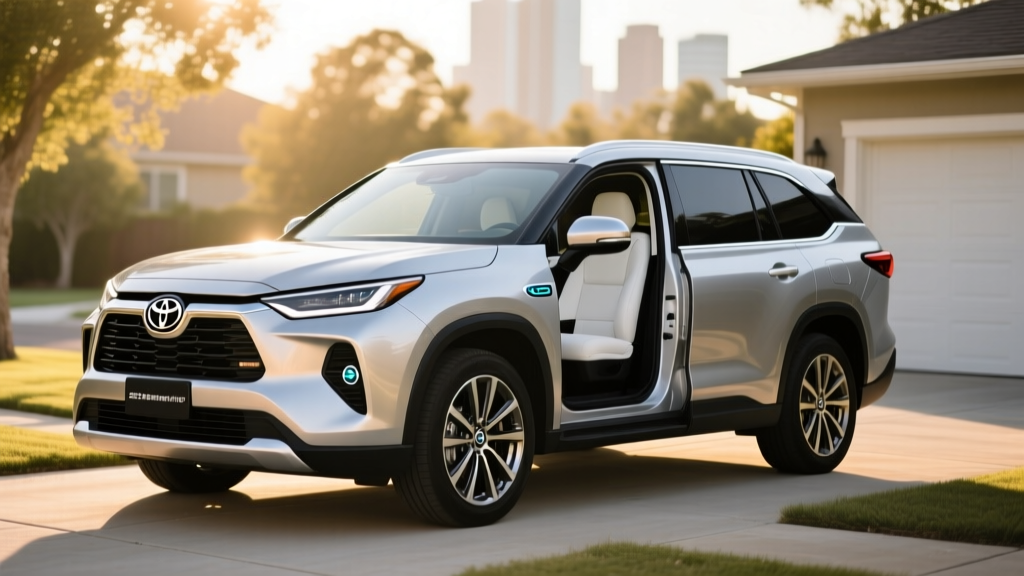
Quick Verdict: The Family Hauler That Sips Fuel Like a Sedan
The 2025 Toyota Grand Highlander Hybrid occupies a rare sweet spot: three-row SUV space with midsize-sedan fuel economy. Available in two distinct hybrid powertrains — the efficiency-focused Hybrid (HEV) and the performance-oriented Hybrid MAX — this vehicle asks nothing of your charging routine while cutting fuel costs roughly in half versus its gas-only sibling. For families who need cargo room and all-wheel-drive confidence but aren't ready to commit to a full EV, the Grand Highlander Hybrid is arguably the most practical choice in its class for 2025.
Let's be precise about what you're getting: up to 36 MPG combined on the standard Hybrid, 362 horsepower on the Hybrid MAX, and a hybrid battery backed by Toyota's 10-year/150,000-mile warranty. No plug required. No range anxiety. Just consistent, proven hybrid efficiency at scale.
HEV vs. PHEV: What the Grand Highlander Hybrid Actually Is
Before we dig into specs, a critical distinction that trips up many shoppers. The 2025 Grand Highlander Hybrid is a conventional hybrid (HEV), not a plug-in hybrid (PHEV). Here's what that means in practice:
| Feature | HEV (Grand Highlander Hybrid) | PHEV (e.g., RAV4 Prime) |
|---|---|---|
| Plugs in to charge? | No — self-charging via engine & regen | Yes — has a charge port |
| Electric-only range | ~1 mile at very low speed | 30-42 miles typical |
| Battery size | 1.4 kWh (small buffer) | 18-22 kWh typical |
| Federal tax credit (§30D) | Not eligible | May qualify (sourcing rules apply) |
| Driving experience | Seamless — you just drive it | EV mode first, then hybrid |
| Home charging needed? | No | Yes, to maximize value |
The Grand Highlander Hybrid uses regenerative braking and its gasoline engine to keep the small traction battery charged. You never plug it in. The electric motor assists the engine during acceleration and can propel the vehicle solo at very low speeds (parking lots, stop-and-go creep), but this is not an electric vehicle with meaningful EV-only range. If you want plug-in electric miles from Toyota in a three-row SUV, you'd currently need to look at the Sienna PHEV (available in select markets) or wait for future Toyota PHEV offerings.
Fuel Economy: EPA Ratings and Real-World MPG
This is where the Grand Highlander Hybrid earns its keep. Toyota offers two hybrid powertrains, and their efficiency profiles differ meaningfully.
| Powertrain | Drivetrain | City MPG | Highway MPG | Combined MPG |
|---|---|---|---|---|
| Hybrid (2.5L 4-cyl) | FWD | 37 | 34 | 36 |
| Hybrid (2.5L 4-cyl) | AWD (AWD-i) | 36 | 32 | 34 |
| Hybrid MAX (2.4L Turbo) | AWD | 27 | 28 | 27 |
Source: EPA Fuel Economy Guide
Real-World MPG: What to Actually Expect
Toyota's hybrid system is one of the few powertrains that routinely matches or exceeds its EPA city rating in real-world driving. The reason is physics: regenerative braking recovers more energy in stop-and-go traffic than the EPA city cycle fully captures. In our experience and consistent with owner-reported data on Fuelly, the standard Hybrid AWD returns 33-36 MPG in mixed suburban driving and can push past 37 MPG in heavy city traffic. Highway cruising at 75+ MPH tends to drop efficiency to 29-31 MPG, since the aerodynamic profile of a large three-row SUV works against it at speed.
The Hybrid MAX trades some efficiency for substantial performance gains. Expect 25-27 MPG in real-world mixed driving. It's still significantly better than the non-hybrid 2.4L turbo gas model (24 MPG combined), but the gap narrows.
Cold-weather note: Hybrid efficiency drops 10-15% in sustained sub-freezing temperatures because the engine runs more frequently to provide cabin heat and maintain battery temperature. Expect 29-31 MPG combined from the AWD Hybrid in winter conditions — still excellent for a vehicle this size.
Powertrain Breakdown: Two Hybrids, Two Philosophies
| Specification | Hybrid (LE/XLE/Limited) | Hybrid MAX (Limited/Platinum) |
|---|---|---|
| Engine | 2.5L inline-4 | 2.4L turbocharged inline-4 |
| Combined horsepower | 245 HP | 362 HP |
| Combined torque | 173 lb-ft (engine) + electric motor torque | 400 lb-ft combined |
| Transmission | eCVT (planetary gearset) | 6-speed automatic |
| 0-60 MPH | ~7.8 seconds | ~6.3 seconds |
| Drivetrain | FWD or AWD-i (electronic rear motor) | AWD (mechanical + electric) |
| Towing capacity | 3,500 lbs | 5,000 lbs |
| Hybrid battery | 1.4 kWh NiMH | 1.4 kWh NiMH |
| Electric motor(s) | Front motor + rear motor (AWD-i) | Front motor + rear motor |
The standard Hybrid pairs Toyota's fourth-generation hybrid system with a naturally aspirated 2.5-liter engine. The eCVT isn't a belt-driven CVT — it's a planetary gearset that seamlessly blends engine and motor power with no fixed "gears" to shift. The result is smooth, linear acceleration with no shift shock. The AWD-i system adds an independent rear electric motor that engages the rear axle when needed, with no mechanical driveshaft connecting front and rear.
The Hybrid MAX is Toyota's performance hybrid. It swaps the eCVT for a traditional 6-speed automatic and pairs a turbocharged 2.4L engine with a more powerful electric motor. The result is 362 HP and genuinely quick acceleration for a 4,700-pound SUV, plus a 5,000-pound towing rating that makes it viable for boat and camper duty. The efficiency penalty is real (27 vs. 36 MPG combined), but for buyers who need power and want to beat a conventional V6's fuel consumption, it's a compelling package.
Pricing, Trims, and Tax Credit Eligibility
| Trim | Powertrain | MSRP (2025) | Drivetrain |
|---|---|---|---|
| LE | Hybrid | $45,405 | FWD or AWD |
| XLE | Hybrid | $47,830 | FWD or AWD |
| Limited | Hybrid | $51,405 | FWD or AWD |
| Limited | Hybrid MAX | $54,040 | AWD |
| Platinum | Hybrid MAX | $59,005 | AWD |
All prices include destination charge. Source: Toyota.com
Federal Tax Credit: Not Eligible
The Grand Highlander Hybrid does not qualify for the federal §30D clean vehicle tax credit. Under current IRS rules, the §30D credit applies only to plug-in electric vehicles (BEVs and PHEVs) that meet battery capacity, critical-mineral sourcing, and MSRP/income requirements. Conventional hybrids — which have no plug and minimal battery capacity — are excluded from this credit entirely.
Some states offer their own incentives for hybrid vehicles, though these are increasingly rare as state programs shift toward plug-in vehicles. Check your state's energy or environmental agency for current programs. A few states still offer reduced registration fees or HOV lane access for hybrids, but these vary by jurisdiction and change frequently.
- Not a plug-in vehicle — no charge port, no external charging capability
- Battery capacity (1.4 kWh) is far below the 7 kWh minimum for PHEV eligibility
- Conventional hybrids have never been eligible for the current §30D credit structure
Battery Warranty, Reliability, and Replacement Costs
This is one of the strongest hybrid battery warranties in the industry, and it reflects Toyota's confidence in a technology they've been mass-producing since the 1997 Prius. The Grand Highlander's hybrid battery is a nickel-metal hydride (NiMH) pack — a chemistry Toyota has refined over decades. NiMH is less energy-dense than the lithium-ion packs in EVs, but it's exceptionally tolerant of the shallow charge-discharge cycles that define hybrid operation.
How Long Will It Actually Last?
Real-world data from millions of Toyota hybrids on the road tells a clear story: the vast majority of Toyota hybrid batteries outlast the warranty period by a wide margin. Taxi fleets running Toyota hybrids routinely log 200,000-300,000 miles on original batteries. The hybrid system's battery management is conservative — it never allows the pack to charge above roughly 80% or discharge below roughly 40%, keeping the cells in their longevity sweet spot.
If replacement is needed out of warranty, a refurbished Toyota hybrid battery typically costs $2,000-$3,500 installed, while a new OEM battery runs $3,500-$5,000. Independent hybrid repair shops have also emerged that can replace individual battery modules for $500-$1,500, depending on the number of failed cells. This is a fraction of EV battery replacement costs, largely because the pack is small (1.4 kWh vs. 60-100 kWh in an EV).
Overall Reliability
Toyota's hybrid powertrain is one of the most reliable propulsion systems in the automotive industry. The eCVT has no belts, no clutches, and no torque converter to wear out — it's a set of planetary gears that's essentially bulletproof. The engine operates under less stress than in a conventional vehicle because the electric motor handles low-speed load. Toyota consistently ranks at or near the top of J.D. Power and Consumer Reports reliability surveys, and the hybrid variants often outperform their gas-only counterparts in long-term durability.
Who Should Choose the Grand Highlander Hybrid?
- 36 MPG combined in a 3-row, 7/8-passenger SUV
- No plug-in charging required — zero lifestyle change
- 10-year/150,000-mile hybrid battery warranty
- AWD-i available on every trim
- 3,500-5,000 lb towing (hybrid vs. Hybrid MAX)
- Smooth eCVT with no shift shock
- Strong resale value — Toyota hybrids hold premium
- No federal tax credit eligibility
- No meaningful electric-only range
- Hybrid MAX drops to 27 MPG combined
- Starting price ~$45K — premium over gas Highlander
- No DC fast charging (not applicable to HEV)
- Third row best for kids; tight for adults on long trips
Hybrid vs. PHEV vs. Full EV: Decision Framework
Choose the Grand Highlander Hybrid if: You need three rows, AWD, and low fuel costs but can't charge at home (apartment, street parking, or no garage). You want zero behavior change — just buy gas less often.
Choose a PHEV (e.g., Toyota RAV4 Prime, Kia Sorento PHEV) if: You have home charging, your daily commute is under 35 miles, and you want electric-only weekday driving with gas-engine flexibility for road trips. You may qualify for the §30D tax credit depending on sourcing rules.
Choose a full EV (e.g., Kia EV9, Tesla Model X) if: You have reliable home Level 2 charging, want zero tailpipe emissions, desire the lowest per-mile energy cost (~$0.04/mile vs. ~$0.10/mile for this hybrid), and are comfortable planning road trips around DC fast charging. You likely qualify for the $7,500 §30D credit (subject to income, MSRP caps, and battery sourcing requirements).
Ownership Economics: Hybrid vs. Gas vs. EV
At 36 MPG combined and $3.40/gallon (national average as of early 2025), the Grand Highlander Hybrid costs roughly $0.094 per mile in fuel. Over 15,000 annual miles, that's about $1,417 per year. The non-hybrid Grand Highlander (24 MPG combined) would cost $2,125 per year — a $708 annual savings for the hybrid. Over a typical 7-year ownership period, that's nearly $5,000 in fuel savings, which largely offsets the hybrid's higher MSRP.
Compared to an EV charging at home at $0.13/kWh and averaging 3 mi/kWh, the EV costs about $0.043/mile — roughly $645/year. The EV saves an additional $772/year over the hybrid, but requires home charging infrastructure ($500-$2,000 for Level 2 installation) and involves public charging logistics on road trips.
The hybrid's economic sweet spot is clear: buyers who want substantial fuel savings without any infrastructure investment or behavioral adaptation.
Frequently Asked Questions
How many MPG does the 2025 Toyota Grand Highlander Hybrid get?
The standard Hybrid with FWD achieves 37 city / 34 highway / 36 combined MPG per the EPA. With AWD, it drops slightly to 36/32/34. The Hybrid MAX AWD is rated at 27/28/27. Real-world results for the standard Hybrid often match or exceed the city rating in stop-and-go driving, while highway cruising at 75+ MPH typically yields 29-31 MPG.
Does the Grand Highlander Hybrid need to be plugged in?
No. This is a conventional hybrid (HEV), not a plug-in hybrid. The battery charges itself through regenerative braking and the gasoline engine. There is no charge port on the vehicle. You fuel it exactly like a conventional gas car — just less frequently.
Does the 2025 Grand Highlander Hybrid qualify for any tax credit?
It does not qualify for the federal §30D clean vehicle credit, which is reserved for plug-in vehicles (BEVs and PHEVs) meeting battery sourcing and MSRP requirements. Some states may offer minor incentives for hybrids, but these vary by jurisdiction. Check your state's environmental or energy agency for current programs.
How long will the hybrid battery last, and what does replacement cost?
Toyota covers the hybrid battery for 10 years or 150,000 miles. Real-world data from Toyota's hybrid fleet shows most batteries last well beyond 200,000 miles. If replacement is needed out of warranty, expect $2,000-$3,500 for a refurbished unit or $3,500-$5,000 for new OEM, installed. Individual module repair is available for $500-$1,500 at specialty shops.
Can the Grand Highlander Hybrid drive on electric power alone?
Only at very low speeds (under ~25 MPH) for very short distances (roughly one mile or less). The 1.4 kWh battery isn't designed for sustained electric-only driving. The electric motor's primary role is assisting the gas engine during acceleration, smoothing out stop-start traffic, and enabling regenerative braking — not replacing gasoline.
Is the Hybrid MAX worth the extra cost and lower MPG?
If you need 5,000-pound towing capacity, want 362 HP for confident highway merging and mountain driving, and value the Platinum trim's premium features, the Hybrid MAX delivers. You sacrifice 9 MPG combined versus the standard Hybrid, but you gain a powertrain that outperforms most V6 competitors while still beating them on fuel economy. For most families who don't tow, the standard Hybrid at 36 MPG is the smarter financial choice.
How does the Grand Highlander Hybrid compare to the Kia Sorento Hybrid?
The Sorento Hybrid is smaller (midsize vs. large SUV), less expensive (~$39K starting), and offers a PHEV variant with 32 miles of electric-only range. The Grand Highlander Hybrid offers more third-row and cargo space, slightly better fuel economy (36 vs. 35 MPG combined), and Toyota's long-proven hybrid reliability. If you need maximum interior volume, the Grand Highlander wins. If budget or PHEV capability is the priority, the Sorento is worth considering.