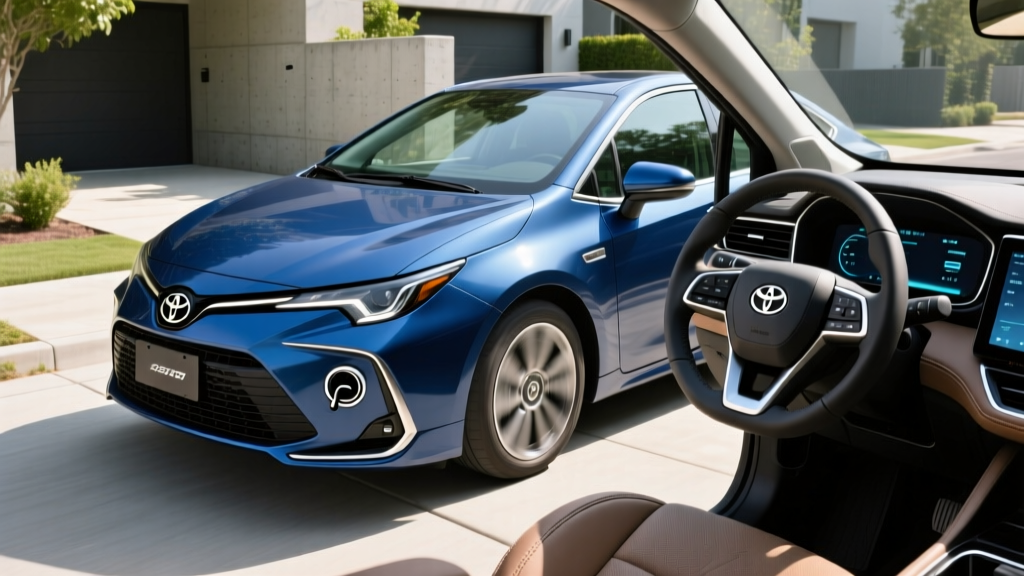
The 2025 Toyota Corolla SE Hybrid sits at a crossroads that many compact-sedan shoppers find themselves at: you want serious fuel savings, but you aren't ready to plug in, manage charging apps, or pay an EV premium. Toyota's answer is a conventional hybrid (HEV) that never needs a charging cable, returns an EPA-estimated 50 MPG combined, and starts at roughly $25,000. The SE trim specifically adds sport-tuned suspension, paddle shifters, and a more aggressive exterior treatment over the base LE Hybrid — making it the enthusiast-leaning choice in the Corolla Hybrid lineup.
But does the real-world fuel economy match the sticker? How does the hybrid battery hold up long-term? And does the SE Hybrid's sporty character come at the cost of efficiency? This guide covers every number that matters.
What Is the 2025 Toyota Corolla SE Hybrid?
The Corolla SE Hybrid is a conventional hybrid electric vehicle (HEV) — not a plug-in hybrid (PHEV) and not a battery electric vehicle (BEV). This distinction matters because it dictates how the car operates and what you'll pay at the pump versus the plug.
HEV vs. PHEV vs. BEV — Where Does the Corolla SE Hybrid Fit?
| Feature | HEV (Corolla SE Hybrid) | PHEV (e.g., Prius Prime) | BEV (e.g., Tesla Model 3) |
|---|---|---|---|
| Plugs in to charge? | No | Yes | Yes |
| Electric-only driving | Very short (under 1 mi at low speed) | 25–44 mi typical | 250–360+ mi |
| Gas engine | Yes (primary power + regen) | Yes (backup + highway) | None |
| Home charging needed | No | Recommended (Level 2) | Essential |
| Federal tax credit (§30D) | Not eligible | Up to $7,500 (if eligible) | Up to $7,500 (if eligible) |
The Corolla SE Hybrid charges its small battery entirely through regenerative braking and the gas engine. You fuel it like any conventional car — no plugs, no apps, no range planning.
Fuel Economy: EPA Ratings and Real-World MPG
The headline number is strong: the 2025 Corolla SE Hybrid carries an EPA-estimated 50 MPG combined (53 city / 46 highway) for the front-wheel-drive configuration. The available all-wheel-drive (AWD) variant drops slightly to 48 MPG combined (51 city / 44 highway) due to the added weight and drivetrain losses of the rear electric motor.
| Configuration | City MPG | Highway MPG | Combined MPG |
|---|---|---|---|
| SE Hybrid FWD | 53 | 46 | 50 |
| SE Hybrid AWD | 51 | 44 | 48 |
Real-World MPG: What to Actually Expect
Toyota's hybrid synergy drive system excels in stop-and-go city driving, where regenerative braking recaptures energy constantly and the engine shuts off at stops. In real-world use, many Corolla Hybrid owners report matching or slightly exceeding the EPA city estimate — 53–56 MPG is common on urban commutes with moderate traffic.
Highway driving tells a different story. At sustained 70–80 MPH speeds, the gasoline engine runs more continuously, and aerodynamic drag dominates. Expect 42–46 MPG on the highway in fair weather. In cold conditions (below 35°F), the engine runs more often to maintain cabin heat and battery temperature, dropping observed economy by roughly 5–8 MPG in mixed driving.
Powertrain and Performance Specs
The 2025 Corolla SE Hybrid pairs a 1.8-liter four-cylinder Atkinson-cycle engine with Toyota's fifth-generation hybrid system. The SE trim gets the same powertrain as other Corolla Hybrid trims — Toyota doesn't offer a performance hybrid tune at this price point.
| Specification | Detail |
|---|---|
| Combined System Horsepower | 138 hp |
| Gas Engine | 1.8L 4-cyl Atkinson-cycle (96 hp / 105 lb-ft) |
| Front Electric Motor | Permanent magnet synchronous (94 hp / 139 lb-ft) |
| Rear Electric Motor (AWD only) | 40 hp (electric AWD, activates on slip) |
| Hybrid Battery | Lithium-ion, ~0.9 kWh (not plug-rechargeable) |
| Transmission | eCVT (electronically controlled continuously variable) |
| 0–60 MPH (est.) | ~9.2 seconds |
| Drivetrain | FWD standard / AWD available |
| Fuel Tank Capacity | 11.4 gallons |
The 138 combined horsepower won't win drag races, but the electric motor's instant torque (139 lb-ft from 0 RPM) gives the Corolla SE Hybrid surprisingly responsive acceleration from a stop. Where you'll notice the modest output is during highway merging at speed — the eCVT drones noticeably under hard throttle. The SE trim's sport-tuned suspension and paddle shifters (which simulate stepped gear ratios) add engagement without changing the fundamental powertrain character.
SE Trim: What You Get Over the LE Hybrid
The SE badge on a Corolla Hybrid is primarily a handling and appearance upgrade, not a powertrain change. For the roughly $1,500–$1,800 premium over the LE Hybrid, the SE adds:
- Sport-tuned suspension — firmer damping and slightly quicker steering ratio for sharper turn-in
- 18-inch graphite-colored alloy wheels (vs. 16-inch on LE) — improves grip but adds minor road noise and a firmer ride
- Paddle shifters — simulated 6-speed stepped shifts via the eCVT
- Sport driving mode — sharpens throttle response and steering weight
- Exterior styling — mesh grille, side rocker panels, rear spoiler, LED accent lighting
- SofTex-trimmed sport seats with bolstering
The trade-off is marginal: the larger wheels and sportier tuning cost roughly 1–2 MPG versus the LE Hybrid in real-world driving (which uses 16-inch low-rolling-resistance tires). If maximum efficiency is your priority, the LE Hybrid edges ahead. If you want a compact hybrid that doesn't feel like an appliance, the SE is the trim to get.
Pricing and Tax Credit Eligibility
The 2025 Toyota Corolla SE Hybrid starts at an MSRP of approximately $25,250 (FWD), with AWD adding roughly $1,400. With destination charges, expect a well-equipped SE Hybrid AWD to land around $27,500–$28,500 before dealer adjustments.
That said, the Corolla Hybrid's lower starting price means you're spending less upfront than any comparable PHEV or BEV. A Toyota Prius Prime (PHEV) starts around $33,000, and a Tesla Model 3 starts near $39,000 — the Corolla SE Hybrid's fuel savings begin paying dividends from day one without the higher purchase price.
Hybrid Battery Warranty, Reliability, and Replacement Cost
This is the question every hybrid buyer eventually asks: what happens when the battery dies?
Toyota Hybrid Battery Warranty
Coverage: 10 years / 150,000 miles (whichever comes first) for all 50 states.
What's covered: Defects and capacity loss below a specified threshold (typically 60–70% of original capacity). Toyota covers repair or replacement of the hybrid battery pack, related control modules, and hybrid system components.
Transferability: The warranty transfers to subsequent owners, which supports strong resale values for Toyota Hybrids.
Real-World Battery Longevity
Toyota's hybrid battery packs have an exceptionally strong track record. The company has been refining this technology since the 1997 Prius, and real-world data from fleet operators and long-term owners consistently shows hybrid batteries lasting 150,000–200,000+ miles before significant degradation. The Corolla Hybrid's lithium-ion pack (replacing the older NiMH packs used in earlier Toyota hybrids) offers better energy density and thermal management.
Should a replacement be needed out of warranty, a new OEM hybrid battery pack for a Corolla Hybrid currently costs approximately $2,000–$3,500 installed at a Toyota dealer. Independent hybrid specialists often offer refurbished packs for $1,200–$2,000. This is dramatically less than a BEV traction battery replacement, which can exceed $10,000–$15,000.
Overall Reliability
Toyota consistently ranks at or near the top of long-term reliability surveys (J.D. Power, Consumer Reports). The Corolla nameplate is one of the best-selling vehicles globally for good reason. The hybrid system adds complexity (electric motor, inverter, eCVT) but these components have proven remarkably durable — the eCVT, in particular, has no traditional gears or clutch packs to wear out, making it one of the most reliable transmission designs in production.
Corolla SE Hybrid vs. the Alternatives
How does the Corolla SE Hybrid stack up against other options in the compact electrified sedan space?
| Vehicle | Type | Combined MPG / MPGe | Starting MSRP | Tax Credit |
|---|---|---|---|---|
| 2025 Corolla SE Hybrid | HEV | 50 MPG | ~$25,250 | None |
| 2025 Toyota Prius (LE) | HEV | 57 MPG | ~$28,550 | None |
| 2025 Toyota Prius Prime (PHEV) | PHEV | 44 mi EV / 52 MPG | ~$33,450 | Up to $7,500* |
| 2025 Hyundai Elantra Hybrid | HEV | 54 MPG | ~$26,500 | None |
| 2025 Honda Civic Hybrid | HEV | 49 MPG | ~$29,000 | None |
* Prius Prime tax credit eligibility depends on battery sourcing, buyer income, and MSRP caps per IRS §30D. Confirm at irs.gov before purchasing.
The Prius is more efficient (57 MPG combined) and has a more modern interior, but costs $3,000+ more. The Hyundai Elantra Hybrid beats the Corolla on EPA paper (54 MPG) but trails in long-term reliability perception. The Honda Civic Hybrid is a strong competitor with a more refined ride but a higher starting price.
Pros
- 50 MPG combined — excellent real-world fuel savings
- No plug-in required — fuel and go
- 10-year / 150,000-mile hybrid battery warranty
- Low starting MSRP (~$25,250) for a hybrid
- AWD available for $1,400
- Strong resale value and reliability reputation
- SE trim adds sport-tuned handling
Cons
- No federal tax credit eligibility
- 138 hp — modest highway passing power
- eCVT drone under hard acceleration
- Trunk slightly reduced vs. gas Corolla (battery placement)
- SE 18-inch wheels add road noise vs. LE
- Infotainment is functional but dated vs. competitors
Who Should Buy the Corolla SE Hybrid?
Choose the Corolla SE Hybrid If:
- You don't have access to home or workplace charging (apartment, street parking)
- You want maximum fuel savings with zero behavioral change — just fill up less
- Your budget is under $30,000 and you want proven reliability
- You drive a mix of city and highway and want strong MPG in both
- You live in a region with harsh winters and want AWD without an EV range penalty
Choose a PHEV (Prius Prime) Instead If:
- You can charge at home (Level 2) and your commute is under 40 miles
- You want electric-only daily driving with a gas backup for road trips
- You qualify for the $7,500 federal tax credit (income + sourcing eligible)
Choose a Full EV Instead If:
- You have reliable home charging and your daily driving is under 250 miles
- You want zero tailpipe emissions and the lowest per-mile fuel cost
- You're willing to pay a higher upfront price for lower operating costs
Frequently Asked Questions
How many MPG does the 2025 Toyota Corolla SE Hybrid get?
The EPA rates the FWD Corolla SE Hybrid at 53 city / 46 highway / 50 combined MPG. The AWD version drops slightly to 51 / 44 / 48. In real-world city driving, many owners report 53–56 MPG. Highway driving at 75+ MPH typically yields 42–46 MPG.
Does the Corolla SE Hybrid need to be plugged in?
No. The Corolla SE Hybrid is a conventional hybrid (HEV). Its small lithium-ion battery charges entirely through regenerative braking and the gasoline engine. You never plug it in — you just fill it at a gas station like any other car.
Does the 2025 Corolla SE Hybrid qualify for any tax credit?
No federal tax credit applies. The IRS §30D clean vehicle credit is available only for plug-in vehicles (BEVs and PHEVs) that meet battery sourcing, MSRP, and income requirements. Some states may offer small hybrid incentives — check your state's energy or DMV website for details.
How long will the hybrid battery last and what does replacement cost?
Toyota covers the hybrid battery for 10 years / 150,000 miles. Real-world data from Toyota's hybrid fleet shows packs regularly lasting 150,000–200,000+ miles. Out-of-warranty replacement costs approximately $2,000–$3,500 at a dealer, or $1,200–$2,000 from independent hybrid specialists using refurbished packs.
Is the Corolla SE Hybrid faster than the gas-only Corolla SE?
Marginally. The gas-only Corolla SE (2.0L, 169 hp) hits 0–60 in roughly 8.2 seconds versus the hybrid's ~9.2 seconds. The hybrid feels quicker off the line thanks to instant electric torque, but the gas model has more top-end passing power. The hybrid's advantage is fuel economy, not acceleration.
How does the Corolla Hybrid compare to the Prius?
The Prius (57 MPG combined) is more efficient and has a more modern interior, but starts ~$3,300 higher. The Corolla Hybrid uses a proven, conservative platform with a more traditional sedan design. If you want the most MPG per dollar and don't mind the Corolla's simpler interior, it's the value pick. If you want the latest tech and maximum efficiency, the Prius wins.
Can I get the Corolla SE Hybrid with AWD?
Yes. AWD is available for approximately $1,400 extra. It uses a separate rear electric motor (40 hp) that engages automatically when the front wheels slip — in rain, snow, or hard cornering. The system adds roughly 100 lbs and drops combined MPG by 2 (to 48 combined).