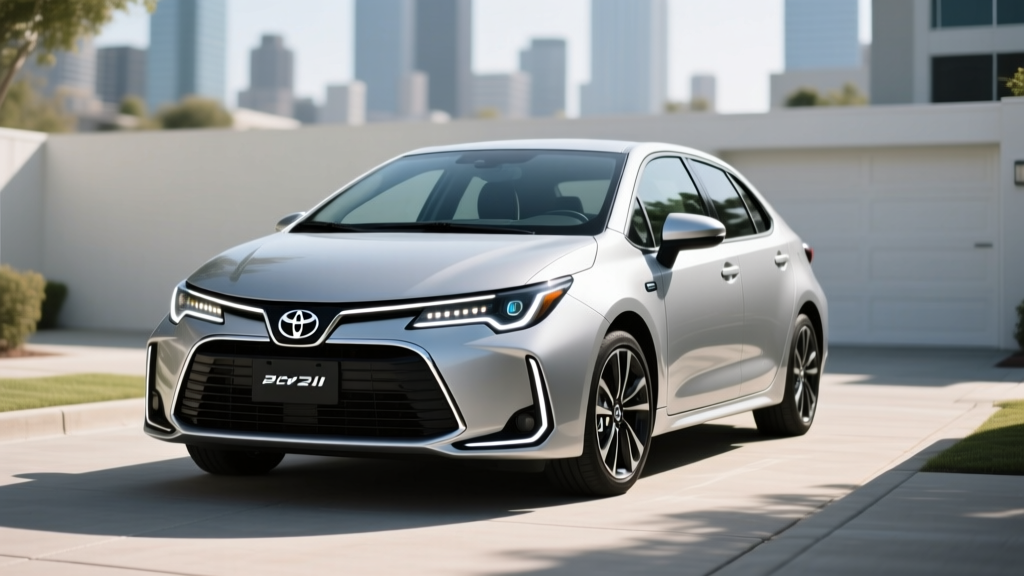
2025 Toyota Corolla Hybrid at a Glance
The Toyota Corolla Hybrid has quietly become one of the most efficient new cars you can buy in the United States, and the 2025 model year carries that reputation forward with minimal changes. If you've been searching for the 2025 Toyota Corolla Hybrid MSRP, here's the short answer: pricing starts at $23,500 for the LE trim (including destination charge) and climbs to roughly $28,900 for the XLE. That positions it only about $1,500–$2,000 above the equivalent gas-only Corolla, a premium you'll typically recoup in fuel savings within two to three years of average driving.
Before we get into the numbers, an important clarification: the Corolla Hybrid is a conventional hybrid electric vehicle (HEV), not a plug-in hybrid (PHEV). You never plug it in. The car generates electricity through regenerative braking and its gasoline engine, storing it in a small battery that assists acceleration and enables brief electric-only driving at low speeds. If you need plug-in capability with 25+ miles of electric-only range, you're looking at the Toyota Prius Prime instead.
| Spec | LE (FWD) | LE (AWD) | SE (AWD) | XLE (FWD) |
|---|---|---|---|---|
| MSRP (incl. destination) | $23,500 | $24,900 | $27,050 | $28,900 |
| EPA Combined MPG | 50 | 47 | 44 | 50 |
| EPA City / Highway | 53 / 46 | 51 / 44 | 47 / 41 | 53 / 46 |
| Combined Horsepower | 138 hp | 138 hp | 138 hp | 138 hp |
| Powertrain | 1.8L 4-cyl + 2 motors | 1.8L 4-cyl + 3 motors | 1.8L 4-cyl + 3 motors | 1.8L 4-cyl + 2 motors |
| Drivetrain | FWD | AWD-e | AWD-e | FWD |
| 0–60 mph (est.) | ~9.0 sec | ~8.8 sec | ~8.8 sec | ~9.0 sec |
| Hybrid Battery Warranty | 10 years / 150,000 miles | |||
Corolla Hybrid MPG: EPA Ratings and Real-World Results
Fuel economy is the entire reason this car exists, and the numbers deliver. According to fueleconomy.gov, the front-wheel-drive LE and XLE trims achieve an EPA-estimated 53 city / 46 highway / 50 combined MPG. That 53-MPG city figure is remarkable — hybrids excel in stop-and-go traffic because regenerative braking recovers energy that a gas car would waste as heat, and the electric motor handles low-speed driving where gasoline engines are least efficient.
| Trim | City | Highway | Combined | Est. Annual Fuel Cost* |
|---|---|---|---|---|
| LE (FWD) | 53 | 46 | 50 | $950 |
| SE (AWD) | 47 | 41 | 44 | $1,080 |
| XLE (FWD) | 53 | 46 | 50 | $950 |
| LE (AWD) | 51 | 44 | 47 | $1,010 |
*Based on 15,000 miles/year, 55% city driving, $3.50/gallon regular unleaded. Your costs will vary.
Real-World MPG: What Owners Actually See
One of the pleasant quirks of conventional hybrids is that real-world city driving often exceeds the EPA city estimate. On routes with frequent stops, moderate speeds, and warm ambient temperatures, many Corolla Hybrid owners report 55–58 MPG in city conditions. The EPA test cycle already accounts for hybrid advantages, but gentle driving in warm weather lets the electric motor shoulder an even larger share of the workload.
Highway driving tells a different story. At sustained 70–80 mph speeds, the gasoline engine does most of the work and aerodynamic drag dominates. Expect 42–46 MPG on the highway in real-world conditions, which aligns closely with the EPA estimate. In cold weather (below freezing), fuel economy drops 10–15% because the engine runs more often to generate cabin heat and the battery is less efficient. If your commute is primarily highway miles in cold climates, a realistic expectation is 40–43 MPG combined during winter months.
Powertrain: How the Hybrid System Works
The 2025 Corolla Hybrid uses Toyota's fifth-generation hybrid system, pairing a 1.8-liter Atkinson-cycle four-cylinder engine with electric motor-generators. In FWD trims, there are two motor-generators (one primarily for propulsion, one for starting the engine and generating electricity). AWD-e trims add a third, independent electric motor on the rear axle that engages when the system detects slip or during hard acceleration from a stop.
Combined system output is 138 horsepower. That's modest, but electric motors deliver peak torque instantly from zero RPM, which makes the car feel more responsive than the number suggests in everyday driving — merging onto highways and pulling away from lights is perfectly adequate. The engine and motors work through a planetary gearset (Toyota calls it an eCVT), which provides seamless, stepless ratio changes with no fixed gear shifts.
The AWD-e system deserves specific mention. Unlike mechanical AWD with a driveshaft and center differential, the Corolla Hybrid's rear motor activates only when needed — typically below 25 mph or when front-wheel slip is detected. This means you get all-weather traction without the fuel-economy penalty of a permanently engaged AWD system. The AWD-e trims lose only 3 MPG combined compared to their FWD counterparts.
Corolla Hybrid (HEV) vs. Prius Prime (PHEV): Which Is Right for You?
| Factor | Corolla Hybrid (HEV) | Prius Prime (PHEV) |
|---|---|---|
| Plug-in charging required? | No — never plug in | Yes — plug in for EV range |
| Electric-only range | ~1 mile at low speed | 44 miles (EPA) |
| Battery size | ~1.0 kWh (small buffer) | 13.6 kWh usable |
| Combined MPG (after battery depletes) | 50 | 48 (hybrid mode) |
| Starting MSRP | $23,500 | $33,445 |
| Federal tax credit (§30D) | Not eligible | Up to $7,500 (eligibility varies) |
| Best for | No home charging; budget-first buyers | Home chargers with short commutes |
Trims, Pricing, and Tax Credit Eligibility
Here's the complete 2025 Corolla Hybrid trim and pricing breakdown. All MSRPs include Toyota's $1,095 destination charge:
- LE (FWD): $23,500 — The value pick. Includes Toyota Safety Sense 3.0 (adaptive cruise, lane-keeping, automatic emergency braking), 8-inch touchscreen, wireless Apple CarPlay/Android Auto, and LED headlights.
- LE (AWD-e): $24,900 — Adds the rear-axle electric motor for all-weather traction. Identical equipment to LE FWD otherwise.
- SE (AWD-e): $27,050 — Sport-tuned suspension, 16-inch alloy wheels, sport seats, rear disc brakes (LE uses rear drums), and a slightly more aggressive exterior treatment. The sport suspension and larger wheels drop fuel economy to 44 combined.
- XLE (FWD): $28,900 — SofTex synthetic leather seats, 10-way power driver seat, heated front seats, wireless phone charging, and Smart Key on all four doors. Returns to 50 MPG combined.
Does the Corolla Hybrid Qualify for a Federal Tax Credit?
No. The Corolla Hybrid is a conventional HEV, and the IRS §30D Clean Vehicle Credit applies only to plug-in electric vehicles (BEVs and PHEVs) with a minimum battery capacity of 7 kWh. Since the Corolla Hybrid's battery is roughly 1.0 kWh and the car cannot be plugged in, it does not qualify for any federal purchase incentive.
Some states and local utilities offer small rebates for conventional hybrids, but these are increasingly rare as incentive programs shift toward plug-in vehicles. Check your state energy office and local utility for any current programs. If the tax credit is a priority and you want a Toyota product, the Prius Prime (PHEV, up to $7,500 credit if eligibility criteria are met) or the bZ4X (BEV) are the models to evaluate — though both cost significantly more upfront.
Battery Longevity, Warranty, and Replacement Cost
Hybrid battery anxiety is the single most common concern we hear from first-time hybrid buyers. Here's what the data shows.
Toyota Hybrid Battery Warranty: 10 years or 150,000 miles, whichever comes first. This applies to all 2025 Toyota hybrids and covers defects and abnormal capacity loss. Toyota defines the coverage threshold at approximately 60% of original capacity — if your battery falls below this, it's covered.
Toyota has been building hybrids since the 1997 Prius in Japan and the 2001 Prius in the US. The long-term reliability data is extensive. The Corolla Hybrid uses a nickel-metal hydride (NiMH) battery pack, not the lithium-ion chemistry found in full EVs. NiMH is a mature, well-understood technology with predictable degradation characteristics. In practice, Toyota hybrid batteries routinely last 150,000–200,000+ miles before needing replacement, and many original Prius batteries from the 2004–2009 era are still in service.
What Does Hybrid Battery Replacement Cost?
If your battery does need replacement outside of warranty, expect to pay between $2,000 and $4,000 for a new OEM battery pack installed at a Toyota dealer. Refurbished and aftermarket NiMH packs are available for $1,000–$2,000 installed. Some independent shops also offer individual cell module replacement (only the degraded cells are swapped), which can bring the cost down to $500–$1,200.
For context, a conventional gas car's transmission replacement can easily cost $3,000–$5,000, and the hybrid system eliminates the traditional starter motor, alternator, and accessory belt — all common failure points on gas cars. The Corolla Hybrid's regenerative braking also dramatically extends brake pad life; many owners report 80,000+ miles on original brake pads.
Driving Impressions and Daily Usability
The Corolla Hybrid isn't a performance car, and it doesn't pretend to be. The 138-hp powertrain delivers adequate acceleration for commuting, merging, and passing, but full-throttle highway on-ramps require planning. The eCVT keeps the engine in its optimal power band, which means you'll hear a sustained drone under hard acceleration — a characteristic of all planetary-gearset hybrids.
Where the car excels is in relaxed, everyday driving. The transition between electric and gasoline power is nearly imperceptible. Ride quality is comfortable and compliant, cabin noise is well-managed for the class, and Toyota Safety Sense 3.0 provides a solid suite of driver-assist features as standard equipment on every trim. Cargo space is 13.1 cubic feet — adequate for a compact sedan, though the hybrid battery does sit under the rear seat, so there's no fold-flat rear-seat pass-through like some competitors offer.
Pros
- 50 MPG combined (LE/XLE) — among the highest of any non-plug-in car sold in the US
- Low MSRP: starts at $23,500, only ~$1,500 above the gas Corolla
- 10-year / 150,000-mile hybrid battery warranty
- No plug-in charging needed — works with your existing routine
- Standard Toyota Safety Sense 3.0 on all trims
- AWD-e available for all-weather traction with minimal MPG penalty
- Proven Toyota hybrid reliability with extensive long-term data
Cons
- 138 hp — adequate but not quick; 0–60 in ~9 seconds
- No federal tax credit (HEV, not PHEV or BEV)
- Rear seat doesn't fold flat (battery placement)
- SE trim drops to 44 MPG combined for sport styling and suspension
- Modest 13.1 cu-ft trunk
- eCVT drone under hard acceleration
Corolla Hybrid vs. Gas Corolla vs. Full EV: Which Fits Your Life?
Choose the Corolla Hybrid if: You want maximum fuel savings without changing your fueling routine. You don't have access to home or workplace charging. Your budget is under $30,000. You drive 12,000+ miles per year (the fuel savings compound quickly).
Choose the gas-only Corolla if: You drive fewer than 8,000 miles per year and the $1,500 hybrid premium won't pay back in fuel savings within your ownership period. You want the absolute lowest upfront purchase price.
Choose a full EV (e.g., Chevrolet Bolt, Hyundai Kona Electric) if: You have reliable home Level 2 charging. Your daily driving is under 200 miles. You want zero tailpipe emissions and minimal maintenance (no oil changes, no spark plugs, no exhaust system). You want to access the $7,500 federal tax credit (subject to IRS §30D eligibility rules including income caps, MSRP caps, and battery sourcing requirements).
Choose a PHEV (e.g., Prius Prime) if: You can charge at home and your commute is under 40 miles round-trip (covering most daily driving on electricity), but you still want the flexibility of a gas engine for longer road trips without planning charging stops.
Frequently Asked Questions
How many MPG does the 2025 Toyota Corolla Hybrid get?
The FWD LE and XLE trims achieve an EPA-estimated 53 city / 46 highway / 50 combined MPG. The AWD-e LE gets 51/44/47, and the sport-tuned SE AWD-e drops to 47/41/44. In real-world city driving with moderate temperatures, many owners see 55–58 MPG. Highway driving at 75+ mph typically yields 42–46 MPG.
Do I need to plug in the Corolla Hybrid?
No. The Corolla Hybrid is a conventional HEV. It charges its own small battery through regenerative braking and the gasoline engine. You fuel it exactly like a regular gas car — at a gas station. If you want plug-in capability, consider the Toyota Prius Prime (PHEV).
Is the Corolla Hybrid reliable, and what does battery replacement cost?
Toyota's hybrid system is one of the most proven in the industry, with over 25 years of production data. The hybrid battery is covered by a 10-year / 150,000-mile warranty. Out-of-warranty replacement costs $2,000–$4,000 for a new OEM pack, or $500–$1,200 for refurbished or cell-level repairs. Many Toyota hybrid batteries last 150,000–200,000+ miles.
Does the 2025 Corolla Hybrid qualify for any tax credit?
It does not qualify for the federal §30D Clean Vehicle Credit, which is limited to plug-in vehicles (BEVs and PHEVs) with at least 7 kWh of battery capacity. Some state or utility programs may offer small hybrid rebates — check your local resources. If a tax credit is important to you, look at plug-in options like the Prius Prime.
How does the Corolla Hybrid compare to the Prius?
The 2025 Prius (redesigned for 2023) offers 57 MPG combined in its most efficient trim, a more powerful 196-hp powertrain, and a more modern interior — but starts around $28,550, roughly $5,000 more than the Corolla Hybrid LE. The Prius also offers the Prime PHEV variant with 44 miles of electric-only range. The Corolla Hybrid is the budget-conscious efficiency play; the Prius is the premium upgrade within Toyota's hybrid sedan lineup.
What's the difference between the Corolla Hybrid and a plug-in hybrid?
A conventional hybrid (HEV) like the Corolla Hybrid has a small battery (~1 kWh) that assists the gas engine and captures braking energy. You never plug it in. A plug-in hybrid (PHEV) like the Prius Prime has a much larger battery (13.6 kWh) that you charge by plugging in, enabling 25–44 miles of electric-only driving before the gas engine takes over. PHEVs cost more but can eliminate gasoline use for short commutes.