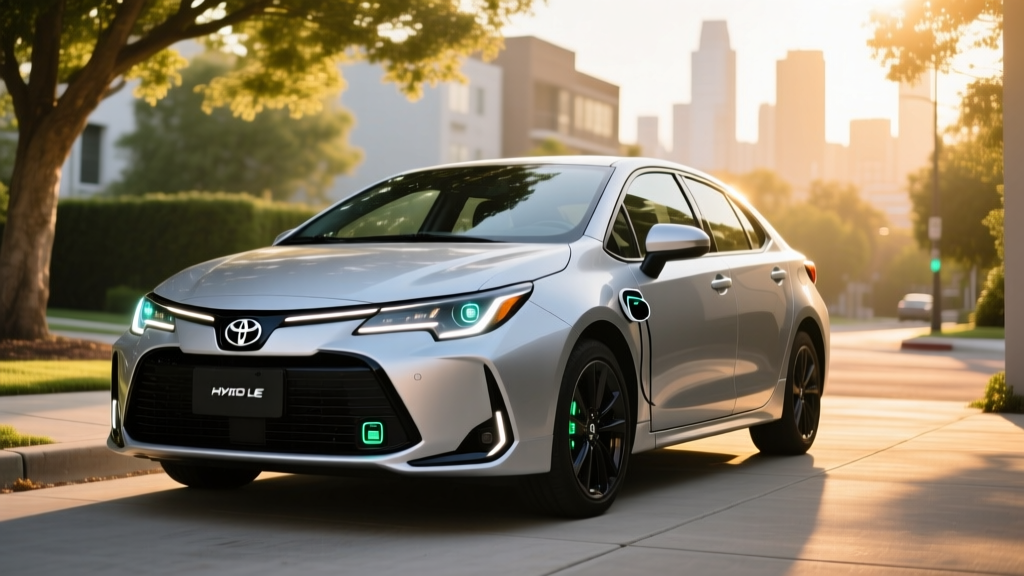
The compact hybrid sedan segment doesn't get much attention in an era of 400-mile EVs and robotaxi headlines, but the 2025 Toyota Corolla Hybrid LE quietly delivers what most drivers actually need: 50 MPG combined, a sub-$25,000 starting price, and Toyota's proven hybrid reliability. No plug required, no range anxiety, no charging infrastructure dependency. For buyers who want to cut fuel costs without changing how they refuel, this car remains one of the most practical vehicles on the market.
In this review, we break down the 2025 Toyota Corolla Hybrid LE's EPA fuel economy, real-world MPG results, powertrain specs, battery warranty, and total cost of ownership — plus where it fits against plug-in hybrids and full battery-electric vehicles.
Quick Verdict: Who Is the Corolla Hybrid LE For?
Choose the 2025 Corolla Hybrid LE if: You want maximum fuel economy with zero lifestyle changes, drive 15,000+ miles per year, lack reliable home or workplace charging access, or want a proven, low-risk entry into electrified driving under $25,000.
Look at a PHEV (like the Prius Prime) if: You have home Level 2 charging, a short commute under 40 miles, and want some electric-only driving without fully committing to a BEV.
Go full EV (like a Chevy Equinox EV or Tesla Model 3) if: You have reliable home charging, want zero tailpipe emissions, qualify for the $7,500 federal tax credit, and drive in a region with robust public DC fast charging.
Fuel Economy: EPA Numbers and Real-World MPG
The 2025 Toyota Corolla Hybrid LE pairs a 1.8-liter four-cylinder engine with two electric motors through Toyota's fifth-generation hybrid system. The result is an EPA-estimated 53 MPG city, 46 MPG highway, and 50 MPG combined, according to fueleconomy.gov.
| Driving Cycle | EPA Estimate | Real-World Expectation |
|---|---|---|
| City | 53 MPG | 52–58 MPG (hybrids excel in stop-and-go) |
| Highway (70–75 mph) | 46 MPG | 42–47 MPG (aero drag and less regen) |
| Combined | 50 MPG | 47–54 MPG depending on driving mix |
| Cold Weather (below 30°F) | — | 42–48 MPG (engine runs more for cabin heat) |
Hybrids typically exceed their EPA city estimates in real-world stop-and-go driving because regenerative braking recovers energy that gas-only cars waste as heat. Highway driving is where the Corolla Hybrid LE's advantage narrows — at sustained 75 mph speeds, the gasoline engine does most of the work with minimal regen assistance. Expect a noticeable 5–8 MPG drop in freezing temperatures, as the engine must run more frequently to provide cabin heating and maintain catalyst temperature.
With a 10.6-gallon fuel tank, real-world total range lands between 470 and 550 miles per tank depending on conditions — competitive with many long-range EVs and far simpler to refill.
HEV vs. PHEV: Understanding What You're Buying
The Corolla Hybrid LE is a conventional hybrid (HEV), not a plug-in hybrid (PHEV). This distinction matters for buyers cross-shopping electrified vehicles.
| Feature | Corolla Hybrid (HEV) | Prius Prime (PHEV) | Full EV (BEV) |
|---|---|---|---|
| Plug-in Charging Required | No | Yes (optional but beneficial) | Yes (required) |
| Electric-Only Range | ~1 mile at low speed | 44 miles (EPA) | 250–360+ miles |
| Battery Capacity | ~0.9 kWh (NiMH) | 13.6 kWh (Li-ion) | 60–82 kWh (Li-ion) |
| Home Charging Needed | No | Recommended (Level 2) | Essential (Level 2) |
| Combined MPG / MPGe | 50 MPG | 52 MPG + 127 MPGe | 120–132 MPGe |
| Federal Tax Credit | Not eligible (§30D) | Up to $7,500 | Up to $7,500 |
| Base MSRP (2025) | $24,225 | $33,445 | $33,000+ |
The HEV's small battery charges entirely through regenerative braking and engine power — you never plug it in. This means zero charging infrastructure requirements but also zero meaningful electric-only driving. The PHEV route (like the Prius Prime) offers 44 miles of electric-only range for short commutes but costs nearly $9,000 more upfront and requires home charging access to realize its efficiency advantage.
Powertrain and Performance Specs
| Specification | 2025 Corolla Hybrid LE |
|---|---|
| Engine | 1.8L 4-cylinder Atkinson cycle |
| Electric Motors | 2 (MG1 generator + MG2 drive motor) |
| Combined Net Horsepower | 138 HP |
| Drivetrain | FWD (AWD-e available on SE/XLE trims) |
| Transmission | eCVT (planetary gearset) |
| 0–60 mph | ~9.0 seconds |
| Battery Type | Nickel-Metal Hydride (NiMH) |
| Battery Capacity | ~0.9 kWh |
| Curb Weight | ~3,085 lbs |
| Fuel Tank | 10.6 gallons |
| Cargo Volume | 13.1 cu ft (trunk) |
The 138 combined horsepower figure is modest by modern standards, and the 9-second 0–60 time reflects that. This is a car optimized for efficiency, not acceleration. The eCVT — Toyota's planetary gearset design, not a belt-driven CVT — delivers seamless power delivery without the rubber-band feel of traditional continuously variable transmissions. Merging onto highways requires planning, but around-town driving feels responsive thanks to the electric motor's instant torque at low speeds.
The LE trim is front-wheel drive only. If you need all-wheel drive, the SE and XLE trims offer Toyota's AWD-e system (an independent rear motor), though this drops combined fuel economy to 47 MPG and adds roughly $1,500–$2,000 to the price.
Pricing, Tax Credits, and Ownership Economics
The 2025 Toyota Corolla Hybrid LE starts at $24,225 MSRP (including destination charge). This positions it roughly $1,500–$2,000 above the gas-only Corolla LE ($22,725) but well below any PHEV or BEV competitor.
Federal Tax Credit Status (§30D):
- The Corolla Hybrid LE does NOT qualify for the $7,500 federal EV tax credit. IRS §30D applies only to plug-in electric vehicles (PHEVs and BEVs) with battery capacities of at least 7 kWh.
- The hybrid battery in the Corolla (~0.9 kWh) falls far below this threshold.
- Some states offer separate hybrid incentives, but these are uncommon and typically small ($500–$1,000). Check your state's energy office or department of revenue for current programs.
Five-Year Cost Comparison: Hybrid vs. Gas Corolla
| Cost Factor | Corolla Hybrid LE | Corolla Gas LE |
|---|---|---|
| MSRP | $24,225 | $22,725 |
| Fuel Cost (5 yr / 75,000 mi at $3.40/gal) | $5,100 | $7,650 (at 33 MPG combined) |
| Estimated Maintenance (5 yr) | $2,200 | $2,400 |
| Insurance (5 yr avg.) | $7,500 | $7,200 |
| Estimated Depreciation | $9,800 | $9,200 |
| Total 5-Year Cost | ~$39,025 | ~$49,175 |
| Net Savings (Hybrid) | ~$10,150 over 5 years | |
The hybrid's $1,500 price premium pays for itself in roughly 14–18 months of average driving (15,000 miles/year) through fuel savings alone. Over five years, the Corolla Hybrid LE saves approximately $2,550 in fuel costs, and Toyota hybrids historically hold resale value well. Note: fuel cost estimates based on national average regular unleaded pricing and EPA combined MPG; actual costs vary by region and driving habits. Source: fueleconomy.gov.
Battery Warranty, Reliability, and Replacement Cost
Toyota Hybrid Battery Warranty:
- Coverage: 10 years or 150,000 miles (whichever comes first)
- What's covered: Hybrid battery pack and all related hybrid system components (inverter, electric motors, control ECU)
- Capacity threshold: Toyota warrants against defects and abnormal loss of capacity; there is no published minimum State of Health percentage, but dealers typically replace batteries that show significant capacity loss affecting drivability
- Transferability: Yes — the warranty transfers to subsequent owners, which supports resale value
Toyota's hybrid battery reliability record is among the best in the industry. The Prius, which shares the same fundamental hybrid architecture, has demonstrated battery lifespans routinely exceeding 200,000 miles with gradual capacity loss rather than sudden failure. The Corolla Hybrid's NiMH battery chemistry is less energy-dense than lithium-ion but is extremely durable and tolerant of the shallow charge-discharge cycles that characterize hybrid operation.
If replacement is needed out of warranty, a new OEM hybrid battery for the Corolla Hybrid costs approximately $2,000–$3,500 including labor. Refurbished and aftermarket options run $1,200–$2,000. This is dramatically lower than a full EV battery replacement ($8,000–$20,000+) because the hybrid battery is small (~0.9 kWh) and operates in a gentle duty cycle.
The 12-volt auxiliary battery (a standard lead-agent unit that powers electronics when the hybrid system is off) typically needs replacement every 4–6 years at a cost of $150–$250 — the same as any conventional car.
Interior, Tech, and Daily Practicality
The LE trim comes equipped with Toyota's 8-inch touchscreen running Toyota Audio Multimedia, wireless Apple CarPlay and Android Auto, a 7-inch digital driver display, and Toyota Safety Sense 3.0 (TSS 3.0) as standard. TSS 3.0 includes:
- Pre-Collision System with Pedestrian Detection
- Lane Departure Alert with Steering Assist
- Lane Tracing Assist
- Full-Speed Range Dynamic Radar Cruise Control
- Road Sign Assist
- Automatic High Beams
This is a SAE Level 1 driver-assistance suite — it supports steering and speed management but does not combine them into a hands-free system. The driver must remain fully engaged at all times. Toyota's approach is conservative compared to GM's Super Cruise or Ford's BlueCruise, but the systems are reliable and well-calibrated for daily commuting.
Cabin materials are hard-plastic-heavy but well-assembled. Front seats are comfortable for long drives; rear legroom (34.8 inches) is adequate for adults on shorter trips. The 13.1-cubic-foot trunk matches the gas Corolla — the hybrid battery is packaged under the rear seat and doesn't compromise cargo space.
Pros
- 50 MPG combined EPA; often exceeded in city driving
- Sub-$25,000 starting price — cheapest path to 50 MPG
- No plug-in charging required — zero infrastructure dependency
- 10-year / 150,000-mile hybrid battery warranty
- Toyota Safety Sense 3.0 standard on all trims
- Strong resale value and proven long-term reliability
- Wireless CarPlay/Android Auto standard
Cons
- 138 HP — sluggish highway merging and passing
- No federal tax credit eligibility
- LE trim is FWD only; AWD requires SE/XLE upgrade
- Modest 13.1 cu ft trunk (sedan, not hatchback)
- Basic interior materials at this price point
- 9-second 0–60 time trails turbocharged competitors
- No DC fast charging (not applicable to HEVs)
Corolla Hybrid vs. the Competition
The Corolla Hybrid LE's direct competitors are limited. The Honda Civic Hybrid (reintroduced for 2025) offers 49 MPG combined with a more refined interior and 200 combined HP, but starts around $29,000 — nearly $5,000 more. The Hyundai Elantra Hybrid Blue achieves 54 MPG combined (4 MPG better than the Corolla) with a $26,000 starting price and a 10-year/100,000-mile powertrain warranty.
For buyers cross-shopping within Toyota's own lineup, the Prius (57 MPG combined, 196 HP, ~$28,350) offers significantly more power and efficiency in a hatchback body, but at a $4,000+ premium. The Prius is the better car; the Corolla Hybrid LE is the better value.
Final Assessment: Is the 2025 Corolla Hybrid LE the Right Choice?
The 2025 Toyota Corolla Hybrid LE is a purpose-built efficiency machine that executes its mission flawlessly. It won't excite you with acceleration or premium materials, but it will deliver 50 MPG day after day, year after year, with minimal maintenance and no charging logistics to manage. For high-mileage commuters, rideshare drivers, budget-conscious buyers, or anyone in a region with limited charging infrastructure, it remains one of the smartest vehicle purchases available.
The math is simple: at 15,000 miles per year and $3.40/gallon fuel, you'll spend roughly $1,020 annually on gas — about $510 less than the gas Corolla and $1,200 less than the average compact crossover. Over a 10-year ownership period, that's $5,000–$12,000 in fuel savings depending on gas prices, with the hybrid premium recouped in under two years.
How many MPG does the 2025 Toyota Corolla Hybrid LE get?
The EPA rates it at 53 MPG city, 46 MPG highway, and 50 MPG combined. Real-world city driving often yields 52–58 MPG thanks to regenerative braking. Highway driving at 70–75 mph typically returns 42–47 MPG. Cold weather (below 30°F) reduces efficiency by roughly 5–8 MPG due to increased engine runtime for cabin heating.
Does the Corolla Hybrid need to be plugged in?
No. The Corolla Hybrid is a conventional hybrid (HEV), not a plug-in hybrid. Its small battery charges entirely through regenerative braking and the gasoline engine. You refuel only at gas stations, exactly like a conventional car.
Does the 2025 Corolla Hybrid qualify for any tax credit?
No. The federal §30D Clean Vehicle Credit applies only to plug-in vehicles (PHEVs and BEVs) with batteries of at least 7 kWh. The Corolla Hybrid's ~0.9 kWh battery does not meet this threshold. Some states may offer small hybrid incentives, but these are uncommon. Consult a tax professional or your state's energy office for current programs. See IRS.gov for federal rules.
Is the hybrid battery reliable and what does replacement cost?
Toyota's hybrid battery reliability is excellent, with many units lasting 200,000+ miles. The battery is covered by a 10-year / 150,000-mile warranty. Out-of-warranty replacement costs approximately $2,000–$3,500 for a new OEM unit, or $1,200–$2,000 for refurbished options — far less than an EV battery replacement.
Hybrid vs. PHEV vs. EV — which should I choose?
Choose a hybrid (HEV) like the Corolla Hybrid if you lack home charging access, want zero refueling behavior changes, or want the lowest upfront cost. Choose a PHEV if you have home charging and a short commute (under 40 miles) and want partial electric driving. Choose a full EV if you have reliable home charging, qualify for the $7,500 federal tax credit, want zero tailpipe emissions, and your region has adequate public charging. The Corolla Hybrid is the lowest-risk, lowest-complexity path to significantly reduced fuel costs.
How does the Corolla Hybrid compare to the gas-only Corolla?
The gas Corolla LE achieves 33 MPG combined (31 city / 36 highway) with a 169 HP 2.0L engine. The hybrid costs ~$1,500 more upfront but saves ~$510/year in fuel at 15,000 miles annually, paying back the premium in under 3 years. The hybrid is slower (138 HP vs. 169 HP) but far more efficient, especially in city driving.
Does the Corolla Hybrid LE offer all-wheel drive?
No. The LE trim is front-wheel drive only. AWD-e (an electrically powered rear axle) is available on the SE and XLE trims, which add $1,500–$2,000 to the price and reduce combined fuel economy to 47 MPG.