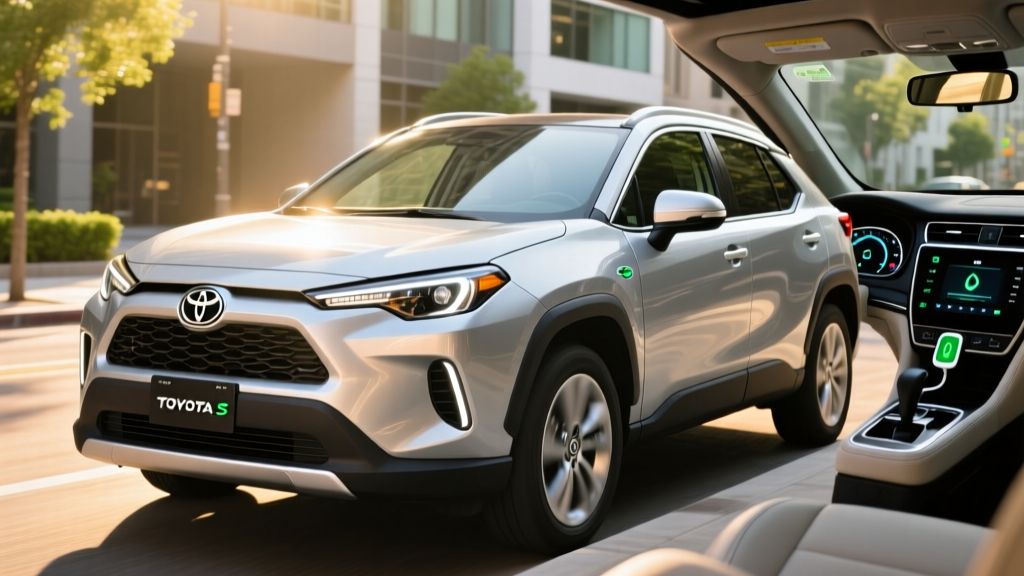
The subcompact hybrid SUV segment is crowded, but the 2025 Toyota Corolla Cross Hybrid S occupies a rare sweet spot: genuine crossover utility, standard all-wheel drive, and EPA-rated fuel economy that embarrasses many compact sedans. At a starting MSRP around $29,000, it undercuts most hybrid competitors while delivering Toyota's fifth-generation hybrid powertrain. This review breaks down exactly what the base S trim offers — and where its limitations lie — so you can decide if it's the right electrified vehicle for your needs.
| Spec | Value |
|---|---|
| EPA Fuel Economy (City / Hwy / Combined) | 46 / 38 / 42 MPG |
| Combined Horsepower | 196 hp (net system) |
| Drivetrain | Electronic AWD (eAWD) |
| Engine | 2.0L 4-cylinder + 2 electric motors (front) + 1 rear motor |
| Hybrid Battery | ~1.0 kWh lithium-ion (self-charging HEV, not plug-in) |
| 0–60 mph | ~7.5 seconds (est.) |
| Cargo Volume (behind rear seats) | 25.5 cu ft |
| Base MSRP (S trim) | ~$29,095 (incl. destination) |
| Federal §30D Tax Credit | Not eligible (HEV, not PHEV/BEV) |
| Hybrid Battery Warranty | 10 years / 150,000 miles |
Hybrid (HEV) vs. Plug-In Hybrid (PHEV): What the Corolla Cross Actually Is
Before evaluating fuel economy and ownership costs, it's essential to classify this vehicle correctly. The Corolla Cross Hybrid is a conventional hybrid electric vehicle (HEV). It cannot be plugged in. Its small lithium-ion battery (roughly 1.0 kWh usable) recharges exclusively through regenerative braking and the gasoline engine. You will never see an "electric-only range" figure for this vehicle because it doesn't operate as a pure EV for meaningful distances — the electric motors assist the engine and enable brief low-speed electric-only crawling, but the gas engine is always the primary energy source.
| Feature | HEV (Corolla Cross Hybrid) | PHEV (e.g., RAV4 Prime) | BEV (e.g., bZ4X) |
|---|---|---|---|
| Plug-in charging? | No | Yes | Yes |
| Electric-only range | Minimal (low-speed assist) | 25–42 miles typical | 200–300+ miles |
| Fuel/energy source | Gasoline only | Gasoline + grid electricity | Grid electricity only |
| Federal §30D credit | No | Up to $7,500 (if eligible) | Up to $7,500 (if eligible) |
| Home charging needed? | No | Recommended for EV range | Essential |
| Typical starting price | $29,000–$32,000 | $40,000–$45,000 | $35,000–$55,000 |
If you want plug-in electric range and federal tax credit eligibility, you need to look at a PHEV like the Toyota RAV4 Prime or a full BEV. The Corolla Cross Hybrid's value proposition is different: zero behavior change from a gas car, lower purchase price, and excellent fuel economy without any charging infrastructure requirement.
Fuel Economy: EPA Ratings and Real-World MPG
The EPA rates the 2025 Corolla Cross Hybrid at 46 MPG city, 38 MPG highway, and 42 MPG combined across all trims (S, SE, XSE) since they share the same powertrain. These figures come from fueleconomy.gov and apply to the AWD configuration, which is standard on every Corolla Cross Hybrid.
| Driving Cycle | EPA MPG | Real-World Expectation |
|---|---|---|
| City | 46 MPG | 44–50 MPG (hybrids often beat EPA in stop-and-go) |
| Highway | 38 MPG | 35–40 MPG (depends on speed; 75+ mph reduces efficiency) |
| Combined | 42 MPG | 39–44 MPG (varies with driving mix) |
Toyota's hybrid system excels in city driving, where regenerative braking and electric motor assist do the heavy lifting. In real-world testing by multiple automotive outlets, the Corolla Cross Hybrid has returned 44–48 MPG in mixed suburban driving. Highway fuel economy is the relative weak point — at sustained speeds above 70 mph, the small 2.0L engine works harder and aerodynamic drag increases, pulling efficiency toward 35–37 MPG. Cold weather will reduce these figures by roughly 5–10%, as the engine runs more frequently to provide cabin heat and the battery operates less efficiently at low temperatures.
For context, the gas-only Corolla Cross AWD achieves 29 MPG combined. The hybrid's 42 MPG combined represents a 45% improvement — translating to roughly 500 miles per 11.4-gallon tank versus about 330 miles for the gas model.
Powertrain Deep Dive: 196 HP with Electronic AWD
The Corolla Cross Hybrid uses Toyota's fifth-generation hybrid system, pairing a 2.0-liter Dynamic Force 4-cylinder engine with three electric motors — two on the front axle and one dedicated motor on the rear axle for electronic all-wheel drive (eAWD). Combined system output is 196 net horsepower, a substantial upgrade over the gas-only model's 169 hp.
The front axle receives power from both the gasoline engine (150 hp on its own) and two motor-generators routed through an eCVT (electronically controlled continuously variable transmission). The rear axle is powered solely by a 40 hp electric motor that engages when the system detects slip or during hard acceleration. There is no mechanical driveshaft connecting the front and rear axles — the eAWD system is entirely electronic, which reduces weight and mechanical complexity.
The eCVT deserves specific mention. Unlike traditional belt-driven CVTs, Toyota's planetary-gear eCVT has no belts or pulleys to wear out. It's one of the most durable transmissions in the industry and contributes to the Corolla Cross Hybrid's strong reliability outlook. Acceleration to 60 mph takes approximately 7.5 seconds — adequate for merging and passing, if not thrilling.
Pricing, Trims, and Tax Credit Eligibility
The 2025 Corolla Cross Hybrid is offered in three trims: S, SE, and XSE. Here's the pricing breakdown:
- S (base): ~$29,095 (includes destination charge)
- SE (sport-tuned suspension, styling upgrades): ~$31,595
- XSE (premium interior, larger wheels, heated seats): ~$34,095
All trims come standard with AWD, Toyota Safety Sense 3.0 (adaptive cruise control, lane-keeping assist, automatic emergency braking, lane departure alert), an 8-inch touchscreen with wireless Apple CarPlay and Android Auto, and a 6-speaker audio system.
Federal Tax Credit: Not Eligible
Under current IRS §30D Clean Vehicle Credit rules, only battery electric vehicles (BEVs) and plug-in hybrid electric vehicles (PHEVs) with sufficient battery capacity qualify for the federal tax credit. The Corolla Cross Hybrid is a conventional HEV with a battery far too small to meet the minimum 7 kWh threshold. It does not qualify for the $7,500 federal tax credit.
Some states offer separate incentives for conventional hybrids, but these are uncommon and vary by jurisdiction. Check your state's energy office or DMV for current programs.
The absence of a tax credit stings on paper, but the Corolla Cross Hybrid's lower base price partially offsets this. A PHEV like the RAV4 Prime starts above $44,000 even before the credit — roughly $15,000 more than the Corolla Cross Hybrid S. If your goal is maximum fuel savings at the lowest purchase price, the HEV math often wins unless you can charge a PHEV at home daily.
Battery Warranty, Lifespan, and Replacement Cost
| Item | Coverage |
|---|---|
| Hybrid Battery Warranty | 10 years / 150,000 miles (whichever comes first) |
| Hybrid System Components (inverter, motors, eCVT) | 8 years / 100,000 miles |
| Estimated Out-of-Warranty Battery Replacement | $2,000–$4,000 (parts + labor) |
| Expected Battery Lifespan | 150,000–200,000+ miles with normal use |
Battery longevity is a top concern for hybrid buyers, and Toyota's track record here is among the best in the industry. The Corolla Cross Hybrid's lithium-ion traction battery is small (~1.0 kWh) and is managed conservatively — Toyota's hybrid system never fully charges or fully depletes the pack, keeping the battery in a narrow state-of-charge window (roughly 40–80%) that dramatically slows degradation. This "buffer" strategy is why Toyota hybrid batteries routinely exceed 150,000 miles with minimal capacity loss.
The 10-year/150,000-mile hybrid battery warranty applies in all 50 states and covers capacity loss below a specified threshold (typically 60–70% of original capacity). If the battery fails within the warranty period, Toyota replaces it at no cost. Out of warranty, a replacement hybrid battery pack for the Corolla Cross Hybrid is estimated at $2,000–$4,000 installed — far less than a BEV battery replacement, which can exceed $10,000–$20,000. Third-party refurbishers also offer reconditioned hybrid batteries at lower cost.
For reliability data, the Corolla Cross Hybrid benefits from the proven fifth-generation Toyota Hybrid System (THS), which shares architecture with the Prius, RAV4 Hybrid, and Camry Hybrid — vehicles with millions of units on the road and well-documented long-term durability. IIHS has evaluated the Corolla Cross for crashworthiness; check their site for the latest ratings.
Who Should Buy the Corolla Cross Hybrid S — And Who Shouldn't
Choose the Corolla Cross Hybrid S if:
- You want a compact AWD crossover with 40+ MPG and no charging hassle
- Your budget is $28,000–$31,000 and you prioritize low cost of ownership
- You don't have access to home or workplace charging (apartment, street parking)
- You drive 12,000–15,000 miles/year and want to minimize fuel spend without a large upfront investment
- You value Toyota's reliability reputation and plan to keep the vehicle 8+ years
Look elsewhere if:
- You want electric-only driving for daily commutes (consider a PHEV like the RAV4 Prime or a BEV)
- You want to qualify for the $7,500 federal tax credit (only PHEVs and BEVs qualify under §30D)
- You need more than 25.5 cu ft of cargo space (consider the RAV4 Hybrid at 37.5 cu ft)
- You want rapid acceleration or a sporty driving experience (the eCVT prioritizes efficiency over engagement)
- You tow — the Corolla Cross Hybrid is not rated for towing
The Corolla Cross Hybrid S is a pragmatic choice for cost-conscious buyers who want crossover ride height, AWD capability for snow and rain, and Prius-level efficiency. It's not a technology showcase or a performance vehicle. It's a transportation appliance that does its job exceptionally well at a fair price.
Pros
- 42 MPG combined with standard AWD — best in the subcompact hybrid SUV class
- 196 hp provides confident passing power vs. the 169 hp gas model
- ~$29,000 starting price undercuts most hybrid competitors
- Toyota Safety Sense 3.0 standard on every trim
- 10-year/150,000-mile hybrid battery warranty
- No charging infrastructure needed — fill up at any gas station
Cons
- Highway MPG drops to 35–37 at sustained 75+ mph speeds
- No federal tax credit eligibility
- 25.5 cu ft cargo space is tight for a crossover; competitors offer more
- eCVT drone under hard acceleration
- Base S trim lacks premium features (heated seats, power liftgate)
- Not rated for towing
5-Year Cost of Ownership: Hybrid vs. Gas vs. EV
To put the Corolla Cross Hybrid's value in perspective, here's a 5-year / 60,000-mile ownership cost comparison against the gas-only Corolla Cross and a comparable BEV (using the Hyundai Kona Electric as a proxy):
| Cost Category | Corolla Cross Hybrid S (~$29,095) | Corolla Cross Gas AWD (~$25,000) | Comparable BEV (~$34,000 after credit) |
|---|---|---|---|
| Purchase Price (after incentives) | $29,095 | $25,000 | $34,000 (est. after $7,500 credit) |
| Fuel / Electricity (60k mi) | $4,570 (at $3.20/gal, 42 MPG) | $6,620 (at $3.20/gal, 29 MPG) | $2,880 (at $0.16/kWh, 3.5 mi/kWh) |
| Maintenance (5 yr) | $2,200 | $2,800 | $1,500 |
| Estimated Insurance (5 yr) | $7,500 | $7,000 | $8,000 |
| Total 5-Year Cost | ~$43,365 | ~$41,420 | ~$46,380 |
The hybrid sits between the gas model and the BEV on total cost. The gas model wins narrowly on pure purchase price, but the hybrid saves ~$2,050 in fuel over 5 years and will likely hold resale value better as fuel prices fluctuate. The BEV offers the lowest operating cost but requires a higher upfront investment and home charging access. Your optimal choice depends on how long you keep the vehicle, your annual mileage, and your electricity rates.
Frequently Asked Questions
How many MPG does the 2025 Toyota Corolla Cross Hybrid get?
The EPA rates it at 46 MPG city, 38 MPG highway, and 42 MPG combined. Real-world results typically range from 39–48 MPG depending on driving conditions, with city driving yielding the best results thanks to regenerative braking.
Can I plug in the Corolla Cross Hybrid to charge it?
No. The Corolla Cross Hybrid is a conventional hybrid (HEV), not a plug-in hybrid (PHEV). It has no charging port. The battery recharges through regenerative braking and the gasoline engine. You fuel it exclusively at gas stations.
Does the Corolla Cross Hybrid qualify for any federal tax credit?
No. Under current IRS §30D rules, only plug-in hybrid (PHEV) and battery electric (BEV) vehicles with battery capacity of at least 7 kWh qualify for the federal Clean Vehicle Credit. The Corolla Cross Hybrid's battery is approximately 1.0 kWh, making it ineligible. Some states may offer minor hybrid incentives — check your local programs.
How long will the hybrid battery last and what does replacement cost?
Toyota's hybrid batteries are designed to last 150,000–200,000+ miles under normal use, and the battery is covered by a 10-year/150,000-mile warranty. Out-of-warranty replacement costs approximately $2,000–$4,000 including labor. Toyota's conservative battery management strategy (never fully charging or depleting the pack) is a key factor in longevity.
Is the Corolla Cross Hybrid better than a full EV or a gas car?
It depends on your situation. If you lack home charging access, drive moderate annual miles, and want the lowest purchase price with excellent efficiency, the hybrid is the best choice. If you can charge at home and want zero tailpipe emissions with the lowest per-mile energy cost, a BEV is superior. If your budget is tight and you don't mind higher fuel costs, the gas model saves ~$4,000 upfront. For most buyers without reliable charging access, the Corolla Cross Hybrid offers the best balance of cost, efficiency, and convenience.
How does the Corolla Cross Hybrid compare to the RAV4 Hybrid?
The RAV4 Hybrid is larger (37.5 cu ft cargo vs. 25.5), more powerful (219 hp vs. 196 hp), and rated for light towing (1,750 lbs). However, it starts around $36,000 — roughly $7,000 more than the Corolla Cross Hybrid S — and achieves 39 MPG combined vs. 42 MPG. If you need the space and can afford the premium, the RAV4 Hybrid is the more versatile vehicle. If you prioritize efficiency and value, the Corolla Cross Hybrid wins.
What is the difference between the S, SE, and XSE trims?
The S is the base trim and includes Toyota Safety Sense 3.0, an 8-inch touchscreen, wireless CarPlay/Android Auto, and LED headlights. The SE adds sport-tuned suspension, unique exterior styling, and SofTex-trimmed seats. The XSE adds heated front seats, a power liftgate, 18-inch alloy wheels, and dual-zone climate control. All three share the identical 196 hp hybrid AWD powertrain and 42 MPG combined rating.
The 2025 Toyota Corolla Cross Hybrid S is not the flashiest vehicle in Toyota's lineup, but it may be one of the smartest purchases for budget-minded buyers who want crossover practicality without the complexity, cost, or infrastructure demands of a plug-in vehicle. At 42 MPG combined with standard AWD and a sub-$30,000 price, it delivers a compelling value equation that's hard to match in the current market.