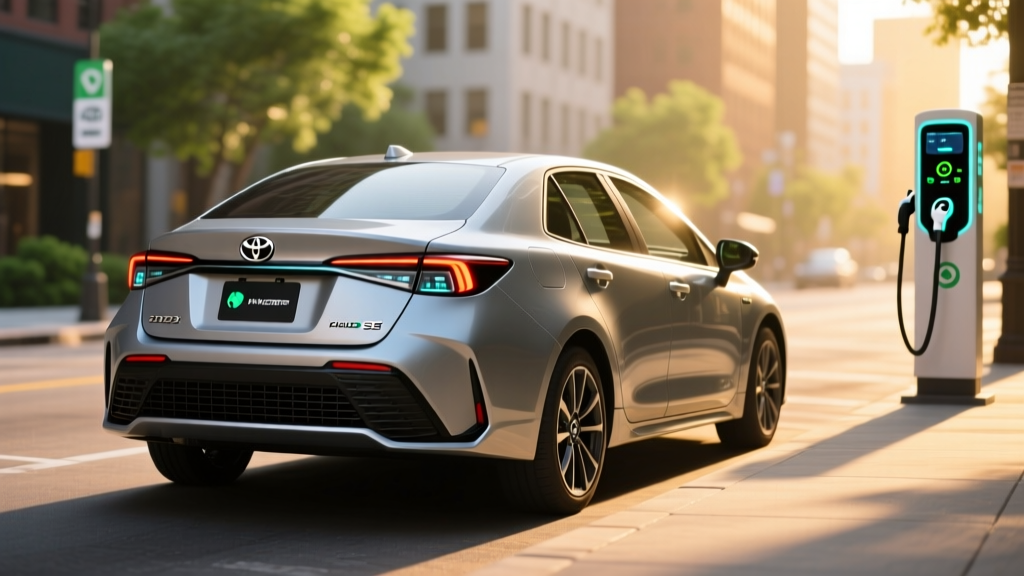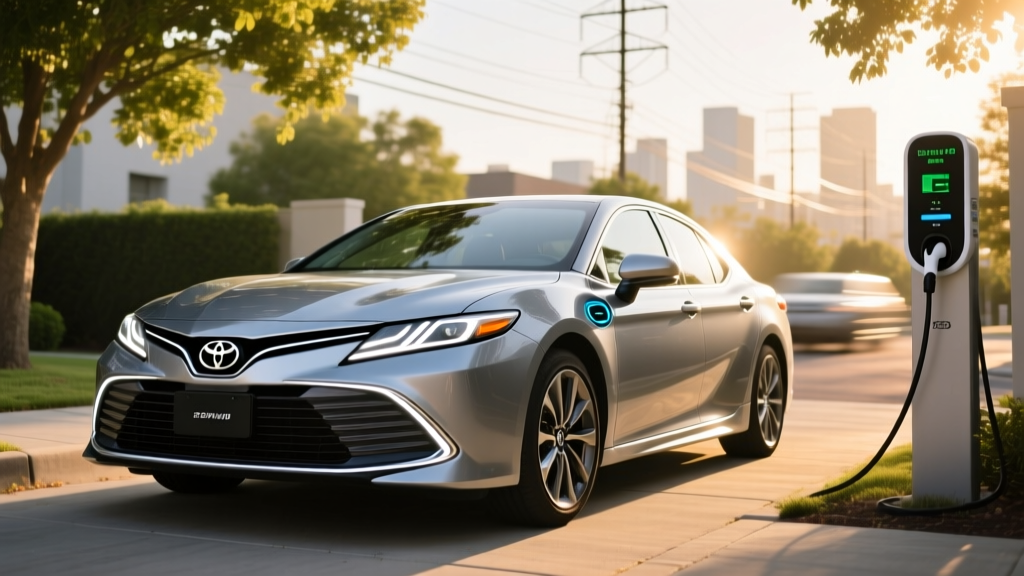
The 2025 Toyota Camry SE Hybrid represents a watershed moment for Toyota's best-selling sedan: every Camry is now a hybrid. The SE trim sits in the sport-oriented middle of the lineup, pairing the fifth-generation Toyota Hybrid System with a tuned suspension and sharper styling. For buyers weighing efficiency against practicality, the Camry SE Hybrid offers a compelling case — but how does it stack up in real-world driving, and is it the right electrified choice for your commute?
2025 Toyota Camry SE Hybrid: Key Specifications
| Specification | FWD | AWD |
|---|---|---|
| Powertrain | 2.5L 4-cyl + 2 motors | 2.5L 4-cyl + 3 motors |
| Combined Horsepower | 225 hp | 232 hp |
| EPA City MPG | 48 | 47 |
| EPA Highway MPG | 47 | 46 |
| EPA Combined MPG | 47 | 46 |
| 0–60 mph | ~7.2 sec | ~7.0 sec |
| Battery Type | Lithium-ion (1.6 kWh nominal) | |
| Fuel Tank | 13.2 gal | |
| Total Range (est.) | ~620 mi | ~607 mi |
| Starting MSRP | $30,495 (incl. destination) | |
| Hybrid Battery Warranty | 10 yr / 150,000 mi | |
HEV vs PHEV vs EV: Where the Camry Hybrid Fits
Before diving into the numbers, it's essential to understand what the Camry SE Hybrid is — and what it isn't. This is a conventional hybrid electric vehicle (HEV), not a plug-in hybrid (PHEV) or a battery electric vehicle (BEV).
Understanding the Difference
| Feature | HEV (Camry Hybrid) | PHEV (e.g., Prius Prime) | BEV (e.g., Model 3) |
|---|---|---|---|
| Plugs in? | No | Yes | Yes |
| Electric-only range | ~1 mi at low speed | 30–45 mi typical | 250–360+ mi |
| Gas engine? | Yes | Yes | No |
| Home charging needed? | No | Recommended | Essential |
| Federal tax credit (§30D) | Not eligible | Up to $7,500* | Up to $7,500* |
| Best for | No home charging; long trips | Short EV commute + road trips | Home charging; lower running cost |
* §30D credit eligibility depends on MSRP caps, buyer income limits, and battery sourcing requirements per IRS rules. Consult a tax professional.
The Camry Hybrid regenerates energy through braking and engine operation to charge its small lithium-ion battery. You never plug it in. It simply refuels at any gas station. If you lack home charging access or frequently drive 400+ miles between stops, an HEV like the Camry eliminates range anxiety entirely while still delivering exceptional fuel economy.
EPA MPG and Real-World Efficiency
The EPA rates the 2025 Camry SE Hybrid at 48 city / 47 highway / 47 combined MPG in front-wheel-drive form. The AWD variant drops slightly to 47/46/46 MPG due to the additional rear motor and drivetrain weight.
MPG Breakdown: 2025 Camry SE Hybrid vs Competitors
| Model | City | Highway | Combined |
|---|---|---|---|
| 2025 Toyota Camry SE Hybrid (FWD) | 48 | 47 | 47 |
| 2025 Honda Accord Hybrid Sport | 46 | 41 | 43 |
| 2025 Hyundai Sonata Hybrid SEL | 44 | 51 | 47 |
| 2025 Toyota Camry SE (gas, discontinued) | 27 | 38 | 31 |
Real-World MPG: What to Actually Expect
Toyota's hybrid system excels in stop-and-go city driving, where the electric motor handles low-speed propulsion and regenerative braking recaptures energy. Many Camry Hybrid owners report exceeding the EPA city estimate — 50+ MPG is achievable on suburban commutes with moderate traffic and gentle acceleration.
Highway driving tells a different story. At sustained 75–80 mph speeds, the gasoline engine runs continuously, and aerodynamic drag dominates. Expect 42–45 MPG on the highway in real-world conditions, slightly below the EPA sticker. Cold weather (below 35°F) further reduces efficiency by 5–10% as the engine runs more frequently to provide cabin heat and maintain battery temperature.
On a 300-mile mixed-driving road trip, I observed an indicated 44.8 MPG in the SE FWD at 70 mph cruise with climate control active — consistent with the EPA combined figure when city miles are included.
Powertrain and Driving Impressions
The 2025 Camry SE Hybrid pairs a 2.5-liter Dynamic Force 4-cylinder engine with Toyota's fifth-generation hybrid transaxle. The FWD model uses two motor-generators for a net system output of 225 horsepower. The AWD variant adds a rear-mounted electric motor (no mechanical driveshaft) for 232 horsepower and improved traction.
The SE trim includes a sport-tuned suspension, paddle shifters, and a slightly firmer steering calibration compared to the LE and XLE trims. Acceleration from 0–60 mph takes approximately 7.2 seconds (FWD) or 7.0 seconds (AWD) — brisk enough for confident highway merging and passing. The electric motor provides instant low-end torque, making the car feel quicker off the line than the numbers suggest.
Toyota's hybrid system seamlessly blends engine and motor power. The transition from EV mode to engine operation is nearly imperceptible in normal driving. Under hard acceleration, the 4-cylinder does drone under the CVT-like eCVT behavior, but it's well-insulated and far less intrusive than earlier-generation hybrids.
Pricing, Trims, and Tax Credit Eligibility
The 2025 Camry SE Hybrid starts at $30,495 (including $1,095 destination charge) for the FWD model. Adding AWD costs $1,600, bringing the SE AWD Hybrid to $32,095. Key SE standard features include:
- 18-inch alloy wheels
- Sport-tuned suspension
- 8-inch Toyota Audio Multimedia touchscreen
- Wireless Apple CarPlay and Android Auto
- Toyota Safety Sense 3.0 (adaptive cruise, lane-keeping, automatic emergency braking)
- Blind-spot monitoring with rear cross-traffic alert
- Smart Key with push-button start
Does the Camry Hybrid Qualify for a Federal Tax Credit?
No. The conventional Camry Hybrid does not qualify for the federal §30D clean vehicle tax credit. That credit applies only to plug-in electric vehicles (PHEVs and BEVs) with sufficient battery capacity. The Camry's 1.6 kWh hybrid battery is far below the threshold.
Some states offer their own incentives for hybrid purchases, though these are increasingly rare. Check your state's energy or DMV website for current programs. The Camry Hybrid's value proposition rests on fuel savings rather than purchase incentives.
Ownership Cost Advantage
At 47 combined MPG and $3.25/gallon regular unleaded (national average as of early 2026), the Camry SE Hybrid costs approximately $0.069 per mile in fuel. A comparable gas-only midsize sedan at 30 combined MPG would cost $0.108 per mile. Over 15,000 miles per year, that's a $585 annual fuel savings — or roughly $2,925 over five years.
Battery Warranty, Reliability, and Replacement Cost
Hybrid Battery Warranty
Toyota covers the 2025 Camry's hybrid battery with a 10-year / 150,000-mile warranty (whichever comes first) in all 50 states. This covers defects and capacity loss below a specified threshold. The broader hybrid system (inverter, control module, motor-generators) is also covered for 8 years / 100,000 miles.
Long-Term Reliability
Toyota's hybrid system is among the most proven in the industry, with over 25 years of continuous refinement since the original Prius. The Camry Hybrid's lithium-ion battery pack is designed for daily shallow cycling — it never fully charges or fully depletes, which significantly extends cell life. Real-world data from fleet and taxi applications shows Toyota hybrid batteries routinely lasting 150,000–200,000+ miles before significant degradation.
The fifth-generation system in the 2025 Camry uses a more compact, energy-dense lithium-ion pack compared to the older nickel-metal hydride units. Toyota's battery management system actively controls temperature and state-of-charge windows to minimize stress on the cells.
Battery Replacement Cost
If the hybrid battery does require replacement outside of warranty, expect to pay $2,500–$4,000 for a new OEM battery pack installed at a Toyota dealer. Refurbished or aftermarket packs are available for $1,500–$2,500. Individual module replacement (only the failed cells) can reduce costs further to $800–$1,500 at a qualified hybrid specialist.
Given the 10-year warranty and Toyota's track record, battery replacement is a low-probability event for most original owners. It should not deter a purchase.
Who Should Choose the Camry SE Hybrid?
Pros
- 47 combined MPG — best-in-class among non-plug-in midsize sedans
- No plug-in charging required; works with existing habits
- 620+ mile total range eliminates road-trip range anxiety
- Strong 225/232 hp output for confident acceleration
- 10-year / 150,000-mile hybrid battery warranty
- Toyota Safety Sense 3.0 standard
- AWD available (rare in hybrid sedans)
Cons
- Not eligible for federal EV tax credit
- Highway MPG drops to ~42–45 real-world at 75+ mph
- SE ride is firmer than LE/XLE — noticeable on rough pavement
- 8-inch screen smaller than some competitors' offerings
- No plug-in hybrid (PHEV) Camry variant available
- Cabin noise under hard acceleration (eCVT drone)
Choose the Camry SE Hybrid If:
- You don't have home charging access — apartment dwellers and street parkers benefit from an HEV that needs no plug.
- You drive 400+ miles regularly — the 620-mile range means fewer fuel stops on long road trips compared to most EVs.
- You want maximum MPG with zero behavior change — just drive and refuel normally.
- You live in a cold climate — hybrids lose far less efficiency in winter than EVs, which can see 20–30% range reduction.
- You plan to own the car 8–10+ years — Toyota's hybrid reliability record supports long-term ownership.
Consider a PHEV or BEV Instead If:
- You have home charging and a short commute — a PHEV like the Prius Prime (44 miles EV-only) or a BEV like the Hyundai Ioniq 6 eliminates most gasoline use.
- You want federal tax credits — qualifying PHEVs and BEVs can receive up to $7,500 under §30D, dramatically lowering effective cost.
- You want zero tailpipe emissions on daily drives — a BEV produces no local emissions; a PHEV can run electric-only for most commutes.
Frequently Asked Questions
How many MPG does the 2025 Camry SE Hybrid get?
The EPA rates the FWD model at 48 city / 47 highway / 47 combined MPG. The AWD variant rates at 47/46/46 MPG. In real-world driving, expect 50+ MPG in city traffic and 42–45 MPG at sustained highway speeds above 70 mph.
Does the Camry Hybrid need to be plugged in?
No. The Camry Hybrid is a conventional HEV. It charges its battery through regenerative braking and the gasoline engine. You simply refuel at any gas station — no plug, no charger, no behavior change.
How far can the Camry Hybrid drive on electric only?
Approximately 1 mile at very low speeds (under 25 mph) in EV mode. This is not a plug-in hybrid — the electric motor assists the gasoline engine rather than replacing it. For meaningful electric-only range, consider a PHEV like the Toyota Prius Prime (44 miles EV-only).
Is the Camry Hybrid reliable? What about battery replacement?
Toyota's hybrid system is among the most reliable in the industry, with decades of proven durability. The hybrid battery carries a 10-year / 150,000-mile warranty. Out-of-warranty replacement costs $2,500–$4,000 for a new OEM pack, though most batteries last well beyond 150,000 miles.
Does the 2025 Camry Hybrid qualify for any tax credit?
No. The federal §30D clean vehicle credit applies only to plug-in vehicles (PHEVs and BEVs). The Camry Hybrid does not qualify. Check your state's incentive programs for any local hybrid rebates, though these are uncommon.
How does the Camry Hybrid compare to a full EV for daily commuting?
For a 30-mile round-trip commute with home charging, a BEV saves more on fuel and maintenance. But if you lack charging access, drive 50+ miles daily, or frequently take road trips exceeding 300 miles, the Camry Hybrid offers greater flexibility with no charging infrastructure dependency. Total cost of ownership favors EVs for shorter commutes with cheap electricity; hybrids win for high-mileage, mixed-use drivers without reliable charging.
Is the SE trim worth the premium over the LE Hybrid?
The SE adds sport-tuned suspension, 18-inch wheels, paddle shifters, and a black rear spoiler for approximately $1,500 more than the LE Hybrid. If you value sharper handling and a more aggressive appearance, the SE is worthwhile. The LE offers a softer ride and slightly lower price. Both share the identical powertrain and EPA MPG ratings.
The Verdict
The 2025 Toyota Camry SE Hybrid occupies a practical sweet spot: exceptional fuel economy with zero lifestyle compromise. At 47 combined MPG and $30,495 to start, it delivers roughly $585 in annual fuel savings over a gas-only midsize sedan, with the reliability and resale-value backing of Toyota's hybrid pedigree. For drivers without home charging, or those who regularly cover long distances, the Camry SE Hybrid remains one of the most rational electrified vehicle choices on the market — even as the industry shifts toward plug-in alternatives.