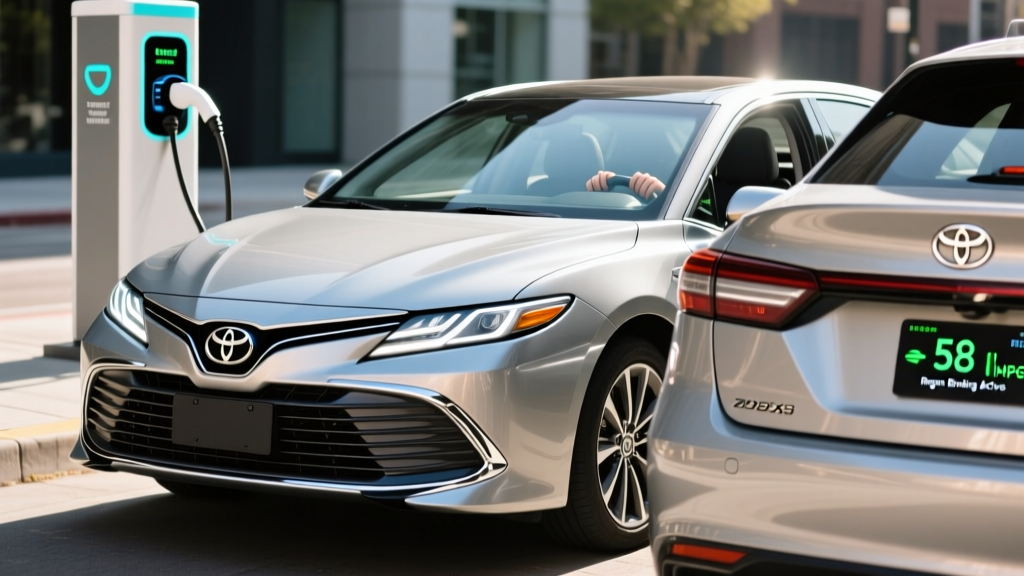
The 2025 Toyota Camry Hybrid XSE occupies a specific niche: the sportiest trim in a lineup that is now exclusively hybrid. Toyota dropped the gasoline-only four-cylinder from the Camry range entirely for the ninth generation, meaning every 2025 Camry is a hybrid electric vehicle (HEV). The XSE sits at the top of the sport-oriented side of the lineup, adding all-wheel drive, a tuned suspension, and aggressive styling — while still delivering the fuel economy that defines the Camry nameplate.
This review breaks down the 2025 Toyota Camry Hybrid XSE's real-world efficiency, powertrain specifications, ownership costs, and where it fits against plug-in hybrids and full battery electric vehicles. If you're cross-shopping midsize sedans and weighing electrification options, the data below should clarify whether this is the right powertrain choice for your driving pattern.
HEV vs. PHEV vs. EV: Where the Camry Hybrid XSE Fits
Conventional Hybrid (HEV) — like the Camry Hybrid XSE: Uses a small battery (1.6 kWh in this case) charged entirely by regenerative braking and the gasoline engine. You never plug it in. The electric motor assists the engine for improved efficiency and low-speed electric-only driving in short bursts. Total range exceeds 550 miles on a single tank.
Plug-in Hybrid (PHEV) — like the Toyota RAV4 Prime: Carries a larger battery (typically 15-20 kWh) that you plug in to charge. Offers 25-42 miles of electric-only range before the gasoline engine engages. Requires access to home or workplace charging to realize full efficiency benefits. Eligible for the federal §30D tax credit (up to $7,500) if battery sourcing and buyer income requirements are met.
Battery Electric Vehicle (BEV) — like the Tesla Model 3 or Hyundai Ioniq 6: No gasoline engine. Runs entirely on a large battery pack (60-80+ kWh). Must be charged via plug. Offers 250-360+ miles of range. Eligible for the federal §30D tax credit. Requires reliable home or public charging infrastructure.
The Camry Hybrid XSE is a conventional HEV. It does not plug in, does not qualify for the federal EV tax credit, and has no meaningful electric-only range beyond low-speed parking-lot maneuvering. Its advantage is simplicity: you fuel it like any gas car and get dramatically better city MPG without changing any habits.
2025 Camry Hybrid XSE Fuel Economy: EPA Ratings and Real-World MPG
| Metric | FWD Trims (SE) | AWD (XSE) |
|---|---|---|
| EPA City MPG | 51 | 44 |
| EPA Highway MPG | 49 | 43 |
| EPA Combined MPG | 50 | 44 |
| Fuel Tank Capacity | 13.2 gal | 13.2 gal |
| Estimated Total Range | ~660 mi | ~581 mi |
The XSE's AWD system and sport-tuned suspension extract an efficiency penalty versus the FWD SE and LE trims. You trade roughly 6 combined MPG for all-wheel-drive traction, 19-inch alloy wheels, and firmer damping. According to EPA data on fueleconomy.gov, the 2025 Camry Hybrid XSE AWD posts 44 city / 43 highway / 44 combined.
Real-World MPG Expectations
Toyota's fifth-generation hybrid system excels in stop-and-go driving, where the electric motor handles frequent low-speed acceleration and regenerative braking recaptures energy. In city and suburban driving, many owners report matching or slightly exceeding the 44 MPG city sticker — a rarity among non-plug-in vehicles.
Highway driving tells a different story. At sustained 70-80 MPH speeds, the gasoline engine does most of the work, and the aerodynamic profile of a midsize sedan limits gains. Expect 40-43 MPG on flat interstate runs in warm weather. In cold climates (below 35°F), the engine runs more frequently to maintain cabin heat and battery temperature, reducing combined economy to roughly 38-41 MPG until the powertrain warms up.
For a driver covering 15,000 miles annually with a 60/40 city/highway split, the Camry Hybrid XSE will consume approximately 340 gallons of fuel per year — roughly $1,100-$1,200 at $3.30/gallon. A comparable non-hybrid midsize sedan averaging 28 MPG combined would burn 535 gallons and cost over $1,750 annually.
Powertrain Specs: Engine, Motors, and Horsepower
| Specification | 2025 Camry Hybrid XSE |
|---|---|
| Engine | 2.5L inline-4 (A25A-FXS, Dynamic Force) |
| Engine Output | 184 hp / 163 lb-ft torque |
| Front Electric Motor | 100 kW (134 hp) |
| Rear Electric Motor (AWD) | 40 kW (54 hp) |
| Combined Net Horsepower | 232 hp (AWD) |
| Hybrid Battery | 1.6 kWh lithium-ion (NiMH on base LE) |
| Transmission | eCVT (planetary gearset, no belt) |
| Drivetrain | Electronic AWD (eAWD, rear motor-driven) |
| 0-60 MPH | ~6.9 seconds (est.) |
| Curb Weight | ~3,595 lbs |
The 2025 Camry's hybrid system pairs Toyota's latest Dynamic Force 2.5-liter four-cylinder with a front-mounted electric motor and, on AWD trims like the XSE, an independent rear motor. The rear motor provides up to 54 hp to the rear axle when slip is detected or during hard acceleration — it is not a mechanical driveshaft system. This eAWD setup adds roughly 130 lbs versus FWD but improves wet-weather traction and cornering stability.
The combined 232 hp represents a meaningful upgrade over the outgoing eighth-generation Camry Hybrid's 208 hp. Acceleration feels responsive in the 0-45 MPH range where the electric motor's instant torque dominates, though the eCVT drone under hard acceleration reminds you this is an efficiency-first powertrain. The XSE's sport-tuned suspension and paddle shifters (which simulate stepped gear ratios) add engagement without changing the fundamental character of the hybrid system.
Pricing, Trims, and Tax Credit Eligibility
The 2025 Toyota Camry Hybrid XSE starts at an MSRP of approximately $33,495, including destination charge. Adding options like the panoramic glass roof, premium audio, or the available Technology Package (head-up display, surround-view camera) pushes the price toward $37,000-$38,000.
Does the Camry Hybrid XSE Qualify for a Federal Tax Credit?
No. The Camry Hybrid XSE is a conventional hybrid (HEV), not a plug-in vehicle. Under IRS §30D rules, only plug-in electric vehicles (PHEVs and BEVs) with sufficient battery capacity and qualifying battery component/critical mineral sourcing are eligible for the federal clean vehicle credit. The Camry Hybrid does not have a plug, does not have a battery large enough to qualify, and therefore receives no federal purchase incentive.
Some states offer modest rebates or HOV-lane access for hybrids, but these programs vary by jurisdiction and change frequently. Check your state's energy or environmental agency website for current offerings. A handful of states still provide small hybrid incentives ($250-$500), but most have shifted incentive budgets toward plug-in vehicles.
Five-Year Fuel Cost Advantage
The Camry Hybrid XSE's value proposition is at the pump, not the tax office. Over five years and 75,000 miles at 44 MPG combined and $3.30/gallon, you'll spend approximately $5,625 on fuel. A non-hybrid competitor averaging 28 MPG would cost roughly $8,840 — a $3,215 difference that partially offsets the Camry Hybrid's higher sticker price versus a base gasoline midsize sedan.
Battery Warranty, Reliability, and Replacement Cost
Toyota Hybrid Battery Warranty: 10 years / 150,000 miles (whichever comes first), covering defects and capacity loss below a defined threshold. This applies to all 2025 Camry Hybrid trims and is transferable to subsequent owners.
Hybrid System Components Warranty: 8 years / 100,000 miles on the inverter, electric motors, and associated control electronics.
How Long Will the Camry Hybrid Battery Last?
Toyota's hybrid battery longevity track record is among the best in the industry. Data from the Prius — which has used a fundamentally similar nickel-metal-hydride and now lithium-ion hybrid battery architecture since 2000 — shows that most original hybrid batteries last 150,000-200,000+ miles before significant degradation. The 2025 Camry XSE uses a 1.6 kWh lithium-ion pack (up from the NiMH pack in the base LE), which offers better energy density and charge/discharge efficiency.
Unlike a full EV battery, the hybrid pack is small, operates within a narrow state-of-charge window (typically 40-80% SoC to minimize stress), and is managed by Toyota's thermal conditioning system. This shallow-cycling approach dramatically extends cycle life. Real-world failure before 100,000 miles is rare and typically covered under warranty.
Battery Replacement Cost
If the hybrid battery does require replacement outside of warranty, expect to pay between $2,000 and $3,500 for a new OEM battery pack plus installation at a Toyota dealer. Independent hybrid specialists and refurbished battery options can reduce this to $1,200-$2,000. This is a fraction of a full EV battery replacement ($10,000-$20,000+), reflecting the Camry Hybrid's much smaller 1.6 kWh pack.
Toyota's reliability ratings remain strong across the Camry line. The brand consistently ranks near the top of Consumer Reports reliability surveys, and the hybrid powertrain's simplicity (no turbocharger, no traditional automatic transmission with clutch packs, no starter motor) reduces the number of failure-prone components versus a conventional gasoline drivetrain.
Who Should Buy the Camry Hybrid XSE — And Who Shouldn't
Reasons to Choose the Camry Hybrid XSE
- 44 MPG combined without plugging in — no charging infrastructure required
- AWD traction for rain, snow, and mountain driving
- Sport-tuned suspension and 232 hp for a genuinely engaging sedan
- 10-year/150,000-mile hybrid battery warranty
- Strong resale value and proven Toyota reliability
- 580+ miles of total range between fill-ups
Reasons to Look Elsewhere
- No federal tax credit — HEVs are ineligible under §30D
- AWD XSE sacrifices 6 MPG versus FWD trims (44 vs. 50 combined)
- No electric-only commuting range — always burns some gasoline
- eCVT drone under hard acceleration lacks the refinement of a multi-speed transmission
- Rear-seat headroom is tighter than some competitors due to sloping roofline
Choose the Camry Hybrid XSE If:
You want a sporty, AWD-equipped midsize sedan with excellent fuel economy, you don't have access to home or workplace charging (ruling out PHEVs and BEVs), and you want to avoid the upfront price premium and range-planning requirements of a full electric vehicle. The XSE is ideal for apartment dwellers, frequent road-trippers, and drivers in regions with limited public charging infrastructure.
Choose a PHEV Instead If:
You have reliable home charging (Level 2, 240V) and a commute under 35 miles round-trip. A plug-in hybrid like the Toyota Prius Prime (44 miles electric-only) or Hyundai Tucson PHEV (33 miles electric-only) lets you drive most weekdays on electricity alone, with a gas engine for longer trips. PHEVs may also qualify for the federal §30D credit, offsetting their higher purchase price.
Choose a Full EV Instead If:
You have home charging, your daily driving is under 250 miles, and you want zero tailpipe emissions, minimal maintenance (no oil changes, no spark plugs), and eligibility for the full federal tax credit. Vehicles like the Hyundai Ioniq 6 (361 miles EPA range) or Tesla Model 3 (341-363 miles) offer lower per-mile energy costs and stronger incentives — but require you to commit to charging infrastructure.
Camry Hybrid XSE vs. Key Competitors
| Vehicle | Combined MPG | HP | AWD Available | Starting MSRP | Federal Credit |
|---|---|---|---|---|---|
| 2025 Camry Hybrid XSE (AWD) | 44 | 232 | Standard | $33,495 | None |
| 2025 Honda Accord Hybrid Sport-L | 44 | 204 | No | $34,990 | None |
| 2025 Hyundai Sonata Hybrid Limited | 47 | 192 | No | $37,250 | None |
| 2025 Toyota Prius (FWD) | 57 | 194 | AWD avail. | $28,350 | None |
| 2025 Toyota Prius Prime (PHEV) | 48 / 44 mi EV | 220 | No | $33,445 | Up to $7,500* |
*Prius Prime federal credit eligibility depends on battery sourcing, buyer income, and MSRP caps under current IRS §30D rules. Verify eligibility at irs.gov before purchase.
The Camry Hybrid XSE's closest rival is the Accord Hybrid, which matches its 44 MPG combined but lacks AWD and offers less horsepower. The Sonata Hybrid achieves higher MPG but also forgoes AWD. If efficiency is the sole priority, the standard Prius delivers 57 MPG combined for thousands less — but in a smaller, less refined package. The Prius Prime is the most compelling alternative if you can charge at home: 44 miles of electric-only range covers most commutes, and the potential $7,500 credit dramatically reduces effective cost.
Frequently Asked Questions
How many MPG does the 2025 Camry Hybrid XSE get in real driving?
The EPA rates it at 44 city / 43 highway / 44 combined. In real-world mixed driving, most owners report 42-46 MPG depending on climate and driving style. City-heavy routes favor the hybrid system and can push results above the sticker. Sustained highway driving and cold weather reduce economy to 38-42 MPG.
Does the Camry Hybrid XSE need to be plugged in?
No. It is a conventional hybrid (HEV), not a plug-in. The 1.6 kWh battery charges through regenerative braking and the gasoline engine. You fuel it exactly like a standard gas car.
Is the Camry Hybrid XSE reliable?
Toyota's hybrid systems have two decades of proven reliability. The hybrid battery is warrantied for 10 years / 150,000 miles, and the eCVT transmission has no friction clutches or belts to wear. Toyota consistently ranks among the top brands in long-term reliability surveys.
What does it cost to replace the Camry Hybrid battery?
Out-of-warranty replacement runs $2,000-$3,500 at a dealer for a new OEM pack. Refurbished or aftermarket options are available for $1,200-$2,000. Most hybrid batteries last 150,000-200,000+ miles, so replacement is uncommon within typical ownership periods.
Does the 2025 Camry Hybrid qualify for any tax credit?
No federal tax credit applies. The §30D clean vehicle credit is limited to plug-in vehicles (PHEVs and BEVs) meeting battery sourcing and buyer income requirements. Some states offer small hybrid incentives — check your local energy agency for current programs.
Should I get the XSE (AWD) or the SE (FWD) for better MPG?
The FWD SE achieves 51 city / 49 highway / 50 combined — 6 MPG better than the AWD XSE. If you don't need all-wheel drive and prioritize maximum fuel economy, the SE delivers meaningfully better efficiency at a lower price. The XSE's advantage is AWD traction, the sport-tuned suspension, 19-inch wheels, and additional standard equipment.
How does the Camry Hybrid compare to a full EV for commuting?
A full EV like the Tesla Model 3 or Hyundai Ioniq 6 offers lower per-mile energy costs (~$0.04-$0.06/mile on home electricity vs. ~$0.08-$0.10/mile on gas in the Camry Hybrid), zero tailpipe emissions, and federal tax credits. However, EVs require home or reliable public charging, cost more upfront, and need route planning for trips beyond their range. The Camry Hybrid eliminates charging concerns entirely while still cutting fuel costs roughly in half versus a gas-only sedan.