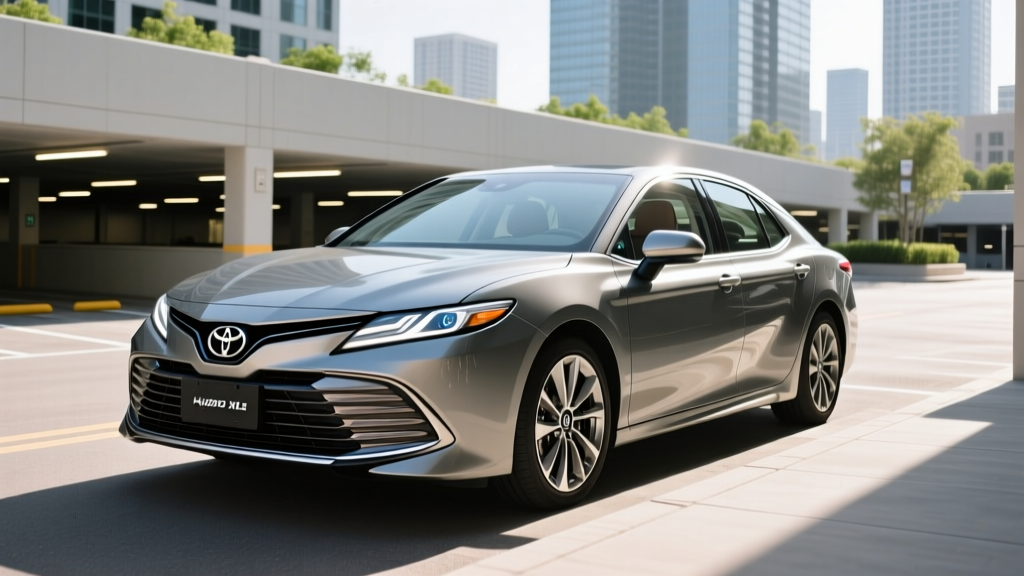
The 2025 Toyota Camry Hybrid XLE sits at the intersection of efficiency and everyday comfort. With the ninth-generation Camry going all-hybrid for 2025, the XLE trim represents the comfort-oriented, feature-rich end of the lineup — and it delivers an EPA-estimated 51 MPG combined that few midsize sedans can touch. Whether you're cross-shopping against a plug-in hybrid, a full EV, or a conventional gas sedan, this review breaks down exactly what the Camry Hybrid XLE offers, what it costs, and where it fits in an increasingly electrified market.
2025 Toyota Camry Hybrid XLE: Quick Specs at a Glance
| Attribute | Specification |
|---|---|
| Powertrain | 2.5L 4-cylinder + electric motor (5th-gen Toyota hybrid) |
| Combined Horsepower | 225 hp (FWD) / 232 hp (AWD) |
| EPA Fuel Economy (FWD) | 51 city / 49 highway / 51 combined MPG |
| EPA Fuel Economy (AWD) | 51 city / 49 highway / 50 combined MPG |
| Hybrid Battery | ~1.6 kWh lithium-ion (sealed, self-charging HEV) |
| Plug-In Required? | No — conventional hybrid (HEV) |
| Electric-Only Range | N/A (not a PHEV) |
| Total Range | ~570 miles (13.2-gal tank) |
| 0–60 mph | ~7.2 seconds (FWD) |
| Base MSRP (XLE FWD) | $33,495 |
| Hybrid Battery Warranty | 10 years / 150,000 miles |
| Federal Tax Credit | Not eligible (§30D applies to PHEVs/BEVs only) |
HEV vs. PHEV vs. EV: Which Camry Buyer Are You?
Before diving deeper, it's critical to understand what the Camry Hybrid XLE is — and what it isn't. This is a conventional hybrid electric vehicle (HEV), not a plug-in hybrid (PHEV) or a battery-electric vehicle (BEV). Here's how the three categories differ and who each one serves:
Conventional Hybrid (HEV) — Camry Hybrid XLE
- How it works: A small battery (~1.6 kWh) is charged by the engine and regenerative braking. No plug required.
- Electric-only driving: Brief, low-speed EV mode only (typically under 1 mile at parking-lot speeds).
- Best for: Drivers who want maximum MPG with zero charging infrastructure, apartment dwellers, and those without garage access.
Plug-In Hybrid (PHEV) — e.g., Toyota RAV4 Prime
- How it works: Larger battery (~18 kWh) that plugs in for 25–42 miles of electric-only range before the gas engine kicks in.
- Best for: Drivers with home charging who commute under 40 miles round-trip but still want gas-engine flexibility for road trips.
- Tax credit: May qualify for up to $7,500 under IRS §30D, subject to income, MSRP caps, and battery-sourcing rules.
Battery Electric (BEV) — e.g., Tesla Model 3, Hyundai Ioniq 6
- How it works: 100% electric, no gas engine. 250–360+ miles of EPA range. Requires home or public charging.
- Best for: Drivers with reliable home Level 2 charging who want zero tailpipe emissions and minimal maintenance.
The Camry Hybrid XLE is squarely an HEV. You never plug it in. You just fill up with gas — less often than a conventional sedan — and drive.
Fuel Economy: EPA Numbers and Real-World MPG
The 2025 Camry Hybrid's fifth-generation Toyota Hybrid System (THS) pairs a 2.5-liter Dynamic Force four-cylinder engine with a front-mounted electric motor (and an additional rear motor on AWD trims). The result is class-leading efficiency for a midsize sedan.
| Drivetrain | City MPG | Highway MPG | Combined MPG |
|---|---|---|---|
| FWD (XLE) | 51 | 49 | 51 |
| AWD (XLE) | 51 | 49 | 50 |
Source: EPA / fueleconomy.gov
Real-World MPG vs. EPA Sticker
Toyota hybrids have a well-documented tendency to exceed their EPA city estimates in stop-and-go driving, where regenerative braking recaptures the most energy. In real-world mixed driving, owners and testers frequently report 48–55 MPG in the Camry Hybrid, depending on conditions:
- City-heavy commuting: 50–55 MPG is common. The hybrid system thrives on low-speed, stop-and-go patterns where the electric motor handles most of the work.
- Highway cruising (70–80 mph): Expect 42–47 MPG. Aerodynamic drag and sustained engine load reduce the hybrid advantage at higher speeds.
- Cold weather (below 30°F): Expect a 5–10% reduction (roughly 45–48 MPG combined). The engine runs more frequently to warm the cabin and maintain battery temperature.
- Hilly terrain: Regenerative braking on descents can partially offset uphill consumption, but mountainous routes typically yield 44–48 MPG.
With a 13.2-gallon fuel tank, real-world total range typically falls between 520 and 600 miles depending on your driving mix — enough for most drivers to visit the gas station once every two weeks.
Powertrain and Performance: More Than Just Efficiency
The 2025 Camry Hybrid's fifth-gen THS delivers 225 combined horsepower in FWD form and 232 hp with AWD (the rear electric motor adds 40 hp). That's a meaningful bump over the previous-generation Camry Hybrid's 208 hp, and it translates to confident merging and passing.
The 0–60 mph time of roughly 7.2 seconds (FWD) puts the Camry Hybrid XLE in the same ballpark as many turbocharged four-cylinder competitors. The e-CVT transmission operates smoothly without the rubber-band sensation that plagued earlier CVTs, thanks to Toyota's use of a physical first-gear launch mechanism in its hybrid transaxle.
AWD is available on the XLE — a rarity in the midsize hybrid sedan segment — and adds a rear-mounted electric motor that activates automatically under acceleration or low-traction conditions. It doesn't transform the Camry into an off-roader, but it provides meaningful stability in rain and light snow.
Pricing, Trims, and Tax Credit Eligibility
The 2025 Camry Hybrid XLE starts at $33,495 (including destination) for the FWD model. Adding AWD costs approximately $1,525. Key standard equipment on the XLE includes:
- 8-inch touchscreen with wireless Apple CarPlay and Android Auto
- Toyota Safety Sense 3.0 (adaptive cruise, lane-keeping, automatic emergency braking, blind-spot monitoring)
- Leather-trimmed heated front seats
- Dual-zone automatic climate control
- Smart Key with push-button start
- 17-inch alloy wheels
Options like a panoramic moonroof, a 12.3-inch upgraded touchscreen with navigation, and a premium JBL audio system can push a loaded XLE AWD above $38,000.
Does the Camry Hybrid Qualify for a Federal Tax Credit?
No. The federal §30D New Qualified Plug-In Electric Drive Motor Vehicle Credit applies only to plug-in hybrids (PHEVs) and battery-electric vehicles (BEVs) that meet battery-capacity, sourcing, MSRP, and buyer-income thresholds. Because the Camry Hybrid is a conventional HEV that cannot be plugged in, it does not qualify for the federal EV tax credit.
Some states and local utilities offer rebates for conventional hybrids, but these vary widely by jurisdiction. Check your state energy office or utility provider for current programs. For federal credit rules, consult IRS.gov §30D guidance or a tax professional.
Battery Warranty, Reliability, and Replacement Cost
Toyota Hybrid Battery Warranty
Coverage: 10 years or 150,000 miles (whichever comes first), applicable to all 50 states.
What's covered: Defects and capacity loss below a defined threshold in the hybrid battery pack and related components (inverter, control module).
Transferable: Yes — the warranty follows the vehicle, not the original owner.
How Long Will the Hybrid Battery Last?
Toyota's hybrid battery packs have an exceptional longevity track record. Data from fleet operators, consumer surveys, and the Taxi Cab Commission in cities like Vancouver (where Prius models have exceeded 400,000 miles) show that Toyota hybrid batteries typically last 15–20 years or 200,000+ miles before significant degradation. The sealed nickel-metal-hydride or lithium-ion pack (depending on model year and trim) is designed for shallow cycling — it never fully charges or fully depletes, which dramatically extends cell life.
The Camry Hybrid's relatively small ~1.6 kWh battery experiences less thermal stress than a large BEV or PHEV pack, further contributing to longevity.
What Does Hybrid Battery Replacement Cost?
If the battery does fail outside warranty, replacement costs for a Toyota Camry Hybrid typically range from $2,000 to $4,000 (parts and labor) at a dealership. Independent hybrid specialists often offer refurbished or reconditioned packs for $1,500–$2,500. Individual module replacement (rather than the full pack) can cost as little as $500–$1,000 if only a few cells have degraded.
For context, this is substantially less than a BEV battery replacement, which can run $8,000–$20,000 depending on the vehicle. The Camry Hybrid's small, simple battery is one of its lowest-risk ownership costs.
Overall Reliability
Toyota's hybrid system is among the most proven in the automotive industry, with over 25 years of continuous refinement since the original 1997 Prius. The Camry nameplate consistently earns top marks from IIHS and strong predicted reliability ratings from Consumer Reports. The e-CVT transaxle has no belts, clutches, or bands to wear out, and regenerative braking significantly extends brake-pad life — many owners report 80,000+ miles on original brake pads.
Who Should Buy the Camry Hybrid XLE — and Who Shouldn't?
Choose the Camry Hybrid XLE if:
- You want 50+ MPG without installing a home charger or relying on public charging infrastructure.
- You live in an apartment or lack garage access for overnight charging.
- You regularly drive 15,000+ miles per year and want to minimize fuel spend.
- You value a quiet, comfortable ride with strong safety tech and proven reliability.
- You want AWD availability in a fuel-efficient sedan for snowy or rainy climates.
Consider a PHEV or BEV instead if:
- You have home Level 2 charging and a short commute — a PHEV like the RAV4 Prime or a BEV like the Ioniq 6 could eliminate most gasoline use.
- You want to qualify for the $7,500 federal tax credit (PHEVs and BEVs only, subject to eligibility).
- You want to minimize tailpipe emissions — the Camry Hybrid still burns gasoline, even if less of it.
- You want one-pedal driving and instant electric torque — the Camry Hybrid's electric assist is subtle, not transformative.
Pros
- 51 MPG combined — among the best of any midsize sedan
- No plug-in charging required
- 225–232 hp with smooth acceleration
- Available AWD for inclement weather
- 10-year / 150,000-mile hybrid battery warranty
- Strong resale value and reliability reputation
- Toyota Safety Sense 3.0 standard
Cons
- No federal tax credit eligibility (HEV, not PHEV)
- Cannot drive on electric power alone beyond very low speeds
- XLE pricing approaches loaded PHEV territory
- e-CVT lacks the sporty feel of a geared transmission
- No DC fast charging capability (not applicable for HEV)
Frequently Asked Questions
How many MPG does the 2025 Toyota Camry Hybrid XLE get?
The EPA rates the FWD Camry Hybrid XLE at 51 city / 49 highway / 51 combined MPG. The AWD version rates 51/49/50. Real-world results typically range from 45 to 55 MPG depending on driving conditions, with city driving often exceeding the EPA estimate.
Is the Camry Hybrid XLE a plug-in hybrid?
No. The Camry Hybrid is a conventional hybrid (HEV). It charges its own small battery through the engine and regenerative braking. You never plug it in. If you want plug-in electric range, look at Toyota's PHEV offerings like the RAV4 Prime or Prius Prime.
Does the 2025 Camry Hybrid qualify for any tax credit?
It does not qualify for the federal §30D plug-in vehicle tax credit, which is limited to PHEVs and BEVs. Some state or utility incentives may apply to hybrids, but these vary by location. Consult your state energy office or a tax professional for details.
How long will the Camry Hybrid battery last, and what does replacement cost?
Toyota hybrid batteries typically last 15–20 years or 200,000+ miles. The battery is warranted for 10 years / 150,000 miles. Out-of-warranty replacement costs $2,000–$4,000 at a dealership, or $1,500–$2,500 through an independent hybrid specialist.
How does the Camry Hybrid compare to a full EV for daily commuting?
If you have home charging and a commute under 40 miles, a BEV or PHEV will eliminate most or all gasoline use and may qualify for tax credits. If you lack charging access, drive long distances frequently, or want zero range-anxiety in extreme weather, the Camry Hybrid's 51 MPG and 570-mile range make it a more practical choice.
Is the 2025 Camry Hybrid XLE good in snow?
With available electronic AWD, the Camry Hybrid XLE provides confident traction in light to moderate snow and rain. The rear electric motor engages automatically when slippage is detected. For severe winter conditions, dedicated winter tires make a larger difference than AWD alone.
What is the total cost of ownership compared to a gas-only Camry?
At 25 MPG (gas Camry) vs. 51 MPG (hybrid) and $3.50/gallon fuel, a driver covering 15,000 miles/year saves roughly $1,400 annually in fuel costs with the hybrid. Over five years, that's approximately $7,000 in fuel savings, easily offsetting the hybrid's modest price premium. Maintenance costs are comparable or lower (less brake wear, no traditional starter or alternator).