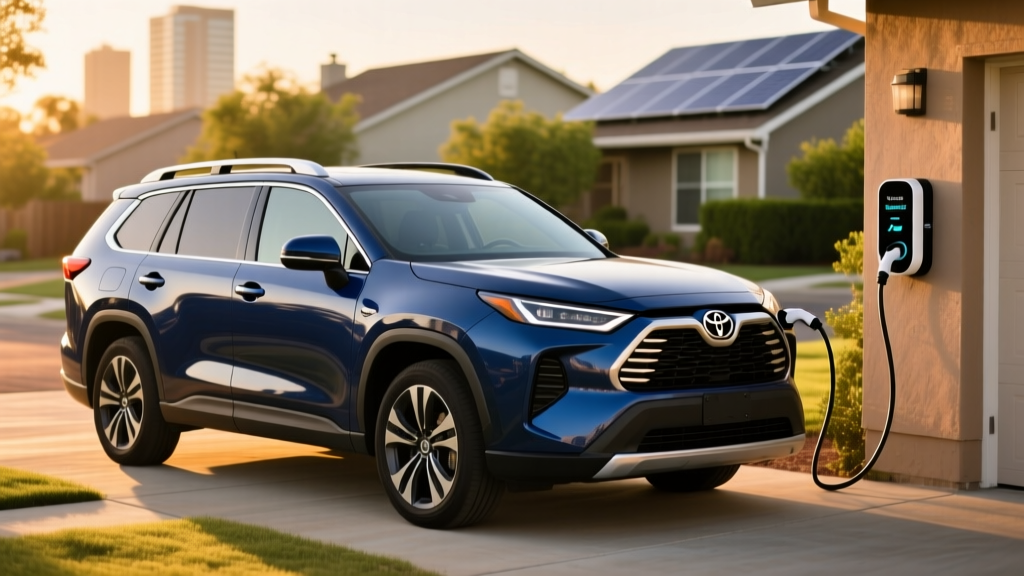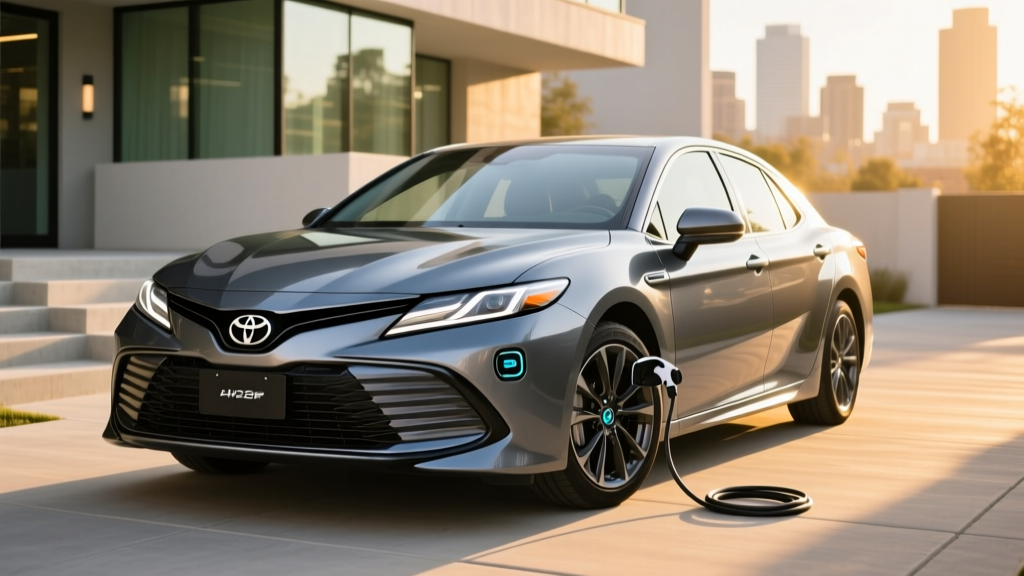
The 2025 Toyota Camry arrives exclusively as a hybrid for the first time, dropping the four-cylinder gas-only option entirely. Toyota's fifth-generation hybrid system now powers every Camry trim, pairing a 2.5-liter four-cylinder engine with electric motors for up to 232 horsepower on all-wheel-drive variants. For buyers researching 2025 Toyota Camry Hybrid specs, the headline numbers are compelling: up to 51 MPG city on the LE trim, a starting MSRP of $28,700, and standard Toyota Safety Sense 3.0. But how does the real-world fuel economy stack up, and what does the hybrid battery warranty actually cover?
This guide breaks down every key specification — from EPA MPG across all trims to the hybrid powertrain architecture — and explains where the Camry Hybrid fits against plug-in hybrids and full battery-electric vehicles in 2025.
HEV vs PHEV: Where the Camry Hybrid Fits
Before examining the numbers, it's critical to understand what the 2025 Camry Hybrid is — and what it isn't. The Camry Hybrid is a conventional hybrid electric vehicle (HEV), not a plug-in hybrid (PHEV). This distinction shapes everything about ownership.
| Feature | HEV (Camry Hybrid) | PHEV (e.g., Prius Prime) | BEV (e.g., Tesla Model 3) |
|---|---|---|---|
| Plug-in charging | No — self-charging via regen & engine | Yes — Level 1/Level 2 | Yes — Level 1/2/DC fast |
| Electric-only driving | Very short distances at low speed | 30-45 miles typical | 250-360+ miles |
| Gas engine | Yes, always available | Yes, kicks in after battery depletes | None |
| Federal tax credit (§30D) | Not eligible | Up to $7,500 (if requirements met) | Up to $7,500 (if requirements met) |
| Home charging install needed | No | Recommended (Level 2) | Essential (Level 2) |
| Best for | No plug access, long commutes, simplicity | Short EV commute + road-trip flexibility | Home charging access, max savings |
The Camry Hybrid recovers energy through regenerative braking and the gasoline engine to charge its small traction battery. You never plug it in. If you need electric-only commuting capability, Toyota offers that in the Prius Prime PHEV, not the Camry lineup.
2025 Toyota Camry Hybrid MPG: EPA Ratings by Trim
Fuel economy varies by trim and drivetrain configuration. Front-wheel-drive (FWD) models achieve the highest EPA numbers, while all-wheel-drive (AWD) variants — which add a rear electric motor — trade a few MPG for traction. Here's the full EPA data from fueleconomy.gov:
| Trim | Drivetrain | City MPG | Highway MPG | Combined MPG |
|---|---|---|---|---|
| LE | FWD | 53 | 50 | 51 |
| LE | AWD | 51 | 49 | 50 |
| SE | FWD | 48 | 47 | 47 |
| SE | AWD | 46 | 46 | 46 |
| XLE | FWD | 48 | 47 | 47 |
| XLE | AWD | 46 | 46 | 46 |
The SE and XLE trims drop a few MPG due to larger 18- or 19-inch wheels, sport-tuned suspensions, and additional weight from premium features. The LE's 51 combined MPG makes it one of the most efficient midsize sedans on the market, rivaling the Hyundai Sonata Hybrid and edging out the Honda Accord Hybrid (48 combined on EX-L).
Real-World MPG vs. EPA Sticker
Toyota's hybrid system excels in city driving, where the electric motor handles low-speed propulsion and regenerative braking recaptures energy at every stop. In real-world use, many owners report matching or slightly exceeding EPA city estimates — a rarity in the auto industry. Highway driving tells a different story: at sustained 75-80 mph speeds, the gasoline engine carries most of the load, and real-world highway MPG typically falls 3-5 MPG below the sticker, landing in the mid-to-upper 40s for FWD LE models.
Cold weather reduces efficiency as the engine runs more frequently to generate cabin heat and warm the catalytic converter. Expect a 5-10% MPG reduction in sub-freezing conditions — less severe than the 20-30% range loss EVs experience, but still meaningful over a winter of commuting.
Powertrain Specs: Horsepower, Engine, and Hybrid System
The 2025 Camry uses Toyota's fifth-generation hybrid powertrain, a significant evolution from the previous generation's system. Here's the complete mechanical breakdown:
| Specification | Detail |
|---|---|
| Engine | 2.5L DOHC 4-cylinder (A25A-FXS) |
| Engine horsepower | 184 hp @ 6,000 rpm |
| Engine torque | 163 lb-ft @ 5,200 rpm |
| Front electric motor | 100 kW (134 hp) |
| Rear electric motor (AWD only) | 30 kW (40 hp) |
| Net combined horsepower (FWD) | 225 hp |
| Net combined horsepower (AWD) | 232 hp |
| Transmission | eCVT (electronically controlled) |
| 0-60 mph (est.) | ~7.1 seconds (FWD) |
| Hybrid battery type | Lithium-ion (Li-ion) |
| Hybrid battery capacity | ~1.1 kWh (nominal) |
| Drivetrain options | FWD or electronic AWD |
| Fuel tank capacity | 13.2 gallons |
| Max cruising range (LE FWD) | ~673 miles (13.2 gal × 51 MPG) |
The AWD system is worth noting: rather than a mechanical driveshaft, the Camry Hybrid AWD uses an independent rear electric motor that engages when the front wheels slip or under hard acceleration. It operates up to approximately 43 mph in normal conditions, though it can activate at higher speeds when traction demands it. This system adds roughly 100 pounds but costs only 1-2 MPG — a worthwhile trade in snow-belt states.
The 225 hp FWD output represents a 22-hp increase over the prior-generation Camry Hybrid (208 hp), giving the 2025 model noticeably stronger highway passing power. The AWD variant's 232 hp makes it the most powerful Camry Hybrid Toyota has produced, short of the discontinued V6.
Pricing by Trim and Tax Credit Eligibility
The 2025 Camry Hybrid is available in three trims, each offered with FWD or AWD. Pricing below reflects base MSRP including destination charge:
| Trim | FWD MSRP | AWD MSRP |
|---|---|---|
| LE | $28,700 | $30,100 |
| SE | $30,990 | $32,390 |
| XLE | $33,495 | $34,895 |
Federal Tax Credit Status
The 2025 Camry Hybrid does not qualify for the IRS §30D federal clean vehicle tax credit. Under current law, conventional hybrids (HEVs) are excluded — only plug-in hybrid electric vehicles (PHEVs) and battery electric vehicles (BEVs) with sufficient battery capacity (≥7 kWh) are eligible, subject to MSRP caps, buyer income limits, and battery component/critical mineral sourcing requirements.
If the federal tax credit is a priority, consider the Toyota Prius Prime (PHEV, up to $7,500 credit eligibility) or the Toyota RAV4 Prime (PHEV, credit eligibility varies by sourcing). Some states offer separate rebates for conventional hybrids — check your state energy office or AFDC state incentives database for local programs.
Hybrid Battery Warranty, Lifespan, and Replacement Cost
Toyota Hybrid Battery Warranty (2025 Camry):
- Coverage: 10 years / 150,000 miles (whichever comes first)
- Applies to: Hybrid traction battery and hybrid system components (inverter, control module)
- Transferable: Yes — transfers automatically to subsequent owners
- Capacity threshold: Toyota covers defects and premature failure; no specific State-of-Health percentage guarantee is published (unlike EV warranties that specify 70% retention)
How Long Do Toyota Hybrid Batteries Last?
Toyota's hybrid battery track record is among the best in the industry. The Camry Hybrid's lithium-ion pack is substantially smaller (~1.1 kWh) than an EV battery (60-100 kWh), and it operates within a narrow State of Charge window — typically between 40% and 80%. This shallow-cycling strategy dramatically reduces cell stress and extends lifespan.
Real-world data from prior-generation Camry Hybrids and Prius models shows most hybrid batteries lasting 150,000 to 200,000+ miles without replacement. Failures within the warranty period are uncommon. The 10-year/150,000-mile warranty (extended from 8 years/100,000 miles in earlier model years) reflects Toyota's confidence in the pack's longevity.
Battery Replacement Cost
If the hybrid battery does require replacement out of warranty, expect the following costs:
- New OEM battery from Toyota: $2,500–$4,000 (parts) + $500–$1,000 (labor) = $3,000–$5,000 total
- Refurbished/remanufactured battery: $1,500–$2,500 installed
- Individual cell module replacement: Some independent hybrid specialists can replace failed modules within the pack for $500–$1,500, depending on the number of bad cells
For context, this is significantly less than EV battery replacement, which typically runs $10,000–$20,000+. The Camry Hybrid's small battery and mature architecture keep replacement costs manageable.
Who Should Choose the Camry Hybrid vs. a PHEV or Full EV?
Choose the 2025 Camry Hybrid (HEV) if:
- You lack access to home or workplace charging (apartment, street parking, no garage outlet)
- You want maximum simplicity — no charging cables, no apps, no route planning
- Your annual mileage is high (20,000+ miles) and you want proven reliability
- You frequently take long road trips and don't want to plan around charging stations
- You want a midsize sedan with 500+ mile range per tank and a sub-$30K starting price
Choose a PHEV (e.g., Prius Prime, RAV4 Prime) if:
- You have home Level 2 charging and a commute under 40 miles round-trip
- You want electric-only daily driving but gas flexibility for road trips
- You want to qualify for the $7,500 federal tax credit (subject to eligibility)
Choose a full EV (e.g., Tesla Model 3, Hyundai Ioniq 6) if:
- You have reliable home Level 2 charging
- You want the lowest per-mile fuel cost (~$0.04–$0.06/mile on home electricity vs. ~$0.08–$0.10/mile hybrid)
- You want zero tailpipe emissions and minimal maintenance (no oil changes, no engine)
- You're eligible for the federal tax credit and state rebates to offset the higher purchase price
The Camry Hybrid occupies a specific and valuable niche: it delivers near-EV city efficiency without any charging infrastructure requirement. For the roughly 35% of US households without dedicated home charging access, a conventional hybrid remains the most practical path to dramatically reduced fuel consumption.
Pros and Cons at a Glance
Pros
- Best-in-class city MPG (53 city on LE FWD)
- No charging infrastructure needed — just fill up with gas
- 225-232 hp is a meaningful upgrade over the previous generation
- 10-year/150,000-mile hybrid battery warranty
- Available AWD with minimal MPG penalty
- Standard Toyota Safety Sense 3.0 (adaptive cruise, lane-keeping, auto emergency braking)
- Competitive starting price of $28,700
- ~673-mile maximum cruising range (LE FWD)
Cons
- Not eligible for the federal §30D tax credit (HEV exclusion)
- No plug-in option in the Camry lineup — must go to Prius Prime or RAV4 Prime for PHEV
- eCVT drone under hard acceleration (inherent to planetary-gear hybrid systems)
- Highway MPG falls short of EPA in real-world 75+ mph driving
- Infotainment system still uses Toyota's older interface on the LE base trim
- AWD rear motor disengages above ~43 mph in normal driving (not full-time AWD)
Frequently Asked Questions
How many MPG does the 2025 Toyota Camry Hybrid get?
The EPA rates the 2025 Camry Hybrid LE FWD at 53 city / 50 highway / 51 combined MPG. The SE and XLE trims achieve 48 city / 47 highway / 47 combined (FWD). AWD models drop 1-2 MPG across the board. In real-world driving, city MPG often matches or exceeds the EPA figure, while highway MPG at 75+ mph typically runs 3-5 MPG below the sticker.
Does the 2025 Camry Hybrid need to be plugged in?
No. The Camry Hybrid is a conventional hybrid (HEV). Its small lithium-ion battery charges through regenerative braking and the gasoline engine. You never plug it in — just refuel at any gas station. If you want plug-in capability, look at the Toyota Prius Prime or RAV4 Prime.
Does the 2025 Camry Hybrid qualify for any tax credit?
The Camry Hybrid does not qualify for the federal IRS §30D clean vehicle tax credit, which is limited to plug-in hybrids and battery-electric vehicles. Some states and local utilities offer rebates for conventional hybrids — check the AFDC state incentives database for programs in your area.
How long will the Camry Hybrid battery last and what does replacement cost?
Toyota covers the hybrid battery for 10 years or 150,000 miles. Based on historical data from Toyota hybrids, most packs last 150,000–200,000+ miles. Out-of-warranty replacement costs $3,000–$5,000 for a new OEM battery, or $1,500–$2,500 for a refurbished unit. The small battery size and shallow-cycling strategy keep costs and degradation well below EV battery levels.
Is the 2025 Camry Hybrid fast enough for highway merging?
With 225 hp (FWD) or 232 hp (AWD), the 2025 Camry Hybrid accelerates to 60 mph in approximately 7.1 seconds. That's competitive with the Honda Accord Hybrid and noticeably quicker than the previous-generation Camry Hybrid (208 hp, ~7.6 seconds). Highway merging and passing are confident, though the eCVT creates a characteristic drone under sustained hard throttle.
Should I get the Camry Hybrid or a full EV like the Tesla Model 3?
If you have reliable home Level 2 charging, drive under 300 miles between stops, and want the lowest operating cost, a full EV saves more on fuel and maintenance over time. If you lack home charging, regularly drive 400+ miles without stopping, or want the lowest upfront cost with no charging logistics, the Camry Hybrid is the pragmatic choice. The Hybrid bridges the gap for drivers who want efficiency without infrastructure dependency.