Quick Verdict: The Everyday Hybrid Done Right
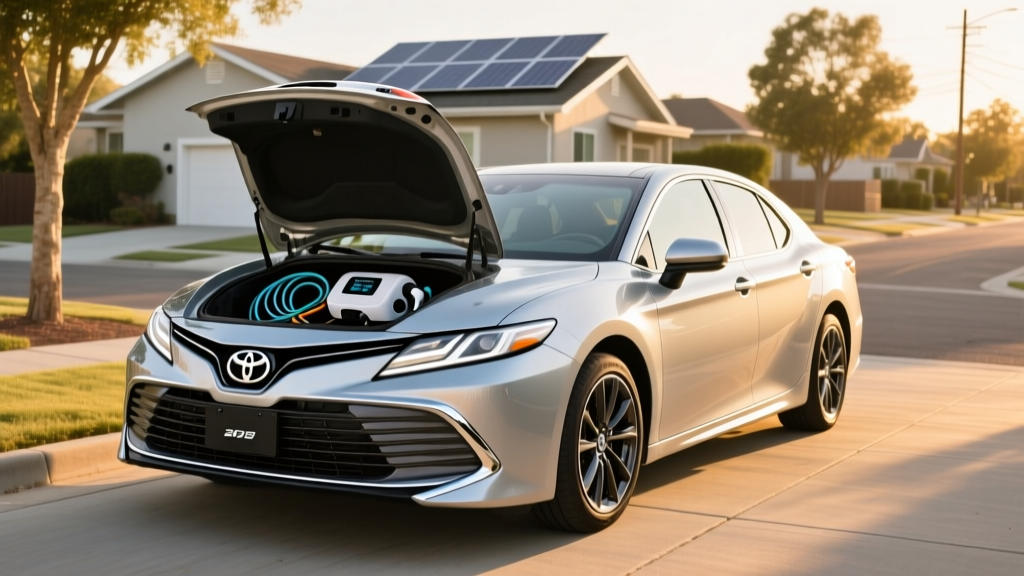
The 2025 Toyota Camry Hybrid SE sits in the sweet spot of Toyota's all-hybrid sedan lineup — a sport-tuned suspension, 225 combined horsepower, and an EPA-estimated 47 MPG combined that makes it one of the most efficient midsize sedans you can buy without plugging in. For 2025, Toyota dropped the gasoline-only Camry entirely, meaning every new Camry is now a hybrid. The SE trim adds firmer damping, paddle shifters, and a more aggressive aesthetic over the LE, but the powertrain and efficiency remain the core draw.
This is a conventional hybrid electric vehicle (HEV), not a plug-in hybrid (PHEV). You never plug it in — the 1.6 kWh nickel-metal hydride battery charges itself through regenerative braking and the gasoline engine. If you're looking for electric-only driving, you'll want to look at the Toyota RAV4 Prime or a full BEV. But if your goal is maximum fuel savings with zero lifestyle change, the Camry Hybrid SE is a benchmark.
The 2025 Camry Hybrid is a conventional HEV: no plug, small battery (~1.6 kWh), electric motor assists the gas engine. A PHEV (like the RAV4 Prime) has a larger battery (18+ kWh), a plug for external charging, and 30-42 miles of electric-only range. An EV (BEV) has no gasoline engine at all. The Camry Hybrid SE is strictly HEV.
Fuel Economy: EPA Numbers and Real-World MPG
The 2025 Camry Hybrid SE carries the following EPA-estimated fuel economy ratings:
| Metric | FWD | AWD |
|---|---|---|
| City MPG | 48 | 46 |
| Highway MPG | 47 | 46 |
| Combined MPG | 47 | 46 |
| Fuel Tank | 13.2 gal | 13.2 gal |
| Total Range (est.) | ~620 mi | ~607 mi |
Real-World MPG: What to Actually Expect
Toyota's fifth-generation hybrid system excels in city driving where regenerative braking recaptures energy at every stop. In real-world mixed driving, owners frequently report matching or slightly exceeding the EPA combined figure — 47-50 MPG is achievable in suburban and city commutes. On sustained highway trips at 75+ mph, expect the number to dip to roughly 42-44 MPG as the gasoline engine does more of the work and aerodynamic drag increases.
Cold weather reduces efficiency in any vehicle, but hybrids are less affected than EVs since the gasoline engine provides cabin heat. Expect a 5-10% MPG reduction in freezing temperatures — still landing around 42-44 MPG combined, which outperforms most gas-only midsize sedans in ideal conditions.
Powertrain and Performance Specs
| Specification | 2025 Camry Hybrid SE |
|---|---|
| Engine | 2.5L 4-cyl Dynamic Force |
| Engine Output | 184 hp / 163 lb-ft |
| Electric Motor (front) | 100 kW (134 hp) |
| Net Combined Horsepower | 225 hp |
| AWD Rear Motor (if equipped) | 30 kW (40 hp) |
| Transmission | eCVT (planetary gearset) |
| 0-60 mph (est.) | ~7.1 sec (FWD) |
| Hybrid Battery | ~1.6 kWh NiMH (bipolar) |
| Drivetrain | FWD standard / AWD available |
The fifth-generation Toyota Hybrid System uses a bipolar nickel-metal hydride battery pack — a chemistry choice that prioritizes longevity and power delivery over the energy density of lithium-ion. This battery is not user-chargeable via a plug. It charges through regen and the engine, cycling constantly in a narrow state-of-charge window that minimizes degradation.
The SE trim's sport-tuned suspension lowers the ride height slightly and firms up the damping compared to the LE. You'll feel more road texture, but body roll is noticeably reduced in corners. The paddle shifters let you select from six simulated gear ratios in the eCVT, though the powertrain is at its most efficient and smoothest in normal Drive mode.
Pricing and Tax Credit Eligibility
| Trim | MSRP (FWD) | MSRP (AWD) |
|---|---|---|
| LE | $28,700 | $30,100 |
| SE | $30,140 | $31,540 |
| XLE | $33,545 | $34,945 |
| XSE | $34,195 | $35,595 |
Prices include destination charge. Source: Toyota USA.
No. The IRS §30D Clean Vehicle Credit applies only to plug-in electric vehicles (BEVs and PHEVs) with a minimum battery capacity of 7 kWh. The Camry Hybrid's ~1.6 kWh NiMH pack does not meet this threshold. There is no federal tax credit for conventional HEVs. Some states or utilities may offer small rebates for high-efficiency vehicles — check your local programs — but do not count on any federal incentive.
Battery Warranty, Reliability, and Replacement Cost
- Coverage: 10 years / 150,000 miles (whichever comes first)
- What's covered: Hybrid battery pack, hybrid control module, inverter, and related hybrid-system components
- Transferable: Yes — fully transfers to subsequent owners
- Capacity threshold: Toyota warrants against defects and abnormal loss of capacity; there is no published minimum SoH percentage, but coverage applies if the battery fails to function normally
Toyota's hybrid battery track record is among the best in the industry. The Prius, which has used NiMH chemistry for over two decades, routinely sees original batteries lasting 150,000-200,000+ miles. The Camry Hybrid's bipolar NiMH pack is a newer, more power-dense variant of the same proven chemistry, designed for faster charge/discharge cycles rather than large energy storage.
What Does Hybrid Battery Replacement Cost?
If your hybrid battery fails outside warranty — typically at very high mileage or age — a new OEM replacement battery from Toyota runs approximately $2,000-$3,500 for the part, plus $500-$1,000 in labor, for a total of roughly $2,500-$4,500. Third-party reconditioned or refurbished NiMH modules are available for $1,000-$2,000 installed at independent hybrid specialists. Given the 10-year/150,000-mile warranty and Toyota's historical longevity, most original owners will never face this cost.
The conventional powertrain (engine, eCVT) also benefits from Toyota's reputation. The eCVT uses a planetary gearset with no belts, clutches, or traditional shifting components — there's less to break than in a conventional automatic. The 2.5L Dynamic Force engine runs an Atkinson cycle, reducing thermal stress. Expect the standard 3-year/36,000-mile bumper-to-bumper and 5-year/60,000-mile powertrain warranties to cover non-hybrid components.
Who Should Choose the Camry Hybrid SE?
✓ Pros
- 47 MPG combined — real-world city driving often exceeds this
- No plug needed — zero infrastructure or lifestyle change
- 225 hp provides confident highway merging
- 10-year/150,000-mile hybrid battery warranty
- SE sport suspension adds engagement without harshness
- AWD available for snow-belt buyers
- ~620-mile total range on a single tank
✗ Cons
- No electric-only driving — always uses gasoline
- No federal tax credit eligibility
- eCVT drone under hard acceleration (common to hybrids)
- SE firmness may not suit buyers prioritizing ride comfort (consider LE/XLE)
- No DC fast charging or plug-in capability
- Infotainment can lag behind competitors in responsiveness
Hybrid vs PHEV vs EV — Which Fits You?
| Factor | HEV (Camry Hybrid) | PHEV (e.g., RAV4 Prime) | BEV (e.g., Model 3) |
|---|---|---|---|
| Plug in required? | No | Yes (for EV range) | Yes (always) |
| Electric-only range | 0 mi | 30-42 mi | 250-350+ mi |
| Home charging needed? | No | Recommended | Essential |
| Federal tax credit | None | Up to $7,500* | Up to $7,500* |
| Best for | No home charging, long trips | Short commutes + road trips | Home charging, low fuel cost |
| Fuel cost per mile (est.) | ~$0.07 | ~$0.04-0.07 | ~$0.03-0.05 |
*§30D credit eligibility depends on MSRP caps, buyer income limits, battery sourcing requirements, and manufacturer qualification. Verify current rules at irs.gov.
Choose the Camry Hybrid SE if: You don't have reliable access to home or workplace charging, you take regular road trips where charging infrastructure is sparse, you want a sedan (not a crossover), and you want maximum fuel savings with zero behavioral change. At roughly $0.07/mile in fuel (at $3.30/gal and 47 MPG), you'll spend about $1,050/year driving 15,000 miles — roughly half what a 28-MPG gas-only midsize sedan would cost.
Look at a PHEV instead if: You can install a Level 2 home charger and your daily commute is under 35 miles. A PHEV lets you drive most days on electricity while keeping a gas engine for road trips — but you'll pay a $5,000-$8,000 premium over the Camry Hybrid and need to commit to plugging in nightly to capture the benefit.
Go full EV if: You have home charging, your daily driving is predictable, and you want the lowest per-mile fuel cost and minimal maintenance. A BEV eliminates oil changes and has fewer moving parts, but requires charging planning for long trips and a higher upfront investment.
Frequently Asked Questions
How many MPG does the 2025 Toyota Camry Hybrid SE get?
The EPA rates the FWD Camry Hybrid SE at 48 city / 47 highway / 47 combined MPG. The AWD version is rated at 46/46/46 MPG. In real-world city and suburban driving, many owners report 47-50 MPG. Sustained highway driving at 75+ mph typically yields 42-44 MPG.
Does the Camry Hybrid need to be plugged in?
No. The 2025 Camry Hybrid is a conventional HEV. Its small hybrid battery charges exclusively through regenerative braking and the gasoline engine. There is no plug, no charging port, and no electric-only driving mode that requires external power.
Is the Camry Hybrid SE reliable, and what will battery replacement cost?
Toyota's hybrid systems have a two-decade reliability track record, and the hybrid battery is warrantied for 10 years or 150,000 miles. If replacement is ever needed outside warranty, expect $2,500-$4,500 for a new OEM battery installed, or $1,000-$2,000 for a refurbished unit at an independent shop. Most original owners will not face this cost.
Does the 2025 Camry Hybrid qualify for a federal tax credit?
No. The IRS §30D Clean Vehicle Credit requires a minimum 7 kWh battery and plug-in capability. The Camry Hybrid's ~1.6 kWh NiMH battery and HEV powertrain do not qualify. Check your state and utility for possible efficiency rebates, but there is no federal incentive.
How does the SE trim differ from the LE and XSE?
The SE adds a sport-tuned suspension, 18-inch alloy wheels, paddle shifters, a leather-trimmed steering wheel, and dual exhaust tips over the LE. The XSE layers on additional premium features like a panoramic glass roof option and upgraded interior materials. The hybrid powertrain, battery, and MPG are identical across all trims; only the suspension tuning, wheels, and amenities change.
What is the total driving range on a full tank?
With a 13.2-gallon fuel tank and 47 MPG combined (FWD), the Camry Hybrid SE can travel approximately 620 miles between fill-ups. Highway-heavy driving will reduce this to roughly 555-580 miles; city-heavy driving can push it past 630 miles.