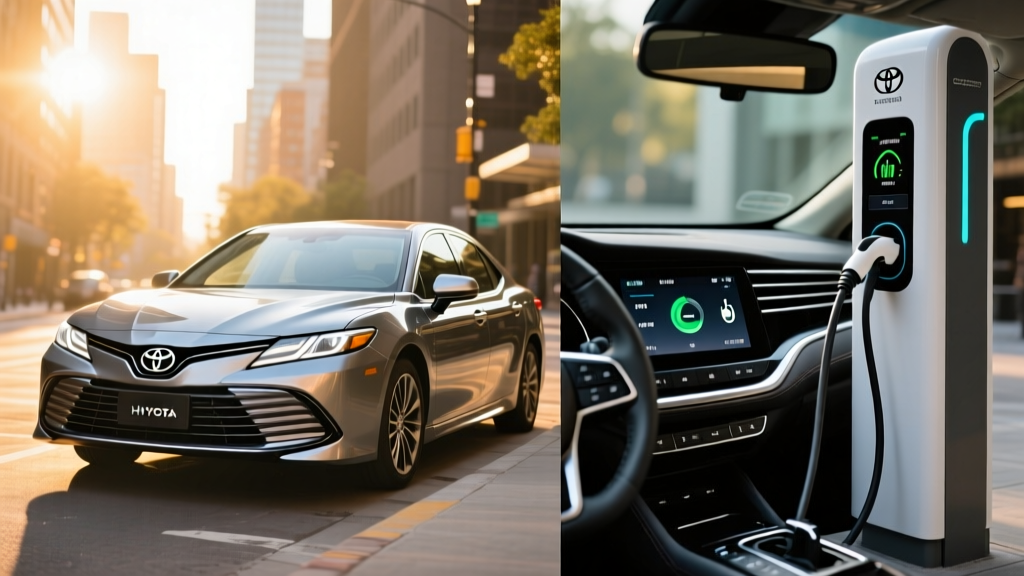
The midsize sedan segment underwent a seismic shift for 2025: Toyota dropped the four-cylinder gas engine entirely from the Camry, making every model a hybrid. The 2025 Toyota Camry hybrid-only lineup now spans four trims—LE, SE, XLE, and XSE—paired with Toyota's fifth-generation hybrid system and an optional electronic all-wheel-drive (AWD) setup on every grade. With EPA ratings reaching 51 MPG city and a starting MSRP under $29,000, the new Camry positions itself as the efficiency benchmark for buyers not yet ready to plug in.
This guide covers every trim's fuel economy, powertrain output, real-world MPG expectations, battery warranty details, and how the hybrid-only Camry stacks up against plug-in hybrids and full battery-electric vehicles (BEVs) in 2025.
Why Toyota Went Hybrid-Only for 2025
For the ninth-generation Camry's debut, Toyota eliminated the 2.5-liter four-cylinder gas engine that previously anchored the base model. The decision reflects both market demand and regulatory pressure: hybrid powertrains now account for a growing share of Toyota's US sales, and the fifth-generation Toyota Hybrid System (THS) delivers performance that makes a gas-only variant redundant.
The result is a simplified lineup where every 2025 Camry pairs a 2.5-liter four-cylinder engine with one or two electric motors, a lithium-ion hybrid battery, and an electronically controlled continuously variable transmission (eCVT). No plug-in variant exists for the 2025 Camry—Toyota reserves plug-in hybrid (PHEV) technology for the RAV4 Prime and Prius Prime. This is a conventional self-charging hybrid (HEV), meaning you never plug it in.
Full Trim Breakdown: MPG, Power, and Pricing
The 2025 Camry hybrid lineup is divided along two axes: trim level (LE, SE, XLE, XSE) and drivetrain (front-wheel drive or electronic AWD). The AWD system adds a second rear-mounted electric motor, boosting combined horsepower while slightly reducing fuel economy.
| Trim | Drivetrain | Combined HP | EPA City | EPA Highway | EPA Combined | Base MSRP |
|---|---|---|---|---|---|---|
| LE | FWD | 225 hp | 53 MPG | 50 MPG | 51 MPG | $28,700 |
| LE | AWD | 232 hp | 51 MPG | 49 MPG | 50 MPG | |
| SE | FWD | 225 hp | 48 MPG | 47 MPG | 47 MPG | $30,700 |
| SE | AWD | 232 hp | 46 MPG | 46 MPG | 46 MPG | |
| XLE | FWD | 225 hp | 48 MPG | 47 MPG | 47 MPG | $33,400 |
| XLE | AWD | 232 hp | 46 MPG | 46 MPG | 46 MPG | |
| XSE | FWD | 225 hp | 48 MPG | 47 MPG | 47 MPG | $34,600 |
| XSE | AWD | 232 hp | 44 MPG | 43 MPG | 44 MPG |
Source: fueleconomy.gov and Toyota Motor Corporation. MSRP excludes destination charge of $1,150.
The LE FWD stands out as the efficiency champion at 51 MPG combined. Moving to the sport-tuned SE and luxury-oriented XLE/XSE trims costs you 4–5 MPG due to larger 19-inch wheels, sport-tuned suspensions, and additional weight from premium features. The AWD system's 7-horsepower bump (232 hp vs. 225 hp) comes from the 40-kW rear electric motor, which also provides torque-vectoring traction in wet or snowy conditions.
Real-World MPG: What to Actually Expect
Toyota's hybrid system excels in stop-and-go urban driving, where the electric motor handles low-speed propulsion and regenerative braking recovers energy that would otherwise be lost. This means real-world city MPG often meets or exceeds the EPA city estimate—the opposite of what most gas cars achieve.
- City / suburban driving: 49–54 MPG (regen-heavy routes favor hybrids)
- Steady-state highway (65–70 mph): 44–48 MPG (aerodynamic drag reduces electric assist benefit)
- Cold weather (below 30°F): 42–47 MPG combined (engine runs more to heat cabin and warm the catalytic converter)
- Mixed daily commute: 47–51 MPG combined
On a 300-mile highway road trip at 75 mph, expect the LE FWD to return roughly 45–47 MPG, yielding a real-world range of approximately 585–610 miles on a single 13.2-gallon tank. In winter conditions with short trips where the engine must run continuously for cabin heat, combined economy can dip into the low 40s—still competitive with any non-hybrid midsize sedan.
The key insight: if your commute is primarily urban or suburban with frequent stops, the Camry hybrid will likely beat its EPA sticker. If you drive 80% highway miles at high speeds, expect results closer to or slightly below the highway rating.
HEV vs. PHEV vs. EV: Where the Camry Fits
The 2025 Camry is a conventional hybrid (HEV). It has no plug, no electric-only driving mode of meaningful distance, and no large battery to charge. Understanding this distinction is critical for buyers cross-shopping electrified vehicles.
| Feature | HEV (Camry Hybrid) | PHEV (e.g., Prius Prime) | BEV (e.g., Tesla Model 3) |
|---|---|---|---|
| Plug-in charging | No — self-charging via engine + regen | Yes — Level 1/2 AC | Yes — Level 1/2 AC + DC fast charge |
| Electric-only range | ~1 mile at low speed | 25–44 miles (model-dependent) | 250–400+ miles |
| Battery size | ~1.0 kWh (small, assists engine) | 10–18 kWh | 50–100 kWh |
| Home charging needed | No | Recommended for full benefit | Essential |
| Federal tax credit (§30D) | Not eligible | Up to $7,500 (if eligible) | Up to $7,500 (if eligible) |
| Starting price range | $28,700–$35,750 | $33,000–$40,000 | $38,000–$55,000+ |
- Choose the Camry HEV if: You want maximum simplicity, no home charger needed, lowest upfront cost, and 500+ mile total range with zero plug-in infrastructure.
- Choose a PHEV if: You have home charging, a short commute (under 30 miles), and want electric-only daily driving with a gas engine for road trips.
- Choose a BEV if: You have reliable home charging, want zero tailpipe emissions, lower per-mile fuel costs, and can accommodate a higher purchase price offset by tax credits.
Powertrain Deep Dive: Fifth-Generation THS
Every 2025 Camry hybrid uses Toyota's fifth-generation Toyota Hybrid System, which pairs a 2.5-liter Dynamic Force four-cylinder engine (running the high-efficiency Atkinson cycle) with one or two permanent-magnet electric motors and a compact lithium-ion hybrid battery pack located under the rear seat.
The front motor-generator handles both propulsion assist and regenerative braking, while the eCVT (which is actually a planetary gearset, not a belt-driven CVT) seamlessly blends power from the engine and motor. On AWD models, a separate 40-kW (54 hp) electric motor mounted on the rear axle provides on-demand all-wheel traction without a mechanical driveshaft, reducing weight and drivetrain loss.
The lithium-ion hybrid battery pack is approximately 1.0 kWh in capacity—far smaller than a PHEV or BEV battery. It functions as a buffer: capturing energy from regenerative braking and engine excess, then deploying it for acceleration assist and low-speed electric creep. This small size means replacement costs are modest compared to full EV batteries.
Battery Warranty, Lifespan, and Replacement Cost
Hybrid battery longevity remains a top concern for buyers, but Toyota's track record with hybrid batteries—dating back to the 2000 Prius—is among the strongest in the industry.
- Hybrid battery warranty: 10 years / 150,000 miles (whichever comes first)
- Hybrid system components: 8 years / 100,000 miles (includes inverter, motor-generators, eCVT)
- Powertrain warranty: 5 years / 60,000 miles (covers engine)
- Basic warranty: 3 years / 36,000 miles
Source: Toyota Warranty Guide
Real-world data from Toyota's hybrid fleet shows most hybrid batteries last well beyond 150,000 miles with minimal capacity loss. The small ~1.0 kWh pack undergoes shallow charge cycles (typically operating between 40–80% state of charge), which dramatically reduces degradation compared to a BEV battery that cycles through deeper discharge ranges.
If replacement is needed out of warranty, a new OEM hybrid battery for the Camry typically costs between $2,000 and $3,500 including installation. Refurbished or aftermarket options can reduce this to $1,000–$1,800. This is a fraction of BEV battery replacement costs, which can exceed $10,000–$20,000.
Tax Credits and Incentives: What's Available
Because the 2025 Camry Hybrid is a conventional HEV (not a plug-in), it does not qualify for the federal §30D Clean Vehicle Credit, which requires a plug-in vehicle with a minimum battery capacity of 7 kWh. This is a meaningful consideration for buyers comparing the Camry against the Prius Prime or RAV4 Prime, which do qualify.
However, some states and municipalities offer rebates or tax incentives for conventional hybrids. These vary widely by jurisdiction and change frequently. Check your state's energy office or department of environmental quality for current programs. Toyota's website also maintains a regional incentive lookup tool that may reflect local dealer or manufacturer promotions.
For buyers who itemize deductions, no federal tax benefit applies specifically to HEV purchases. The total cost of ownership advantage comes from fuel savings: at 51 MPG combined and $3.40/gallon regular unleaded, the Camry LE FWD costs approximately $0.067 per mile in fuel—roughly half the cost of a comparable 28-MPG gas-only midsize sedan.
Who Should Buy the 2025 Camry Hybrid
Pros
- Class-leading 51 MPG combined (LE FWD)
- No plug-in charging required — zero infrastructure needed
- 600+ mile real-world range on one tank
- AWD available on every trim
- Strong 10-year/150k-mile hybrid battery warranty
- Low battery replacement cost vs. BEV
- Competitive starting price under $29,000
Cons
- No federal tax credit (HEV, not PHEV/BEV)
- No electric-only commuting capability
- eCVT can feel droning under hard acceleration
- XSE AWD drops to 44 MPG combined
- Not eligible for HOV lane access in most states
- Still uses gasoline — tailpipe emissions remain
The 2025 Camry hybrid is ideal for: apartment dwellers without home charging access, high-mileage commuters who want minimal fuel costs without behavioral changes, buyers in regions with sparse public charging infrastructure, and anyone who wants electrified efficiency without thinking about it. It's the lowest-friction path to 50 MPG.
Consider a PHEV or BEV instead if: you have home charging, a short daily commute you'd like to run on electricity, or want to access the federal tax credit to offset a higher purchase price.
Frequently Asked Questions
How many MPG does the 2025 Camry hybrid get?
The most efficient trim, the Camry LE FWD, achieves an EPA-rated 53 city / 50 highway / 51 combined MPG. Sport and luxury trims (SE, XLE, XSE) range from 44–47 MPG combined depending on drivetrain. Real-world results often match or exceed EPA city figures in urban driving.
Does the Camry hybrid need to be plugged in?
No. The 2025 Camry is a conventional hybrid (HEV). Its small lithium-ion battery recharges automatically through the gasoline engine and regenerative braking. There is no plug, no charging cable, and no electric-only driving range to manage.
Is the Camry hybrid reliable, and what does battery replacement cost?
Toyota's hybrid powertrains have demonstrated excellent long-term reliability across millions of vehicles since 2000. The hybrid battery is covered by a 10-year/150,000-mile warranty. Out-of-warranty replacement costs approximately $2,000–$3,500 for a new OEM battery—significantly less than a BEV battery replacement.
Does the 2025 Camry hybrid qualify for any tax credit?
The Camry Hybrid does not qualify for the federal §30D Clean Vehicle Credit because it is a conventional HEV, not a plug-in vehicle. Some state or local incentive programs may offer rebates for hybrids—check your state's energy office. For the federal credit, you would need a plug-in hybrid like the Prius Prime or a full BEV.
What's the difference between the Camry Hybrid and the Prius?
Both use Toyota's fifth-generation hybrid system, but the Camry is a larger midsize sedan with more rear legroom and trunk space (15.1 cu ft vs. the Prius hatchback). The 2025 Prius is slightly more efficient (up to 57 MPG combined for the LE) and offers a plug-in Prime variant with 44 miles of electric range. The Camry prioritizes comfort and traditional sedan packaging; the Prius leans into maximum efficiency and hatchback utility.
How does AWD affect fuel economy?
The electronic AWD system costs 1–4 MPG combined depending on trim, primarily due to the added weight and mechanical drag of the rear motor. The LE AWD drops just 1 MPG (50 combined vs. 51), while the XSE AWD sees a larger 3-MPG penalty (44 vs. 47). For buyers in snowy climates, the traction benefit typically outweighs the small efficiency loss.