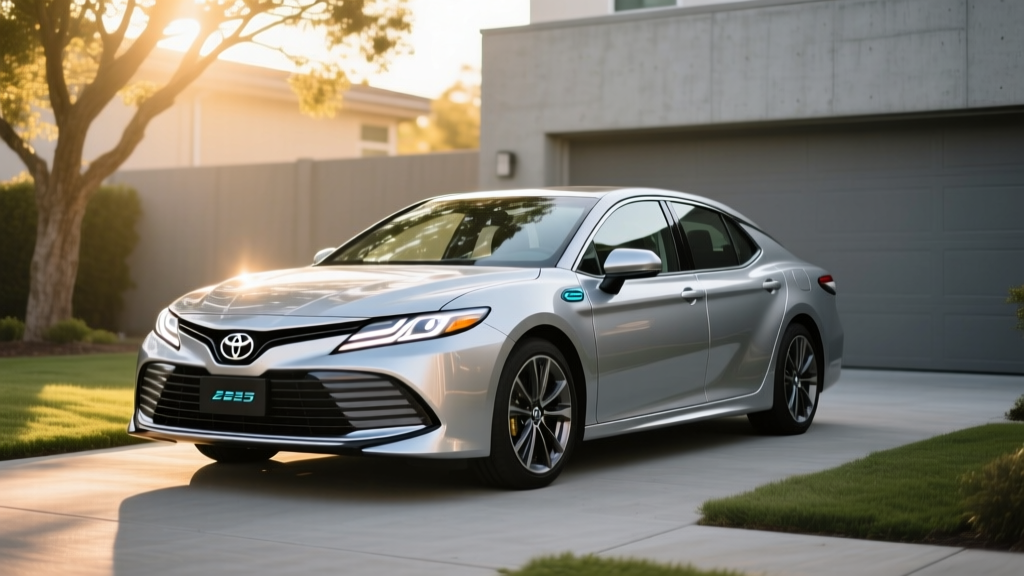
The 2025 Toyota Camry arrives with a powertrain shakeup that matters more than any styling refresh: every single trim is now a hybrid. Toyota dropped the four-cylinder gas-only option entirely, betting that the fifth-generation Toyota Hybrid System (THS 5) delivers the performance and efficiency buyers actually want. For a midsize sedan that has defined the hybrid segment for two decades, the 2025 Camry Hybrid isn't just an option anymore — it is the Camry.
This guide breaks down the real-world efficiency, powertrain specs, pricing, battery longevity, and how the Camry Hybrid stacks up against plug-in hybrids and full battery-electric vehicles for your next purchase.
2025 Camry Hybrid MPG: EPA Numbers and Real-World Results
The headline number for the 2025 Camry Hybrid is its EPA-estimated fuel economy, which varies by drivetrain. Front-wheel-drive (FWD) models achieve the highest ratings, while all-wheel-drive (AWD) trims carry a modest efficiency penalty due to the rear-mounted electric motor.
| Drivetrain | City MPG | Highway MPG | Combined MPG |
|---|---|---|---|
| FWD (LE, SE) | 53 | 50 | 51 |
| AWD (LE, SE, XLE, XSE) | 51 | 49 | 50 |
Source: EPA / fueleconomy.gov
Toyota hybrids consistently outperform their EPA city estimates in stop-and-go traffic, where regenerative braking and electric-motor assist do the heavy lifting. In mixed suburban driving, owners regularly report 48–55 MPG in FWD trims. Highway-only trips at 75+ mph tend to pull the average down to 42–46 MPG, since the gasoline engine carries more of the load at sustained speed. In cold weather (below 30°F), expect a 5–10% reduction as the engine runs more frequently to heat the cabin and warm the catalytic converter. Real-world combined driving for most owners settles around 46–52 MPG — competitive with or slightly above the EPA sticker.
Powertrain: Fifth-Gen Hybrid System With 225–232 HP
The 2025 Camry pairs a 2.5-liter four-cylinder engine operating on the Atkinson cycle with Toyota's fifth-generation hybrid transaxle. FWD models use two motor-generators (MG1 for starting/charging, MG2 for propulsion), while AWD models add a third motor on the rear axle for on-demand traction.
| Specification | FWD | AWD |
|---|---|---|
| Engine | 2.5L 4-cyl Atkinson cycle | |
| Engine Horsepower | 184 hp @ 5,700 rpm | |
| Combined Net Horsepower | 225 hp | 232 hp |
| Front Motor (MG2) Output | 100 kW (134 hp) | |
| Rear Motor Output (AWD only) | — | 30 kW (40 hp) |
| Hybrid Battery | Lithium-ion, ~1.1 kWh (nominal) | |
| Transmission | eCVT (planetary gearset) | |
| 0–60 mph (est.) | ~7.1 sec | ~6.8 sec |
The eCVT is not a belt-driven continuously variable transmission like those in some competitors. It uses a planetary gearset that blends engine and motor power with no fixed gear ratios and no rubber belt to wear. This design has proven exceptionally durable over millions of Toyota hybrid miles on the road.
HEV vs PHEV vs EV: Where Does the Camry Hybrid Fit?
The 2025 Camry is a conventional hybrid (HEV), not a plug-in hybrid. This distinction matters for buyers cross-shopping electrified vehicles. Here's how the three categories differ in practice:
| Feature | HEV (Camry Hybrid) | PHEV (e.g., Prius Prime) | BEV (e.g., Tesla Model 3) |
|---|---|---|---|
| Plug-in Required? | No — self-charging | Yes — for electric range | Yes — sole energy source |
| Electric-Only Range | ~1 mi at low speed | 35–44 mi typical | 250–360+ mi (EPA) |
| Gasoline Engine? | Yes (primary + assist) | Yes (backup after EV range) | No |
| Home Charging Needed? | No | Recommended (Level 2) | Essential |
| Fuel Cost per Mile | ~$0.07–0.09 | ~$0.03–0.08 (varies) | ~$0.03–0.05 (home) |
| Maintenance Burden | Low (no plug, simple battery) | Moderate (two systems) | Lowest (no engine) |
| Federal Tax Credit (§30D) | Not eligible | Up to $7,500* | Up to $7,500* |
* §30D credit eligibility depends on MSRP caps, buyer income limits, battery sourcing requirements, and point-of-sale transfer rules. See IRS guidelines for current-year details.
Choose the Camry Hybrid (HEV) if: You lack home charging access, drive a mix of city and highway, want zero behavior change from a gas car, and prioritize a low purchase price with proven reliability.
Choose a PHEV if: You have a garage or driveway for Level 2 charging, your daily commute is under 40 miles (covering most trips on electricity), but you still want gas-engine flexibility for road trips.
Choose a full BEV if: You have reliable home charging, want the lowest per-mile fuel cost, prefer minimal maintenance, and your typical trips fall within the vehicle's range or you're comfortable with DC fast charging on road trips.
2025 Camry Hybrid Pricing by Trim
Toyota simplified the 2025 Camry lineup to four trims, all hybrid. Pricing remains competitive within the midsize sedan segment, especially given the standard hybrid powertrain and included Toyota Safety Sense 3.0 suite.
| Trim | Drivetrain | Starting MSRP |
|---|---|---|
| LE | FWD | $28,700 |
| LE | AWD | $30,200 |
| SE | FWD | $30,990 |
| SE | AWD | $32,490 |
| XLE | FWD | $33,400 |
| XLE | AWD | $34,900 |
| XSE | FWD | $34,600 |
| XSE | AWD | $36,100 |
Source: Toyota.com — Destination charge additional. Prices subject to change.
Federal Tax Credit Eligibility
The 2025 Camry Hybrid does not qualify for the federal §30D Clean Vehicle Credit. That credit applies only to plug-in electric vehicles (PHEVs and BEVs) with sufficient battery capacity and compliant sourcing. As a conventional hybrid with a small self-charging battery, the Camry HEV falls outside §30D eligibility. Some states and utilities offer modest rebates for high-efficiency hybrids — check your local programs — but there is no federal purchase incentive for this specific model.
Battery Longevity, Warranty, and Replacement Cost
Battery durability is consistently the top concern among hybrid shoppers. The 2025 Camry uses a compact lithium-ion hybrid battery pack (approximately 1.1 kWh nominal capacity) that never fully charges or discharges — Toyota's battery management system keeps the state of charge between roughly 40% and 80%, which dramatically extends cycle life.
Coverage: 10 years / 150,000 miles (whichever comes first) for the hybrid battery and all hybrid-system components including the inverter, motor-generators, and eCVT.
What's covered: Defects in materials or workmanship, and capacity loss below a defined threshold that impairs vehicle operation.
Transferable? Yes — the hybrid warranty transfers to subsequent owners, which supports resale value.
Real-World Battery Lifespan
Toyota's hybrid battery track record spans over 25 years since the original Prius. Data from fleet operators, taxi services, and high-mileage owners consistently shows that Toyota hybrid batteries regularly last 150,000–200,000+ miles before any significant degradation. Many original batteries exceed the vehicle's useful life.
Battery Replacement Cost
If replacement is needed outside warranty, a new OEM hybrid battery for the Camry typically runs between $2,000 and $4,000 installed, depending on the model year and dealer. Refurbished and aftermarket options exist for $1,000–$2,000. For context, this is a fraction of BEV traction battery replacement costs ($8,000–$20,000+), because the Camry's hybrid battery is small and designed for power delivery, not energy storage.
Pros, Cons, and Ownership Verdict
Pros
- Class-leading 51 MPG combined (FWD) — among the most efficient non-plug-in vehicles sold in the U.S.
- No charging infrastructure required — fills up at any gas station in 3 minutes
- 225–232 hp provides confident merging and passing power
- Standard AWD availability across all trims
- 10-year/150,000-mile hybrid battery warranty
- Toyota Safety Sense 3.0 standard (pre-collision, lane trace, adaptive cruise, road sign assist)
- Strong resale value — Camry historically retains value well in the midsize segment
Cons
- No plug-in option — cannot drive on electric-only power for commutes
- No federal tax credit eligibility (unlike PHEV and BEV competitors)
- eCVT drone under hard acceleration (inherent to planetary gearset design)
- Small hybrid battery (~1.1 kWh) means no meaningful EV-only range
- Infotainment screen on LE trim is 8-inch (12.3-inch on SE and above)
- Rear seat space slightly tighter than some competitors due to battery packaging
5-Year Ownership Cost Snapshot
| Category | Estimated Cost | Notes |
|---|---|---|
| Purchase Price (MSRP) | $28,700 | Before dealer discounts or fees |
| Fuel (gasoline) | ~$4,200 | At 51 MPG combined, $2.85/gal avg, 15,000 mi/yr |
| Insurance | ~$7,500 | Varies significantly by driver and state |
| Maintenance | ~$2,200 | Oil changes, filters, tires, brakes (regen extends pad life) |
| Depreciation (est.) | ~$12,500 | Camry retains ~56% of value at 5 years (industry avg) |
| Total Estimated 5-Yr Cost | ~$55,100 | Including purchase; ~$26,400 operating cost only |
At 51 MPG combined and current fuel prices, the Camry Hybrid LE costs roughly $0.08 per mile in fuel — about 40% less than a comparable 30 MPG gas-only midsize sedan. That savings compounds to approximately $2,100 over five years of average driving.
Who Should Buy the 2025 Camry Hybrid?
The 2025 Camry Hybrid is the right call for buyers who want maximum fuel efficiency without changing their fueling habits. If you live in an apartment without charging access, regularly take road trips beyond EV range, or simply want the lowest-friction transition from a gas car, the Camry HEV delivers 50+ MPG with no plugs, no range calculations, and no cold-weather range anxiety.
It is not the right choice if you want to commute on electric power alone (look at the Prius Prime PHEV for 44 miles of EV range) or if you're ready to eliminate gasoline entirely (consider the Hyundai Ioniq 6 or Tesla Model 3 for full EV operation). But for the vast middle of the market — drivers who want a reliable, efficient, no-compromise sedan — the 2025 Camry Hybrid remains the benchmark.
Frequently Asked Questions
How many MPG does the 2025 Camry Hybrid actually get?
The EPA rates the FWD Camry Hybrid at 53 city / 50 highway / 51 combined MPG. AWD models are rated at 51/49/50. In real-world mixed driving, most owners report 46–52 MPG combined, with city driving often exceeding the EPA estimate thanks to regenerative braking.
Does the 2025 Camry Hybrid need to be plugged in?
No. The Camry Hybrid is a conventional hybrid (HEV) that charges its battery entirely through regenerative braking and the gasoline engine. There is no plug and no electric-only driving range to manage.
Is the Camry Hybrid reliable, and what does a battery replacement cost?
Toyota's hybrid system has over 25 years of proven reliability. The hybrid battery is covered by a 10-year/150,000-mile warranty. Out-of-warranty replacement costs $2,000–$4,000 for an OEM unit, though most batteries last well beyond 150,000 miles.
Does the 2025 Camry Hybrid qualify for any tax credit?
The Camry Hybrid does not qualify for the federal §30D Clean Vehicle Credit, which applies only to plug-in vehicles. Some state or utility programs may offer small efficiency rebates — check your local offerings.
How does the Camry Hybrid compare to the Prius or a PHEV sedan?
The Camry Hybrid offers more interior space, a more powerful engine (225 hp vs 194 hp in the Prius), and a traditional sedan driving experience. The Prius offers slightly higher MPG (57 combined) and a PHEV variant (Prius Prime) with 44 miles of electric-only range. If electric commuting matters, the Prius Prime is the stronger pick; if space and power matter more, the Camry wins.
Is AWD worth the MPG trade-off?
AWD costs you only 1 MPG combined (50 vs 51) and adds $1,500 to the MSRP. If you drive in rain, snow, or on gravel roads regularly, the traction benefit justifies the small efficiency and price penalty. For dry-climate highway commuters, FWD is the more economical choice.