For 2025, Toyota made a bold move: every single Camry is now a hybrid. The gasoline-only four-cylinder is gone, replaced entirely by the fifth-generation Toyota Hybrid System. The result is a midsize sedan that delivers luxury-car refinement with subcompact-car fuel economy. If you've been searching for a Toyota Camry 2025 hybrid luxury sedan that doesn't force you into plug-in life or full EV ownership, this is the most complete picture of what you're getting — and what you're giving up.
Below, we break down every trim's real-world MPG, the new hybrid powertrain, battery warranty specifics, pricing, tax-credit eligibility, and how the Camry Hybrid stacks up against PHEVs and full EVs in 2025.
The 2025 Camry Lineup: Every Trim Is a Hybrid
Toyota simplified the Camry lineup for 2025. You no longer choose between gas and hybrid — the decision is now about trim level, drivetrain (FWD vs. AWD), and how many features you want. All trims use the same 2.5-liter four-cylinder hybrid powertrain, but output varies slightly between front-wheel-drive and all-wheel-drive configurations.
| Spec | FWD Models | AWD Models |
|---|---|---|
| Combined Horsepower | 225 hp | 232 hp |
| Engine | 2.5L 4-cyl + 2 electric motors (3rd motor on AWD) | |
| Transmission | eCVT (electronically controlled continuously variable) | |
| EPA City MPG | 53 | 51 |
| EPA Highway MPG | 50 | 49 |
| EPA Combined MPG | 51 | 50 |
| Fuel Tank Capacity | 13.2 gallons | |
| Total Driving Range | ~673 miles | ~660 miles |
| 0–60 mph (est.) | ~7.2 sec | ~6.9 sec |
| Hybrid Battery | Lithium-ion, ~1.0 kWh (self-charging, no plug) | |
The AWD system adds a dedicated rear electric motor (40 hp) that engages automatically for traction — there's no mechanical driveshaft connecting the engine to the rear wheels. This is a meaningful advantage in snow-belt states without a significant fuel-economy penalty.
Fuel Economy: EPA Numbers and Real-World MPG
The headline figure is 51 MPG combined for FWD trims (LE, SE, XLE) and 50 MPG combined for AWD trims (SE, XLE, XSE). According to fueleconomy.gov, the 2025 Camry Hybrid LE FWD achieves 53 city / 50 highway / 51 combined — making it one of the most efficient non-plug-in midsize sedans on the market.
| Trim | Drivetrain | City | Highway | Combined |
|---|---|---|---|---|
| LE | FWD | 53 | 50 | 51 |
| SE | FWD | 53 | 50 | 51 |
| SE | AWD | 51 | 49 | 50 |
| XLE | FWD | 53 | 50 | 51 |
| XLE | AWD | 51 | 49 | 50 |
| XSE | AWD | 51 | 49 | 50 |
Cold weather reduces hybrid efficiency by roughly 5–10% due to increased engine runtime for cabin heat and reduced battery efficiency at low temperatures. In sub-freezing conditions, expect combined figures closer to 45–47 MPG until the powertrain reaches operating temperature.
HEV vs. PHEV vs. Full EV: Which Powertrain Fits You?
The 2025 Camry is a conventional hybrid (HEV) — it has no plug, no electric-only driving mode, and no external charging requirement. The small lithium-ion battery recharges through regenerative braking and the gasoline engine. This is fundamentally different from a plug-in hybrid (PHEV) or a battery-electric vehicle (BEV).
| Feature | HEV (Camry Hybrid) | PHEV (e.g., Prius Prime) | BEV (e.g., Tesla Model 3) |
|---|---|---|---|
| Plug-in charging? | No | Yes | Yes |
| Electric-only range | ~1 mile at low speed | 25–44 miles | 250–360+ miles |
| Total range | ~660–673 miles | ~400–450 miles | 250–360+ miles |
| Home charging needed? | No | Recommended (Level 2) | Essential (Level 2) |
| Federal tax credit (§30D)? | No | Up to $7,500 (if eligible) | Up to $7,500 (if eligible) |
| Maintenance | Oil changes + standard | Oil changes + standard | Minimal (no oil, fewer fluids) |
| Best for | No home charging, high-mileage commuters | Short commutes + road trips | Home charging + daily driving under 300 mi |
- You don't have access to home or workplace charging
- You drive 15,000+ miles/year and want minimal fuel cost without plug-in hassle
- You frequently take road trips exceeding 300 miles
- You want proven, low-risk hybrid reliability with no range anxiety
- Your daily commute is under 40 miles round-trip and you can charge at home
- You want electric-only daily driving but gas flexibility for longer trips
- You have reliable Level 2 home charging
- Your daily driving is under 250 miles and you rarely road-trip beyond Supercharger/DC fast-charger coverage
Powertrain Deep Dive: Fifth-Gen Toyota Hybrid System
The 2025 Camry uses Toyota's fifth-generation hybrid system, which is lighter, more compact, and more powerful than the fourth-gen setup in the previous Camry Hybrid. The 2.5-liter Dynamic Force four-cylinder engine produces 184 hp and 163 lb-ft of torque on its own, supplemented by a front electric motor contributing additional power for a combined system output of 225 hp (FWD) or 232 hp (AWD).
The eCVT transmission isn't a traditional belt-and-cone CVT — it uses a planetary gearset to seamlessly blend engine and motor power. The result is smooth, linear acceleration without the "rubber-band" feel that older CVTs suffered from. The AWD model adds a 40-hp rear electric motor that activates during acceleration from stop, slippery conditions, and cornering for improved stability.
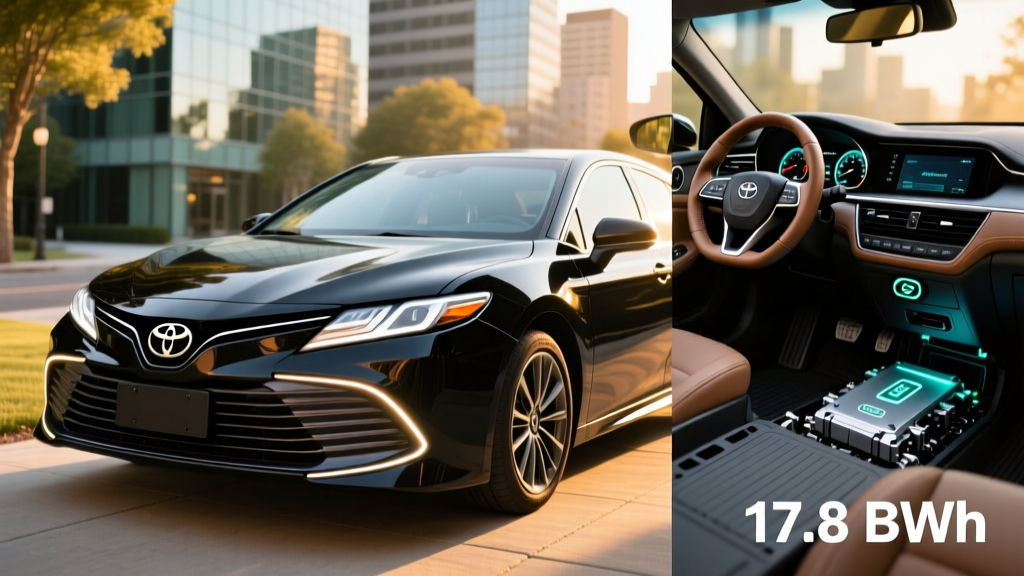
Toyota has moved to a lithium-ion hybrid battery for 2025, replacing the nickel-metal-hydride (NiMH) pack used in prior generations. The lithium-ion pack is smaller, lighter, and more energy-dense — roughly 1.0 kWh of capacity — and it enables more aggressive regenerative braking and electric-motor assist. This battery is not designed for plug-in charging or sustained electric-only driving; it functions as a buffer that smooths power delivery and captures braking energy.
Pricing, Trims, and Tax Credit Eligibility
The 2025 Camry Hybrid starts at a notably accessible price point for a midsize sedan with this level of standard equipment. Here's the trim-level breakdown:
| Trim | Drivetrain | MSRP (incl. destination) |
|---|---|---|
| LE | FWD | $29,495 |
| SE | FWD | $30,790 |
| SE | AWD | $32,190 |
| XLE | FWD | $33,495 |
| XLE | AWD | $34,895 |
| XSE | AWD | $35,495 |
Important luxury context: The XLE and XSE trims push the Camry into near-luxury territory with features like a 12.3-inch touchscreen, panoramic glass roof (XLE), heated and ventilated front seats, leather-trimmed interior, JBL premium audio, and Toyota's Safety Sense 3.0 suite. At $33,500–$35,500, the upper Camry Hybrid trims compete with entry-level luxury sedans but deliver far better fuel economy.
Hybrid Battery Warranty, Lifespan, and Replacement Cost
Hybrid battery longevity is the single most common concern among first-time hybrid buyers. Here's what Toyota provides and what real-world data shows:
- Coverage: 10 years / 150,000 miles (whichever comes first)
- Applies to: Hybrid battery pack, hybrid control module, inverter, and related hybrid-system components
- Transferable: Yes — warranty transfers to subsequent owners automatically
- Capacity threshold: Toyota covers defects and premature failure; there is no published minimum capacity-retention percentage (unlike EV batteries)
Real-world lifespan data: Toyota's hybrid battery packs have an excellent longevity track record. Based on data from Prius, Camry Hybrid, and RAV4 Hybrid fleets, most Toyota hybrid batteries last 150,000–200,000+ miles before needing replacement, and many outlast the vehicle itself. The switch to lithium-ion chemistry for 2025 should further improve longevity, as Li-ion cells degrade more slowly than the NiMH packs used in earlier models.
Replacement cost if out of warranty: A Toyota Camry Hybrid battery replacement currently runs $2,000–$4,000 depending on whether you choose a new OEM pack, a remanufactured unit, or an independent-shop refurbishment. Given that the battery is warranted for 10 years / 150,000 miles and typically lasts well beyond that, the risk of an out-of-pocket replacement during normal ownership is low.
Reliability, Safety, and Ownership Costs
Toyota's hybrid powertrains are among the most reliable in the industry. The eCVT has no clutch packs, belts, or torque converters to wear out — the planetary gearset is essentially bulletproof under normal use. Regenerative braking also reduces wear on the friction brake pads; many Camry Hybrid owners report original brake pads lasting 80,000–100,000 miles.
The 2025 Camry comes standard with Toyota Safety Sense 3.0, which includes:
- Pre-Collision System with Pedestrian Detection
- Lane Departure Alert with Steering Assist
- Lane Tracing Assist (centering in lane)
- Dynamic Radar Cruise Control (full-speed adaptive)
- Road Sign Assist
- Proactive Driving Assist (gentle braking when approaching slower vehicles or curves)
This is an SAE Level 2 driver-assistance system — the driver must remain attentive, keep hands on the wheel, and supervise the system at all times. It is not autonomous or "self-driving."
The 2025 Camry earned strong safety marks, with the previous-generation model achieving IIHS Top Safety Pick+ status. NHTSA ratings for the redesigned 2025 model can be checked at nhtsa.gov/ratings as they're published.
5-Year Estimated Cost of Ownership (Camry Hybrid XLE FWD):
| Category | Camry Hybrid XLE | Comparable Gas Sedan (est.) |
|---|---|---|
| Fuel (at $3.40/gal avg) | ~$5,000 | ~$8,800 |
| Maintenance | ~$2,800 | ~$3,400 |
| Insurance (avg) | ~$7,500 | ~$7,200 |
| Depreciation (est.) | ~$14,000 | ~$15,500 |
| Total (approx.) | ~$29,300 | ~$34,900 |
The Camry Hybrid saves an estimated $5,600 over 5 years compared to a conventional gas midsize sedan getting 30 MPG combined, driven primarily by fuel savings. Toyota hybrids also tend to hold resale value well due to strong reliability reputation and growing demand for efficient vehicles.
Pros, Cons, and Final Verdict
- 51 MPG combined — among the best of any midsize sedan
- No plug-in charging required — works with any lifestyle
- 660+ mile total range — one tank, two fill-ups per month for average drivers
- AWD available on SE, XLE, and XSE trims
- 10-year/150,000-mile hybrid battery warranty
- XLE/XSE trims deliver near-luxury features under $36K
- Standard Toyota Safety Sense 3.0 on every trim
- Strong predicted reliability and resale value
- No federal tax credit (HEV, not a plug-in)
- eCVT drones under hard acceleration (common hybrid trait)
- No electric-only driving mode for short trips
- Base LE trim interior feels budget-oriented for the segment
- AWD only available on SE, XLE, and XSE (not base LE)
- Rear seat headroom slightly reduced vs. prior generation
- No DC fast charging capability (not applicable — HEV)
The verdict: The 2025 Toyota Camry Hybrid is the default recommendation for buyers who want a refined, spacious, fuel-efficient sedan without the infrastructure demands of a plug-in vehicle. If you can charge at home and your commute is short, a PHEV like the Prius Prime might save more fuel. If you're ready for full electric, a Model 3 or Ioniq 6 eliminates gas entirely. But for the vast middle ground — drivers who want set-it-and-forget-it efficiency with no lifestyle changes — the Camry Hybrid is the strongest option in its class.
Frequently Asked Questions
How many MPG does the 2025 Toyota Camry Hybrid get?
The FWD trims (LE, SE, XLE) achieve an EPA-estimated 53 city / 50 highway / 51 combined MPG. AWD trims (SE, XLE, XSE) get 51 city / 49 highway / 50 combined. In real-world city driving, many owners report exceeding the EPA city figure thanks to regenerative braking. Highway driving at speeds above 70 mph typically yields 44–47 MPG.
Does the 2025 Camry Hybrid need to be plugged in?
No. The Camry Hybrid is a conventional hybrid (HEV), not a plug-in hybrid. The small lithium-ion battery charges itself through regenerative braking and the gasoline engine. You never plug it in — you simply fill it with gasoline like any other car.
Does the 2025 Camry Hybrid qualify for any federal tax credit?
No. The federal §30D Clean Vehicle Credit applies only to plug-in electric vehicles (PHEVs and BEVs) with a battery capacity of at least 7 kWh. The Camry Hybrid's ~1.0 kWh battery and lack of plug-in capability make it ineligible. Check the IRS website for the current list of qualifying vehicles. Some state or local utility incentives may apply to hybrids — check your jurisdiction.
Is the Camry Hybrid reliable, and what does battery replacement cost?
Toyota's hybrid systems are among the most reliable powertrains on the road, with decades of proven data from millions of Prius, Camry, and RAV4 Hybrid vehicles. The hybrid battery is warrantied for 10 years / 150,000 miles and typically lasts 150,000–200,000+ miles. If replacement is needed out of warranty, expect to pay $2,000–$4,000 depending on OEM vs. remanufactured parts.
Hybrid vs. PHEV vs. EV — which should I choose?
Choose the Camry Hybrid (HEV) if you lack home charging, drive long distances frequently, or want zero lifestyle changes. Choose a PHEV (like the Toyota Prius Prime or RAV4 Prime) if you have home charging and a commute under 40 miles — you'll drive electric daily and use gas only on longer trips. Choose a full BEV (like the Tesla Model 3 or Hyundai Ioniq 6) if you have reliable Level 2 home charging, drive under 250 miles daily, and want to eliminate gasoline entirely.
How fast is the 2025 Camry Hybrid?
The FWD model produces 225 combined horsepower and reaches 0–60 mph in approximately 7.2 seconds. The AWD model, with 232 hp and the added rear electric motor, cuts that to roughly 6.9 seconds. It's not a sports sedan, but it's quicker than most hybrid competitors and provides confident highway merging.
Is AWD worth it on the Camry Hybrid?
If you live in a region with frequent rain, snow, or icy roads, the electronic AWD system is a worthwhile upgrade for roughly $1,400 additional. It costs you only 1 MPG combined versus FWD and adds a dedicated rear electric motor for traction without the weight or efficiency penalty of a mechanical AWD system.