Quick Verdict: A 570-Mile Range Machine
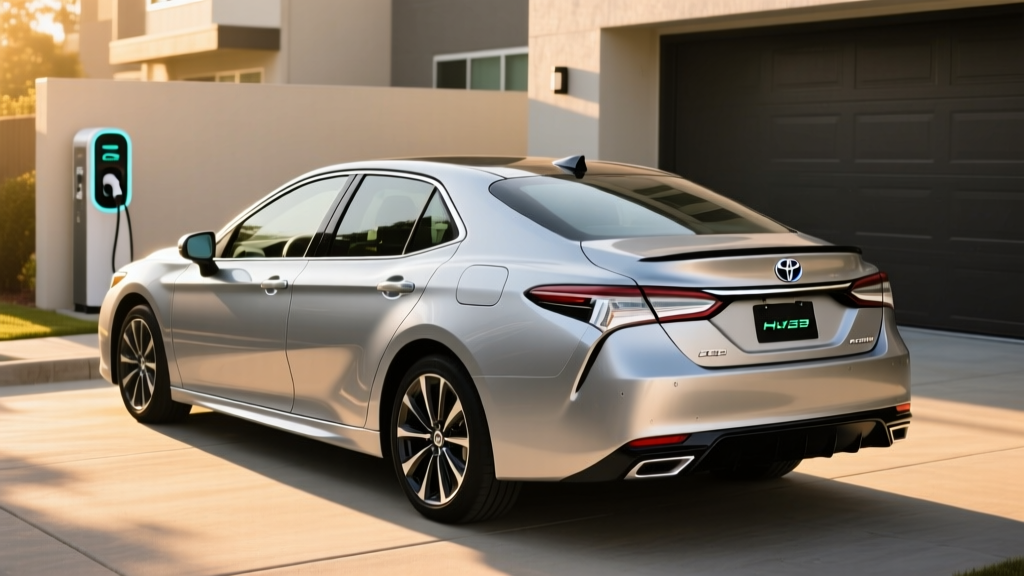
The 2025 Toyota Camry Hybrid is now exclusively a hybrid — Toyota dropped the gas-only four-cylinder entirely for this generation. That decision pays dividends at the pump. With an EPA-rated 51 MPG combined (FWD) and a 13.2-gallon fuel tank, the Camry Hybrid delivers roughly 570–620 miles of real-world driving between fill-ups. That's Los Angeles to San Francisco on a single tank, with fuel to spare.
This guide covers the exact fuel tank capacity by trim, EPA and real-world MPG data, the hybrid powertrain specs, ownership economics, and how the Camry Hybrid stacks up against plug-in hybrids and full EVs for different drivers.
| Spec | FWD Trims | AWD Trims |
|---|---|---|
| Fuel Tank Capacity | 13.2 gal (50.0 L) | 13.2 gal (50.0 L) |
| EPA City / Highway / Combined | 53 / 50 / 51 MPG | 51 / 49 / 50 MPG |
| Estimated Total Range | ~673 mi (EPA) | ~660 mi (EPA) |
| Combined Horsepower | 225 hp | 232 hp |
| Engine | 2.5L 4-cyl + electric motor | 2.5L 4-cyl + 2 motors |
| Hybrid Battery | Lithium-ion (NiMH on prior gen) | |
| Starting MSRP | ~$29,495 (LE FWD) | |
| Hybrid Battery Warranty | 10 years / 150,000 miles | |
2025 Toyota Camry Hybrid Fuel Tank Capacity by Trim
Every 2025 Camry Hybrid — whether LE, SE, XLE, or XSE, FWD or AWD — shares the same 13.2-gallon (50.0-liter) fuel tank. Toyota standardized the tank size across the lineup, so your range calculation depends only on which drivetrain you choose.
This 13.2-gallon capacity is slightly smaller than the outgoing gas-only Camry's 15.8-gallon tank, but the hybrid's dramatically higher MPG more than compensates. The old gas Camry (32 MPG combined) delivered roughly 505 miles per tank. The 2025 Camry Hybrid FWD achieves an EPA-estimated 673 miles — a 33% improvement in total range despite holding 2.6 fewer gallons.
EPA MPG vs. Real-World Efficiency
| Drivetrain | City | Highway | Combined |
|---|---|---|---|
| FWD (LE) | 53 MPG | 50 MPG | 51 MPG |
| AWD (LE, SE, XLE, XSE) | 51 MPG | 49 MPG | 50 MPG |
Source: EPA Fuel Economy Guide
Real-World MPG: Where Hybrids Surprise
Toyota's hybrid system excels in city driving, where regenerative braking and electric-motor assist reduce engine load. In real-world city commuting, many Camry Hybrid owners report 54–58 MPG — consistently exceeding the EPA city estimate. This is the inverse of gas cars, which always rate worse in the city.
Highway driving tells a different story. At sustained 70–80 MPH speeds, the 2.5L engine does most of the work with less regenerative benefit. Expect real-world highway MPG in the 44–48 MPG range, which is below the EPA highway estimate of 50 MPG. Cold weather (below 40°F) further reduces efficiency by 5–10% as the engine runs more frequently to maintain cabin heat and battery temperature.
For a mixed commute (60% city, 40% highway), a realistic year-round average is 48–52 MPG for FWD models, translating to roughly 630–680 miles per 13.2-gallon tank under normal conditions.
The Hybrid Powertrain: How It Works
The 2025 Camry uses Toyota's fifth-generation hybrid system. Understanding the difference between this car and a plug-in hybrid is essential before you buy.
Conventional Hybrid (HEV) vs. Plug-In Hybrid (PHEV)
| Feature | Camry Hybrid (HEV) | Plug-In Hybrid (e.g., Prius Prime) |
|---|---|---|
| Plug-in charging | No — charges via engine + regen | Yes — Level 1/2 AC charging |
| Electric-only range | ~1 mile at low speed | 35–44 miles typical |
| Battery size | ~1.1 kWh (small) | 13.6 kWh (large) |
| Fuel tank | 13.2 gal | Varies (often smaller) |
| Federal tax credit (§30D) | Not eligible | Up to $7,500 (if eligible) |
| Driving experience | Seamless — no behavior change | Needs charging to maximize EV miles |
The 2025 Camry Hybrid is a conventional hybrid (HEV). You never plug it in. The small lithium-ion traction battery charges through regenerative braking and the gasoline engine. The electric motor assists during acceleration and can propel the car solo at very low speeds (parking lots, stop-and-go traffic), but this is not meaningful "electric-only range" — it's an efficiency assist.
Powertrain output: The 2.5-liter Dynamic Force four-cylinder engine produces 184 hp on its own. Combined with the electric motor(s), the FWD system delivers 225 net horsepower, while the AWD system — which adds a rear electric motor — produces 232 net horsepower. Both use an electronically controlled CVT (eCVT) that Toyota calls the Hybrid Transaxle.
The AWD system is worth noting: it's an electronic on-demand system with no mechanical driveshaft. The rear motor engages only when slip is detected or during hard acceleration, minimizing the efficiency penalty. The AWD penalty is just 1 MPG combined compared to FWD.
Pricing, Trims, and Tax Credit Eligibility
The 2025 Camry Hybrid starts at approximately $29,495 for the LE FWD trim (including destination). Here's the approximate trim pricing:
- LE FWD: ~$29,495
- LE AWD: ~$30,995
- SE FWD: ~$31,995
- SE AWD: ~$33,495
- XLE FWD: ~$34,495
- XLE AWD: ~$35,995
- XSE AWD: ~$36,495
Does the Camry Hybrid Qualify for a Federal Tax Credit?
No. The Camry Hybrid is a conventional hybrid (HEV), not a plug-in hybrid. The IRS §30D Clean Vehicle Credit applies only to plug-in electric vehicles (BEVs and PHEVs) with sufficient battery capacity. The Camry Hybrid's ~1.1 kWh battery does not meet the minimum 4 kWh threshold.
However, the Camry Hybrid's lower purchase price — roughly $10,000–$15,000 less than a comparable EV after the credit — means the total cost of ownership can be competitive without any incentive. Some states offer small rebates for conventional hybrids; check your state energy office for current programs.
Battery Longevity, Warranty, and Replacement Cost
Hybrid Battery Warranty
Coverage: 10 years or 150,000 miles (whichever comes first) in all 50 states.
What's covered: Defects and capacity loss below a specified threshold (typically ~60–70% of original capacity). Toyota's hybrid battery warranty has been 10/150k since the 2020 model year.
How Long Do Camry Hybrid Batteries Last?
Toyota's hybrid batteries are among the most proven in the industry. The Prius — which uses a nearly identical hybrid architecture — has demonstrated battery lifespans of 150,000–200,000+ miles in real-world taxi and fleet use. The Camry Hybrid benefits from the same conservative battery management: the system never fully charges or fully depletes the pack, keeping it in a narrow state-of-charge window (roughly 40–80%) that minimizes degradation.
The 2025 model uses a lithium-ion hybrid battery (previous generations used nickel-metal hydride). Li-ion packs in Toyota's hybrid system have shown excellent longevity in the Prius and RAV4 Hybrid, with failure rates well below 2% within the warranty period based on industry fleet data.
Battery Replacement Cost
If the hybrid battery fails outside warranty, a new OEM replacement from Toyota typically costs $2,000–$4,000 including labor at a dealership. Independent hybrid specialists often offer refurbished or reconditioned packs for $1,000–$2,000. This is dramatically less than full EV battery replacements ($8,000–$20,000+), because the Camry's hybrid battery is small (~1.1 kWh) and modular.
For most owners who drive 12,000–15,000 miles per year, the battery will outlast the car's economic life. The 10-year/150,000-mile warranty covers the period when most owners hold the vehicle.
Total Cost of Ownership: Camry Hybrid vs. Gas vs. EV
Here's a 5-year ownership cost estimate for a driver covering 15,000 miles per year, using national averages:
| Cost Factor | Camry Hybrid (51 MPG) | Gas Sedan (30 MPG) | EV (4 mi/kWh) |
|---|---|---|---|
| Purchase Price (base) | $29,495 | $26,000 | $38,000 |
| Federal Tax Credit | $0 | $0 | Up to $7,500* |
| Effective Purchase | $29,495 | $26,000 | $30,500 |
| Fuel/Energy (5 yrs) | ~$4,600 | ~$7,800 | ~$2,800 (home) |
| Maintenance (5 yrs) | ~$2,200 | ~$3,500 | ~$1,500 |
| Insurance (5 yrs avg) | ~$7,500 | ~$7,000 | ~$8,500 |
| Total 5-Yr Cost | ~$43,795 | ~$44,300 | ~$43,300 |
*EV tax credit subject to IRS §30D income, MSRP, and battery-sourcing requirements. Fuel costs based on $3.15/gal gas, $0.15/kWh electricity. Actual costs vary by region, driving pattern, and trim.
The Camry Hybrid essentially matches the EV on 5-year cost while eliminating charging logistics entirely. The gas sedan costs more in fuel and maintenance despite a lower sticker price.
Who Should Choose the Camry Hybrid?
Choose the Camry Hybrid If:
- You want 50+ MPG without changing your fueling habits
- You drive a mix of city and highway (especially city-heavy commutes)
- You don't have access to home Level 2 charging
- You want a proven, reliable powertrain with a 10-year battery warranty
- You need 600+ miles of range for long road trips without stops
- You want a mid-size sedan under $35,000
Consider a PHEV or Full EV If:
- You have home charging and a short commute (PHEV can do 35–44 mi electric-only)
- You want zero tailpipe emissions on daily drives (BEV) or most daily drives (PHEV)
- You want to qualify for the $7,500 federal tax credit (§30D eligible EVs/PHEVs)
- You want instant torque and a quieter, single-speed driving experience
- Your state offers additional EV/PHEV rebates (e.g., California, Colorado, New York)
Hybrid vs. PHEV vs. EV — The Decision Framework
No home charging access? The Camry Hybrid is your best option. PHEVs lose their efficiency advantage if you never plug in (they become heavier, less efficient hybrids). EVs require reliable charging access.
Home charging + short commute (<40 miles)? A PHEV like the Toyota Prius Prime (44 miles electric range) lets you commute on electricity and take road trips on gas. You'll use almost no fuel on weekdays.
Home charging + want lowest operating cost? A full BEV (Tesla Model 3, Hyundai Ioniq 6) costs 3–5 cents per mile on home electricity vs. ~6 cents per mile in the Camry Hybrid. But the EV costs $8,000–$15,000 more upfront before credits.
Frequently Asked Questions
How many gallons does the 2025 Toyota Camry Hybrid fuel tank hold?
Every 2025 Camry Hybrid trim has a 13.2-gallon (50.0-liter) fuel tank, regardless of FWD or AWD configuration.
How many MPG does the 2025 Camry Hybrid get?
The FWD model is EPA-rated at 53 city / 50 highway / 51 combined MPG. The AWD model rates at 51 / 49 / 50 MPG. In real-world city driving, owners frequently report 54–58 MPG. Highway driving at 75+ MPH typically yields 44–48 MPG.
How far can the Camry Hybrid go on a full tank?
Using the EPA combined estimate of 51 MPG and the 13.2-gallon tank, the theoretical range is approximately 673 miles (FWD). In mixed real-world driving at ~49 MPG, expect about 645 miles before the low-fuel warning. On a pure highway trip at ~46 MPG, that drops to roughly 607 miles.
Is the 2025 Camry Hybrid a plug-in hybrid?
No. The Camry Hybrid is a conventional hybrid (HEV). It does not plug in. The battery charges through regenerative braking and the gasoline engine. Toyota does not currently offer a Camry PHEV in the US market. If you want a Toyota plug-in hybrid, look at the Prius Prime or RAV4 Prime.
Is the Camry Hybrid battery reliable and what does replacement cost?
Toyota's hybrid batteries are among the most reliable in the industry, with typical lifespans exceeding 150,000 miles. The battery is warranted for 10 years / 150,000 miles. Out-of-warranty replacement costs $2,000–$4,000 for a new OEM pack, or $1,000–$2,000 for a refurbished unit from an independent hybrid specialist.
Does the Camry Hybrid qualify for any federal tax credit?
No. The IRS §30D Clean Vehicle Credit requires a plug-in vehicle with at least 4 kWh of battery capacity. The Camry Hybrid's ~1.1 kWh battery does not qualify. Check your state's energy office for any local hybrid incentives, which vary by jurisdiction.
Is the Camry Hybrid AWD system worth the 1 MPG penalty?
If you regularly drive in snow, rain, or on loose surfaces, the electronic AWD system provides meaningful traction benefits for a negligible 1 MPG combined penalty. It's a $1,500 upcharge across trims. For dry-climate drivers who rarely encounter slippery conditions, the FWD model's extra MPG and lower price make it the better value.