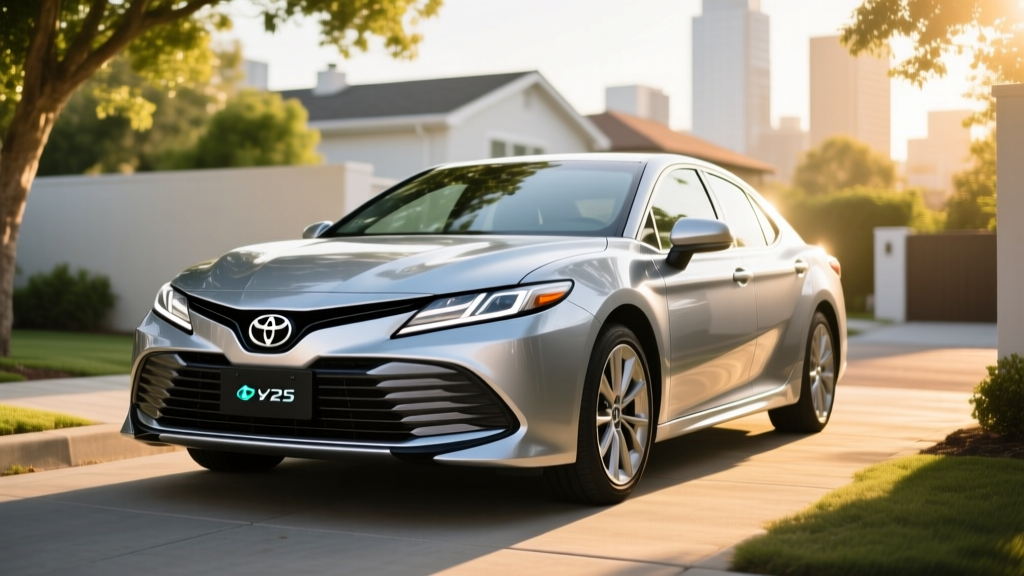
The 2025 Camry Goes All-Hybrid: What Changed Under the Hood
For 2025, Toyota eliminated the gas-only Camry entirely. Every model now ships with the fifth-generation Toyota Hybrid System (THS5), pairing a 2.5-liter four-cylinder engine with electric motors and a lithium-ion traction battery. This isn't a mild update — it's a complete powertrain consolidation that positions the Camry as one of the most efficient midsize sedans available without a plug.
If you're researching the 2025 Toyota Camry hybrid drivetrain, you're likely weighing fuel savings against the higher upfront cost of electrification, or comparing it against plug-in hybrids and full EVs. This guide breaks down the exact specs, real-world MPG data, warranty coverage, and ownership economics you need to decide.
Powertrain Specs: 221 to 232 Horsepower, FWD or AWD
The 2025 Camry hybrid drivetrain uses Toyota's latest parallel hybrid architecture. Here's exactly what's under the hood:
| Specification | FWD Models | AWD Models |
|---|---|---|
| Engine | 2.5L 4-cyl (184 hp, 163 lb-ft) | 2.5L 4-cyl (184 hp, 163 lb-ft) |
| Front Electric Motor | 100 kW (134 hp) | 100 kW (134 hp) |
| Rear Electric Motor | — | 40 kW (54 hp) |
| Combined System Output | 225 hp | 232 hp |
| Transmission | eCVT | eCVT |
| Hybrid Battery | 1.0 kWh lithium-ion | 1.0 kWh lithium-ion |
| 0-60 mph | ~7.2 sec | ~6.8 sec |
| Drivetrain Type | HEV (no plug-in) | HEV (no plug-in) |
The eCVT is not a belt-driven continuously variable transmission like you'd find in older hybrids. It's a planetary gearset that blends engine and motor torque seamlessly — no rubber-band sensation, no shifting lag. The AWD system uses the rear electric motor exclusively (no mechanical driveshaft), engaging only when traction is needed or during hard acceleration.
Fuel Economy: EPA MPG and Real-World Numbers
The headline number for the 2025 Camry hybrid is its EPA-estimated fuel economy. Here's the full breakdown by trim and drivetrain, sourced from fueleconomy.gov:
| Trim / Drivetrain | City MPG | Highway MPG | Combined MPG |
|---|---|---|---|
| LE FWD | 53 | 50 | 51 |
| SE FWD | 48 | 47 | 47 |
| XLE FWD | 48 | 47 | 47 |
| SE AWD | 46 | 46 | 46 |
| XLE AWD | 46 | 46 | 46 |
The LE trim achieves the highest rating (51 combined) thanks to lighter weight, smaller 16-inch wheels, and lower rolling-resistance tires. Moving to SE or XLE trims adds weight and larger 18- or 19-inch wheels, dropping the combined figure to 47 MPG. AWD costs you roughly 1 MPG across the board.
Hybrid sedans like the Camry often exceed their EPA city ratings in stop-and-go driving because regenerative braking recaptures energy that gas cars waste as heat. Expect 50-55 MPG in city commuting on the LE trim. Highway cruising at 75+ mph will net closer to 42-45 MPG, as aerodynamic drag dominates and the engine runs more frequently. In cold weather (below 35°F), expect a 10-15% drop as the engine runs longer to warm the cabin and maintain battery temperature. Over a 15,000-mile year at $3.50/gallon, the LE trim's 51 MPG combined translates to roughly $1,030 in fuel — about $860 less than a comparable 30-MPG gas sedan.
HEV vs PHEV vs EV: Which Powertrain Fits You?
The 2025 Camry is a conventional hybrid (HEV). It does not plug in, has no electric-only range, and cannot drive on battery power alone for meaningful distances. If you're cross-shopping, here's how the three electrified options compare:
| Factor | HEV (Camry Hybrid) | PHEV (e.g., Prius Prime) | Full EV (e.g., Tesla Model 3) |
|---|---|---|---|
| Plug-in Required? | No — gas only | Yes, for max benefit | Yes, mandatory |
| Electric-Only Range | ~1 mi at low speed | 35-44 mi typical | 250-350+ mi |
| Home Charging Needed? | No | Recommended (120V or 240V) | Yes (240V Level 2 ideal) |
| Fuel Cost (15k mi/yr) | ~$1,030 | ~$600-800 (mix) | ~$450-650 (electricity) |
| Federal Tax Credit | Not eligible | Up to $7,500 (§30D) | Up to $7,500 (§30D) |
| Best For | No home charging, high mileage | Short commute + home charging | Home charging, low road-trip frequency |
- You don't have access to home or workplace charging
- You drive 15,000+ miles/year and want minimal fuel cost without lifestyle change
- You want a proven, low-complexity powertrain with no plug-in hassle
- Upfront price matters — the Camry LE Hybrid starts at $28,400, thousands less than a PHEV or EV
- You have Level 2 home charging and a commute under 40 miles
- You want to drive mostly on electricity and qualify for the federal tax credit
- You want one-pedal driving and instant torque
Tax Credit Eligibility: The Camry Hybrid Does NOT Qualify
This is a common point of confusion. The IRS §30D federal tax credit applies only to plug-in electric vehicles — battery-electric (BEV) and plug-in hybrid (PHEV) models that meet battery capacity, critical-mineral sourcing, MSRP, and buyer income thresholds.
Because the 2025 Camry Hybrid is a conventional HEV with no plug-in capability and a battery under 1 kWh, it does not qualify for the $7,500 federal credit or the point-of-sale transfer. There is currently no federal incentive for conventional hybrids.
Some states offer their own hybrid incentives (California's CVRP previously included hybrids, but current funding focuses on BEVs and PHEVs). Check your state energy office or DMV for any active programs — but plan your purchase assuming no incentive.
Pricing: What the 2025 Camry Hybrid Costs by Trim
MSRP figures (destination included) for the 2025 model year:
| Trim | FWD MSRP | AWD MSRP |
|---|---|---|
| LE | $28,400 | $29,950 |
| SE | $30,440 | $31,990 |
| XLE | $33,545 | $35,095 |
Compared to the outgoing 2024 gas-only Camry LE (~$26,420), the hybrid carries a roughly $2,000 premium. At 51 vs 32 combined MPG and $3.50/gallon gas, a driver covering 15,000 miles/year saves about $860 annually — recouping the premium in roughly 2.3 years. If you plan to own the car 5+ years, the hybrid is the clear economic winner.
Hybrid Battery Warranty and Long-Term Reliability
The traction battery is the single biggest concern for hybrid buyers. Here's what Toyota covers:
- Hybrid Battery: 10 years / 150,000 miles (whichever comes first)
- Hybrid System Components: 8 years / 100,000 miles (inverter, motors, control module)
- Powertrain: 5 years / 60,000 miles
- Basic Bumper-to-Bumper: 3 years / 36,000 miles
Toyota's 10-year/150,000-mile hybrid battery warranty is among the strongest in the industry. The lithium-ion pack in the 2025 Camry is small (~1.0 kWh) and never deeply discharged — the hybrid system keeps it between roughly 40-80% state of charge at all times, which dramatically reduces degradation.
Real-world longevity data: Toyota has been building Camry Hybrids since 2007. Fleet data and owner reports consistently show the hybrid batteries lasting 150,000-200,000+ miles before significant capacity loss. The 5th-generation system uses a more energy-dense lithium-ion pack (replacing the older nickel-metal hydride), which runs cooler and degrades more slowly.
Battery replacement cost: If the hybrid battery does fail outside warranty, a replacement from Toyota currently runs $2,000-$4,000 including labor. Independent hybrid specialists can often refurbish or replace individual modules for $1,000-$2,000. Given the 10-year warranty and proven longevity, premature battery failure is rare.
Driving Impressions and Practical Ownership Notes
The 2025 Camry hybrid drivetrain prioritizes smoothness over sportiness. Off the line, the electric motor provides immediate torque (the engine doesn't need to build RPM), so city acceleration feels brisk and responsive. The eCVT keeps the engine in its optimal efficiency band, which means you'll hear a steady drone under hard acceleration — but it's quieter and less intrusive than previous generations.
The AWD system is transparent. You won't feel the rear motor engage; it simply adds grip in rain, snow, or during aggressive cornering. There's no fuel-economy penalty in normal driving because the rear motor freewheels when not needed.
Cargo and interior: The hybrid battery sits under the rear seat, so trunk space is identical to the previous gas Camry at 15.1 cu ft. No compromises there.
Pros
- 51 MPG combined on LE trim — class-leading for a midsize sedan
- No plug-in required; works with existing gas-station infrastructure
- 10-year/150,000-mile hybrid battery warranty
- AWD available without significant MPG penalty
- Proven reliability from 17+ years of Toyota hybrid engineering
- Low annual fuel cost (~$1,030 at 15k miles/year)
Cons
- No federal tax credit eligibility (HEV, not PHEV/BEV)
- ~$2,000 premium over the outgoing gas-only model
- eCVT drone under hard acceleration
- No electric-only driving mode for neighborhood/zero-emission zones
- AWD limited to SE and XLE trims (not available on base LE in some configs)
Frequently Asked Questions
How many MPG does the 2025 Toyota Camry Hybrid get?
The FWD LE trim achieves an EPA-estimated 53 city / 50 highway / 51 combined MPG. SE and XLE FWD trims rate at 48/47/47 MPG. AWD models drop to 46 combined. In real-world city driving, many owners report exceeding the EPA city figure thanks to regenerative braking. Highway cruising at 75+ mph typically yields 42-45 MPG.
Is the 2025 Camry Hybrid a plug-in?
No. The 2025 Camry Hybrid is a conventional hybrid (HEV). You never plug it in — the battery recharges through regenerative braking and the gasoline engine. If you want plug-in capability with electric-only range, look at the Toyota Prius Prime (PHEV, 44 mi electric-only) or a full EV.
Does the 2025 Camry Hybrid qualify for any tax credit?
No. The IRS §30D federal tax credit applies only to plug-in vehicles (BEVs and PHEVs). Conventional hybrids like the Camry are not eligible. Check your state for any local hybrid incentives, but plan your budget assuming no credit.
How long will the Camry Hybrid battery last, and what does replacement cost?
Toyota warranties the hybrid battery for 10 years or 150,000 miles. Real-world data from previous-generation Camry Hybrids shows batteries routinely lasting 150,000-200,000+ miles. If replacement is needed outside warranty, expect $2,000-$4,000 from a Toyota dealer or $1,000-$2,000 from an independent hybrid specialist for module refurbishment.
Should I buy the Camry Hybrid, a PHEV, or a full EV?
Choose the Camry Hybrid if you lack home charging access, drive high annual miles, and want maximum simplicity with no plug-in routine. Choose a PHEV (like the Prius Prime) if you have home charging and a commute under 40 miles — you'll drive mostly on electricity while keeping a gas backup. Choose a full EV if you have reliable Level 2 home charging, want zero tailpipe emissions, and can plan around DC fast charging for road trips.
Is the Camry Hybrid AWD system good in snow?
Yes. The electronic AWD uses a dedicated 40 kW rear motor that engages automatically when the front wheels slip. It's not a heavy-duty off-road system, but for snow, rain, and light gravel, it provides confident traction. There's no mechanical driveshaft — the system adds minimal weight and doesn't hurt fuel economy in dry conditions.
What is the total range of the 2025 Camry Hybrid?
With a 12.7-gallon fuel tank and 51 combined MPG (LE trim), the Camry Hybrid can travel approximately 647 miles between fill-ups. Real-world range on a tank typically falls between 550-620 miles depending on driving style and conditions.