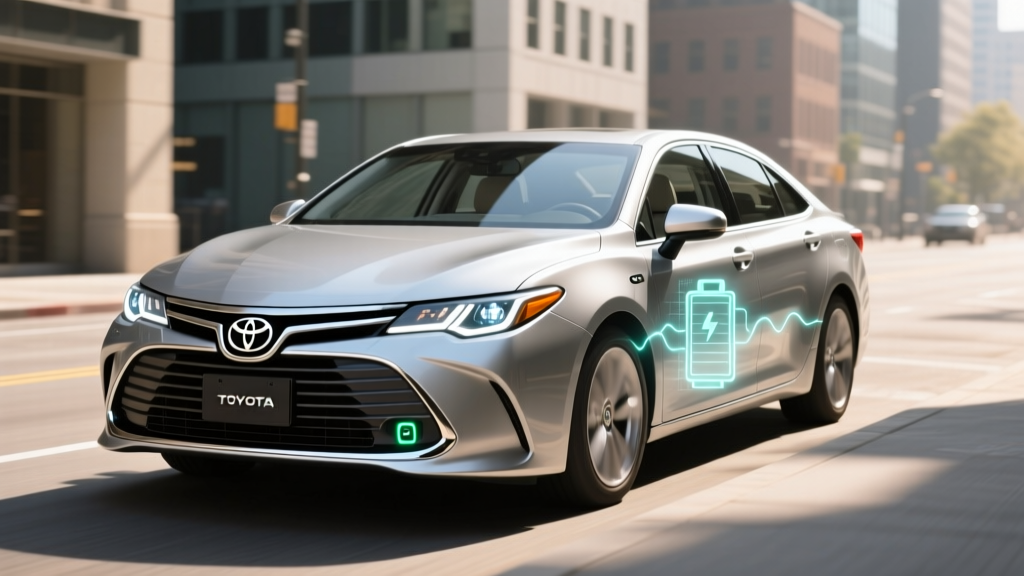
The 2025 Toyota Camry is now exclusively a hybrid. Toyota dropped the four-cylinder gas engine entirely, betting that its fifth-generation hybrid system delivers enough efficiency, power, and refinement to satisfy midsize-sedan buyers without a conventional alternative. For those who need all-weather traction, the 2025 Toyota Camry Hybrid AWD adds an independent rear electric motor, making it one of the few all-wheel-drive hybrids in its class that doesn't require a plug.
This guide breaks down the AWD powertrain, real-world fuel economy, trim pricing, warranty coverage, and how the Camry Hybrid stacks up against plug-in hybrids and full EVs for different driving patterns.
HEV vs PHEV: Where the Camry Hybrid Fits
Before diving into specs, it's worth clarifying what the Camry Hybrid is—and isn't. The Camry Hybrid is a conventional hybrid electric vehicle (HEV). It has a small battery (roughly 1.0 kWh usable) that charges through regenerative braking and the gasoline engine. You never plug it in. It cannot drive on electric power alone for meaningful distances—only at very low speeds for short bursts, such as creeping through a parking lot.
A plug-in hybrid (PHEV), like the Toyota RAV4 Prime or Hyundai Tucson PHEV, carries a much larger battery (typically 15–20 kWh), can travel 25–42 miles on electricity alone, and must be plugged in to realize its efficiency advantage. The Camry lineup does not currently include a PHEV variant in the U.S. market.
| Feature | Camry Hybrid (HEV) | Typical Midsize PHEV |
|---|---|---|
| Plug-in required? | No | Yes (for EV range) |
| Battery size | ~1.0 kWh | 15–20 kWh |
| Electric-only range | N/A (low-speed assist only) | 25–42 miles |
| Home charging needed? | No | Yes (Level 1 or 2) |
| Federal tax credit (§30D) | Not eligible | Up to $7,500 (if eligible) |
| Best for | No home charging, simplicity | Short commutes with home plug |
Powertrain: How the AWD System Works
The 2025 Camry Hybrid AWD pairs a 2.5-liter four-cylinder engine with Toyota's fifth-generation hybrid transaxle up front and a separate rear-mounted electric motor (40 hp / 90 lb-ft) that activates the rear axle when additional traction is needed. There is no mechanical driveshaft connecting the engine to the rear wheels—the AWD system is entirely electronic, engaging the rear motor during acceleration, slippery conditions, or when the front wheels lose grip.
Combined system output is 232 horsepower for AWD models (versus 225 hp for the front-wheel-drive variant). The AWD system adds approximately 165 pounds to the curb weight compared to FWD trims.
| Specification | Value |
|---|---|
| Engine | 2.5L 4-cylinder + hybrid system |
| Combined horsepower (AWD) | 232 hp |
| Front motor output | 100 kW (134 hp) |
| Rear motor output (AWD) | 30 kW (40 hp) |
| Transmission | eCVT (electronically controlled) |
| Drivetrain | Electronic on-demand AWD |
| Hybrid battery | Lithium-ion, ~1.0 kWh usable |
| 0–60 mph (est.) | ~7.1 seconds |
| Curb weight (AWD) | ~3,630 lbs |
Fuel Economy: EPA Ratings and Real-World MPG
The 2025 Camry Hybrid AWD is rated by the EPA at 51 city / 49 highway / 50 combined MPG on the LE trim. The XLE and SE trims with AWD drop slightly to 44 city / 43 highway / 44 combined MPG, due to larger 18- or 19-inch wheels, wider tires, and additional equipment weight.
For context, the FWD LE achieves 53/50/51 MPG—a modest 1 MPG advantage over the AWD LE, suggesting the rear motor's parasitic drag is minimal when disengaged.
| Trim (AWD) | City MPG | Highway MPG | Combined MPG | Fuel Tank | Est. Total Range |
|---|---|---|---|---|---|
| LE AWD | 51 | 49 | 50 | 13.0 gal | ~650 mi |
| SE AWD | 44 | 43 | 44 | 13.0 gal | ~572 mi |
| XLE AWD | 44 | 43 | 44 | 13.0 gal | ~572 mi |
Source: EPA Fuel Economy
Real-World MPG: What to Actually Expect
Toyota's hybrid system excels in stop-and-go city driving, where regenerative braking recaptures energy and the engine shuts off frequently. In real-world mixed driving, most owners report meeting or slightly exceeding the EPA combined figure on the LE trim—typically 48–53 MPG in moderate climates. The SE and XLE trims with sportier tires tend to land between 41–46 MPG in mixed use.
Highway-only driving at 75+ mph will reduce efficiency to the low-to-mid 40s for the LE and high 30s for heavier trims. Cold weather (below 30°F) typically costs 5–10% in fuel economy as the engine runs longer to heat the cabin and bring the catalytic converter up to temperature. Short-trip winter driving in cold climates may see the LE dip to 42–45 MPG.
Pricing, Trims, and Tax-Credit Eligibility
The 2025 Camry Hybrid AWD starts at $29,990 for the LE trim (including destination charge). Here's the full AWD trim breakdown:
- LE AWD: $29,990
- SE AWD: $31,990
- XLE AWD: $34,490
AWD adds $1,600 to each trim versus the equivalent FWD model.
Does the Camry Hybrid Qualify for a Federal Tax Credit?
No. Under current IRS §30D rules, the federal clean vehicle credit applies only to plug-in electric vehicles (BEVs and PHEVs) with battery capacities of at least 7 kWh. The Camry Hybrid's ~1.0 kWh battery does not meet this threshold. Conventional HEVs are not eligible for the $7,500 federal credit, regardless of price or buyer income.
Some states offer their own incentives for hybrids, though these are increasingly rare as state programs shift toward plug-in vehicles. Check your state's energy or DMV website for current programs.
Battery Warranty, Lifespan, and Replacement Cost
Toyota covers the Camry Hybrid's battery pack with a 10-year / 150,000-mile warranty (whichever comes first) in all 50 states, up from the previous 8-year/100,000-mile coverage that applied in non-CARB states before 2020. This warranty covers defects and capacity loss below a defined threshold.
Hybrid Battery Warranty Summary
- Coverage: 10 years / 150,000 miles (all states)
- Hybrid system components: 8 years / 100,000 miles
- What's covered: Battery module failure, inverter, hybrid control module
- Typical degradation: Minimal — Toyota's hybrid system uses a shallow charge/discharge window (~40–80% SoC) that minimizes stress on the lithium-ion cells
Source: Toyota Warranty Guide
How Long Do Camry Hybrid Batteries Actually Last?
Real-world data from Toyota's hybrid fleet—now spanning two decades since the original Prius—shows that most hybrid batteries outlast the vehicle itself. The Camry's hybrid system keeps the battery in a narrow state-of-charge window, avoiding the deep cycles that accelerate degradation in full EVs. Failures before 150,000 miles are uncommon.
If a replacement is needed out of warranty, a new OEM hybrid battery pack for the Camry costs approximately $2,000–$3,500 including labor. Refurbished or reconditioned modules are available for $1,000–$1,800 from independent hybrid specialists. This is far less than a full EV battery replacement, which can exceed $10,000.
Reliability and Ownership Costs
The Camry has long been a benchmark for reliability, and the hybrid variant benefits from a simpler drivetrain than a conventional gas car. There is no traditional automatic transmission (the eCVT uses a planetary gearset with no clutches or bands to wear), no starter motor, no alternator, and regenerative braking significantly extends brake pad life—many owners report original brake pads lasting 70,000+ miles.
Toyota Safety Sense 3.0 is standard on all trims, including pre-collision braking with pedestrian detection, full-speed adaptive cruise control, lane departure alert with steering assist, and automatic high beams. The Camry earned a TOP SAFETY PICK+ rating from the IIHS for the 2025 model year.
Insurance costs for the Camry Hybrid AWD are moderate—typically 5–10% above the segment average for midsize sedans, reflecting the higher MSRP and hybrid-specific repair considerations. Average annual premiums range from $1,400–$1,900 depending on driver profile and location.
Camry Hybrid AWD vs PHEV vs Full EV: Which Is Right for You?
Choosing between a conventional hybrid, a plug-in hybrid, and a full battery-electric vehicle depends on your charging access, driving pattern, and budget.
Decision Framework
Choose the Camry Hybrid AWD (HEV) if:
- You don't have reliable access to home or workplace charging
- You want maximum simplicity—no charging cables, no range planning
- Your annual mileage is moderate to high (15,000+ miles/year) and you want consistent 44–51 MPG without behavior changes
- You need AWD for snow or rain but don't want an SUV
- Your budget is under $35,000
Choose a PHEV (e.g., Toyota Prius Prime, Hyundai Tucson PHEV) if:
- You can install a Level 2 charger at home
- Your daily commute is under 35 miles round-trip (covering most driving on electricity)
- You want to reduce gasoline use by 60–80% while retaining gas-engine flexibility for road trips
- You may qualify for the $7,500 federal tax credit (subject to income, MSRP, and battery-sourcing rules)
Choose a full EV (e.g., Tesla Model 3, Hyundai Ioniq 6) if:
- You have reliable home Level 2 charging
- Your daily driving is under 250 miles and you're willing to plan for longer road trips
- You want the lowest per-mile fuel cost (electricity at $0.13/kWh ≈ $0.04/mile vs. gasoline at $3.30/gal ≈ $0.07/mile at 50 MPG)
- You want to eliminate oil changes, transmission fluid, and exhaust system maintenance
Annual Fuel Cost Comparison
At 15,000 miles per year and $3.30/gallon regular unleaded:
- Camry Hybrid AWD LE (50 MPG): ~$990/year in fuel
- Camry Hybrid AWD XLE (44 MPG): ~$1,125/year in fuel
- Comparable gas-only midsize sedan (28 MPG): ~$1,768/year in fuel
- Comparable EV ($0.13/kWh, 3.5 mi/kWh): ~$557/year in electricity
The Camry Hybrid AWD saves $600–$780 per year versus a gas-only rival, but a full EV saves an additional $400–$550 per year versus the Camry Hybrid. The EV's higher upfront cost and potential insurance premium must offset these savings over your ownership period.
Pros and Cons at a Glance
Pros
- 50 MPG combined (LE AWD) — best-in-class for AWD midsize sedans
- 232 hp with smooth, linear hybrid torque delivery
- No plug-in required — works with existing fueling habits
- Electronic AWD adds confidence in rain and snow without major efficiency penalty
- 10-year / 150,000-mile hybrid battery warranty nationwide
- Standard Toyota Safety Sense 3.0 on all trims
- ~650 miles of total range on a single tank (LE)
Cons
- No PHEV variant — cannot drive on electric-only power for commutes
- SE and XLE trims drop to 44 MPG combined (18/19-inch wheels)
- Not eligible for the $7,500 federal EV tax credit
- eCVT drone under hard acceleration (common to Toyota hybrids)
- Modest 13.0-gallon fuel tank limits single-fill range vs. larger sedans
- Rear-seat headroom slightly reduced vs. prior-generation Camry
Frequently Asked Questions
How many MPG does the 2025 Toyota Camry Hybrid AWD get?
The LE AWD trim is EPA-rated at 51 city / 49 highway / 50 combined MPG. The SE and XLE AWD trims are rated at 44/43/44 MPG due to larger wheels and added equipment. In real-world mixed driving, most owners of the LE report 48–53 MPG, while highway-only driving at 75+ mph may reduce that to the low-to-mid 40s.
Is the Camry Hybrid a plug-in vehicle?
No. The 2025 Camry Hybrid is a conventional hybrid (HEV). It charges its small battery through regenerative braking and the gasoline engine. You never plug it in. Toyota does not currently offer a Camry plug-in hybrid (PHEV) in the U.S. market. If you need plug-in electric driving range, consider the Toyota Prius Prime (44 miles EV range) or the RAV4 Prime (42 miles EV range).
Does the Camry Hybrid AWD qualify for any tax credit?
Not at the federal level. The IRS §30D clean vehicle credit requires a battery capacity of at least 7 kWh and plug-in capability. The Camry Hybrid's ~1.0 kWh battery does not qualify. Some states may offer small incentives for hybrids, but these are becoming less common. Check your state's energy office or IRS.gov for current eligibility details.
How reliable is the Camry Hybrid battery and what does replacement cost?
Toyota's hybrid batteries are among the most proven in the industry, with a 10-year/150,000-mile warranty in all states. The system's shallow charge/discharge window (~40–80% SoC) minimizes cell stress, and most batteries last well beyond 150,000 miles. If replacement is needed out of warranty, expect to pay $2,000–$3,500 for a new OEM pack or $1,000–$1,800 for a refurbished unit from a hybrid specialist.
How does the AWD system affect fuel economy?
The electronic on-demand AWD system adds only a ~1 MPG penalty versus the FWD Camry Hybrid on the LE trim (50 vs. 51 combined). The rear electric motor only engages when needed—during acceleration, slippery conditions, or front-wheel slip—and otherwise freewheels with minimal drag. The added weight (~165 lbs) is the primary efficiency cost.
Should I buy the Camry Hybrid AWD or a full EV?
If you lack home charging access, drive in extreme cold frequently, or regularly take road trips exceeding 300 miles, the Camry Hybrid AWD offers excellent efficiency without infrastructure dependence. If you can charge at home, drive under 250 miles daily, and want the lowest operating cost and zero tailpipe emissions, a full EV like the Tesla Model 3 or Hyundai Ioniq 6 will save more per mile and eliminate gasoline entirely. A PHEV splits the difference if you can charge at home but want gas-engine backup for longer trips.