The 4Runner Goes Hybrid: What Changed for 2025
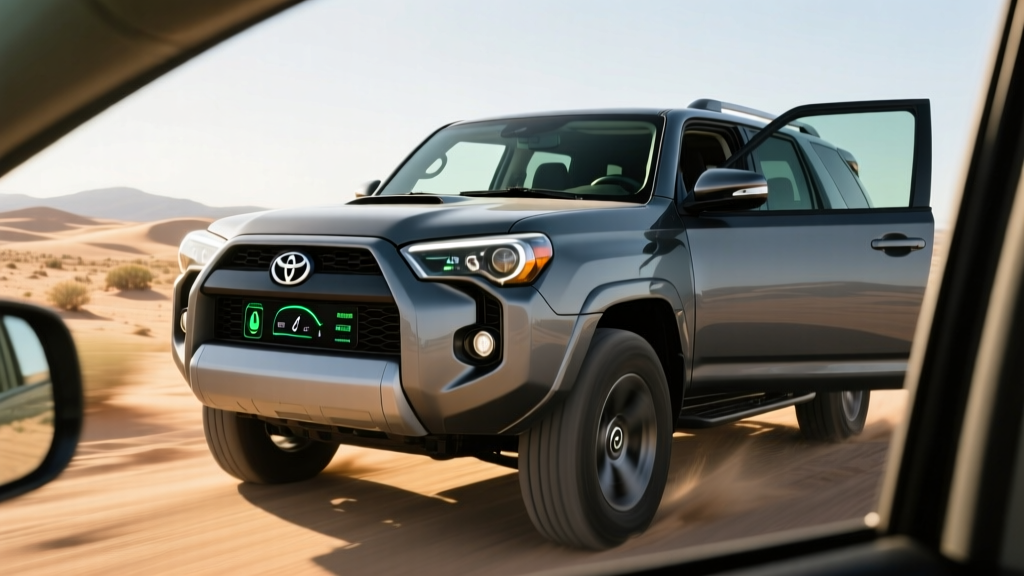
After two decades on the previous generation, the sixth-generation Toyota 4Runner arrived for the 2025 model year with an entirely new platform — and, for the first time, a hybrid powertrain. The 4Runner Hybrid uses Toyota's i-FORCE MAX system, pairing a turbocharged 2.4-liter inline-four with an electric motor integrated into the eight-speed automatic transmission. The result is a body-on-frame SUV that delivers 326 combined horsepower and 465 lb-ft of torque while squeezing meaningfully better fuel economy out of a vehicle that historically returned mid-teens MPG.
This is a conventional hybrid (HEV), not a plug-in hybrid (PHEV). There is no charge port, no electric-only driving mode, and no need to plug in. The small hybrid battery charges through regenerative braking and the engine. If you're looking for electric-only commuting, you'll need to look at a PHEV or a full BEV — we cover that decision framework below.
EPA Fuel Economy: 2025 4Runner Hybrid MPG Breakdown
The EPA rates the 2025 Toyota 4Runner Hybrid at 23 MPG combined (22 city / 24 highway) for 4x2 models, and 22 MPG combined (21 city / 23 highway) for 4x4 models, according to fueleconomy.gov. For a 6,000-pound body-on-frame SUV, those numbers represent a significant improvement over the outgoing V6 4Runner, which returned just 17 MPG combined.
| Configuration | City MPG | Highway MPG | Combined MPG |
|---|---|---|---|
| 4Runner Hybrid 4x2 | 22 | 24 | 23 |
| 4Runner Hybrid 4x4 | 21 | 23 | 22 |
| 4Runner Gas (non-hybrid) 4x4 | 20 | 24 | 21 |
Real-World MPG: What to Actually Expect
Toyota hybrids routinely match or exceed their EPA city estimates in stop-and-go driving, where regenerative braking and electric-motor assist do the most work. On a mixed suburban commute with frequent stops, expect the 4Runner Hybrid 4x4 to deliver 22–24 MPG. However, sustained highway driving at 75+ MPH with a roof rack or all-terrain tires will push consumption toward 19–20 MPG. Cold weather (below freezing) typically reduces hybrid efficiency by 5–10% as the engine runs more frequently to heat the cabin and maintain battery temperature. Towing — the 4Runner Hybrid is rated for up to 6,000 pounds — will drop fuel economy to roughly 12–15 MPG depending on trailer weight and terrain.
i-FORCE MAX Powertrain: Engine, Motor, and Performance
The i-FORCE MAX hybrid system in the 4Runner is the same powertrain architecture Toyota uses in the Tacoma Hybrid and Tundra i-FORCE MAX, though tuned differently for the 4Runner's weight and use case.
| Specification | Detail |
|---|---|
| Engine | 2.4L turbocharged inline-4 |
| Electric Motor | 48 hp / 184 lb-ft (integrated in transmission) |
| Combined Output | 326 hp / 465 lb-ft |
| Transmission | 8-speed automatic |
| Drivetrain | RWD (4x2) or part-time 4WD (4x4) |
| 0–60 mph (est.) | ~6.5 seconds |
| Towing Capacity | 6,000 lbs (properly equipped) |
| Hybrid Battery | ~1.87 kWh NiMH (self-charging, not plug-in) |
The key performance story is torque. The outgoing 4.0L V6 produced 278 lb-ft; the i-FORCE MAX delivers 465 lb-ft, with peak torque arriving much lower in the rev range thanks to electric-motor assist. This makes the 4Runner Hybrid feel substantially more responsive from a stop and far more confident when merging onto highways or climbing grades. The 0–60 time drops from roughly 8.0 seconds (old V6) to an estimated 6.5 seconds — a transformation you feel every day behind the wheel.
The 4Runner Hybrid is a conventional hybrid (HEV). It has a small battery (~1.87 kWh) that charges via regenerative braking and the engine. You never plug it in. A plug-in hybrid (PHEV) like the Toyota RAV4 Prime carries a much larger battery (~18.1 kWh), can be plugged in to charge, and offers 30–42 miles of electric-only driving before the engine engages. The 4Runner does not currently offer a PHEV variant. If electric-only commuting is a priority, you'll need to consider a different model.
Trims, Pricing, and Tax Credit Eligibility
The 4Runner Hybrid is available across multiple trims. Pricing below reflects 2025 MSRP before destination charges:
| Trim | Drivetrain | MSRP (approx.) |
|---|---|---|
| TRD Off-Road Hybrid | 4x4 | $52,620 |
| Limited Hybrid | 4x2 | $54,590 |
| TRD Pro Hybrid | 4x4 | $64,310 |
| Platinum Hybrid | 4x4 | $62,290 |
Federal Tax Credit: Does the 4Runner Hybrid Qualify?
No. Under current IRS §30D rules, the federal clean vehicle credit of up to $7,500 applies only to plug-in electric vehicles (BEVs and PHEVs) with sufficient battery capacity and compliant battery sourcing. The 4Runner Hybrid is a conventional HEV with a small nickel-metal hydride battery and no plug — it does not qualify for the §30D new clean vehicle credit. There is also no federal hybrid-specific tax credit currently in effect.
Some states offer their own incentives for hybrid purchases, but these vary widely by jurisdiction. Check your state's energy or environmental agency website for current programs. Consult a tax professional for eligibility specifics.
- ✅ Vehicle must be a BEV or PHEV with ≥7 kWh battery — 4Runner Hybrid does NOT meet this
- ✅ Buyer income caps: $150K single / $300K joint
- ✅ MSRP caps: $55K (sedans) / $80K (SUVs, trucks, vans)
- ✅ Battery components and critical minerals must meet sourcing thresholds
- ❌ Conventional hybrids (HEVs) are excluded
Battery Warranty, Lifespan, and Replacement Cost
Hybrid battery longevity is consistently the top concern for first-time hybrid buyers. Toyota addresses this with robust warranty coverage.
- Hybrid Battery: 10 years / 150,000 miles (whichever comes first)
- Hybrid System Components: 8 years / 100,000 miles
- Powertrain (engine, transmission): 5 years / 60,000 miles
- Bumper-to-Bumper: 3 years / 36,000 miles
Toyota's hybrid systems have an exceptionally strong reliability track record. The Prius, now in its fifth generation and 25+ years of production, has demonstrated that Toyota's hybrid battery packs routinely last 150,000–200,000+ miles before significant degradation. The 4Runner's NiMH hybrid battery is smaller and less stressed than a PHEV or BEV pack, which further supports longevity.
If replacement is eventually needed out of warranty, a Toyota hybrid battery pack typically costs $2,000–$4,000 including labor, depending on the source (new OEM, refurbished, or aftermarket). This is far less than a BEV battery replacement, which can exceed $10,000–$20,000. Independent hybrid specialists in most metro areas can perform the swap in a few hours.
4Runner Hybrid vs the Alternatives: Which Powertrain Fits You?
The 4Runner Hybrid occupies a specific niche. Here's how to decide whether it's the right choice versus a full EV, a PHEV, or the standard gas 4Runner.
Choose the 4Runner Hybrid If:
- You want a rugged body-on-frame SUV with real off-road capability
- You tow up to 6,000 lbs regularly
- You lack home charging access for a PHEV or BEV
- You want better fuel economy than the gas 4Runner without plugging in
- You prioritize Toyota's long-term reliability and resale value
Look at a PHEV or BEV Instead If:
- You want electric-only commuting (30+ miles zero-emission)
- You have home Level 2 charging and want $7,500 federal tax credit eligibility
- Your daily driving is under 40 miles and you want near-zero fuel use
- You prioritize lowest possible per-mile energy cost
- You don't need body-on-frame towing or hardcore off-road capability
Competitive MPG Comparison
| Vehicle | Type | EPA Combined MPG | Towing (lbs) |
|---|---|---|---|
| Toyota 4Runner Hybrid 4x4 | HEV | 22 | 6,000 |
| Toyota Grand Highlander Hybrid | HEV | 36 | 3,500 |
| Ford Explorer Hybrid | HEV | 23 | 5,600 |
| Jeep Wrangler 4xe | PHEV | 49 MPGe / 20 gas | 3,500 |
| Toyota Land Cruiser (2024+) | HEV | 23 | 6,000 |
The 4Runner Hybrid trades outright MPG efficiency for capability. The Grand Highlander Hybrid achieves 36 MPG combined, but it's a unibody crossover with half the towing capacity. If you need a true body-on-frame SUV that can handle trails, tow a boat, and still deliver low-20s MPG, the 4Runner Hybrid and the redesigned Land Cruiser are essentially the only options in this segment.
Ownership Costs: 5-Year Estimate
Here's a practical look at what five years of 4Runner Hybrid ownership costs compared to the non-hybrid gas 4Runner, assuming 15,000 miles per year and $3.50/gallon regular unleaded:
| Model | Combined MPG | Gallons Used | Fuel Cost | Savings vs Gas |
|---|---|---|---|---|
| 4Runner Hybrid 4x4 | 22 | 3,409 | $11,932 | — |
| 4Runner Gas 4x4 (2025 turbo) | 21 | 3,571 | $12,499 | +$567 |
| Outgoing 4Runner V6 (2024) | 17 | 4,412 | $15,441 | +$3,509 |
The fuel savings versus the old V6 4Runner are substantial — roughly $700/year. Against the new non-hybrid turbo four-cylinder, the savings narrow to about $113/year, meaning the hybrid premium is justified more by performance gains (the 148 additional lb-ft of torque) and resale value than by fuel cost alone. Toyota hybrids historically command strong resale value, often retaining 5–10% more than gas equivalents at the 5-year mark.
Frequently Asked Questions
How many MPG does the 2025 4Runner Hybrid actually get?
The EPA rates it at 22 MPG combined (21 city / 23 highway) for 4x4 and 23 MPG combined (22 city / 24 highway) for 4x2. In real-world mixed driving, expect 21–24 MPG. Highway-only driving at high speeds or with a loaded roof rack will reduce that to 19–20 MPG. City driving with frequent stops often matches or slightly exceeds the EPA estimate.
Is the 4Runner Hybrid a plug-in? Do I need a charger at home?
No. The 4Runner Hybrid is a conventional self-charging hybrid (HEV). There is no plug and no need for any home charging equipment. The battery charges through regenerative braking and the gasoline engine. You fuel it like any other vehicle at a gas station.
Does the 2025 4Runner Hybrid qualify for any federal tax credit?
No. The IRS §30D Clean Vehicle Credit applies only to plug-in electric vehicles (BEVs and PHEVs). The 4Runner Hybrid is a conventional HEV and is not eligible for the $7,500 federal credit. No current federal hybrid-specific incentive exists. Some states may offer their own hybrid incentives — check your state energy office for details.
How long will the hybrid battery last and what does replacement cost?
Toyota covers the hybrid battery for 10 years / 150,000 miles. Based on Toyota's long track record with hybrid systems (the Prius has been in production since 1997), these batteries routinely last 150,000–200,000+ miles. If replacement is needed out of warranty, expect $2,000–$4,000 for a new or refurbished pack with labor — far less than a full EV battery replacement.
Is the 4Runner Hybrid reliable?
Toyota's hybrid powertrains are among the most proven in the automotive industry. The i-FORCE MAX system shares architecture with the Tundra and Tacoma Hybrid. The 2.4L turbo engine is new to the 4Runner but is also used in the Tacoma and Grand Highlander. While long-term data on this specific application is still accumulating (the 6th-gen 4Runner launched for 2025), Toyota's hybrid system components — electric motor, power control unit, and battery — have demonstrated exceptional durability across millions of vehicles. The NHTSA and IIHS publish crash-test results as they become available for the new platform.
Hybrid vs PHEV vs EV — which should I choose?
Choose the 4Runner Hybrid (HEV) if you need body-on-frame capability, tow regularly, lack home charging, and want a modest fuel-economy bump with zero lifestyle change. Choose a PHEV (like a RAV4 Prime or Wrangler 4xe) if you want 30–42 miles of electric-only daily driving, have access to a Level 2 home charger, and want to qualify for the $7,500 federal credit. Choose a full EV (like a Rivian R1S or upcoming electric SUV) if you want zero tailpipe emissions, the lowest per-mile fuel cost, and have reliable charging access — but understand you'll sacrifice the 4Runner's specific blend of off-road hardware and towing capacity until electric body-on-frame SUVs mature.