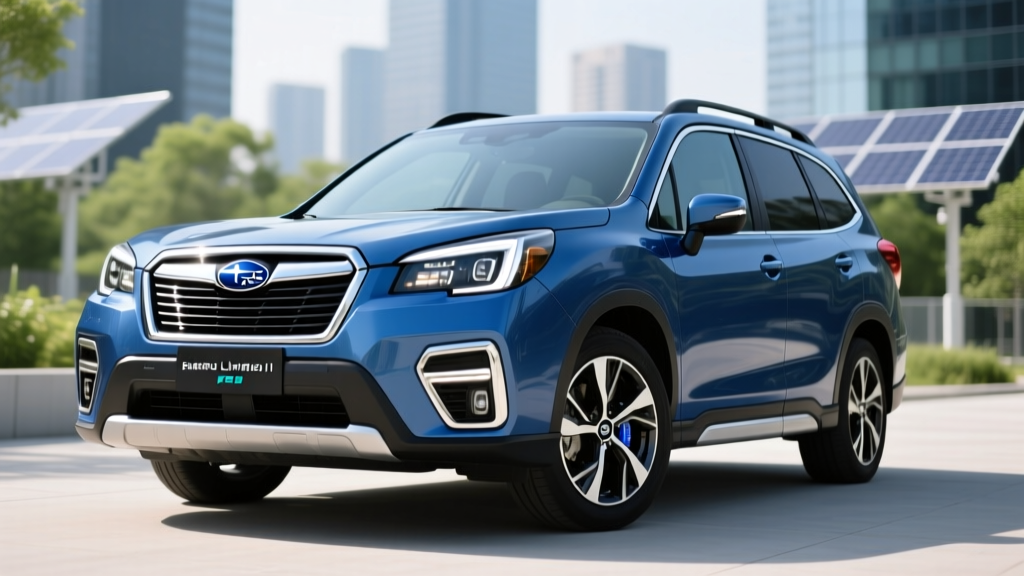
The Subaru Forester has long been the default compact SUV for buyers who need standard all-wheel drive, solid visibility, and genuine all-weather capability. For 2025, Subaru reintroduced a hybrid powertrain to the Forester lineup for the first time since 2018, and the top-tier 2025 Subaru Forester Limited Hybrid pairs that efficiency with the most feature-rich trim available. This guide breaks down exactly what you get — real MPG, powertrain specs, battery longevity, pricing, and whether this HEV makes more sense than a PHEV or full EV for your daily driving.
What Is the 2025 Subaru Forester Limited Hybrid?
The 2025 Forester Hybrid uses a conventional hybrid (HEV) powertrain — not a plug-in hybrid (PHEV). That means you never plug it in. The system pairs a 2.5-liter horizontally opposed (boxer) four-cylinder engine with an electric motor integrated into a continuously variable transmission (CVT). A small lithium-ion battery pack, charged through regenerative braking and the engine itself, powers the electric motor to assist during acceleration, low-speed driving, and start-stop conditions.
HEV vs PHEV: What's the Difference Here?
| Feature | Conventional Hybrid (HEV) | Plug-In Hybrid (PHEV) |
|---|---|---|
| Plug-in charging? | No — self-charging via engine + regen | Yes — plug into Level 1 or Level 2 |
| Electric-only range | ~1 mile or less at low speed | Typically 20–40 miles |
| Battery size | ~1–2 kWh | ~10–20 kWh |
| Federal tax credit (§30D) | Not eligible | Up to $7,500 (with sourcing/income rules) |
| Best for | Drivers without home charging access | Drivers who can charge at home + want electric-only commuting |
The Forester Hybrid is an HEV. Subaru does not currently offer a Forester PHEV in the U.S. market.
Fuel Economy: EPA Ratings and Real-World MPG
The headline number for the 2025 Forester Hybrid is its EPA-estimated fuel economy. Subaru targets a meaningful improvement over the gas-only Forester, which is rated at 26 city / 33 highway / 29 combined MPG.
| Powertrain | City MPG | Highway MPG | Combined MPG |
|---|---|---|---|
| 2025 Forester Gas (AWD) | 26 | 33 | 29 |
| 2025 Forester Hybrid (AWD) | 35 | 34 | 35 |
Source: fueleconomy.gov — EPA estimates. Your mileage will vary.
Real-World MPG: What to Expect
Hybrids typically match or exceed their EPA city rating in real-world stop-and-go driving, where regenerative braking and electric motor assist shine. Highway driving is a different story: at sustained 70–80 mph speeds, the aerodynamic drag of the Forester's boxy SUV shape works against it, and the hybrid system provides less benefit.
Based on early owner reports and Subaru's own testing parameters:
- City / suburban driving: Expect 33–38 MPG. Short trips with frequent stops maximize regen braking.
- Highway (65–75 mph): Expect 30–33 MPG. The hybrid advantage narrows at sustained speed.
- Cold weather (below 30°F): Expect a 5–10% drop across the board. The engine runs more often to provide cabin heat, reducing electric-only assist time.
- Combined real-world average: Most owners should see 32–36 MPG in mixed driving.
The hybrid's 35 MPG combined represents roughly a 20% fuel savings over the gas-only Forester's 29 MPG combined. Over 15,000 miles per year at $3.50/gallon, that translates to approximately $310 in annual fuel savings.
Powertrain Specs: Engine, Motor, and Combined Output
| Specification | 2025 Forester Limited Hybrid |
|---|---|
| Engine | 2.5L DOHC Boxer 4-cylinder |
| Engine horsepower | ~160 hp (gas engine alone) |
| Electric motor output | ~34 hp (integrated in CVT) |
| Combined system horsepower | 194 hp |
| Transmission | Lineartronic CVT |
| Drivetrain | Symmetrical All-Wheel Drive (standard) |
| Hybrid battery | Lithium-ion, ~1.1 kWh (estimated) |
| 0–60 mph | ~8.0 seconds (estimated) |
| Towing capacity | 1,500 lbs (estimated) |
The 194 combined horsepower is a notable upgrade over the gas-only Forester's 180 hp. The electric motor's instant torque fills in the low-end gap that Subaru's naturally aspirated 2.5L boxer engine has historically exhibited, making the Hybrid feel more responsive around town and during highway merging. The CVT remains the weak link for enthusiasts — it drones under hard acceleration — but it's optimized for efficiency in this application.
Subaru's AWD system on the Hybrid uses a motor-driven rear axle in certain conditions rather than a mechanical driveshaft, which allows for more efficient power distribution. This is worth noting if you frequently drive on low-traction surfaces.
Limited Trim: What You Get for the Price
The Limited is the top trim in the 2025 Forester Hybrid lineup. Here's the pricing breakdown:
| Trim | MSRP (incl. destination) |
|---|---|
| Forester Hybrid Premium | ~$35,995 |
| Forester Hybrid Sport | ~$37,495 |
| Forester Hybrid Limited | ~$38,995 |
Source: Subaru.com — MSRP includes destination charge. Dealer pricing may vary.
The Limited trim adds leather upholstery, a power-adjustable driver's seat, heated front seats, a heated steering wheel, a Harman Kardon premium audio system, and a power liftgate over lower trims. Standard across all 2025 Forester trims is Subaru's EyeSight suite of driver-assistance features (adaptive cruise control, lane-keeping assist, pre-collision braking) — this is a Level 2 driver-assist system per SAE classification, meaning you must remain engaged and supervising at all times.
Tax Credit Eligibility
The 2025 Subaru Forester Hybrid does not qualify for the federal §30D new clean vehicle tax credit. That credit applies only to plug-in electric vehicles (BEVs and PHEVs) that meet battery sourcing, MSRP cap, and buyer income requirements as defined by the IRS. Conventional hybrids like this Forester are excluded.
Some states offer separate rebates or tax incentives for hybrid vehicles. These vary by jurisdiction and change frequently — check your state's energy or environmental agency website, or consult a tax professional, for current local incentives.
Hybrid Battery Warranty, Lifespan, and Replacement Cost
Subaru Hybrid Battery Warranty
Subaru covers the hybrid battery pack under its powertrain warranty for 8 years / 100,000 miles (whichever comes first). In states that follow California Air Resources Board (CARB) emissions standards — including California, New York, Massachusetts, and others — hybrid battery coverage extends to 10 years / 150,000 miles.
The warranty covers battery capacity loss below a defined threshold and any manufacturing defects. Normal degradation that doesn't impair function is not covered.
How Long Will the Hybrid Battery Last?
Modern hybrid battery packs (lithium-ion in the 2025 Forester) are engineered for the life of the vehicle. Toyota's hybrid batteries — the benchmark in this space — routinely last 150,000–200,000+ miles with minimal degradation. Subaru's hybrid system, developed with Toyota partnership technology, is expected to deliver similar longevity.
The battery in a conventional hybrid is small (~1 kWh) and never undergoes the deep charge/discharge cycles that stress EV batteries. It operates in a narrow state-of-charge window (roughly 40–60%), which is the least stressful operating range for lithium-ion chemistry.
Battery Replacement Cost
If the hybrid battery does fail outside warranty, replacement costs for compact SUV hybrid batteries typically range from $2,000 to $4,000 including parts and labor. This is significantly less than EV traction battery replacements ($5,000–$20,000+) because the pack is much smaller. Third-party refurbished hybrid batteries are increasingly available for $1,000–$2,000.
Who Should Choose the Forester Hybrid vs. a PHEV or Full EV?
Choose the 2025 Forester Limited Hybrid If:
- You don't have access to home or workplace Level 2 charging
- You want better fuel economy without changing your refueling habits
- You live in a cold climate where EV range loss is a concern
- You need AWD and ground clearance for snow or light off-road use
- Your daily driving is 30–80 miles and you take regular road trips
Consider a PHEV (e.g., Toyota RAV4 Prime) If:
- You can install a Level 2 charger at home
- Your commute is under 40 miles round-trip (you could drive mostly on electric)
- You want to qualify for the §30D federal tax credit (up to $7,500, subject to IRS eligibility rules)
- You want the option of zero-emission local driving with a gas engine for road trips
Consider a Full EV (e.g., Hyundai Ioniq 5, Tesla Model Y) If:
- You have reliable home charging and your daily driving is under 250 miles
- You want the lowest per-mile fuel cost (electricity vs. gasoline)
- You want minimal maintenance (no oil changes, fewer brake replacements due to regen)
- You're comfortable planning charging stops on longer road trips
Pros and Cons: 2025 Forester Limited Hybrid
Pros
- 35 MPG combined — meaningful savings over the 29 MPG gas model
- Standard AWD with no fuel-economy penalty vs. FWD-only competitors
- 194 hp combined — more responsive than the gas-only Forester
- No charging infrastructure needed — just fill up with gas
- 8-year/100k-mile hybrid battery warranty (10yr/150k in CARB states)
- EyeSight driver-assist suite standard across all trims
- Top Limited trim well-equipped with luxury features
Cons
- No federal tax credit eligibility (HEV, not PHEV)
- ~$3,000 price premium over the gas-only Limited trim
- CVT drone under hard acceleration
- Hybrid system adds weight, slightly reducing cargo capacity
- Towing capacity limited to ~1,500 lbs (not class-leading)
- No PHEV option available if you want electric-only commuting
FAQ: 2025 Subaru Forester Limited Hybrid
How many MPG does the 2025 Forester Hybrid get?
The EPA rates the 2025 Forester Hybrid at 35 city / 34 highway / 35 combined MPG. In real-world driving, expect 33–38 MPG in city conditions and 30–33 MPG at sustained highway speeds. Cold weather can reduce these figures by 5–10%.
Does the Forester Hybrid need to be plugged in?
No. The 2025 Forester Hybrid is a conventional hybrid (HEV), not a plug-in hybrid. It charges its own battery through regenerative braking and the gasoline engine. You refuel it exclusively at gas stations.
Does the 2025 Forester Hybrid qualify for any tax credit?
It does not qualify for the federal §30D new clean vehicle credit, which is reserved for plug-in vehicles (BEVs and PHEVs). Some states may offer hybrid-specific incentives — check your state's energy department or consult a tax professional for local programs.
Is the Forester Hybrid reliable? What about battery replacement?
Subaru's hybrid system benefits from shared technology with Toyota, which has the longest track record in hybrid reliability. The hybrid battery is warranted for 8 years/100,000 miles (10 years/150,000 miles in CARB states). Replacement costs, if needed outside warranty, typically run $2,000–$4,000.
How much more does the Hybrid cost vs. the gas Forester?
The Hybrid carries approximately a $2,500–$3,000 premium over the equivalent gas-only trim. At roughly $310 in annual fuel savings (based on 15,000 miles/year at $3.50/gallon), the payback period is approximately 8–10 years at current fuel prices — though the Hybrid also delivers more horsepower and a smoother low-speed driving experience.
How far can the Forester Hybrid drive on electric power alone?
As a conventional hybrid, the Forester can operate on electric power alone for very short distances (roughly 1 mile or less) at low speeds (under 25 mph). It is not designed for electric-only commuting. If you need meaningful electric-only range, consider a PHEV like the Toyota RAV4 Prime (42 miles electric-only EPA).
Is the Forester Hybrid good in snow?
Yes. Subaru's Symmetrical AWD is standard, and the hybrid system's motor-driven rear axle can enhance traction distribution. Combined with 8.7 inches of ground clearance and available all-weather floor liners, the Forester Hybrid remains one of the most capable compact SUVs in winter conditions.
Specifications and pricing based on Subaru's published data for the 2025 model year. EPA fuel economy figures sourced from fueleconomy.gov. Tax credit information reflects current IRS §30D rules — always verify eligibility with a qualified tax professional. Subaru's EyeSight is an SAE Level 2 driver-assist system and requires active driver supervision at all times.