The 2025 Subaru Forester Hybrid: Towing, Efficiency, and What Buyers Need to Know
The 2025 Subaru Forester Hybrid returns after a generation-long absence of a hybrid variant in the Forester lineup. Built on the sixth-generation Forester platform introduced for 2025, this hybrid pairs Subaru's proven symmetrical all-wheel drive with a 2.5-liter flat-four hybrid powertrain. For buyers researching the 2025 Subaru Forester Hybrid towing capacity alongside fuel economy and daily practicality, this guide covers every spec that matters — from EPA MPG to battery warranty to real-world trailering limits.
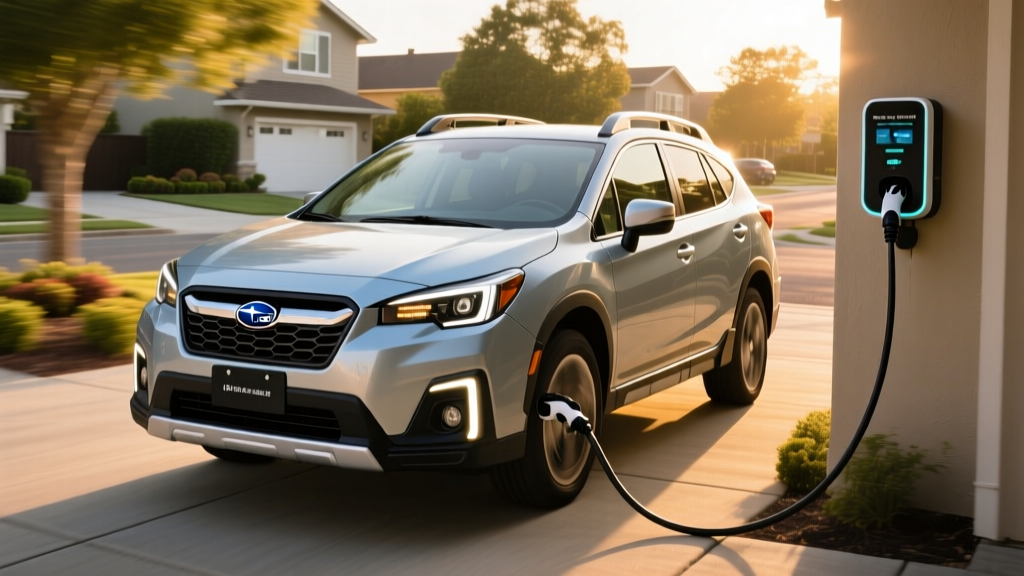
Let's be clear upfront: this is a conventional hybrid (HEV), not a plug-in hybrid (PHEV). You never plug it in. The small battery recharges through regenerative braking and the gasoline engine. If you want electric-only driving, you'll need to look at a PHEV or a full battery-electric vehicle (BEV). The Forester Hybrid is designed for buyers who want better fuel economy without changing their fueling habits.
HEV vs. PHEV — Where Does the Forester Hybrid Fit?
Conventional Hybrid (HEV): Small battery (typically 1–2 kWh), no plug, no electric-only range to speak of. The electric motor assists the gas engine during acceleration and captures energy during braking. The 2025 Forester Hybrid is an HEV.
Plug-in Hybrid (PHEV): Larger battery (typically 10–20+ kWh), requires plugging in to realize full benefit, offers 20–40+ miles of electric-only range before the gas engine kicks in. Examples: Toyota RAV4 Prime, Jeep Wrangler 4xe.
Full EV (BEV): No gas engine. 100% electric, requires charging infrastructure. Examples: Tesla Model Y, Hyundai Ioniq 5.
2025 Subaru Forester Hybrid Towing Capacity: The Numbers
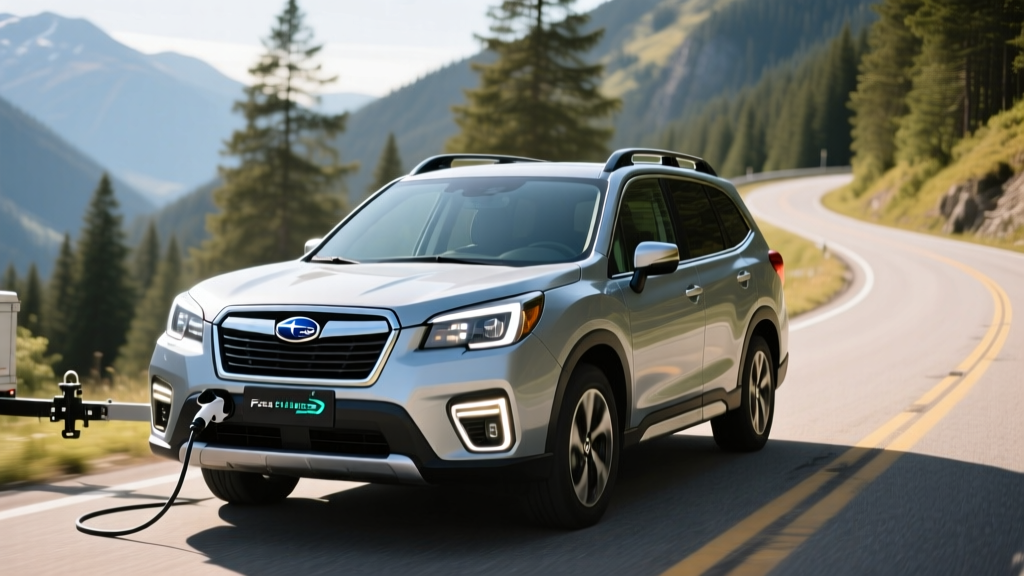
The 2025 Subaru Forester Hybrid towing capacity is rated at 1,500 pounds when properly equipped. This matches the towing rating of the standard gas-only 2025 Forester and is typical for compact crossover hybrids in this segment. Subaru specifies this limit with a factory-installed trailer hitch receiver and a weight-distributing setup for anything approaching the maximum.
| Specification | 2025 Forester Hybrid |
|---|---|
| Towing Capacity (max) | 1,500 lbs |
| Payload Capacity | ~1,000 lbs (varies by trim) |
| Drivetrain | Symmetrical AWD (standard) |
| Hitch Type | 1.25" receiver (dealer-installed) |
| Trailer Wiring | 4-pin (dealer-installed accessory) |
What can you actually tow at 1,500 lbs? A small utility trailer, a pair of dirt bikes on a lightweight carrier, a compact teardrop camper (many weigh 800–1,200 lbs loaded), or a small aluminum boat on a single-axle trailer. You won't be pulling a full-size travel trailer or a horse trailer — that requires a body-on-frame SUV or truck rated for 5,000+ lbs.
Towing efficiency note: Expect fuel economy to drop significantly when towing. Hybrid towing MPG typically falls to 18–22 MPG combined under load, depending on trailer weight, terrain, and speed. The hybrid system's low-end torque assist helps off the line, but sustained highway towing relies primarily on the 2.5L engine.
Hybrid Powertrain Specs: Horsepower, Engine, and Motor
The 2025 Forester Hybrid uses a series-parallel hybrid system built around Subaru's FB25 2.5-liter horizontally opposed (boxer) four-cylinder engine. An electric motor is integrated between the engine and the Lineartronic CVT (continuously variable transmission), with a small lithium-ion battery pack mounted under the rear cargo floor.
| Powertrain Component | Specification |
|---|---|
| Gas Engine | 2.5L boxer-4 (FB25) |
| Engine Output | ~180 hp / 178 lb-ft torque |
| Electric Motor | Integrated AC motor (~27 hp assist) |
| Combined System Output | ~194 hp |
| Transmission | Lineartronic CVT |
| Battery Type | Lithium-ion (~1.1 kWh, HEV) |
| Drivetrain | Symmetrical AWD |
| 0–60 mph | ~8.5 seconds (est.) |
The combined ~194 hp is a modest bump over the standard Forester's 180 hp. In practice, the electric motor's instant torque fill makes the hybrid feel more responsive in city driving and during passing maneuvers, even though the peak horsepower advantage is small. The CVT keeps the engine in its most efficient range, which is where the MPG gains come from.
Fuel Economy: EPA MPG and Real-World Expectations
The 2025 Subaru Forester Hybrid is EPA-rated at 35 MPG combined, with a breakdown of approximately 36 MPG city and 33 MPG highway, according to fueleconomy.gov. This represents a meaningful improvement over the standard gas Forester's 29 MPG combined (26 city / 33 highway).
| Metric | Forester Hybrid | Forester Gas |
|---|---|---|
| City MPG | 36 | 26 |
| Highway MPG | 33 | 33 |
| Combined MPG | 35 | 29 |
| Annual Fuel Cost* | ~$1,550 | ~$1,870 |
*Based on 15,000 miles/year at $3.50/gallon regular unleaded. Your costs will vary with local fuel prices.
Real-World MPG vs. EPA Sticker
Hybrids consistently outperform their EPA city ratings in stop-and-go traffic because regenerative braking recaptures energy that a gas car wastes as heat. In real-world city driving, many Forester Hybrid owners report 37–39 MPG. Conversely, highway MPG tends to run slightly below the EPA figure at sustained 75+ mph speeds — expect 30–32 MPG on long interstate trips. Cold weather (below 30°F) can reduce combined MPG by 3–5 MPG as the engine runs more frequently to maintain cabin heat and battery temperature.
Pricing, Trims, and Tax Credit Eligibility
The 2025 Subaru Forester Hybrid is offered across multiple trim levels, with pricing starting at approximately $33,995 MSRP (including destination) for the base Hybrid trim. Higher trims, including Hybrid Premium and Hybrid Sport, range from $36,000 to $39,000.
| Trim | MSRP (incl. destination) |
|---|---|
| Forester Hybrid | ~$33,995 |
| Forester Hybrid Premium | ~$36,495 |
| Forester Hybrid Sport | ~$38,995 |
Does the Forester Hybrid Qualify for a Federal Tax Credit?
No. The 2025 Forester Hybrid is a conventional hybrid (HEV), not a plug-in hybrid or battery-electric vehicle. Under current IRS §30D rules, only plug-in electric vehicles (PHEVs and BEVs) with a battery capacity of at least 7 kWh qualify for the federal Clean Vehicle Credit of up to $7,500. The Forester Hybrid's ~1.1 kWh battery does not meet this threshold.
Some states offer modest incentives for conventional hybrids, but these vary widely. Check your state's energy office or DMV for current programs. Subaru dealerships may also offer manufacturer incentives — ask your local dealer.
Battery Warranty, Reliability, and Replacement Cost
Hybrid Battery Warranty
Subaru covers the Forester Hybrid's lithium-ion battery pack under its hybrid system warranty for 8 years or 100,000 miles (whichever comes first). In states that follow California Air Resources Board (CARB) emissions standards — including California, New York, Oregon, Washington, and others — the hybrid battery warranty extends to 10 years or 150,000 miles.
This warranty covers battery capacity loss beyond a defined threshold (typically below 60–70% of original capacity) and any defects in the hybrid system components, including the electric motor, inverter, and associated control modules.
Subaru's hybrid system is derived from Toyota's well-established hybrid synergy drive technology, as the two companies co-developed the hybrid architecture used in several models. Toyota's hybrid systems have an extensive track record — the Prius hybrid battery routinely lasts 150,000–200,000+ miles before significant degradation. The Forester Hybrid benefits from this proven engineering lineage.
Battery replacement cost: If the hybrid battery fails outside warranty, expect a replacement cost of approximately $2,000–$3,500 for the battery pack, plus labor. This is significantly less than a full EV battery replacement ($8,000–$20,000+) because the HEV battery is small (~1.1 kWh). Third-party hybrid battery refurbishers also offer reconditioned packs for $1,000–$1,800 as vehicles age out of warranty.
Forester Hybrid vs. Competitors: Towing and Efficiency Compared
The compact hybrid SUV segment has strong alternatives. Here's how the Forester Hybrid stacks up against key rivals on towing and efficiency:
| Model | Combined MPG | Towing (lbs) | AWD | Starting MSRP |
|---|---|---|---|---|
| 2025 Subaru Forester Hybrid | 35 | 1,500 | Standard | ~$33,995 |
| Toyota RAV4 Hybrid | 39 | 1,750 | Standard | ~$33,425 |
| Honda CR-V Hybrid | 37 | 1,000 | Optional | ~$35,395 |
| Ford Escape Hybrid | 39 | 1,500 | Optional | ~$34,490 |
The RAV4 Hybrid leads on both MPG and towing in this group. The Forester Hybrid's advantage is standard AWD across all trims, Subaru's strong reputation in snow and rough-road conditions, and class-leading outward visibility. If towing is your top priority and you need more than 1,500 lbs, consider stepping up to a midsize SUV like the Toyota Highlander Hybrid (3,500 lbs towing) or a body-on-frame vehicle.
Who Should Choose the Forester Hybrid vs. a PHEV or Full EV?
Decision Framework
Choose the Forester Hybrid (HEV) if:
- You don't have access to home or workplace charging
- You want better MPG without changing your fueling routine
- You live in a cold or snowy climate where AWD is essential year-round
- You need a compact SUV with moderate towing (up to 1,500 lbs)
- You want a lower purchase price than a PHEV or EV
Choose a PHEV (e.g., RAV4 Prime) if:
- You can charge at home (Level 1 or Level 2) and want 30–42 miles of electric-only commuting
- Your daily commute is under 40 miles round-trip
- You want to qualify for the $7,500 federal tax credit (subject to IRS income and sourcing rules)
Choose a full EV (e.g., Tesla Model Y, Hyundai Ioniq 5) if:
- You have reliable home Level 2 charging
- You want zero tailpipe emissions and minimal maintenance
- Your typical trips are within 250–300 miles or you're comfortable with DC fast charging on road trips
Pros and Cons: The Honest Assessment
Pros
- 35 MPG combined — a 6 MPG gain over the gas Forester
- Standard symmetrical AWD on every trim
- Proven hybrid tech co-developed with Toyota
- 8-year/100,000-mile hybrid battery warranty (10/150k in CARB states)
- Same cargo space and interior as gas Forester
- Low-end electric torque fill improves city drivability
- No plug-in charging required — fuel like a normal car
Cons
- 1,500-lb towing capacity limits you to light trailers only
- No federal tax credit (HEV, not PHEV/BEV)
- Highway MPG (33) matches the gas model — gains are city-focused
- ~$3,000 price premium over equivalent gas Forester trim
- No DC fast charging capability (not applicable to HEVs)
- CVT can drone under hard acceleration or when towing uphill
Frequently Asked Questions
How many MPG does the 2025 Subaru Forester Hybrid get?
The EPA rates the 2025 Forester Hybrid at 36 MPG city, 33 MPG highway, and 35 MPG combined. Real-world city driving often yields 37–39 MPG thanks to regenerative braking, while sustained highway driving at 75+ mph typically returns 30–32 MPG.
Can the 2025 Forester Hybrid tow a camper or boat?
Yes, within its 1,500-pound limit. This covers most teardrop campers (800–1,200 lbs), small aluminum boats on single-axle trailers, and light utility trailers. It cannot tow full-size travel trailers, car haulers, or horse trailers.
Does the Forester Hybrid need to be plugged in?
No. The Forester Hybrid is a conventional hybrid (HEV). The battery recharges automatically through regenerative braking and the gasoline engine. You fuel it at any gas station, exactly like a non-hybrid vehicle.
Is the Forester Hybrid battery reliable and what does replacement cost?
Subaru's hybrid system is co-developed with Toyota, whose hybrid batteries routinely last 150,000–200,000+ miles. The battery is warranted for 8 years/100,000 miles (10 years/150,000 miles in CARB states). Out-of-warranty replacement runs approximately $2,000–$3,500, with refurbished options available for $1,000–$1,800.
Does the 2025 Forester Hybrid qualify for any tax credit?
The Forester Hybrid does not qualify for the federal §30D Clean Vehicle Credit, which requires a plug-in vehicle with at least 7 kWh of battery capacity. Some states may offer small hybrid incentives — check your state energy office. No federal credit applies.
How does the Forester Hybrid compare to the RAV4 Hybrid for towing?
The Toyota RAV4 Hybrid has a slightly higher towing capacity at 1,750 lbs and achieves 39 MPG combined versus the Forester Hybrid's 35 MPG combined and 1,500-lb rating. The Forester counters with standard AWD on all trims, better outward visibility, and Subaru's reputation for rough-road durability.
What is the Forester Hybrid's ground clearance and off-road capability?
The 2025 Forester Hybrid maintains 8.7 inches of ground clearance and includes Subaru's X-Mode traction management system, making it one of the most capable compact crossovers for light off-road use, snow, and unpaved roads.
Sources: EPA fueleconomy.gov, Subaru of America, IRS §30D Clean Vehicle Credit. All specifications based on manufacturer data available at time of publication. Verify final specs and pricing with your local Subaru dealer, as MSRP and incentives are subject to change.