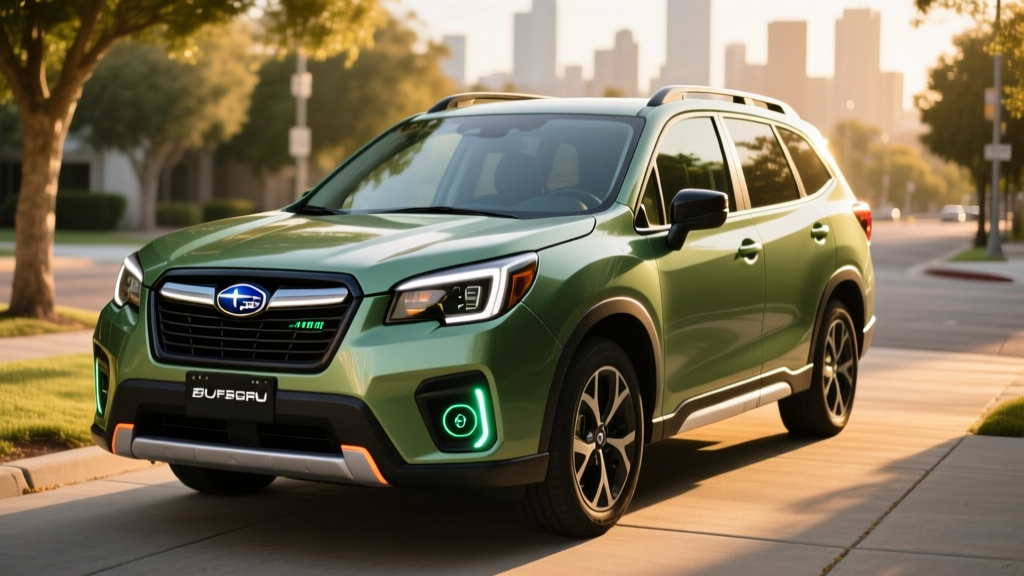
The 2025 Subaru Forester Hybrid Sport arrives as a conventional hybrid (HEV) — not a plug-in — pairing Subaru's 2.5-liter flat-four with an electric motor for a combined 194 horsepower and a meaningful bump in fuel economy over the gas-only Forester. For buyers who want all-weather capability and better city mileage without changing how they refuel, this is one of the few hybrid compact SUVs that still comes standard with all-wheel drive.
Below, we break down the EPA numbers, real-world fuel economy expectations, the HEV vs. PHEV distinction, battery longevity, and whether the Forester Hybrid Sport actually qualifies for any federal tax credits.
What Is the 2025 Subaru Forester Hybrid Sport?
The Forester Hybrid Sport is a conventional hybrid electric vehicle (HEV). It charges its small battery through regenerative braking and the gasoline engine — you never plug it in. This is fundamentally different from a plug-in hybrid (PHEV) like the Toyota RAV4 Prime, which offers 40+ miles of electric-only driving before the gas engine kicks in.
HEV vs. PHEV — What's the Difference?
| Feature | HEV (Forester Hybrid) | PHEV (e.g., RAV4 Prime) |
|---|---|---|
| Plug in to charge? | No | Yes |
| Electric-only range | ~1 mile (low-speed only) | 25–42 miles typical |
| Battery size | ~1.1 kWh | 13–18 kWh |
| Federal tax credit | No (§30D excludes HEVs) | Up to $7,500 (if eligible) |
| Fueling | Gas station only | Gas + home/outlet charging |
Subaru chose the HEV route for the Forester Hybrid likely because it keeps the price competitive, avoids the weight penalty of a larger battery, and preserves cargo space. For buyers without home charging access, an HEV is the pragmatic electrified option.
Fuel Economy: EPA Numbers and Real-World MPG
The 2025 Forester Hybrid carries an EPA-estimated 35 MPG combined, broken down as follows:
| Cycle | EPA Estimate | Real-World Expectation |
|---|---|---|
| City | 35 MPG | 36–39 MPG |
| Highway | 34 MPG | 30–33 MPG |
| Combined | 35 MPG | 33–36 MPG |
Real-world caveat: Like most hybrids, the Forester Hybrid benefits from regenerative braking and frequent engine shut-off in stop-and-go traffic. City drivers often exceed the EPA city estimate by 1–4 MPG. Highway driving, especially above 70 mph, tends to yield lower numbers because the electric motor provides less assistance at sustained high speeds and the 2.5L engine shoulders more of the load.
In cold weather (below 30°F), expect a 5–10% fuel economy dip as the engine runs longer to heat the cabin and the battery operates less efficiently. This is less severe than the 20–30% range loss a full EV experiences in winter, but it's real.
Compared to the gas-only 2025 Forester (EPA 26 city / 33 highway / 29 combined), the Hybrid Sport delivers roughly a 20% improvement in combined MPG — translating to about 80–100 fewer gallons per year for a driver covering 15,000 miles annually.
Powertrain Specs: Horsepower, Engine, and Motor
| Specification | 2025 Forester Hybrid Sport |
|---|---|
| Combined system horsepower | 194 hp |
| Gas engine | 2.5L DOHC flat-4 (Boxer), ~180 hp |
| Electric motor | Integrated AC motor, ~14 hp assist |
| Hybrid battery | ~1.1 kWh lithium-ion |
| Transmission | Lineartronic CVT |
| Drivetrain | Symmetrical AWD (standard) |
| 0–60 mph (est.) | ~8.0 seconds |
| Towing capacity | 1,500 lbs |
The electric motor fills in torque at low RPM where the naturally aspirated Boxer is weakest, giving the Hybrid Sport noticeably punchier acceleration from a stop than the gas-only Forester. The 194 combined hp is a meaningful upgrade over the gas model's 180 hp, though this is still a comfort-oriented compact SUV, not a performance vehicle.
The hybrid system is derived from Toyota's hybrid synergy architecture (Subaru and Toyota share platform technology). This is the same proven architecture underpinning millions of Toyota hybrids — a strong reliability signal.
Pricing, Trims, and Tax Credit Eligibility
The 2025 Forester Hybrid is available in Sport and Sport Touring trims:
- Forester Hybrid Sport: Starting MSRP ~$36,495 (includes destination)
- Forester Hybrid Sport Touring: Starting MSRP ~$39,995 (includes destination)
The Sport trim adds hybrid-specific styling cues, a 12.3-inch infotainment display, wireless Apple CarPlay/Android Auto, and Subaru's EyeSight driver-assist suite. The Sport Touring adds a Harman Kardon audio system, heated rear seats, and a panoramic moonroof.
Does the Forester Hybrid Qualify for a Federal Tax Credit?
No. Under current IRS §30D rules, the federal clean vehicle credit applies only to plug-in electric vehicles (BEVs and PHEVs) with a battery capacity of at least 7 kWh. The Forester Hybrid's ~1.1 kWh battery disqualifies it entirely. There is no federal income tax credit for conventional hybrids purchased new in 2025 or 2026.
Some states and municipalities offer rebates or HOV-lane access for hybrids — check your state energy office or AFDC state incentives database for local programs.
Battery Warranty, Reliability, and Replacement Cost
Hybrid Battery Warranty
Subaru hybrid battery warranty: 8 years / 100,000 miles (whichever comes first), covering defects and capacity loss below a usable threshold. In states that follow California Air Resources Board (CARB) regulations — including CA, NY, MA, NJ, CT, and others — the warranty extends to 10 years / 150,000 miles.
Reliability outlook: The Forester Hybrid uses a Toyota-derived hybrid system that has been in production across millions of vehicles since the late 1990s. Hybrid battery failures before 150,000 miles are rare. When they do occur outside warranty, replacement costs for a Subaru hybrid battery typically range from $2,000 to $4,000 including labor — far less than a full EV battery pack.
Subaru's overall brand reliability has been mixed in recent years (head gasket issues on older Boxer engines, CVT concerns), but the hybrid powertrain sidesteps some of these by reducing mechanical stress on the engine through electric motor assist. The CVT remains a watch item — Subaru has extended CVT warranties on some prior model years.
Who Should Buy the Forester Hybrid Sport?
Pros
- 35 MPG combined — ~20% better than gas Forester
- Standard AWD — rare in the hybrid compact SUV segment
- No plug-in required — refuel at any gas station
- Toyota-derived hybrid system — proven longevity
- 194 hp — adequate passing power with electric torque fill
- Subaru EyeSight safety suite standard
Cons
- No federal tax credit — higher net cost vs. some PHEV competitors
- CVT can drone under hard acceleration
- 1,500-lb towing limit — lower than some gas rivals
- No electric-only driving beyond very low speeds
- Sport Touring trim pushes near $40K
- Highway MPG can dip below EPA at 75+ mph
Forester Hybrid vs. PHEV vs. Full EV — Which Fits You?
| Factor | Forester Hybrid (HEV) | PHEV (e.g., RAV4 Prime) | Full EV (e.g., Ioniq 5) |
|---|---|---|---|
| Home charging needed? | No | Recommended | Essential |
| Annual fuel cost (15K mi) | ~$1,500 | ~$900–$1,300 | ~$500–$800 |
| Federal tax credit | None | Up to $7,500 | Up to $7,500 |
| Road trip ease | Gas & go | Gas & go | Plan DC fast stops |
| AWD availability | Standard | Available | Available |
Decision Framework
Choose the Forester Hybrid if you lack home charging, live in a snowy/rural area where AWD matters, and want a no-hassle upgrade from a gas car with better MPG and no behavioral change.
Choose a PHEV if you can install a Level 2 home charger, your daily commute is under 35 miles round-trip, and you want to drive mostly on electricity while keeping gas for road trips — plus capture the $7,500 federal credit.
Choose a full EV if you have reliable home charging, drive under 250 miles daily, want the lowest operating costs, and are ready to plan DC fast-charging stops on longer trips.
Frequently Asked Questions
How many MPG does the 2025 Subaru Forester Hybrid Sport get?
The EPA rates it at 35 city / 34 highway / 35 combined MPG. In real-world city driving with moderate stop-and-go traffic, owners commonly report 36–39 MPG. Highway-only driving at 75+ mph typically yields 30–33 MPG.
Does the Forester Hybrid need to be plugged in?
No. This is a conventional hybrid (HEV). The battery recharges through regenerative braking and the gasoline engine. You fuel it exclusively at gas stations, exactly like a non-hybrid car.
Is the hybrid battery reliable and what does replacement cost?
Subaru covers the hybrid battery for 8 years/100,000 miles (10 years/150,000 miles in CARB states). The Toyota-derived hybrid system has an extensive track record of lasting 150,000+ miles without battery replacement. If replacement is needed out of warranty, expect $2,000–$4,000 including labor.
Does the 2025 Forester Hybrid qualify for any tax credit?
Not the federal §30D clean vehicle credit — that applies only to plug-in vehicles with 7+ kWh batteries. Some states or utilities offer hybrid rebates; check the AFDC state incentive database for your area.
How does the Forester Hybrid compare to the Toyota RAV4 Hybrid?
The RAV4 Hybrid is rated at 39 MPG combined (41 city/38 highway) — about 4 MPG better. However, the Forester Hybrid offers standard AWD with Subaru's X-Mode for off-road traction, a more commanding driving position, and Subaru's EyeSight safety suite. The RAV4 Hybrid has a slight efficiency edge; the Forester Hybrid has the visibility and all-weather confidence edge.
Can the Forester Hybrid Sport tow?
Yes, but the towing capacity is rated at 1,500 lbs — adequate for a small utility trailer or a pair of dirt bikes, but not enough for most boat or camper trailers. If towing is a priority, the gas-only Forester is rated identically at 1,500 lbs, so the hybrid doesn't penalize you here.