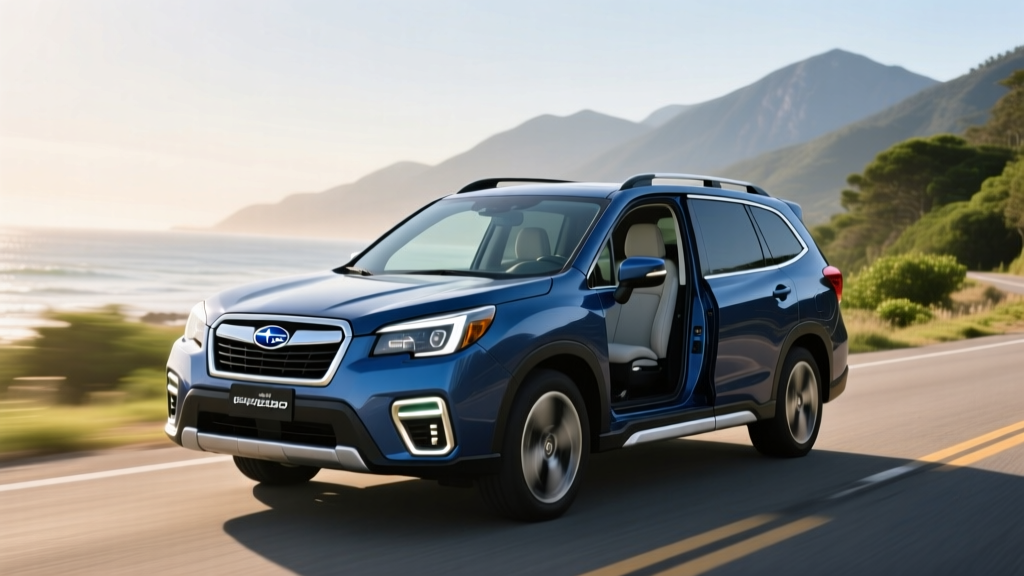
The 2025 Subaru Forester Hybrid marks the nameplate's return to electrified powertrains after a multi-year absence. Unlike its discontinued plug-in predecessor (the Forester e-Boxer/PHEV sold through 2023), the 2025 model is a conventional hybrid electric vehicle (HEV) — meaning it charges its small battery through regenerative braking and the gasoline engine. You never plug it in.
For buyers cross-shopping compact hybrid SUVs against the Toyota RAV4 Hybrid, Honda CR-V Hybrid, and Ford Escape Hybrid, the Forester Hybrid's standard all-wheel drive, strong safety ratings, and Subaru's reputation for durability make it a compelling option. But the numbers tell a nuanced story. Here's every spec that matters.
2025 Subaru Forester Hybrid: Key Specs at a Glance
| Specification | 2025 Forester Hybrid |
|---|---|
| Powertrain Type | Conventional Hybrid (HEV) — no plug |
| Engine | 2.5L horizontally opposed 4-cylinder (Boxer) |
| Electric Motor | Integrated AC synchronous motor |
| Combined Horsepower | 194 hp (net system output) |
| Transmission | Lineartronic CVT (continuously variable) |
| Drivetrain | Symmetrical All-Wheel Drive (standard) |
| EPA Fuel Economy | 35 city / 34 highway / 35 combined MPG |
| Hybrid Battery | ~1.1 kWh lithium-ion (self-charging) |
| Electric-Only Driving | Not applicable (HEV, not PHEV) |
| Fuel Tank Capacity | 13.2 gallons |
| Total Driving Range | ~462 miles (EPA combined estimate) |
| 0–60 mph (estimated) | ~8.5 seconds |
| Cargo Volume (rear seats up/down) | 28.9 / 69.1 cu ft |
| Towing Capacity | 1,500 lbs |
| Base MSRP (Hybrid Premium) | $36,495 (incl. destination) |
| Battery Warranty | 8 years / 100,000 miles |
HEV vs PHEV: What the 2025 Forester Hybrid Actually Is
This distinction trips up many shoppers. The 2025 Forester Hybrid is a conventional hybrid (HEV). It is not a plug-in hybrid (PHEV), and Subaru does not currently offer a PHEV variant of the sixth-generation Forester.
Conventional Hybrid (HEV) — 2025 Forester Hybrid
- Plug-in charging: No. The battery charges via the engine and regenerative braking.
- Battery size: ~1.1 kWh (small buffer for assist and regen)
- Electric-only range: None — the electric motor assists the gas engine but cannot power the vehicle alone at meaningful speeds.
- Federal tax credit: Not eligible under IRS §30D (requires plug-in capability and minimum battery capacity)
- Best for: Drivers who want better fuel economy without changing their refueling habits
Plug-In Hybrid (PHEV) — e.g., Toyota RAV4 Prime, Subaru Crosstrek PHEV
- Plug-in charging: Yes — Level 1 (120V) or Level 2 (240V)
- Battery size: Typically 13–19 kWh
- Electric-only range: 25–42 miles on battery alone before the gas engine kicks in
- Federal tax credit: May qualify for up to $7,500 under §30D, subject to MSRP caps, income limits, and battery sourcing rules
- Best for: Drivers with home charging who want short commutes on electricity with gas-engine backup
If you were hoping for a plug-in Forester that can do 30 miles on electricity alone, this isn't it. Subaru's current PHEV strategy is limited to the Crosstrek Hybrid (discontinued after 2023 in the U.S.) and the Solterra (a full BEV). The 2025 Forester Hybrid is strictly a self-charging HEV.
Fuel Economy: EPA Ratings and Real-World MPG
| Driving Condition | EPA Rating | Real-World Expectation |
|---|---|---|
| City | 35 MPG | 34–37 MPG (hybrids often exceed EPA in stop-and-go) |
| Highway | 34 MPG | 30–33 MPG (AWD drag and Boxer engine reduce highway efficiency) |
| Combined | 35 MPG | 32–35 MPG |
The EPA rates the 2025 Forester Hybrid at 35 MPG combined, which is competitive but trails the class leaders. The Toyota RAV4 Hybrid AWD achieves 39 MPG combined, and the Honda CR-V Hybrid AWD returns 37 MPG combined, per fueleconomy.gov.
Where the Forester Hybrid shines is in city driving. Like most hybrids, its regenerative braking system recovers energy during deceleration and stop-and-go traffic, meaning city MPG often meets or slightly exceeds the EPA estimate. On the highway, however, Subaru's standard Symmetrical AWD and the inherent friction of the Boxer engine layout create more parasitic loss than front-biased AWD systems in competitors. Expect highway fuel economy to dip to 30–33 MPG at sustained 70–75 mph speeds, especially with roof cargo or in cold weather.
Cold-weather note: Hybrid fuel economy drops 10–15% in sub-freezing temperatures as the engine runs more frequently to maintain cabin heat and battery temperature. Forester Hybrid owners in northern climates should plan for 28–31 MPG combined in winter months.
Powertrain Deep Dive: 194 HP and the Boxer Hybrid System
The 2025 Forester Hybrid pairs Subaru's naturally aspirated 2.5-liter Boxer four-cylinder engine with an AC synchronous electric motor integrated into the Lineartronic CVT. The combined system output is 194 horsepower — a meaningful step up from the standard gas-only Forester's 180 hp.
The electric motor provides low-end torque fill that addresses one of the gas Forester's most common complaints: sluggish off-the-line acceleration. The hybrid system's torque assist is most noticeable from 0–30 mph and during passing maneuvers at partial throttle. Subaru's e-Boxer system can briefly operate in EV mode at very low speeds (parking lots, traffic crawls), but this is limited to a few hundred yards and under ~25 mph.
The Lineartronic CVT has been recalibrated for the hybrid powertrain with simulated stepped gear ratios under hard acceleration, reducing the "drone" effect that CVTs are known for. It's not sporty, but it's unobtrusive during normal driving.
Pricing, Trims, and Tax Credit Eligibility
The 2025 Forester Hybrid is offered in two trims:
- Hybrid Premium: $36,495 (including $1,495 destination)
- Hybrid Limited: $39,495 (including destination)
Both trims come with standard Symmetrical AWD, Subaru's EyeSight driver-assist suite (adaptive cruise control, lane-keeping assist, pre-collision braking), an 11.6-inch touchscreen, and wireless Apple CarPlay/Android Auto. The Limited adds leather upholstery, a power liftgate, heated rear seats, and a Harman Kardon audio system.
Federal Tax Credit: Not Eligible
The 2025 Forester Hybrid does not qualify for the IRS §30D Clean Vehicle Credit. Under current IRS rules, the §30D credit requires a vehicle to be a plug-in electric vehicle (PHEV or BEV) with a minimum battery capacity of 7 kWh. The Forester Hybrid's ~1.1 kWh battery and lack of plug-in capability exclude it entirely.
Some states offer separate incentives for conventional hybrids, but these are uncommon and vary by jurisdiction. Check your state's energy office or DMV for current programs.
For comparison, a Toyota RAV4 Prime PHEV (42 miles electric range, 94 MPGe) may qualify for a partial federal credit depending on battery sourcing compliance, while full EVs like the Hyundai Ioniq 5 or Tesla Model Y may qualify for up to $7,500 — subject to MSRP caps ($80,000 for SUVs), buyer income limits ($300,000 joint / $150,000 single), and critical mineral/battery component sourcing requirements.
Battery Warranty, Reliability, and Replacement Cost
Subaru Hybrid Battery Warranty
- Coverage: 8 years or 100,000 miles (whichever comes first)
- What's covered: Defects in materials/workmanship, capacity loss beyond manufacturer threshold
- Extended in CARB states: 10 years / 150,000 miles in California and states adopting CARB emissions standards
Subaru's hybrid battery warranty matches the industry standard for conventional hybrids. Toyota, Honda, and Hyundai all offer similar 8-year/100,000-mile hybrid battery coverage (with 10-year/150,000-mile extensions in CARB states).
Real-world reliability: Conventional hybrid battery packs have proven exceptionally durable across the industry. Toyota's hybrid systems routinely exceed 150,000–200,000 miles on the original battery. Subaru's hybrid system is less battle-tested than Toyota's (Subaru's hybrid volume has been low), but the 2.5L Boxer engine itself is a proven, long-running design. The hybrid battery in the 2025 Forester is small (~1.1 kWh) and operates in a narrow state-of-charge window, which significantly reduces degradation stress compared to larger PHEV or BEV batteries.
Replacement cost: If the hybrid battery does require replacement outside of warranty, expect a dealer-installed replacement to cost between $2,500 and $4,000 including labor. This is significantly less than a PHEV or BEV battery replacement because the pack is small. Independent hybrid specialists often offer refurbished units for $1,500–$2,500.
Who Should Buy the Forester Hybrid — and Who Should Look Elsewhere
Choose the 2025 Forester Hybrid if:
- You want AWD standard without a fuel-economy penalty vs. gas-only AWD SUVs
- You drive a mix of city and highway miles and don't want to plug in
- You prioritize visibility, ground clearance (8.7 inches), and Subaru's safety reputation
- You live in a region with harsh winters where AWD and cold-weather reliability matter
- You want a modest fuel-economy upgrade (~5–7 MPG better than the gas Forester) without a large price premium
Look at a PHEV or full EV instead if:
- You have home charging and a short commute — a PHEV like the RAV4 Prime can run on electricity alone for 42 miles
- You want to qualify for the federal tax credit (up to $7,500 for eligible PHEVs and BEVs)
- You prioritize maximum fuel economy — the RAV4 Hybrid gets 39 MPG combined, 4 MPG more
- You want electric-only driving for zero tailpipe emissions on daily trips
- You drive mostly highway miles — the Forester Hybrid's highway MPG advantage over the gas model is modest
Forester Hybrid vs. Key Competitors
| Spec | 2025 Subaru Forester Hybrid | 2025 Toyota RAV4 Hybrid | 2025 Honda CR-V Hybrid |
|---|---|---|---|
| Powertrain | HEV (AWD standard) | HEV (AWD standard) | HEV (AWD standard) |
| Combined HP | 194 hp | 219 hp | 204 hp |
| EPA Combined MPG | 35 MPG | 39 MPG | 37 MPG |
| EPA City / Highway | 35 / 34 | 41 / 38 | 40 / 34 |
| Cargo (rear seats up) | 28.9 cu ft | 37.5 cu ft | 36.3 cu ft |
| Ground Clearance | 8.7 in | 8.1 in | 8.2 in |
| Towing Capacity | 1,500 lbs | 1,750 lbs | 1,000 lbs |
| Starting MSRP (AWD Hybrid) | $36,495 | $34,725 | $36,695 |
| Federal Tax Credit | No | No | No |
The Forester Hybrid trails the RAV4 Hybrid in fuel economy and cargo volume, and the RAV4 starts nearly $1,800 lower. However, the Forester offers more ground clearance (useful for snow and light trail use), standard EyeSight safety tech across all trims, and Subaru's reputation for long-term durability in harsh climates. Cargo volume is the Forester's most notable weakness — at 28.9 cu ft behind the rear seats, it gives up significant space to both competitors.
Pros and Cons
Pros
- Standard AWD with minimal fuel-economy penalty
- 194 hp hybrid system is noticeably quicker than the gas Forester
- 8.7 inches of ground clearance — best in class for snow/trail capability
- Standard EyeSight safety suite on every trim
- Strong real-world city MPG from regenerative braking
- 8-year/100,000-mile hybrid battery warranty (10 yr in CARB states)
Cons
- 35 MPG combined trails RAV4 Hybrid (39) and CR-V Hybrid (37)
- Cargo volume (28.9 cu ft) is the smallest in the segment
- No PHEV option — cannot drive on electric power alone
- Not eligible for any federal tax credit
- Highway MPG advantage over the gas Forester is modest
- 1,500-lb towing capacity is limited for the class
Frequently Asked Questions
How many MPG does the 2025 Subaru Forester Hybrid get?
The EPA rates the 2025 Forester Hybrid at 35 MPG city, 34 MPG highway, and 35 MPG combined. In real-world city driving with frequent stops, owners can expect to meet or slightly exceed the 35 MPG city estimate thanks to regenerative braking. Highway driving at sustained speeds typically yields 30–33 MPG.
Does the Forester Hybrid need to be plugged in?
No. The 2025 Forester Hybrid is a conventional hybrid (HEV). Its small battery charges through regenerative braking and the gasoline engine. You refuel it exactly like a regular gas car — at the pump.
Can the 2025 Forester Hybrid drive on electric power only?
Only at very low speeds (under ~25 mph) for very short distances (a few hundred yards), such as creeping through a parking lot. It cannot sustain electric-only driving at road speeds. If you want meaningful electric-only range, you need a PHEV like the Toyota RAV4 Prime (42 miles EV range).
Is the Forester Hybrid reliable, and what does a battery replacement cost?
Subaru's hybrid system is backed by an 8-year/100,000-mile battery warranty (10 years/150,000 miles in CARB states). Conventional hybrid batteries across the industry routinely last 150,000+ miles. If replacement is needed out of warranty, expect $2,500–$4,000 at a dealer — less than a PHEV or BEV battery because the pack is small (~1.1 kWh).
Does the 2025 Forester Hybrid qualify for any tax credit?
No. The federal §30D Clean Vehicle Credit requires plug-in capability and a minimum 7 kWh battery. The Forester Hybrid has neither. Some states may offer small incentives for conventional hybrids, but these are uncommon. Check your state's energy office for details.
How does the Forester Hybrid compare to the gas-only Forester?
The hybrid produces 194 hp (vs. 180 hp for the gas model) and gets approximately 35 MPG combined vs. about 29 MPG combined for the gas AWD Forester — a gain of roughly 6 MPG. The hybrid carries a price premium of approximately $3,000–$4,000 over equivalent gas trims. At current fuel prices, that premium pays back in roughly 4–6 years for a driver covering 15,000 miles annually.
Hybrid vs PHEV vs EV — which is right for me?
HEV (Forester Hybrid): Best if you lack home charging, want zero behavior change, and drive a varied mix of city/highway. PHEV (RAV4 Prime, etc.): Best if you have home charging and a commute under 30–40 miles — you'll drive mostly on electricity with gas-engine backup for longer trips. BEV (Ioniq 5, Model Y, etc.): Best if you have reliable home charging, want zero tailpipe emissions, and are comfortable planning around DC fast charging on road trips.